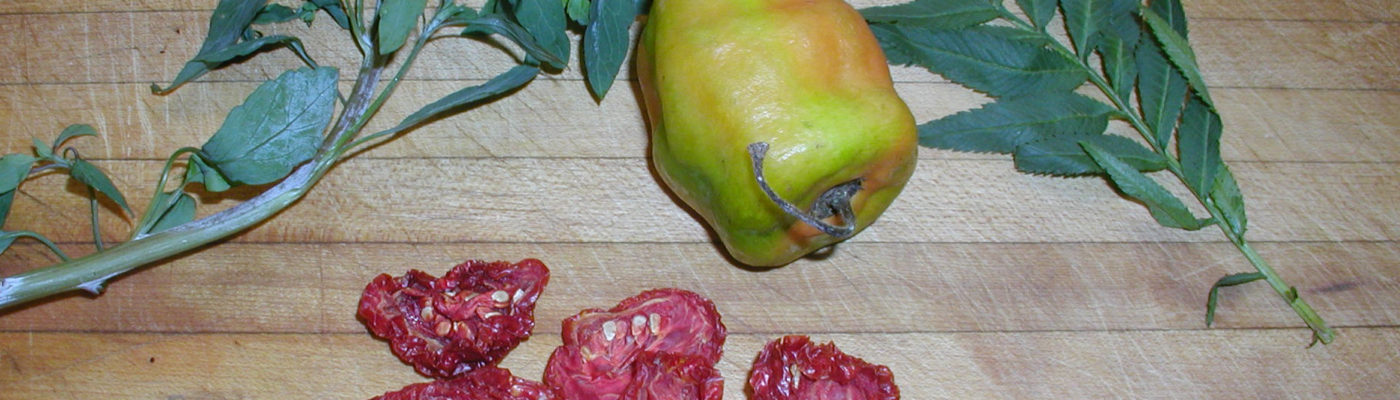
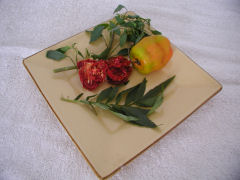
 Buenos Aires – Salsa Llajwa is sometimes known as the Bolivian National Hot Sauce. I first encountered it at a restaurant in Palermo, and it was so delicious that I’d asked the manager of the restaurant what was in it. He described it as containing the Peruvian herb huacatay and the Bolivian herb quirquiña, blended with rocoto peppers and oven dried tomatoes. I’ve spent a bit of time looking for recipes, figuring one of these days, like yesterday (see last post), I’d make it out to Liniers and possibly be able to find the key ingredients. Although he didn’t mention it, every recipe I saw included either onion or garlic, so I added in a shallot. Recipes varied wildly, using various herbs, generally on the aromatic side, but from coriander to mint to parsley, and the peppers varied as well – from just rocoto to rocoto and much hotter pepper combos, to others.
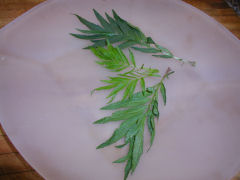 Huacatay is referred to by some as Amazon Black Mint, and it has a pungent aroma, sort of a like spearmint; and others insist that it is a variety of the Mexican herb epazote – it doesn’t look at all like the epazote I used to get in New York at the Mexican markets, which had longer, arrowhead shaped jagged leaves, and it has a much more intense flavor. Other names for this are Chiquilla, Chinchilla, and Zuico. I’ve seen both the scientific name Tagetes minuta, and also Pazote chenopodium ambrosioides, which between them come back to a variety of different English names, including muster John Henry, Stinking Roger, Mexican Marigold, Hedionda Grass, Sagrada Grass, and Tall Khaki Weed. Searching for various photos online, some of these look the similar, some don’t. Such is the world of plant names, however I’m leaning more towards the non-epazote camp and something in the mint-ish world. [Edit: further research says that the non-epazote/tagetes minuta camp is the correct one.] It is a common ingredient in Peruvian cooking especially, and is the key herb in both ají de huacatay (not surprising), a spicy hot sauce from the Arequipa area, and in the sauce for ocopa, one of my favorite potato dishes.
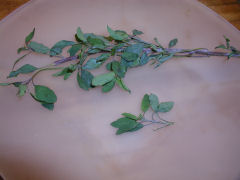 Quirquiña, or Bolivian coriander, (also called quilquiña or killi), is a vibrant green herb found throughout Bolivia. It has an aroma and flavor that is similar to coriander, but with a touch of bitterness (Wikipedia describes it as a cross between coriander, arugula, and rue). Scientific name Porophyllum ruderale, which puts it in the Aster family, as an annual herb. In different parts of the globe it is known as Pápalo, Papaloquilitl, Tapakuelo, Yiwa ndusú, Yiwa pápalo and many others. Obviously, it looks nothing like coriander, and even the flavor is different enough that it’s clearly not related, merely possessing similar aromatics.
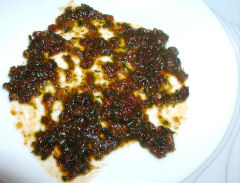 I’d remembered the sauce as having a brownish color to it, which, given the bright green of the various ingredients, seemed unlikely, though the tomato red might have managed. I also remembered a very smoky flavor, and attribute that to the oven drying process that the restaurant manager had mentioned. Although all the recipes I’ve found call for this to be an uncooked, fresh herbal sauce, I decided on a compromise to try to get the effect that I wanted. So, I cooked the shallot and some sun-dried tomatoes (they’re what I had) in oil until they were all lightly golden, then poured the hot oil mixture over the fresh herbs and rocoto pepper and immediately blended them. This took a lot of the edge off of the shallots, the herbs, and the hot peppers, and gave me the smoky flavor I was looking for. If you don’t have access to these herbs, I’m not sure what to suggest – but given the references, the closest substitutes might be to give a shot with coriander cilantro and spearmint, it might just work – after all, both match well with hot peppers in salsas!
Salsa Llajwa
1 cup of good olive oil
1 cup of sun-dried tomatoes
1 coarsely chopped shallotHeat these three ingredients together until the oil just starts to bubble, then reduce the heat to minimum and cook slowly, stirring regularly, until the shallots are lightly browned and the tomatoes have reconstituted and taken on a touch of toastiness.
1 packed cup of huacatay leaves
1 packed cup of quirquiña leaves
2 seeded rocoto peppers
1 tablespoon of coarse saltPut these ingredients into your blender or food processor. When the oil mixture is ready, pour it directly onto the herbs and blend immediately.
If you need to add a touch more oil to smooth this out to a consistency you like, feel free, but you don’t want this runny. Makes about a cup and a half of sauce, which will keep well in the refrigerator and can also be frozen – like you won’t finish it off within 2-3 days!
This sauce can be used on a variety of things where you want a nice, herbal and spicy sauce. I’m especially fond of it on crustacea – shrimp approach perfection tossed with or dipped into this. It also works well on fish, chicken, and even veal.




Dan,
I am second to no one in my adoration of delicious hot sauce and I’d love to make this recipe. But my local supermarket is fresh out of quirquiña and huacatay leaves and may not get more for a little while. Like five years. Are there any substitutes possible?
What a great post for Weekend Herb Blogging. I’ve never heard of either of these herbs before.
Now Ken, you’ve got to start reading thoroughly. The last paragraph before the recipe I suggested substitutes, really just for people who live in god-forsaken places like Massachusetts, where markets don’t carry fresh quirquña and huacatay? It’s heresy I tell you, heresy!
That looks good, I’ll have to try it. IF I can find the herbs. I have like 100 packets of dried locoto “en polvo” that someone gave me from Bolivia. Hardly has any taste. Like a milder version of cayenne. Good for soups, sauces, and marinades though. Llajwa recipe on the back says grate 2 or more tomatoes. Add locoto powder to taste. Season with salt, minced onion, and quilquiña. Just need to get my hands on quilquiña. Maybe I can score some seeds and grow it myself.
Asadoarg, aren’t you in Argentina? If so, it shouldn’t be hard to find either herb, there are enough pockets of Andean communities around. And if not, depending on where you are, there might be a source of Peruvian or Bolivian products somewhere near to you? Maybe if there’s a restaurant of either type near to you you could ask them. Also, powdered rocoto/locoto is no substitute for the fresh peppers!
Beyond that, if you just want to try the sauce (though, of course, not as good as my version…), or any of lots of other Peruvian products (for example, they have pureed rocoto and pureed huacatay, ready to use – though I didn’t see quirquiña), you can check out: Peru Cooking: Pricelist
I’m down in Rio Grande, btw. Amazingly, there are some Bolivans here and “supposedly”, from what someone told me, there is a little store in Ushuaia that has Bolivian/Northwest Argentina products.
Definitely agree on the fresh peppers. I live by them. Same person who gave me the powder gave me some fresh ones, well not really fresh. A bit blemished and when I cut them open the seeds were all black. Was hoping for the seeds to be alright so I could at least grow them but no such luck. Thankfully a supermarket here sells a bunch of jalapeños and cilantro so I can make due with a pseudo-llajwa, cough Mexican-type salsa. Speaking of cilantro, when I lived in Buenos Aires, it was quite a challenge to find. Jumbo would sell like a few sprouts in a container for $3 pesos. Here the supermarket sells them by the bunch for almost half the price. Probably due to the amount of Chileans here and their love for pebre.
The seeds in rocotos should be black, so that’s normal. If they’ve been refrigerated, that’s probably why they didn’t grow, who knows?
These days, cilantro is readily available here.
Cool post. Never hear of any of these herbs before. Very enlightening.
Paz
[…] All of which leads us to last night. Friends Tuomas and Alfredo are in town visiting from Finland. I had made a couple of more sauces from the herbs I talked about last weekend, the huacatay and quirquiña, plus still have plenty of salsa llajwa left over. So we invited them over for dinner, and I decided to start in with just a simple two course meal (plus a bought dessert, horror of horrors – no really, it’s hard to justify baking when there’s a patisserie on the corner that makes amazing tarts for 10-12 pesos apiece). So, I started thinking and hit the markets. I’d mentioned that the salsa works beautifully with shrimp, but frozen shrimp at 140 pesos per kilo (just over $21 a pound) were just not going to fit the bill. In fact, no one seemed to have any non-frozen crustacea yesterday, so I finally picked up some small scallops, which were only reasonably priced by comparison at 80 pesos per kilo ($12 a pound), so I picked up a quarter kilo, or just over half a pound. I tossed these with a bit of the salsa llajwa, and put them in a baking dish with some sun-dried tomatoes that had been soaked for a bit in water to plump up, and some sliced tomatillos. The whole thing then went in the oven, covered with foil, until the tomatillos were cooked through and the tomatoes and scallops had stewed together for a bit. […]
[…] 1 rocoto pepper 1 hot chile pepper 1 cup of huacatay leaves olive oil salt […]
[…] Round two was a double serving of potatoes. Two classic dishes, which I’ve mentioned many times before, are Papas a la Huancaina and Ocopa. They both start from the same base mixture – a large handful of saltine crackers soaked in milk, some type of fresh, creamy cheese (Henry likes Port Salut, though I understand that something more like ricotta or farmer’s cheese is far more traditional). After the crackers are nice and mushy, they get turned into one of the two sauces, or, in our case last night, both. The Huancaina is the simpler of the two, a mere blending of the base mixture with ají panca amarilla. These peppers aren’t available fresh here, so we buy them dried and then reconstitute them in a little boiling water. We started by blending in just the flesh, along with a little powdered ají amarilla as well, mostly for color (the dried peppers turn a fairly dull yellow-orange, whereas the fresh, and the powder, are a vivid yellow), and then added salt and some of the seeds and veins from the boiled peppers to get a little bit of spiciness into it. The Ocopa requires several ingredients – a small amount of the same peppers, nuts (we used toasted pecans, though apparently peanuts are the most traditional, with walnuts being a close second – pecans are apparently “special”), cilantro, and a whole lot of huacatay, or Amazon Black Mint. Traditional toppings are hard-boiled eggs and black olives. […]
[…] A few weeks ago one of our local food writers reviewed a new Japanese restaurant located just off the main strip in Barrio Chino. One of the assertions made was “Para empezar debo decir que probé las gyosas mejores de mi vida, sin exagerar.”, or, “To start I have to say that I tried the best gyozas in my life, without exaggeration.” At a later juncture, she also asserts that some of the sushi tried is, in essence, invented on site and not available anywhere else (an example given is salmon with mango and avocado, available from almost any sushi bar here I can think of). On the other hand, this same columnist recently wrote up one of our favorite Peruvian restaurants, Zadvarie, claiming that it is the only place in town offering ocopa arequipeña because they have the only source of huacatay herb in town through a store in Barrio Chino. We eat the dish regularly at other restaurants (and it’s better at some and not as good at others), and as regular readers here know, I buy huacatay in the markets in Liniers by the bagful for mere pesos. […]
[…] color and a nice glow when egg washed and baked. We served these up with some freshly made Salsa Llajwa – with some modifications – I used fresh tomatoes which had been peeled and seeded, so just the […]
[…] hard boiled egg, I bound the whole thing together with lightly beaten eggs, added some chopped huacatay, crumbled some fresh farmer’s cheese over the top and then baked them in the oven. We served […]
[…] of salsa llajwa, the classic Bolivian hot sauce – puree of tomatoes, rocotos, shallots, huacatay, quirquiña, olive oil, salt and pepper (different preparation from the attempt on the link, much fresher […]
I hate to tell you, but Huacatay, garlic, onions, and puree of tomatoes are definitely NOT ingredientes in Bolivian Llajua.
Tomatoes
Quirquiña
Locoto
Salt
THAT is Llajua. Anything else is…..something else.
It’s quite possible that that is the classic recipe, but saying it’s the only way to make it is like saying there’s only one way to make chimichurri, or ketchup, or anything else. A two second search of the internet yields recipes using various herbs, including huacatay, parsley, cilantro, and others – solo or in combinations; some have garlic; some don’t, some have onions; some don’t, some have oil, some don’t – the only constants seem to be tomatoes and rocotos. Part of the world of food and cooking is that things evolve. Since that first encounter with the sauce four years ago I’ve had it in more than a dozen restaurants, all Bolivian or Peruvian and each version was different. Even my own version is now different, I dropped the sun-dried tomatoes and went with fresh and use very little oil, just enough to get a slightly smooth texture to it.
The most traditional old school pre-Colombian llajua from Cochabamba that gastric anthropologist believe to be the very first hot sauce in human history has been found by chemical analysis of pottery to have followed the tomato, rocoto/locoto, quirquiña formula. That said a lot of people nowadays add onion, regionally there can be preference for huacatay over quirquiña outside of Cochabamba, some difference in opinion over the color of rocoto to use, as well as the name of the pepper itself (Peruvians say ‘rocoto’ and tend to exclusively use the red whereas in Bolivia they say ‘locoto’ and use both green and red). Anyways, if you want ultra-Orthodox llajua, you should follow that tomato, locoto, quirquiña formula but be aware that many Bolivians nowadays mix it up and still call it llajua.
Brian – I somehow or other don’t think Gabriela is still monitoring this post for replies 13 years later… but, that was kind of my point, there may be a very traditional way to do it, but that doesn’t mean there’s not individual variation, just like any sauce, from any country or culture. By the way, in Peruvian cooking we use red, green, and yellow rocotos….
If you are in the U.S. you can by huacataya by mail from Noly’s World Cuisine in Chicago. Sometimes they have quilquina too. I checked their website and right now they have huacataya but no quilquina. They say to check back in late summer for the quilquina.
I agree with Gabriela Bieri, llajua is simply huacataya/quilquina, locoto, tomato and salt.
Thanks for the sources for those in the U.S. You are however, missing the point about the recipe. Sure there’s a traditional, simple recipe, but that doesn’t mean one can’t vary it, just like any other sauce gets varied. You think ketchup or mustard only have one recipe? If so, we wouldn’t have a zillion brands of each. Even if you look at the ingredients on different commercial brands of llajwa you’ll find different ingredients, and the different brands taste different. Even though you claim to agree with Gabriela, you specified huacatay as an ingredient and she says it has no place in the sauce. There’s a place for tradition, and there’s also a place for realizing one doesn’t have to be stuck in it.
Dan, hi! I’m from Buenos Aires, your post is nice! Do you remember the name of the restaurant? I want to go and eat Llajwa…
Thanks!
Bye
What restaurant? The one where I first tried it here in town? It doesn’t exist anymore.
There aren’t a lot of Bolivian restaurants here in town, mostly out in Liniers and Flores. And there’s one in Belgrano that I know of.
[…] of our favorite dishes, ocopa, a chilled potato dish topped with a cheese based sauce flavored with huacatay, ají amarillo and walnuts. Status’ menu claims that there’s also contains […]
[…] red potatoes, and pork tenderloin all sauteed with a little shichimi spice blend. On the side, salsa llajwa – a puree of huacatay, quirquiña, rocoto peppers, olive oil, vinegar and salt (a […]
[…] https://www.saltshaker.net/20060302/llajwa-weekend-herb-blogging […]
[…] the filling in between. The filling was pretty much a very good saute of mixed shellfish, and a huacatay foam atop. It was tasty, not a great dish, but good. Found a small piece of wire on the plate […]
[…] little green strip along the side of the rice on both dishes – it was a mixture of ground huacatay herb, which I’ve mentioned many times before, sort of a black mint, mixed with sea salt […]
[…] and smoked chili (merquén) in place of the ají panca pureed with a good handful of huacatay leaves, then whisked together with cream and a little cornstarch to thicken it. On top of the sauce, cubes […]
[…] step-by-step for in the past. To the puree is added sauteed onions and garlic and a good handful of huacatay leaves. Also, often, in place of walnuts, toasted peanuts are used, which I did this time to give […]
Hi, I was looking for a llajwa recipe and stumbled upon this page, so I know it’s out of date. But I need to say to Gabriela Bieri, I’ve had llajua with huacatay in Bolivia and it even appears in some recipes from Bolivian sources. They may spell it as “wacataya”, but obviously it’s the same leaf. I’ve also been told it’s the same herb known as suyco (or suico, suyko, etc. however they wish to spell it.). Here’s one mention from the renowned “gastronomic capital” of Bolivia.
Charangoman – thanks for your comment! Yes, the herb actually has quite a few different names, depending on where in the Andean communities one lives.
Ha! I had no idea it had so many names, but one thing’s for sure, it definitely is an option for authentic Bolivian llajua.
One of the things a lot of people enjoy about Andean food is that it’s very ancestral and traditional. Make the slightest change from what they’re used to, and they (especially Bolivians) will jump “that’s not llajua!”, “that’s not sillpancho!” or whatever dish you’re making. But all their traditional favorites were innovations at one point, so why not continue innovating? Even Bolivians in Bolivia are tinkering with other herbs in their llajua!
http://llajwapicante.blogspot.com/2011/02/una-llajwa-con-cilantro.html?utm_source=BP_recent
Exactly. It’s why restaurants like Gustu are so wildly popular! Even note in the link you sent – that it says “traditionally made with either quirqiña or huacatay”, belying the claims that only one of them is the “correct” one.
[…] also, in the same vein, way back, and in need of updating, covered some Peruvian herbs like huacatay and quirquiña, and some of the Andean root vegetables like papalisas and ocas, and others where I’ve just […]
[…] in front at the left… Small white potatoes, puree of rehydrated mirasol chilies, huacatay, garlic, onion, fresh homemade cheese (not by us, by someone out at the Liniers markets), parboiled […]
[…] to complete the Andean twist – I turned the classic Salsa Llajwa into a pasta sauce – I sauteed garlic, shallots, and rocoto chilies in olive oil until […]
[…] prawns, there’s ocopa, the chilled sauce, but colored green by the addition of the herb huacatay. And […]
[…] But it cut down on our choices significantly. While we mused, we spread a delicious fiery salsa llajwa (tomato, rocoto chili, huacatay and quirquiña) on bread – in fact, we pretty much finished this bowl off over the course of the lunch on the […]
[…] leeks, garlic, butternut squash, topped with goat cheese; arugula leaf; the marmalade is based on salsa llajwa, a Bolivian condiment, but a sweetened version, made by cooking down tomatoes, rocotos, garlic, […]
[…] half cream and half milk), and fresh cheese. Some parsley just for garnish. Some recipes call for huacatay instead of oregano, usually infused into the dish for a short time while cooking and then removed, […]
[…] simple fish main course of broiled sole (lightly dusted with salt and pepper) served over a salsa llajwa inspired sauce. The classic sauce is a blend of tomato, rocoto chili, and two Andean herbs […]