“What is sauce for the goose may be sauce for the gander but is not necessarily sauce for the chicken, the duck, the turkey or the guinea hen.
– Alice B. Toklas
Buenos Aires – I’ve been promising on and off since our trip to Perú that I’d share a step-by-step how-to for ají de gallina, or chicken (traditionally hen) in a spicy yellow chili pepper sauce – one of our favorite dishes. So, follow along with Maria, Henry’s sister, as she demonstrates making it at home…
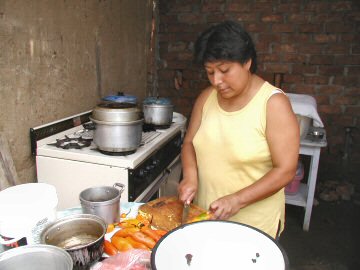
Remove seeds and veins from fresh ají amarillo (here in Buenos Aires we end up having to reconstitute dried ones as the fresh simply aren’t available). [This has changed over the couple of years since this post was written and fresh ají amarillo are now pretty readily available.]
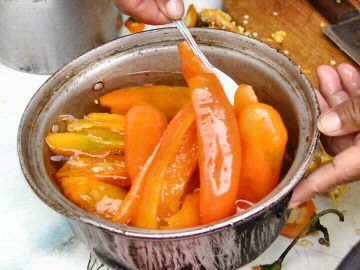
Put chilies in a pan of water, bring to a boil, cover, and let boil until soft.
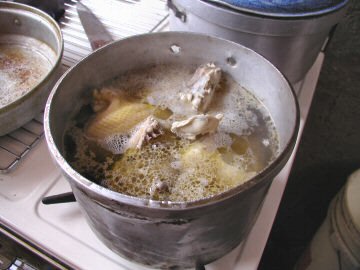
In another pan, put chicken breasts, cover with water, bring to a boil, and let simmer until cooked through and soft enough to shred.
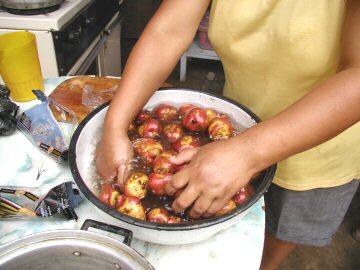
Wash potatoes, boil until cooked but not mushy (sliceable), cool, peel, and set aside. In the same pot, toss a few eggs to let them hard-boil. Let them cool and then peel and quarter them.
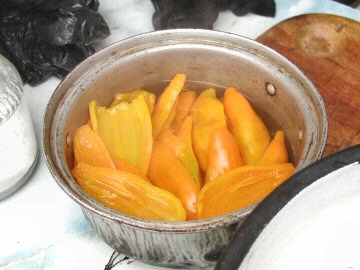
When the chilies are nice and soft, take them off the heat.
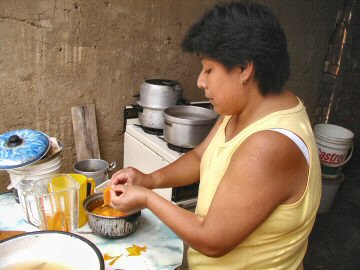
Peel the chilies and put in a blender. If you’re using dried chilies the peeling won’t be possible, just include the skin. If you want a milder version of the sauce, remove the seeds too.
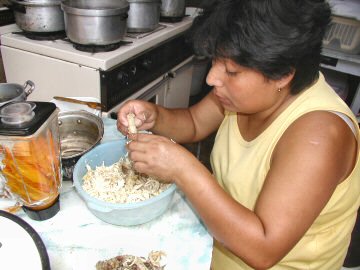
When the chicken is done, remove from the water, and let cool until you can handle it, then shred the meat into fine shreds.
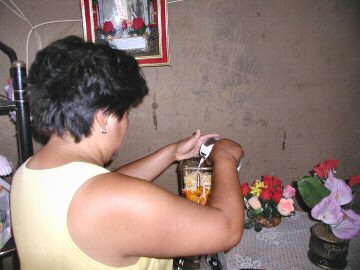
This comes down to a “to taste” – in the blender with the chilies add a little fresh cheese (farmer’s cheese, or something like port salut), some chunks of stale bread, a handful of walnuts or peanuts (you can leave these out if someone is allergic), and start it blending. Add milk while blending until you’ve got a thick, but smooth puree. I’ve seen recipes that use the chicken water instead of milk, and others that use evaporated milk or cream, this is just the way I’ve learned to make it. When we want it extra spicy we use the chili cooking water for at least a part of the liquid. To this point, the sauce is what’s called huancaina and can be chilled and served over chilled, boiled potatoes, a classic Peruvian dish, papas a la huancaina.
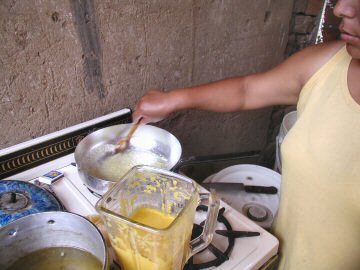
Saute finely chopped garlic and a white onion in olive oil until translucent and soft. Then add the pepper puree to this and continue cooking for a few minutes.
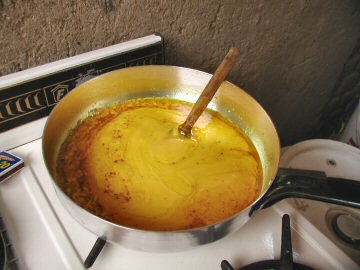
Add a little red chili powder or paste – more just to give the dish a vivid color than for additional spice.
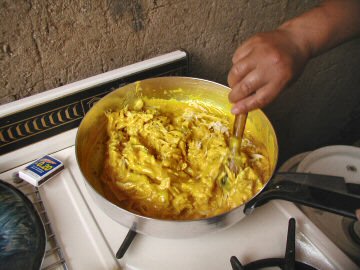
Add the chicken and stir well to coat, turn the heat down to low and let simmer.
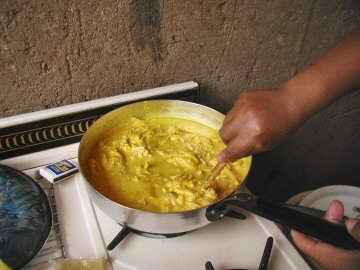
The sauce will thicken and get glossy after about 10-15 minutes (stir occasionally so it doesn’t burn). It’s ready to serve.
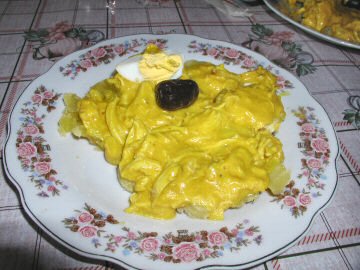
Serve over sliced potatoes, decorated with black olives and hard-boiled eggs. Rice on the side is optional, but usual.
I really was helping Maria cook, and learning to make this in between taking photos. We just posed her for the shots.




I’m stumped with ají amarillo. What is this and what, if anything, can I use in its place that I can find in the hinterlands of lilly white New England? The resulting dish looks sensational.
What a gorgeous dish! I’m going on a hunt for aji amarillo so I can make this. If I can’t find them in NYC, however, can you recommend a substitute chile?
Well, let’s see, as far as I know it doesn’t have another name besides ají amarillo, or ají mirasol when dried – I guess in the U.S. they’re sometimes called Yellow Peruvian Chilies, more or less just a translation. I did a bit of an internet search and pretty much just come up with those names. It’s a fairly hot pepper – with a Scoville Rating of 30,000-50,000, which puts it around the same heat level as a cayenne pepper. It has a slightly smoky flavor that’s intensified in the dried version. I’ve seen them in New York, so it shouldn’t be a problem there, up in Ipswich, you’ll have to wing it – I simply don’t know. I guess you could just experiment with different peppers that are fairly hot and try them out – alot of it, of course, depends on how spicy you want the dish – it’s not a real spicy dish, it has a kick, but it’s tempered by the other ingredients.
Thanks, Dan. I’m heading out now to the Ipswich Peruvian Chili Shop.
You know, I didn’t choose to live somewhere without a proper supply of chilies… if you were back in Manhattan where Homesick Texan is, you could just pop down to the Whole Foods Market and pick some up…
I’m not complaining. I can also afford to own a home AND eat on a regular basis where I live. Whole Foods is here, of course, just not in my town. But I’ll get those peppers one way or another.
[…] combo. The dish was tasty, it was really quite good. It was, however, missing a key ingredient for ají de gallina – which you may remember from various writings I’ve done about Peruvian cuisine, is chicken […]
[…] the past. The ají de gallina a wet pool of near flavorless sauce (for god’s sake, the sauce is supposed to be pureed medium hot peppers, what did they use, yellow bell pepper?) with the chicken and some rice. The seco de cabrito, too, […]
[…] are so big that we should only order one or two for the three of us to share. We opt for two, an ají de gallina and a seco de cordero, each of which arrives as a fairly standard plate of food if not actually […]
If you live in NY you can certainly find Aji Amarillo. There is a store on 8th ave in Chelsea that specializes in chiles. Also you can venture out to Jackson Heights, Queens. Take the #7 Train to 82nd St. station. Go down the stairway on the same side of the strret the train ran. One-third down the block is a market that sells the paste and the Aji Panca dried. Venture further down Roosevelt Ave and there are several Peruvian restaurants you can try. Visit a Colombian bakery in the area and try some Almojabanas or Pan de Yuca. These are breads made from one part starch (corn meal, corn starch, and in the case of Pan de Yuca just yuca starch, or manioc starch) and three parts cheese!!!! Yum!!! Jackson Heights deserves to be explored.
I had my very first Aji de Gallina last night at my Peruvian friend’s house.
It was DELICIOUS!!!
[…] my entree. It was an Ají de Gallina Lasagna, a brilliant sounding combination. First, the chicken dish is a favorite – shreds of chicken stewed in a spicy yellow pepper, cream, and cheese sauce. And […]
[…] ideas. So, first off, made a batch of this savory and mildly spicy stewed chicken dish just the way Henry’s sister taught me. I made a batch of simple semolina pasta, though added in some dried herbs – basil, oregano, […]
I hope you guys haven’t lost hope over the chile… I just discovered this site. My Peruvian husband and I are having a baby shower in a couple of weeks and Aji (ahh-he) de Gallina (Guy-eenuh) is on the menu because my mother in law is somewhat of an expert, having been born and raised in the Mountain Region of Peru. (Sorry to toot my horn, but I want you to know the info I have IS credible…) So the demo given by this lady is very traditional and looks just as though my “suegra” were making it. Oh and also, I used to live in New England before moving to So Cal… and it can be very hard to find things like Aji Amarillo up there unless you live near Boston or Hartford or NYC. It’s just really hard to find. It’s challenging to find here if you don’t know where to go. It can’t be found in Kroger or Albertsons or anything like that. Usually, they are found in Latin Markets because they are imported. Oh and the olives in Peruvian Cuisine are typically the purple Kalamata olive, which can be found in your normal grocer. One of the substitutes that the Peruvians use here are the Habanero, yup, that’s what I said—the same pepper used to make rocket fuel. Can we say beam me up, Scottie? So I would use a Habanero and no more because it’s HOT! You may be able to mix it with a yellow or Orange Bell Pepper for color and to lessen the heat. The word “Aji” is actually the word down in the hemisphere for “Pepper”. Not be rude to other Latinos, but my husband says that the word “Chile” is actually made-up and they don’t know what Chile’s are down in South America. He’s very blunt. Anyway- I hope this info was useful. If you are insistent in getting the Aji, try shopping online…
Julie – thanks for your input. Down here, the name is pronounced “akhi de gazhina” might be the closest way to write it – it changes depending on what part of the Spanish speaking world you’re in.
As to the peppers, your husband is, well, wrong – even if he likes to be blunt about it. Chili or chilie is a perfectly good word in modern day Spanish – it is adopted from the Náhuatl language where it refers to the group of peppers that are found in the area of that culture – while meanwhile ají comes from the Taino language of the Carribean – both of them are adopted, neither is traditional to Spanish. Most of the peppers found in Perú, Bolivia, Ecuador and surrounds are of the aji family, while most of the peppers found in the north part of Central America and Mexico belong to the chili family. They’re just different species and varieties of peppers. In other parts of the Spanish speaking world they are called, variously, pimiento, guindilla, morrón, peperonchino and capsicum (the last of which being the traditional Latin).
The common species of chili peppers are:
– Capsicum annuum, which includes many common varieties such as bell peppers, paprika, cayenne, jalapeños, and the chiltepin
– Capsicum frutescens, which includes the tabasco and Thai peppers
– Capsicum chinense, which includes the hottest peppers such as the naga, habanero, Datil and Scotch bonnet
– Capsicum pubescens, which includes the South American rocoto peppers
– Capsicum baccatum, which includes the South American aji peppers
Dan, Aji de gallina is my favorite food! I’ve been looking everywhere for aji amarillo so i can make it at home. can you tell me the name of the stores in chelsea and jackson heights you referred to above? thank you sooooo much!
Sarah, I’m not the one who said the bit about Jackson Heights/Chelsea – I live in Buenos Aires, so unfortunately, I can’t really help you there. I do recall some latino markets along 9th Avenue within a block or two of the back of Port Authority, but I can’t do much better than that. These days, however, at least prior to leaving NYC some years ago, you could buy these peppers at places like Whole Foods, at the Union Square Greenmarket, and probably at a good number of other markets – you really didn’t need to go to a specialty one anymore. That may have changed, but I’d think it’d change towards easier rather than harder to find….
I live in Las Vegas and just went to the Mexican market down the street. They had the Aji Amarillo paste/sause in a jar. I couldn’t believe I found it that quick and easy. So I don’t think it is going to be that hard to find if you have any kind of latino market. I can’t wait to make the chicken dish i just read about. I got it for a recipe for a quinoa salad, but plan on experimenting with it.
Liz, that’s great! Let us know how it goes.
I have searched everywhere for the paste and we simply do not carry this here in Gurnee, IL – and Chicago is way to far for me to commute to. Is there a substitute pepper i can use … I am looking to make Arroz Con Pollo and the way my ex mother-n-law made it, she used the aji paste. Any help would be great, i am craving this dish
Vickie, without knowing what peppers or pepper pastes are available where you live, I can’t really recommend one in particular. Ají amarillo is a medium hot long yellow pepper. Beyond that, I’m not sure what to tell you – I would say that things like jalapeños and serranos are probably about the right heat level, but have a distinctly different flavor. Maybe if you have access to Mexican guajillo peppers…?
I did a quick online search for Gurnee and popped up with Woodland Foods, who carry both the amarillo and the panca in dried form, as well as dozens of other peppers. You can reconstitute either of those by simmering in water for about 20-25 minutes and then pureeing the result (just puree the peppers, only add some of the cooking water if you need to thin it out a bit.
Thank you DAn for that information … I think thats a shipping place though, cuz i cant seem to find the “order” link to order the chilies … At least i know they have them around here, cuz my search turned up nadda … your way better than me .. haha
I think what they are is a restaurant/hotel supplier, but you could call them and ask if their products are available retail, or if there’s a way to obtain some of them.
I just came back from living in Peru for three years, and the aji amarillo (also known as aji verde or escabeche) is not that hot compared to others. I live in Utah, grew up in Iowa, and I can eat an escabeche straight, which I can’t do with a jalapeno or others which are hotter. I made aji de gallina today without the aji…my MIL uses turmeric for the color, and says the aji is optional. I had a maid in Peru, she never put the aji in it, because she knew my kids and (Peruvian) husband wouldn’t eat it. And I think I have only had it with any kind of nuts at one restaurant, and that was here in Utah. Most people I know don’t add nuts (added bonus, due to a nut allergy in the family). I may add a bit of the aji if I get around to hunting some down, or when my plants grow (should I admit I brought some seeds into the country in a contact lens case?), but a tiny bit. Like I said, my kids can’t tolerate any heat. I think the cheese is also optional. I would suggest using a red onion, because in Peru, yellow onions are hard to find and rarely used. They use red onion for everything.
And to the person that said that panca is a dried aji amarillo…I don’t think that is right. Panca is what they also call “aji especial”, and it is red. The aji amarillo starts out green, looks like an Anaheim chile, and then slowly turns orange. That is why in Lima they call it aji verde most of the time.
This is an excellent dish. I have a number 1 son who is a very picky eater, and he loves this dish.
Elizabeth – ají panca is a dried reddish-brown pepper, and the yellow as ají mirasol, which is the dried version of the yellow chilies above, but yeah, sometimes if you go into a market in Peru, Bolivia, Chile, or here in Argentina… when you ask for the panca, they ask, “yellow or red?”. As to options, sure, you can leave it out, but “Ají de Gallina” without “Ají”? And without the nuts and cheese, which are part of the tradition as well, it’s just chicken in milk thickened with a little bread – there’s really nothing else in the sauce but onions and garlic. It sounds like something that you or I might have grown up on in the Midwest (though we would have definitely put in at least the cheese!), but it’s not this dish, by any stretch of the imagination. I mean, you can leave butter out of butter sauce and still call it that, but it don’t make it so.
I’ve never tried it but in Steven Raichlen’s “Barbecue Bible Sauces Rubs and Marinades” book, he recommends roasted yellow bell pepper (skinned) plus heat from a hot chile pepper (if you want the heat) as a suitable replacement–turmeric for color if needed. He is usually good at recreating flavors for recipes that call for ingredients that may be difficult to find. Do you think that would work?
Marc, With all respect to Raichlen, the answer would be, I suppose, which chili pepper is providing the heat? Because they also provide flavor. Are we adding some habanero to the bell pepper (as Julie, way back above says the Peruvians near her do), or are we adding a chipotle or a guajillo or…? The final sauce will be different in flavor. This is, despite Elizabeth’s spice-averse husband, a spicy dish. Peruvian ají amarillo has a heat rating somewhere in the range between tabasco and cayenne peppers, even verging on to chiltepins, and it’s a straightforward puree of the pepper mixed in, not just a pinch or a drop. When made right, you should break a little sweat eating the dish, despite the tempering effects of the milk and cheese (which do have a huge impact – I suppose since she leaves out the chilies, she may as well leave them out too, since it’s the casein in the milk products that normally interacts with the capsaicin in the peppers to tame the intensity of them).
Now, I’m not one to object to the altering of dishes, I do it all the time. But I don’t try to claim it’s the traditional way to make it. And of course there are individual variations on the dish to begin with, but there is a core to it – the nuts for example are definitely optional, and I’ve seen many folk leave them out, or use peanuts instead, which also seems to be popular – but the version presented above is about as traditional as you can get. When it comes down to it, I could pour ketchup on my pasta and call it marinara sauce, and there are people who do, but that don’t make it so. And it seems to me that if the entire list of a sauce’s ingredients are 6 – chili puree (plus more of a second chili added later on), cheese, bread, milk, walnuts, onions and garlic, and you leave out three of those, you have a quite different dish – actually, it sort of sounds like it’s closer to a classic French sauce soubise than anything else – bechamel with onions – with what amounts to yellow food coloring added.
He makes it clear that it’s not traditional and goes on about the use of aji amarillo but, at the same time, notes that the pepper is difficult for many–at the time of writing at least–to find, thus the suggestion. On the chili pepper description page he suggests pureeing roasted yellow bell pepper with cayenne, not just for color but for flavor and heat as well. However, in the pepper sauce recipe, jalapeño provides the heat. I don’t know why he made the switch for that.
Probably because the heat of the cayenne pepper is closer to the original, and the flavor is more similar, than that of a jalapeño, which would be too mild and a bit more vegetal – at least that would be my guess.
[…] sauces. It’s essentially an enhanced version of huancaina sauce which I’ve laid out the step-by-step for in the past. To the puree is added sauteed onions and garlic and a good handful of huacatay […]
[…] Henry likes my ají de gallina lasagna, he really prefers something a bit closer to the traditional. I can compromise. Kept the aji itself completely traditional, and it’s served over classic […]
[…] trends, we can take almost any recipe and make it safely gluten-free, which is what I did with the aji de gallina recipe I found on the SaltShaker website. The ingredient amounts aren’t really specific, for I was […]
[…] new dish – made a yellow pepper sauce the way we would for ají de gallina, sauteed quartered fresh artichoke hearts in oil with garlic and bay leaf, and served both over […]
[…] the main course coming up, plus prawns and mussels). To garnish, little baguette toasts topped with huancaina sauce in place of rouille and fennel […]
[…] rhombus or trapezoid kinda sorta shaped whole wheat pasta) that were tossed with a cauliflower huancaina sauce – the only differences from the traditional sauce is that I simmer a small head of […]
[…] Provecho Peru Classic Peruvian Aji de Gallina on Taste with the Eyes Aji de Gallina on Pisco Trail Aji de Gallina on the Salt […]
[…] cream. Into a semolina pasta dough in the form of sorrentinos, large round ravioli. Served over a salsa huancaina made with toasted peanuts, aji amarillo, fresh cheese, bread, milk, and salt. Atop, a saute of bell […]
[…] our main courses, Henry went with one of our favorites, the ají de gallina – served up very elegantly, and tasty to boot. A little more hot sauce had to make it to the […]
[…] de langostinos – the same yellow chili sauce we use to make ají de gallina, with prawns sauteed at last moment and then tossed with the sauce, then arranged on […]
[…] trends, we can take almost any recipe and make it safely gluten-free, which is what I did with the aji de gallina recipe I found on the SaltShaker website. The ingredient amounts aren’t really specific, for I was […]
[…] of tabasco or cayenne chilies, but can edge up a bit hotter too. I’ve already written a step-by-step process for making the latter dishes mentioned […]
[…] And, one of the best ají de gallinas I’ve had, anywhere – very reminiscent of the version Henry’s sister Maria showed me how to prepare so many years ago – perhaps not surprising given that Cajamarca is the next closest city […]
[…] Aji de Gallina – although I do most of the cooking around here, sometimes either I’m not in the mood, or Henry is – in this case, he had some friends he wanted to invite over and wanted to cook for them. […]
[…] chilies, and milk. It’s generally served chilled, over potatoes, as a simple cold appetizer. I learned it on the way to making an ají de gallina, the same base sauce, heated, with the addition of onions, garlic, and mild red chili powder for […]
[…] or red noodles with chicken (recipe if you follow the link), both accompanied by creamy, spicy papas a la huancaina. And, also tried a leche de tigre, an appetizer sized portion – one of the better ones […]
[…] good flavor, but there wasn’t much sauce on it – could have used more. The accompanying papas a la huancaina were really good. 700 pesos including beverage, ($2.25). I liked the flavors of everything, might […]
[…] I guess, a fusion lasagna of sorts. Freshly made semolina pasta sheets, layered alternately with ají de gallina (shredded chicken in a cheese and yellow chili sauce), creamy mashed potatoes, and a chopped salsa […]
[…] I guess, a fusion lasagna of sorts. Freshly made semolina pasta sheets, layered alternately with ají de gallina (shredded chicken in a cheese and yellow chili sauce), creamy mashed potatoes, and a chopped salsa […]