“The average person puts only 25% of his energy and ability into his work. The world takes off its hat to those who put in more than 50% of their capacity, and stands on its head for those few and far between souls who devote 100%”
– Andrew Carnegie, Industrialist, Philanthropist
Buenos Aires – I was going to apologize for not having my camera with me (but then, am I really required to always have it with me?), and the quality of the phone photos, but then I realized, that a more or less average photo is pretty much what this new Peruvian restaurant deserves. Mochica, Agüero 520, alongside the Abasto, is that place. Now, had I looked at their website beforehand, we might not have gone (and we only did because Solopescados, on the other side of the Abasto, was closed for vacation when we arrived) – after all, the entry flash screen announces in bold red letters “Restaurante Turistico”. Warning, Danger Will Robinson, Warning…
You know how when you ask someone in English how they are and they respond “Fine”, that pretty much says it all – it adds up to an okay, nothing special, nothing bad, nothing worth really reporting on in my life sort of statement? Here, when you ask, the standard response is “Acá” or “here”… pretty much the same thing. Mochica is acá. If there’s anything that’s out of line, it’s that the prices are geared towards those tourists it is seeking out, so though the room may be white tablecloth set with wine glasses, and the food is authentic and reasonably well prepared, and prettily presented, the cost is about 50% higher than most Peruvian spots around.
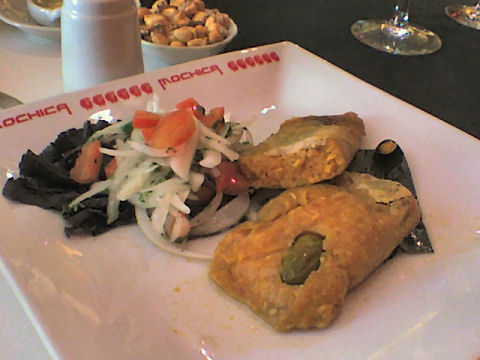
We started off with sharing a tamal, good enough. Flavorful, all the right components, actually the onion salad was quite good. It just cost 12 pesos.
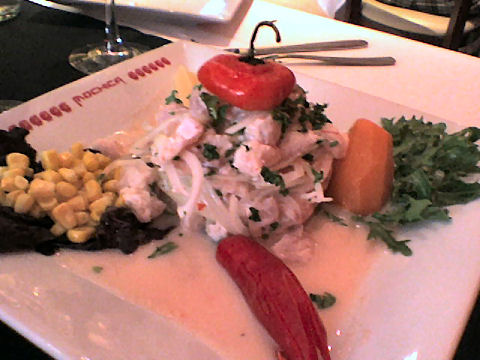
The ceviche was fresh, and reasonably good, though missing any real kick, just a bit of ginger and onion with an obligatory chili off to the side rather than chopped up and mixed in. The usual simple boiled potato, yam and yuca root were replaced by a couple of pieces of saccharine sweet caramelized yam, which didn’t work at all. And at 35 pesos, it’s one of the more expensive ceviches around.
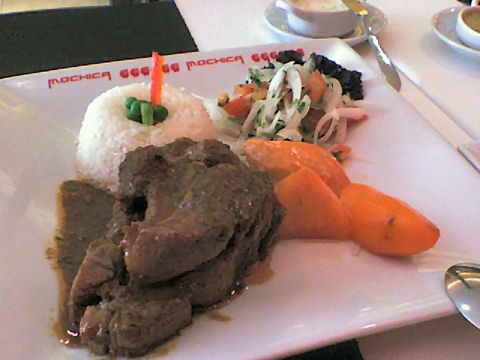
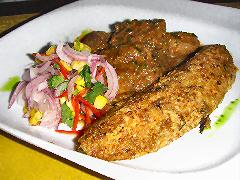
The adobo de cerdo or pork braised in beer and spices, was also lacking in much of spice – it was fine, other than one piece that was a little tough, the rest was nice and tender, it just desperately needed to be “kicked up a notch”, and suffered from the same caramelized yams and a 28 peso price tag.
So, it was an okay lunch and that’s where we’ll leave it. The cost, while not high for a touristy restaurant (and everyone else who was in the place was a tourist from one of the nearby hotels, sent over no doubt), and not even that high by current BsAs standards, was simply high for the quality and for a Peruvian spot, which tend to be less expensive, especially in the ‘hood around the Abasto.
Copyright © 2026 SaltShaker. This feed contains copyrighted photos and text from SaltShaker. If you are not reading this material in a feed aggregator or by e-mail subscription, the site you are viewing may be guilty of copyright infringement. Please contact [email protected] so that I can take appropriate action.
Plugin by Taragana




 ]]>
]]>“Linking these extremes is food activist Isabel Alvarez, an anthropologist who has studied colonial cuisine and teaches the history of food at St Marcs University. She owns El Senorio de Sulco, a cliff-edge restaurant overlooking the sea in the elegant Lima suburb of Miraflores. Alvarez, of Andean (Quechuan) and Catalan descent, is evangelical about preserving authentic dishes, such as the pre-Hispanic huatia sulcana, beef braised in a clay pot and strewn with aromatic herbs, which is on the restaurant menu. She says there has been a revival of interest in Peru’s rich food history and attitudes to cooking as a profession have changed. Sons and daughters of well-to-do families are embracing the formerly lowly work, training in Lima’s 20 or so cooking schools.”
– Judith Elen, Eyes Peeled
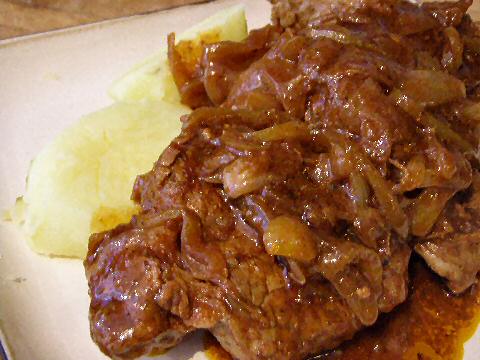
Buenos Aires – It’s hard to believe, but there are days when I don’t feel like cooking. Really. Henry’s not very good about those days, and given that although he’ll pretty much eat anything put in front of him, he strongly prefers the flavors of Peruvian cuisine, those are usually the days that he’ll pick for a manipulative tantrum – something that is rarely effective at getting me to do anything more than stick an unopened can of tuna in front of him with the can-opener and a fork. On the other hand, I like to eat well too, and it happened, the other day, that I had picked up a nice piece from the end of a lomo, or loin of beef, that was sitting in the refrigerator looking forlorn and awaiting my attention.
Rather than head into butting heads territory, I flipped through Tony Custer’s The Art of Peruvian Cuisine (well, the Spanish edition), looking for something simple to make. Of course, my eyes lighted on a recipe that looked mouthwatering in his photo, and takes hours to make. Truthfully, a huátia sulcana probably takes all day to make – a huátia being a traditional, pre-hispanic cooking oven that’s created for a one-time use – you dig a firepit, build a fire, put lots of big stones in it to heat up really hot, put your food in, and then build a clay dome over it. The food is considered done when the dome more or less collapses in on itself. Our garden is kind of the reverse of what you need – lots of clay underneath a bit of topsoil, and besides, it was already noon, I wasn’t about to start digging.
Now, the sulcana part, apparently, was a near modernization – I assume it refers to a place or pre-hispanic culture in some way, though I didn’t find any references that fit (the only other sulcanas I came across were some New Zealand moths) – instead of a firepit covered by a clay dome, the food is cooked slowly in a sealed clay pot. Now, in his book, Custer takes it a step further into modern day and braises it all slowly in a “deep, thick sided pot”. I have no doubt that following these steps results in an amazingly rich, complex and satisfying dish. Did I mention it was already noon? I also didn’t have the half a dozen different aromatic herbs lying about, at least not in fresh form – though, strangely, I had a small handful of hierba buena and cilantro in the refrigerator that I’d picked up a couple of days earlier – and if you see photos of the real dish, you’ll note that mine is missing all the “strewn aromatic herbs” – they’re just in the sauce.
So here is the completely inauthentic, yet took under 30 minutes to make version of a huátia sulcana, lunch special. It was so good, we can’t wait to try making the real thing!
And let’s all meet up one day at El Senorio de Sulco for the real thing….
Copyright © 2026 SaltShaker. This feed contains copyrighted photos and text from SaltShaker. If you are not reading this material in a feed aggregator or by e-mail subscription, the site you are viewing may be guilty of copyright infringement. Please contact [email protected] so that I can take appropriate action.
Plugin by Taragana
]]>“Under the… new hypothesis [of Continental Drift] certain geological concepts come to acquire a new significance amounting in a few cases to a complete inversion of principles, and the inquirer will find it necessary to re-orient his ideas. For the first time he will get glimpses… of a pulsating restless earth, all parts of which are in greater or less degree of movement in respect to the axis of rotation, having been so, moreover, throughout geological time. He will have to leave behind him—perhaps reluctantly—the dumbfounding spectacle of the present continental masses, firmly anchored to a plastic foundation yet remaining fixed in space; set thousands of kilometres apart, it may be, yet behaving in almost identical fashion from epoch to epoch and stage to stage like soldiers, at drill; widely stretched in some quarters at various times and astoundingly compressed in others, yet retaining their general shapes, positions and orientations; remote from one another through history, yet showing in their fossil remains common or allied forms of terrestrial life; possessed during certain epochs of climates that may have ranged from glacial to torrid or pluvial to arid, though contrary to meteorological principles when their existing geographical positions are considered -to mention but a few such paradoxes!”
– Alexander Logie Du Toit, Our Wandering Continents: An Hypothesis of Continental Drifting
Buenos Aires – With United Nations Day upon us, the simplest approach to a Casa SaltShaker dinner was to offer up one dish from each of the five continents. Now, yes, I know there are more than five – but we’ll start by eliminating any conversations about the Arctic or Antarctic as not having any particularly appealing cuisine for me to undertake preparing, and then Africa because, well, because I had to eliminate one more. In terms of various other versions of what constitute the official continents, I’m sticking with the five I learned growing up many decades ago, and I’m not budging. As to the dishes, I decided to pick from past favorites – with one exception, which I’ll focus on.
We began here in South America with a causa de atún from Peru. Regular readers have seen this one pulled out of the hat many a time, it’s a delicious yet simple dish to prepare and tends to be a crowd pleaser. From there, we moved to North America, and my twist on a classic creamy tomato soup, which some might recall involved a tad of gin…
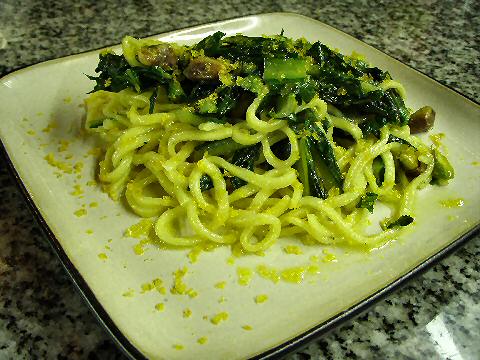
From there, we headed to Asia, in particular Pakistan, and shahi chicken, which is a dish that ended with almost everyone who attended the trio of dinners asking for the recipe. And, finally off to Australia and my version of inside-out lamingtons.
Now, hmm… I picked up half a kilo of bottarga while I was in Manhattan… I’ve now used… oh, about 2 ounces, if that… where do we go from here? Look for more upcoming fun!
Copyright © 2026 SaltShaker. This feed contains copyrighted photos and text from SaltShaker. If you are not reading this material in a feed aggregator or by e-mail subscription, the site you are viewing may be guilty of copyright infringement. Please contact [email protected] so that I can take appropriate action.
Plugin by Taragana
]]>“Before the Spanish banned Inti Raymi in 1572, this winter solstice festival was the biggest event on the calendar of the Awantinsuyu Incan empire. It occurred at the time of the sun’s rebirth (around June 24th on our calendar) in Cuzco, Peru, the Inca capital. Native residents gathered to honour the Inca, the first-born son of the sun god. They fasted for days, then sacrificed llamas and feasted, imbibed chicha and chewed coca, asking the sun to return the following year and make the crops grow. When the Spanish banned the festival as a pagan and therefore Satanic ritual, it went underground.”
– G.A.P. Adventures
Buenos Aires – Last week being the annual celebration of the Andean New Year, Inti Raymi, the Festival of the Sun, or however one wants to put it, noting, of course, that on the calendar of “my people” we’ve got nearly 243 years over this one… just sayin’… we thought we’d celebrate with one of our ever-popular Peruvian dinners. We decided to focus on inspirations from the south of Peru and the communities around Cusco and Puno, where we spent a little time last year. We didn’t sacrifice any llamas, nor eat any guinea pigs, I haven’t quite talked Henry into making our own chicha, though I’m getting there, and although coca leaves were procured, he used them earlier in the day more as an incense or offering, presumably to keep us on good terms with the Sun god here in Casa S.
We started off with a dish called Capchi de Setas, an interesting amalgamation in name (capchi being in Quechua and setas being in Spanish), which sort of fits the traditional mash-up that is the dish. Essentially, it’s a scramble of crushed potatoes and mushrooms. I fancied it up slightly by making a tart shell and filling it with the mixture – which I made by sauteing sliced portobello mushrooms with garlic, onions, ají rojo, salt and cumin and then mixing that with pureed potatoes and some butter beans (favas are more traditional, but not in season right now). Instead of chopped hard boiled egg, I bound the whole thing together with lightly beaten eggs, added some chopped huacatay, crumbled some fresh farmer’s cheese over the top and then baked them in the oven. We served them up with some hot sauce of hot yellow and green peppers finely chopped in vinegar.
We’ve both had fantasies about the sopa incaica that we had last year in Puno at the restaurant Coca Kintu, and while I’ve had success at finding references to the soup in various Peruvian food literature, at best I’ve gotten descriptions of the dish – I haven’t found a recipe for the traditional version, and the owner of the restaurant, while he thanked me for my kind compliments, has ignored requests for their recipe. So be it. Based on my notes from the evening and what I’ve found, I came up with a passable imitation, though definitely less complex than the one we tried there. Still, it was delicious – in a pot, I simmered some finely diced potatoes, white onion, and minced hot peppers with a good amount of quinoa until nearly cooked through. At that point, I added pureed tomatoes, some milk, and, a quinoa slurry – hmmm… essentially I soaked a small amount of quinoa in roughly double the amount of water for several hours, then ran it through the blender until it was completely liquefied. Pouring that into the simmering soup, it immediately thickened it up just like using flour or cornstarch. I seasoned the soup with some chopped quirquiña and huacatay, adjusted the salt, and away we went.
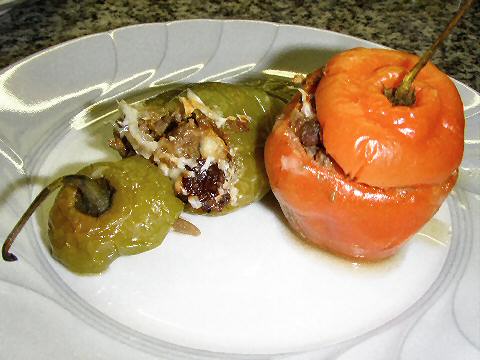
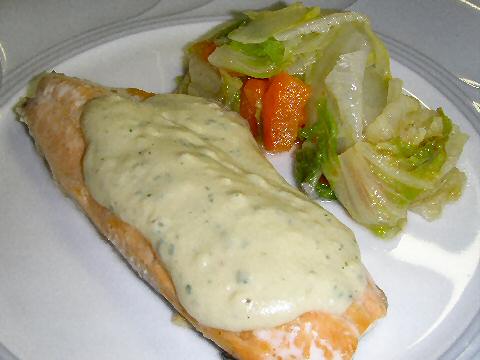
Finally, we finished off with a Cusco Chocolate Cake – purely inspired by the flavors of a local bonbon of chocolate, honey, nuts and quinoa flour. Thanks go out to Beatrice Peltre and her blog La Tartine Gourmande for her Amaranth, Quinoa and Dark Chocolate Cake – I more or less followed her recipe, though using only quinoa since I didn’t have any amaranth, and trying it one night with walnuts and the other with almonds. Cut it into triangles and presented it with one lying down and one standing. To top it, I glazed it with a simple tangerine glaze (tangerines are in season right now, so I’m enjoying them while they last) – ½ cup of fresh tangerine juice, basically two tangerines, 1 egg white, and 250 grams (just over half a pound) of confectioner’s sugar all whisked together to create a pour-able glaze.
Copyright © 2026 SaltShaker. This feed contains copyrighted photos and text from SaltShaker. If you are not reading this material in a feed aggregator or by e-mail subscription, the site you are viewing may be guilty of copyright infringement. Please contact [email protected] so that I can take appropriate action.
Plugin by Taragana
]]>“In the ’90s we began to blossom and feel proud of ourselves, of our architecture, our designs, our cultural heritage – and our food. The secret ingredient to this whole revolution was believing in what you have. Loving it.”
– Gastón Acurio, Peruvian chef
Buenos Aires – Sipán should not be confused with Saipan, the largest island in the U.S. Commonwealth of the Marianas Islands; nor with Šipan, the largest of the Elaphiti Islands, off the northwest coast of Croatia. Sipán is an archaeological site in northern Peru, considered by many archaeologists to be one of the most important sites discovered in the last couple of decades, preserving as it does (did, perhaps, until the archaeologists found it) the undisturbed tomb of the Lord of Sipán, dating from the Moche culture – 100-800 A.D. – along with three other important tombs in the area, and a Caral fire temple dating back to 2600 B.C.E. In our particular case today, a relatively new restaurant here in BsAs is the topic, once again, not to be confused with the restaurant of the same name that was, until recently, located on Manhattan’s upper west side.
No, this particular Sipán is located in the heart of tourism – mere steps from the pedestrian souvenir mall that is Calle Florida, at Paraguay 624, 4315-0763, and bills itself as a destination for Peruvian food and Pisco (the “pisco bar” offers up, or at least based on the menu we received, a whole five different piscos – not exactly representative of the hundreds of them produced out there, in both Peru and Chile (I won’t get into the debate about who has the rights to the name for this brandy) – we order a couple of pisco sours and a mojito, the former two rather small renditions, the latter a decent amount, all well made. [Closed – their Palermo branch is still open]
The style of the place is sort of advertising billboard meets Japanese sushi bar – a look that you’d have to see to quite understand – with huge colorful photographs of ingredients on some walls, collaged together, and then little mini-shrines of buddhas and hello kitty-ish statuary along others. The clientele, for the most part, are clearly tourists, and particularly those well-heeled, as Sipán is not inexpensive – this is a spot for those who want to try reinterpreted Peruvian cuisine with some Japanese thrown in for good measure, but don’t want to have to deal with the more typical clatter and clutter of most Peruvian spots around town.
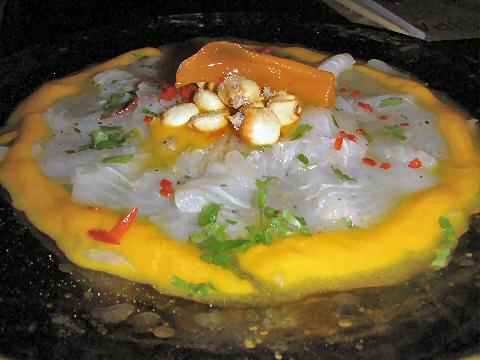
We start off with a trio of appetizers, very smartly brought to the table one by one after our waiter realizes we plan to share them. A ceviche of mero, or sea bass, hits the table perhaps too soon after being introduced to its citrus marinade. It’s pretty, but clearly the large chunks of fish are completely raw – and the waiter actually pours a pot of lemon juice over the top of them, while claiming that they were pre-marinated and this is just for added citrus. Given that the ceviche arrived within moments of our ordering it, that’s a dubious claim, and the crudo state of the fish belies it. Still, we mix it up and let it sit while we chat for a short while and then dig in. The fish is fresh, but the ceviche holds little more than fish, salt, and lemon juice. Nothing spicy – no hot peppers, no garlic, no ginger – a few slivers of green onion atop, some scattered toasted corn kernels. It is bland, plain and simple. We add some of the barely hot sauce that is on the table which adds some interest, but not much.
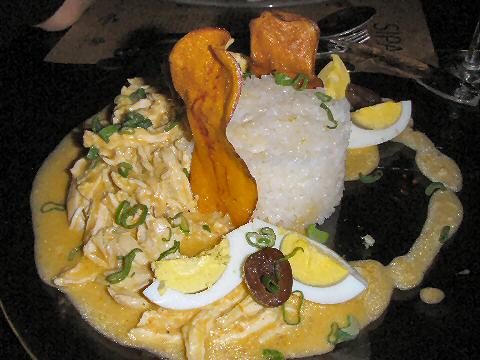
If you’re looking for interesting higher quality Peruvian food, both Moche and Zadvarie provide far better dining experiences; and if Peruvian-Japanese fusion is your desire, Osaka, while probably more expensive than Sipán, certainly delivers food of much higher quality and creativity. Or, Ceviche, which I found to be a bit too pricey for what it offered, was certainly better quality than this for about the same price. And all of these four (in Palermo) have better ambiance and, other than for the business traveler who simply doesn’t want to go more than a few blocks from a downtown hotel, better location.
Copyright © 2026 SaltShaker. This feed contains copyrighted photos and text from SaltShaker. If you are not reading this material in a feed aggregator or by e-mail subscription, the site you are viewing may be guilty of copyright infringement. Please contact [email protected] so that I can take appropriate action.
Plugin by Taragana
]]>“Those quotation marks around “cooked” have been driving me nuts for years. Virtually every mention of ceviche (seh-VEE-chay; I’ll use the Spanish spelling) by food writers is accompanied by a gratuitous statement to the effect that lime juice does to protein what heat does to protein, and therefore that the fish is essentially “cooked” by the lime juice. Well, does “cooked” mean cooked, or doesn’t it? And if the quotation marks are necessary, whom, pray tell, is everyone quoting? Apparently it’s a vicious cycle, with everyone quoting everyone else.”[[- Robert L. Wolke, The Acid Test, Washington Post
Buenos Aires – I’ve decided that we’re acid heads. Nothing to do with drugs, unless you consider ceviche a drug. And maybe it is in some ways. Kind of like guys who go out searching for the hottest hot sauce, though, in this case we’re looking for perfect, exquisite balance, as opposed to overload. So maybe more like Valium than LSD (oh, I can see my ‘bot spam going up with those words in this post). But we’ll pretty much go anywhere in the city to find a good ceviche… which is, for me, maybe a compromise on looking for good sushi – which Henry won’t eat, being uncooked and all – and don’t try explaining to him that ceviche isn’t exactly, really cooked (click on that article linked above for one of the clearest and simplest explanations I’ve seen of the process) – tradition going back to pre-Inca times is ingrained in him that it is.
So, what better place to finally get ourselves off to than Ceviche itself, a relatively new restaurant that has opened in the former Central space at Costa Rica 5644 in Palermo. Owned, I gather, by the same guy who’s behind the Dashi sushi chain, I had initially heard nothing but “expensive but not worth it”, so we simply hadn’t bothered to check it out. Then recently I started hearing recommendations for the spot and figured maybe they got their act together and it would be worth splurging a bit. Turns out that they got a new act entirely – or rather, a new star – they snagged the chef from Moche, the former Peruvian embassy chef Marco Espinosa, who prior to that was a “disciple” of Gastón Acurio of the Astrid & Gastón restaurants, certainly the most expensive restaurant in Lima, and arguably among the most in South America – we actually thought about going to their main spot in Lima (they’re now expanding all over the continent it seems) but turned around and walked away when we got to the door after looking at the prices and the people heading in the door. Interestingly, Moche is still listing Espinosa as their chef, though gives a different resume for his background, which has me curious as to just what that background is – and also wondering if he really is overseeing both restaurants – I did notice that although he jumped in here and there during the evening (Ceviche’s kitchen is an open one that runs alongside the dining room), mostly he was watching and giving instruction. [This location has closed. They’ve opened other spots, to be reviewed.]
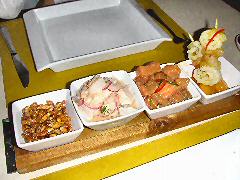 Back to our visit – first, we liked the room. It’s big, long, and very modern, but very tasteful, with good lighting. I love open kitchens, and we snagged one of the tables right by the ceviche station so we could watch them putting those together. They’ve got thing very organized, as is probably necessary for a restaurant of this size – rows of gleaming stainless steel containers filled with various prepped ingredients sitting atop the counter – including the fish (cut, though not submerged in citrus juice), which, if they weren’t a busy spot would be, perhaps, a bit of a concern, but it looks like they go through stuff fast enough that it likely isn’t. We started off with a degustación de ceviches which was listed as a trio of lenguado (flounder), salmon, and vegetable versions. We specified we’d like it “Peruvian spicy” not the “Argentine spicy” that our waiter admitted it was. What arrived was a trio of lenguado, salmon, and a skewer of cooked squid… hmmm… apparently no vegetable ceviche but we’d “like this better”. Well, actually, I’d have liked to try the vegetable ceviche just to see what he was doing. The two ceviches were clearly very fresh, and nicely composed, though not remotely spicy – a small dish of vaguely hot sauce was brought along with for us to add – we used the entire bowl just spicing up the lenguado ceviche and had to ask for more – it wasn’t a big bowl, and they didn’t seem to get it – we had it refilled half a dozen times during the meal, and had to flag down the waiter and ask each time, and then he had to go ask the kitchen, and they seemed to think it was a big chore to dish up a spoonful or two of this vaguely hot sauce into a mini-bowl. The lenguado ceviche was quite good, the salmon one interesting – it was “Japanese style”, which seemed to mean that they’d added a splash of soy sauce, the skewered squid with tropical fruit was tasty, just not ceviche – and overall, all three bowls wouldn’t have made a decent sized ceviche at most Peruvian restaurants, and for 40 pesos… on the other hand, it probably topped the versions at both Moche and Zadvarie that have been the exemplars of haute cuisine ceviche here prior to this…
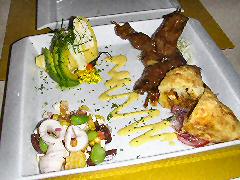 Since we were splurging, we decided on a second round of what was called the degustación de chef – a quartet of appetizers for another 40 pesos… two skewers of anticuchos, or grilled beef heart that were simply salty, with no spice, a small seafood salad that was refreshing but uninteresting, an interestingly re-interpreted tuna causa – with a mayonnaise heavy tuna salad wrapped inside a layer of mashed potatoes, like a sushi roll – but without the other usual components of the dish, like tomato, peppers, olives, onions… okay, there were a couple of slices of avocado standing near to it – still, it gives us ideas for our presentation, we may just copy it at some point for fun, though with the other flavor components. And, finally, the one real winner on the plate, a yuca rellena, with a nice meat filling inside a golden and slightly crisped ball of yuca mash. Again, no spice on anything, and we zipped through another couple of bowls of sauce – someone just bring us the container, it’s not like anyone else in the room was asking for it.
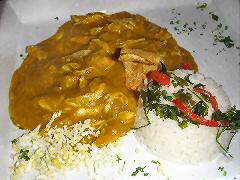
Here’s my take, overall. This is reinterpreted, fancily presented versions of Peruvian dishes that have been completely denuded of spice in order not to offend or assault Argentine palates, and priced to make the trendy neighborhood “Palermo Hollywood” crowd feel like they’re paying for something special (the above, with a couple of bottles of water, ran us 175 pesos). I have no doubt they’ll be a runaway success.
Next day we went back to Solopescados and had a great, filling, and nicely spicy ceviche for 27 pesos…
Copyright © 2026 SaltShaker. This feed contains copyrighted photos and text from SaltShaker. If you are not reading this material in a feed aggregator or by e-mail subscription, the site you are viewing may be guilty of copyright infringement. Please contact [email protected] so that I can take appropriate action.
Plugin by Taragana
]]>