“The history of intellectual growth and discovery clearly demonstrates the need for unfettered freedom… the right to think the unthinkable… discuss the unmentionable, and challenge the unchallengeable…
To curtail free expression, strikes twice at intellectual freedom… for whoever deprives another of the right to state unpopular views… necessarily deprives others of the right to listen to those views.”
– C. Vann Woodward, Pulitzer Prize winning historian, of the American South
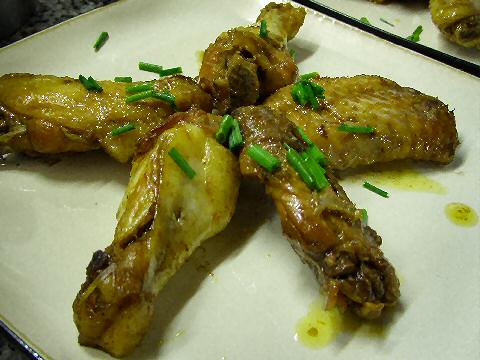
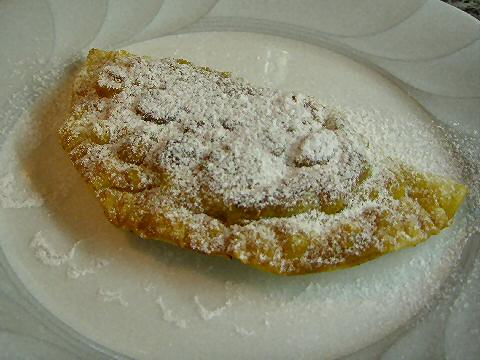
Buenos Aires – Joining the ranks of our centenarians is Comer Vann Woodward, one of the preeminent historians of the United States during the 20th century – with a specialization in race relations south of the Mason-Dixon Line. Woodward was born and raised in Arkansas, so that gave us a starting point for our Casa S dinner – it’s not one of the first states I think of when I start thinking about American regional cooking, but like the other 49 states, it has its unique quirks, flavors, and recipes. Game, fresh trout, tomatoes, watermelons, and fried pies all popped up time and again in researching ideas – it didn’t take long to come up with an Arkansas inspired menu – quite probably nothing that would be directly recognizable (other than the fried pie) at your average roadside cafe outside of Little Rock, but we didn’t hear any complaints…
The second course, our soup, you’ve seen before – with Arkansas reputation for good tomatoes, I thought about the wonderful sun-dried tomato soup that I’d made a couple of months ago for our umami dinner.
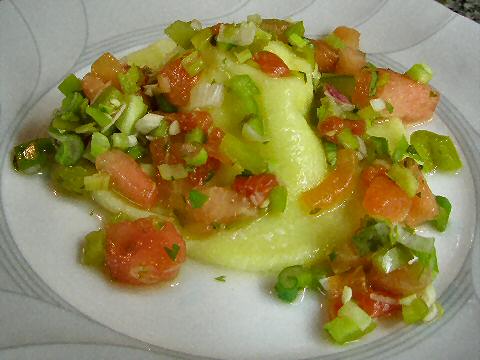
The main course was a minor twist on the oven roasted trout that I’ve made before with the charred tomato sauce – the trout were skewered in a ring shape, then drizzled with olive oil and baked in the oven – no pumpkin seed crust. Underneath, some buttermilk mashed potatoes (I had the suero, or whey, from making the ravioli handy – I used most of it in the tomato soup, but kept a cup or so to flavor the potatoes, and then the sauce drizzled around.
Copyright © 2026 SaltShaker. This feed contains copyrighted photos and text from SaltShaker. If you are not reading this material in a feed aggregator or by e-mail subscription, the site you are viewing may be guilty of copyright infringement. Please contact [email protected] so that I can take appropriate action.
Plugin by Taragana




 ]]>
]]>“Under the… new hypothesis [of Continental Drift] certain geological concepts come to acquire a new significance amounting in a few cases to a complete inversion of principles, and the inquirer will find it necessary to re-orient his ideas. For the first time he will get glimpses… of a pulsating restless earth, all parts of which are in greater or less degree of movement in respect to the axis of rotation, having been so, moreover, throughout geological time. He will have to leave behind him—perhaps reluctantly—the dumbfounding spectacle of the present continental masses, firmly anchored to a plastic foundation yet remaining fixed in space; set thousands of kilometres apart, it may be, yet behaving in almost identical fashion from epoch to epoch and stage to stage like soldiers, at drill; widely stretched in some quarters at various times and astoundingly compressed in others, yet retaining their general shapes, positions and orientations; remote from one another through history, yet showing in their fossil remains common or allied forms of terrestrial life; possessed during certain epochs of climates that may have ranged from glacial to torrid or pluvial to arid, though contrary to meteorological principles when their existing geographical positions are considered -to mention but a few such paradoxes!”
– Alexander Logie Du Toit, Our Wandering Continents: An Hypothesis of Continental Drifting
Buenos Aires – With United Nations Day upon us, the simplest approach to a Casa SaltShaker dinner was to offer up one dish from each of the five continents. Now, yes, I know there are more than five – but we’ll start by eliminating any conversations about the Arctic or Antarctic as not having any particularly appealing cuisine for me to undertake preparing, and then Africa because, well, because I had to eliminate one more. In terms of various other versions of what constitute the official continents, I’m sticking with the five I learned growing up many decades ago, and I’m not budging. As to the dishes, I decided to pick from past favorites – with one exception, which I’ll focus on.
We began here in South America with a causa de atún from Peru. Regular readers have seen this one pulled out of the hat many a time, it’s a delicious yet simple dish to prepare and tends to be a crowd pleaser. From there, we moved to North America, and my twist on a classic creamy tomato soup, which some might recall involved a tad of gin…
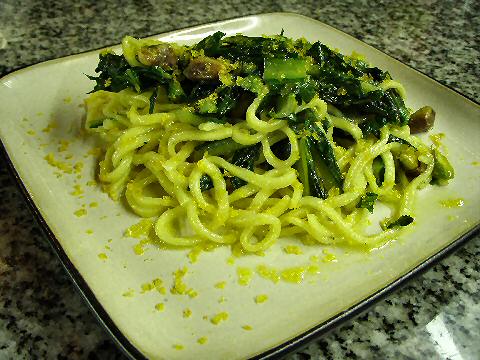
From there, we headed to Asia, in particular Pakistan, and shahi chicken, which is a dish that ended with almost everyone who attended the trio of dinners asking for the recipe. And, finally off to Australia and my version of inside-out lamingtons.
Now, hmm… I picked up half a kilo of bottarga while I was in Manhattan… I’ve now used… oh, about 2 ounces, if that… where do we go from here? Look for more upcoming fun!
Copyright © 2026 SaltShaker. This feed contains copyrighted photos and text from SaltShaker. If you are not reading this material in a feed aggregator or by e-mail subscription, the site you are viewing may be guilty of copyright infringement. Please contact [email protected] so that I can take appropriate action.
Plugin by Taragana
]]>“People are like stained-glass windows. They sparkle and shine when the sun is out, but when the darkness sets in, their true beauty is revealed only if there is a light from within.”
– Elisabeth Kubler-Ross, psychiatrist
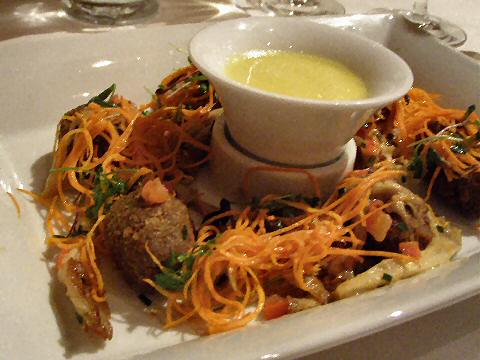
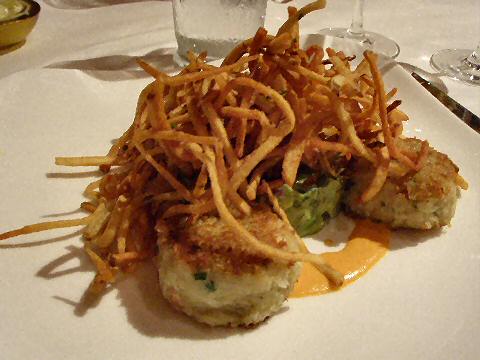
Highwood, Illinois – Trying to get a group of people to agree on some place to go out for dinner is generally an exercise in futility. Trying to get a group of friends to agree is often such. Trying to get a group of family members to agree is simply useless. Luckily, our family is relatively tolerant of someone making a decision, following that lead, and then, the praise or blame can be laid later, depending on how it all goes. My brother narrowed the choices for our wine evening out over the weekend down to a quintet, handed the local Zagat’s to me, and said “choose”. Very smart boy. Not for letting me choose, but for not making the choice himself. Given the vagaries of allergies, food preferences, and price, I settled on The Stained Glass, 1735 Benson Avenue, in nearby Evanston, a “wine bar bistro” with “seasonal American” offerings. The allure of wine flights, hopefully good ones, was a strong draw.
And, there’s no question, those are the draw for many guests – flights of three wines abound on the tables, delivered via very cool carriers that allow the servers to deposit all three glasses at once. The selection is eclectic, with nearly three dozen wines available by the glass in standard sized pours or half pours as part of the trios (along with an additional wine list of over 250 selections by the bottle), and contains quite a few gems. I was in a white mood and found myself in front of a Meinklang Grüner Veltliner from Austria, Clayhouse Vineyards “Adobe White” from California (blend of Chenin blanc, Chardonnay, Roussanne, Viognier and Princess), and a Hahn SLH Pinot Gris from California. All quite nice – nothing earth shattering, but certainly far more interesting than, say, a trio of $10 Chardonnays like some places come up with. Around the table various other flights made it – a trio of French reds with a Rhône, a Provençe, and a Bordeaux placed together; a different grouping of whites of various aromatic varietals; and then, several individual glasses.
Copyright © 2026 SaltShaker. This feed contains copyrighted photos and text from SaltShaker. If you are not reading this material in a feed aggregator or by e-mail subscription, the site you are viewing may be guilty of copyright infringement. Please contact [email protected] so that I can take appropriate action.
Plugin by Taragana
]]>“Amaranthus, collectively known as amaranth or pigweed, is a cosmopolitan genus of herbs. Approximately 60 species are presently recognized, with inflorescences and foliage ranging from purple and red to gold. Members of this genus share many characteristics and uses with members of the closely related genus Celosia. Although several species are often considered weeds, people around the world value amaranths as leaf vegetables, cereals and ornamentals. The word comes from the Greek amarantos, the “one that does not wither,” or the never-fading (flower).”
Buenos Aires – I expect this one will not whither. A restaurant, that is. Relatively new, it’s a mere couple of blocks from home and I’d passed it by numerous times, thinking it was nothing but a simple cafe. Then one Sunday morning I wandered in, figuring on some toast and coffee, perhaps an egg, only to discover that they offer real brunch – eggs benedict (though having difficulty sourcing Canadian bacon), huevos rancheros, bagels with lox and cream cheese – and real bagels too, they make them on-site, muffins, waffles, pancakes… you get the idea, right? Not common here in Buenos Aires. Since then, I’ve been back to Amaranta, Junín 1559, many more times, and it’s become my neighborhood hangout. It’s also seems to be the spot of choice for many a norteamericano expat or visitor, as they seem to be the mainstay of the clientele. [As of December 2009, this place is closed, and the owners have moved back to Bolivia, where the chef is now teaching at a culinary school in Santa Cruz. We stay in touch, on and off.]
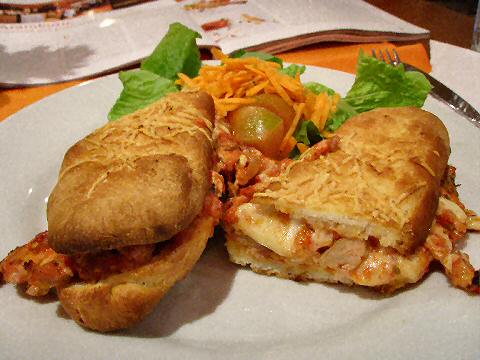
As best I can tell, the name is just a name, I have yet to see amaranth or any other Andean grains on the menu, even if Humberto is from Bolivia.
Copyright © 2026 SaltShaker. This feed contains copyrighted photos and text from SaltShaker. If you are not reading this material in a feed aggregator or by e-mail subscription, the site you are viewing may be guilty of copyright infringement. Please contact [email protected] so that I can take appropriate action.
Plugin by Taragana
]]>“Cajun is country food by farmers and fisherman that arrived in Louisiana from Acadiana, Canada…. Creole is New Orleans city food. Communities were created by the people who wanted to stay and not go back to Spain or France.”
– Paul Prudhomme, Chef
Buenos Aires – You’d think, given the constant harping about lack of spiced food that goes on amongst us folk in the expat community here, that the offer of a weekend of cajun and creole cooking would have filled up faster than Justin Wilson could have said “I gar-on-tee!” And Friday eve packed with reservations almost immediately, though there was a bit of give and take after that as folks changed around schedules. Not a one for Saturday, and only a trio for Sunday, whom, unfortunately, we decided to cancel on without any additional folk coming. I know it was Mothers’ Day here on Sunday, but not every expat in town was out feting dear old Mom. And it’s not even a cuisine I was just experimenting with – during a part of my past I was sous chef at The Sazerac House in New York, which while not turning out the most authentic Louisiana cuisine out there, I think we did a decent job, and it gave me a good exposure to the flavors involved. Such is life – the same thing seems to be happening with an Indian dinner coming up this weekend, while meanwhile, the following week, with a promise of cooking from the region around Paris, filled up weeks ago – go figure – maybe I’ll do spicy Parisian food and trick them all…
Now the first thing, there’s not just one cuisine of the state – which we were celebrating because this weekend was the anniversary of the ratification by Congress of the Louisiana Purchase – as noted above in the quote from Chef Paul Prudhomme, one of the deans of the cuisine. And it’s not all universally picante – what there is is a depth of flavor that comes from a lot of slow cooked dishes, where spices and herbs meld together to form complexities that can be quite subtle. And then, of course, there can be those quick cooked, multi-spiced things like the famed “blackened redfish”, that literally cooks in a mere minute or two over searingly high heat, crisping spice mixtures right into the surface (that was out for this weekend – you need high intensity heat under cast iron, to the point where the metal is actually changing color, and you need enough space to put each piece of meat or fish into the pan without cooling the whole thing down – I just don’t have that much room).
 I wanted to start out at the non-spicy end and work my way up – so we began the evening with a chilled Creole Tomato Soup. My guess, given the ingredients that go into this, is this derives from some of the Spanish population that settled in parts of the New Orleans area. It’s actually a really simple soup to make, and can be eaten hot when just cooked – but I recommend letting it cool and then chilling, as something changes in the flavor profile that really makes this soup shine. Saute a few sliced garlic cloves in olive oil for about 2-3 minutes, just to flavor the oil well. Add a chopped red bell pepper, and if you can, a chopped ancho pepper or two (if not available, like here, use a teaspoon or two of ancho chili powder). Cook until the peppers soften, 3-4 minutes. Add a whole lot of tomatoes (I probably used about 4 pounds), simply cut into pieces – depending on their size, 4-8 pieces, and a good splash of sherry vinegar (¼ cup, more or less). Cover the pot, bring the whole mixture up to a simmer (no water needs to be added, the tomatoes will release enough liquid), then turn the heat down and leave it to simmer away for about 15-20 minutes, until the tomatoes are all soft and cooked through. Remove from the heat, and then puree in a blender with a handful of thyme and basil leaves. Season with salt and black pepper. Let cool, then chill for several hours. Re-season – remember that spices, while they’ll meld well during the chilling process, will also become a bit muted. If it needs a little more acidity, add some more sherry vinegar. I garnished the soup with some black olive crumbs.
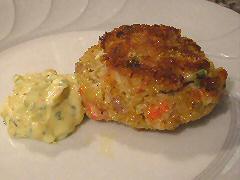 One reviewer of the Sazerac House, back in the day (the place closed last year after a nearly four decade run), said that the crabcakes “stopped by heaven” on their way to your plate. They’re still pretty much the best crabcakes I’ve ever had, and I’m always thrilled that I have the recipe in my repertoire. I even served a “kosher” version of them for my dad’s 60th birthday party a few years back, using surimi instead of crab, and people raved about them. Now, here’s the thing, it’s not really my recipe to give out, at least in detail – I just wouldn’t feel right about that without getting Barry and Dierdre’s permission – perhaps one day. But here’s the thing – there are a couple of key things – lots of crabmeat and not a lot of filler. One of the problems at most places I’ve had crabcakes is that they may as well be breadcrumb cakes with crab flavoring. Now, they didn’t turn out perfectly here – the crab that’s available is different, I had to settle for frozen centolla, or spider crab, meat – just not that same lump crab meat from blue crabs. Also, no scallions – even in Chinatown for some reason, where I usually can find them – so green onions. And, no real Old Bay Spice, though I have worked up an acceptable subsitute spice mixture. The cakes themselves – a mix of, I repeat, lots of crabmeat, just enough mayo to bind it together, chopped scallions or green onions, Old Bay, Tabasco, Worcestershire, and, like the mayo, just enough breadcrumbs to give the cakes a little bit firmer texture. Then the mixture is formed into patties and rolled in breadcrumbs to form the crust. To cook, they’re sauteed in a mix of 50:50 neutral oil and butter (peanut oil is best if no one has an allergy to it), until they’re golden brown on each side. They get served up with homemade tartar sauce.
So let’s see – tartar sauce… mayo, preferably freshly made, mixed with dijon mustard, chopped parsley, chopped dill pickles, and a little chopped ginger, salt, and white pepper to taste. Old Bay seasoning – you can find a variety of versions of substitutions out there on the ‘net – I like to start with a base of equal parts of salt and dry mustard powder, then about half those amounts of celery seed, paprika, black pepper, and bay leaf, and then just touches of clove, allspice, ginger, cardamom, cinnamon, and nutmeg. Grind it all together to get a very fine powder. I won’t claim you can’t tell the difference from Old Bay, but it’s close enough to work in dishes that use the mixture.
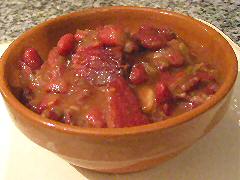 Maybe it was the concern about lack of traditional ingredients… after all, folks here know I wasn’t going to find tasso or andouille, right? But you know what, you can always work it out. For tasso, which is a spiced and smoked ham, I went out and found a butcher who had a nice supply of smoked fresh ham. Then I took that ham and rubbed it all over with salt, smoked paprika and cayenne, and let it sit for a day. To make relatively traditional cajun red beans and rice, I sauteed chopped celery, onion, and green bell pepper in oil until soft, then added the “tasso”, cut in small pieces, and cooked that until the meat was just starting to brown. At that point, I added a good amount of dry red beans (not soaked – I don’t know why, but this dish works out better when the beans aren’t pre-soaked, maybe because they absorb more flavors as they cook rather than water). Topped it all off with water, brought it to a boil, reduced the heat to a full simmer, covered the pan, and let it go for about four hours, stirring occasionally (add more water if necessary). When the beans are cooked through, adjust the seasoning with salt (note, I didn’t put any salt into the mix while the beans were cooking as it toughens their skins) and cayenne to the spiciness you want. Serve over rice.
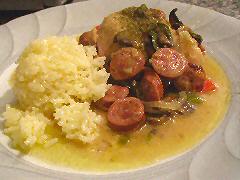 Okay, gumbo. Let me just say upfront that I’ve heard all the arguments about what goes into it, how to thicken it, and everything else under the sun. Given my “druthers”, I’d thicken with a nice red roux and some sliced okra, and finish with a little filé powder – the trio of thickening agents. But, it was not to be – okra isn’t in season yet, and although I think of it as a pretty key ingredient, you can make gumbo without it (except, of course, in the opinion of the folk who say you can’t because gumbo means okra and okra means gumbo… such is the way things go sometimes). First, a roux – equal parts of oil and flour, cooked, stirring regularly, over very low heat, until the flour has browned – actually turning a sort of reddish brown color, hence “red roux” versus a blond roux – the latter only cooked for about 15 minutes or so, a red one taking well over an hour to get the color right – I’d guess mine went about an hour and a half before I decided it was ready. To that, I added a mix of red and green bell peppers, white and green onions, all chopped, salt and cayenne, and cooked them in the mixture until they were soft. Then, some andouille – well, the closest I could find here, which turned out to be some smoked, hot pepper German sausages that a butcher put together for me – a little more like a midwest style “red hot” than an andouille, but they had a great flavor. I also added a couple handfuls of chopped mushrooms, I like them in a gumbo – another thing not everyone would agree with. When this whole mixture is cooked down well, the mushrooms having released their liquid, I added the chicken pieces and just a little water, enough to be able to submerge the chicken pieces but not enough to make it a soup. Covered the pot and cooked, stirring occasionally, until the chicken was pretty much falling off the bone, a couple of hours. Season with salt and cayenne if needed, and serve with rice.
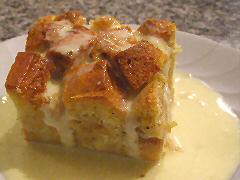 Finally, dessert, and a good old New Orleans style bread pudding. Leftover bread is the key – depending on who you talk to, either completely dried out or just a day or two old stale – I like the latter better. Cut in small cubes and soak in a basic custard mixture made from cream, vanilla, eggs, sugar, cinnamon, and nutmeg. I let the mixture soak for only about half an hour – some folks like to let it sit for several hours, but I find the texture turns too pudding-like as opposed to bread-like… it’s a matter of personal preference. Butter a casserole pan and pour the mixture into it, packing it in well, making sure to fill the corners and get it all fairly even. Then cover with foil and cook at about 250°F for 2 hours, remove the foil, turn the heat up to 300°F and cook another hour until the top has browned nicely. Let cool… I like to serve it just slightly warm… with whiskey sauce – cream thickened with cornstarch and then flavored with vanilla, bourbon, and sugar.
Y’all missed out. I gar-on-tee!
Copyright © 2026 SaltShaker. This feed contains copyrighted photos and text from SaltShaker. If you are not reading this material in a feed aggregator or by e-mail subscription, the site you are viewing may be guilty of copyright infringement. Please contact [email protected] so that I can take appropriate action.
Plugin by Taragana
]]>Oh Lord please don’t burn us don’t kill or toast your flock Don’t put us on the barbecue or simmer us in stock, Don’t bake or baste or boil us or stir-fry us in a wok…”
– Monty Python
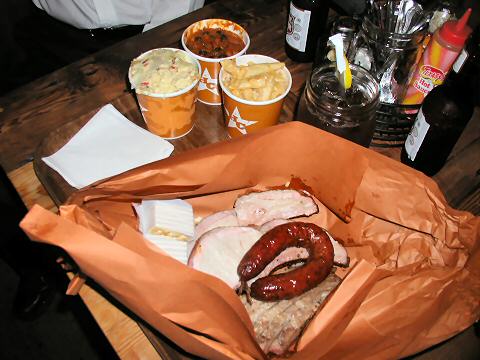
New York City – So, all the rage these days is barbecue in New York. On just one night last week, Justin Timberlake opened his southern bbq restaurant, and a Georgia bbq joint opened up with less fanfare on the lower east side. Most of the recent press, however, has been raving about the experience at Hill Country, 30 West 26th Street, in the Flatiron district. Most of the raving has been positive, a bit has been negative, especially in regard to the “process”. And it is a process – you enter, each person in your party is given a card, upon which, over the course of the evening, various items will be marked off by one waiter or waitress or server or… well, they really don’t have much in the way of service staff, you’re kind of on your own – you wander around, go to the meat counter, and order your meat by the pound, or fraction thereof – normally a wide range of lean and fatty brisket, ribs, chops, chicken, sausages, and whatever else one might barbecue (which, in the case of Hill Country, involves no sauce, just slow smoking… what those of us who grew up in the midwest would call… ummm… smoking and/or grilling, rather then barbecue) – it’s all piled into a piece of pseudo-butcher paper, some white bread or crackers are tossed in, and it’s almost, kinda, sorta wrapped up and deposited on your cafeteria tray. Now, we got there at 9 p.m. and they were already out of everything except lean brisket, pork chops, and plain sausages… so that’s what we got. Side dishes are laid out on steam tables at another counter and ladled into your choice of a small, medium, or large cardboard cup – we decided on baked beans, mac and cheese, and potato salad. Drinks of the bottled variety are at another counter, mixed drinks at yet another, desserts at…. well you get the idea. What service staff there is outside of behind the counters basically spend their time clearing up the detritus of departing diners (tables are a mix of regular types and long picnic tables that are shared by various and sundry folk), or offering up more rounds of drinks. Music is loud and brash and more or less something country-ish. There’s a downstairs which we didn’t enter that apparently has live music as well.
The verdict – the plain sausage was good, but, well, plain, though smoky; the pork chops were huge, and tasty; the lean brisket was dry and relatively flavorless… well, not quite true, it simply tasted of smoke. Actually, everything tasted like smoke, which is far more intense than any meat flavors that might have remained, other than perhaps in the center of the pork chop, which is what made it the winner for the evening. The crackers serve no purpose that I could see. There’s hot sauce that’s not hot in the slightest on the table, and barbecue sauce called something like “if you simply must have sauce”… The “unsweet” iced tea was quite good. The mac and cheese – “made with five differen’ cheeses” was quite good, the potato salad too, the beans a bit on the vinegary side and not very interesting. Were we transported to hog or cow eatin’ heaven? Not so much.
Copyright © 2026 SaltShaker. This feed contains copyrighted photos and text from SaltShaker. If you are not reading this material in a feed aggregator or by e-mail subscription, the site you are viewing may be guilty of copyright infringement. Please contact [email protected] so that I can take appropriate action.
Plugin by Taragana
]]>