“Savoriness or umami is the name for the taste sensation produced by the free glutamates commonly found in fermented and aged foods. The additive monosodium glutamate (MSG), which was developed as a food additive in 1907 by Kikunae Ikeda, produces a strong umami taste. Umami is also provided by the nucleotides that are naturally present in many protein-rich foods, including dried Bonito flakes and in high concentration in dried Shiitake mushrooms, used in much of Asian cooking…. Umami is considered basic in Japanese and Chinese cooking, but is not discussed as much in Western cuisine, where it is sometimes referred to as “savory” or “moreish.” The Japanese name for the taste sensation literally means “delicious flavour.”
– paraphrased from Wikipedia
Buenos Aires – How could we pass up the opportunity to celebrate the 100th anniversary of the discovery of glutamate? I mean, break out the party hats and noisemakers! Yes, indeed, July 25, 1907, a researcher at the University of Tokyo, clearly bored to tears with whatever task the department chair had given him, decided to analyze the ingredients in his daily noodle soup bowl, and figure out why grandma’s tasted better than mom’s. With great glee, given his obviously poor relationship with his maternal parent, he announced it was because nana used more konbu seaweed and bonito flakes, and he even declared the chemical he isolated from those two ingredients was the source of umami, or “delicious taste”. This founded an entire industry and also got him out of having to go home for Sunday lunch visits.
I started off figuring that I had to make some form of dashi – a quick trip to chinatown yielded up some konbu, the bonito flakes were already in the pantry. Instead of infusing them into water, I decided to infuse them in a cream and milk mixture (we don’t have half-and-half here), spice it up slightly with some shichimi, or “seven spice” powder, a touch of salt, and thicken it up in a double boiler with a couple of egg yolks. Now, what to put that on… Salmon, yes that’ll work. And a cream sauce, how about a pasta? So, fresh salmon, put through the coarse meat grinder, some fried onions, and the grated rind of some lemons, oranges, and limes, along with a splash of their juices and some salt – makes a great little salmon burger… oh, a basic egg pasta dough, filled giant raviolis with the salmon mixture, left to dry slightly, cooked off, topped with the cream sauce, sprinkled with chive batons, and yes, that’s got umami in spades.
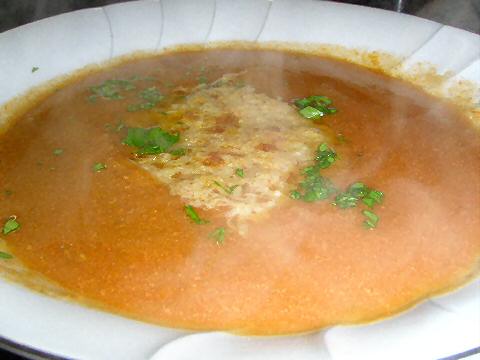
Dried, aged, tomatoes, cheese, cold and wet days – how about a steaming bowl of tomato soup. Remember those Campbell’s soup ads for a bowl of tomato soup on a cold wintery day? Soup and sandwich, soup and sandwich… soup this good just has to be Ca… mmm, mmm, good. Oh wait, where was I? Ahh yes, a big pot, a liter of milk, about two of water, a whole bunch of sun-dried tomatoes, a couple of onions, some garlic cloves, fresh parsley, cloves, black pepper, thyme, bay leaf, all simmered together for about half an hour, then pureed, strained through a coarse strainer, a little salt… and what atop? Why yes, a parmesan crisp… just a scoop of freshly grated parmesan cheese sprinkled with a little smoked paprika, melted and browned on a silpat, and left to cool and crisp up. Float that right on top of the soup.
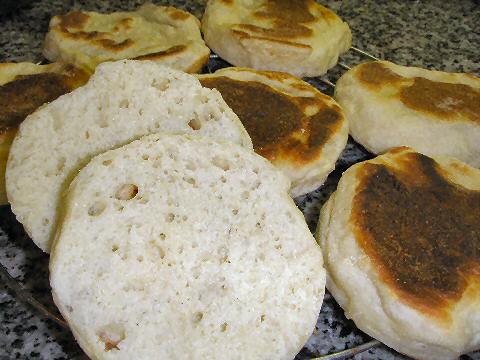
Found ’em. English muffins. The recipe that works. Since I’ve been on this baking kick recently I’ve started reading various baking sites. And who knows more about norteamericano baking than King Arthur’s Flour company? And, lo and behold, English Muffins, and the recipe turns out perfectly. Really. Look at them. Try it.
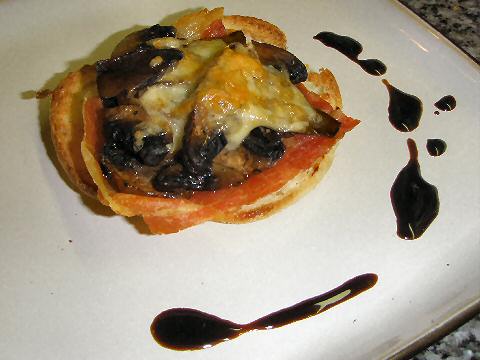
Great sources of umami… bacon or similar cured meats… meaty sorts of mushrooms like shiitake and portobellos… cheese…. How about a sort of McMuffin kind thing? Split those English Muffins we just made. Top with a slice of crispy prosciutto (okay, modern chef’s trick here… you’re gonna love this… get two plates of equal size… lay a square of kitchen towel paper on one… lay strips of prosciutto, pancetta, bacon, whatever you like on the paper, not touching each other… lay another square of towel paper on top… put the second plate atop to press it all together… stick in the microwave on high power for 50 seconds, no more, no less… you tell me), top with some thickly sliced portobellos that have been briefly sauteed in butter, grate some cheese over the top, something that will melt well, I used a cheese called fynbo that has a sort of nutty character to it. Broil. Drizzle a little glaze of reduced soy and balsamic vinegar around it. Eat.
One of the things that I get asked alot is a sort of “where did you get that idea?” usually referring to some sort of strange sounding combination. Much of the time I have no idea, these things just come to me. But this one I know, and I forgot to mention it when I posted about my blue cheese sauce back on the evening of our Sherry Dinner. It was from Tony Bourdain. Now, not anything the man cooked, because my past experience with his cooking is, well, less than favorable. But I do occasionally enjoy watching him traipse around the globe – not because I enjoy listening to him prattle on as if he actually has the “street cred” he thinks he does, but because he often ends up in front of someone who’s whipping up something really cool. In this case, it was a drink. A martini. I think it was a show on India, and he’d gone out to some floating bar in the middle of a lake, where the bartender prepared him what he declared was the best martini he’d ever had – it was garnished with an olive filled with blue cheese, onion, and mint. It got me thinking, and that’s how I ended up with a sauce made from gin-deglazed shallots, melted blue cheese, chopped black olives, stock (lamb for this evening), and finished with freshly chopped mint. You can follow the logical progression, no? The sauce this eve was ladled over seared and roasted lamb loin, which was atop brown butter miso sauteed chinese cabbage. An umami bomb, in the best sense of the word, basically.
Chocolate isn’t an umami sort of thing, but then, few dessert items are. Some beans are. Adzukis for example, so what about adzuki bean paste? And what about sandwiching it between that cocoa crust and chocolate ganache I’ve been playing around with over the last couple of months? It comes out like a dense, really interesting fudge kind of intense dessert. Maybe a little over the top. Maybe.
Copyright © 2026 SaltShaker. This feed contains copyrighted photos and text from SaltShaker. If you are not reading this material in a feed aggregator or by e-mail subscription, the site you are viewing may be guilty of copyright infringement. Please contact [email protected] so that I can take appropriate action.
Plugin by Taragana




 ]]>
]]>“Before the Spanish banned Inti Raymi in 1572, this winter solstice festival was the biggest event on the calendar of the Awantinsuyu Incan empire. It occurred at the time of the sun’s rebirth (around June 24th on our calendar) in Cuzco, Peru, the Inca capital. Native residents gathered to honour the Inca, the first-born son of the sun god. They fasted for days, then sacrificed llamas and feasted, imbibed chicha and chewed coca, asking the sun to return the following year and make the crops grow. When the Spanish banned the festival as a pagan and therefore Satanic ritual, it went underground.”
– G.A.P. Adventures
Buenos Aires – Last week being the annual celebration of the Andean New Year, Inti Raymi, the Festival of the Sun, or however one wants to put it, noting, of course, that on the calendar of “my people” we’ve got nearly 243 years over this one… just sayin’… we thought we’d celebrate with one of our ever-popular Peruvian dinners. We decided to focus on inspirations from the south of Peru and the communities around Cusco and Puno, where we spent a little time last year. We didn’t sacrifice any llamas, nor eat any guinea pigs, I haven’t quite talked Henry into making our own chicha, though I’m getting there, and although coca leaves were procured, he used them earlier in the day more as an incense or offering, presumably to keep us on good terms with the Sun god here in Casa S.
We started off with a dish called Capchi de Setas, an interesting amalgamation in name (capchi being in Quechua and setas being in Spanish), which sort of fits the traditional mash-up that is the dish. Essentially, it’s a scramble of crushed potatoes and mushrooms. I fancied it up slightly by making a tart shell and filling it with the mixture – which I made by sauteing sliced portobello mushrooms with garlic, onions, ají rojo, salt and cumin and then mixing that with pureed potatoes and some butter beans (favas are more traditional, but not in season right now). Instead of chopped hard boiled egg, I bound the whole thing together with lightly beaten eggs, added some chopped huacatay, crumbled some fresh farmer’s cheese over the top and then baked them in the oven. We served them up with some hot sauce of hot yellow and green peppers finely chopped in vinegar.
We’ve both had fantasies about the sopa incaica that we had last year in Puno at the restaurant Coca Kintu, and while I’ve had success at finding references to the soup in various Peruvian food literature, at best I’ve gotten descriptions of the dish – I haven’t found a recipe for the traditional version, and the owner of the restaurant, while he thanked me for my kind compliments, has ignored requests for their recipe. So be it. Based on my notes from the evening and what I’ve found, I came up with a passable imitation, though definitely less complex than the one we tried there. Still, it was delicious – in a pot, I simmered some finely diced potatoes, white onion, and minced hot peppers with a good amount of quinoa until nearly cooked through. At that point, I added pureed tomatoes, some milk, and, a quinoa slurry – hmmm… essentially I soaked a small amount of quinoa in roughly double the amount of water for several hours, then ran it through the blender until it was completely liquefied. Pouring that into the simmering soup, it immediately thickened it up just like using flour or cornstarch. I seasoned the soup with some chopped quirquiña and huacatay, adjusted the salt, and away we went.
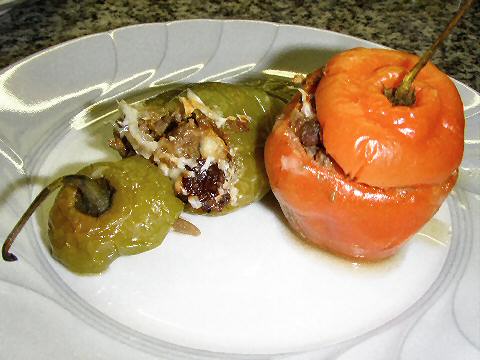
Finally, we finished off with a Cusco Chocolate Cake – purely inspired by the flavors of a local bonbon of chocolate, honey, nuts and quinoa flour. Thanks go out to Beatrice Peltre and her blog La Tartine Gourmande for her Amaranth, Quinoa and Dark Chocolate Cake – I more or less followed her recipe, though using only quinoa since I didn’t have any amaranth, and trying it one night with walnuts and the other with almonds. Cut it into triangles and presented it with one lying down and one standing. To top it, I glazed it with a simple tangerine glaze (tangerines are in season right now, so I’m enjoying them while they last) – ½ cup of fresh tangerine juice, basically two tangerines, 1 egg white, and 250 grams (just over half a pound) of confectioner’s sugar all whisked together to create a pour-able glaze.
Copyright © 2026 SaltShaker. This feed contains copyrighted photos and text from SaltShaker. If you are not reading this material in a feed aggregator or by e-mail subscription, the site you are viewing may be guilty of copyright infringement. Please contact [email protected] so that I can take appropriate action.
Plugin by Taragana
]]>“Pioneer 10 will continue to coast silently as a ghost ship through deep space into interstellar space, heading generally for the red star Aldebaran, which forms the eye of Taurus (The Bull). Aldebaran is about 68 light years away and it will take Pioneer over 2 million years to reach it.”
– NASA, The Pioneer Missions
Buenos Aires – A mere five years ago, happily ensconced in New York City and never envisioning a visit, let along a move, to this part of the world, I hosted a dinner in honor of the space probe, Pioneer 10. At that point, June 13, 2004, it was 21 years to the day since the craft had departed our solar system, heading for deep reaches of space. At the time, my general theme for the menu was a sort of “way out there” sort of combinations. Not crazy, but off the beaten track, at least as far as my cooking went at the time. The menu for that evening was:
Mumm DVX 1997
Rye Bruschetta, Fresh Morel Sauce
Dirler Riesling “Spiegel” Grand Cru 1992
Wild Bass Sashimi, Crab & Root Vegetable Stuffing
Apostiles Palo Cortado Muy Viejo 30-Year Old Sherry
Slow-Braised Pork, Salmon Roe Beurre Noisette, Swiss Chard
Chateau de la Charriere Santenay “Clos de la Confrerie” 1988
Chocolate-Rhubarb Pudding
Borgogno Barolo Chinato
Back in those days of the “Second Sunday Supper Circle” the dinners were attended by a small group of friends and involved various wines that I’d collected, and pretty much random food that I planned. It was a playtime in the kitchen for me – no one ever knew the menus in advance, and I didn’t take special requests – hey, one of my closest friends came for years and never told me he was allergic to shrimp, because he didn’t want to miss out on whatever might pop up for the evening.
My first thought was a reasonably straightforward re-creation of the evening’s menu, though with different wines and whatever adjustments were needed for ingredient availability. However, in the end, much of it simply had to change because of those reasons and, well, my cooking has evolved since that time – I hope.
So, let’s take the courses one by one – no green tomatoes available here. No tomatillos either at this point, they were in the markets up until a couple of weeks ago, but then simply disappeared. And, just plain underripe tomatoes aren’t quite the same thing. I decided on a warm gazpacho, with the tomatoes, some almonds, and garlic all roasted together and then pureed, and then diced peppers, cucumbers, and onion added, along with herbs and spices at the end. I moved it to the second course (logistics-wise, soup works best for our dinners as the second plate).
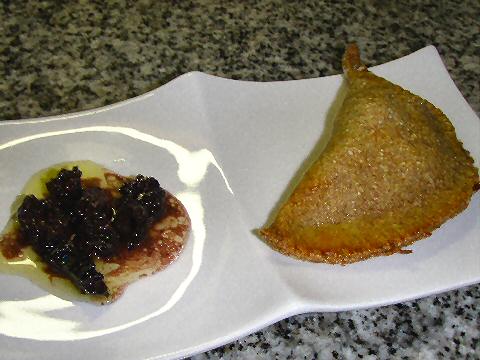
The rye bruschetta stayed more or less on my radar until the last moment. I decided to reinterpret it more in the style of cooking that I’m doing now – plus, fresh morels are essentially non-existent here (there’s one supplier I know of, and they’re only available in spring, in limited quantities). I found dried morels, and decided to reconstitute them and make them into a simple sauce on the side – sauteed in butter, then deglazed with armagnac, and finished with a dollop of elderberry jam. The dried morels are also outrageously expensive (at a price of 1,920 pesos a kilo, or roughly $265 a pound). One 25 gram package was all that I was going to use. The bruschetta I decided to reinvent as empanadas – filled with sauteed portobello mushrooms, shallots, and a touch of hot peppers and molasses – much like the topping I’d made for my mushroom coca. The crust became the interesting thing – every baking source I looked at assured me that rye couldn’t be made into a real pastry crust, because you couldn’t get a texture that you could roll out properly and have it hold together. And then, I found these “Karelian Rye Crusted Pastries” from Finland. I made the dough, let it rest in the refrigerator, rolled it out into rounds, and made empanadas, brushed with egg wash, and baked. I like the flavor, however the thin edges of the empanadas got very crispy – the original pastries didn’t really have edges – just sealed into an ovoid packet – so a form redesign is in order. The flavor was great!
I’d made the sashimi and crab rolls for the previous dinner, the one non-vegan course, that I wrote about in yesterday’s post. I wasn’t thrilled with them, and decided to do something completely different. I made a crab and root vegetable flan. For the most part, they were fine, though a few of them didn’t quite set all the way, leaving a bit of liquid when they were unmolded – I suppose in some ways that made them almost more flan-like, though I would have preferred them set through. I served them with a red onion and chili sauce, and as the first course of the evening.
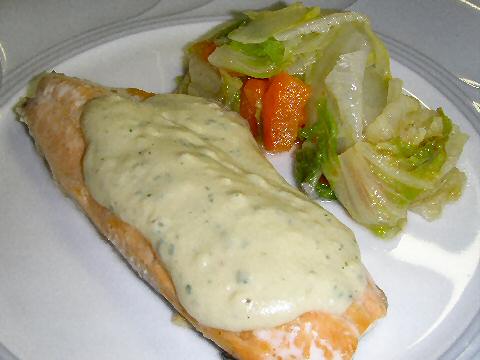
The main course underwent the biggest change. First, there were several requests for a substitution for the pork, enough that it just made more sense to change the dish completely. I was going to simply braise some salmon and serve it the same way – but then, I couldn’t find salmon roe, so that went out the window – but I did find hake roe. It didn’t sound like it would combine as well with the salmon to me, it needed a lighter fish of some sort, I went with albacore tuna, oven baked with a little olive oil, then topped with a simple sauce made from lightly browned butter, the roe, yellow onions, and white wine, and then strained at the last minute and kept warm. I served the fish with a scoop of polenta aside.
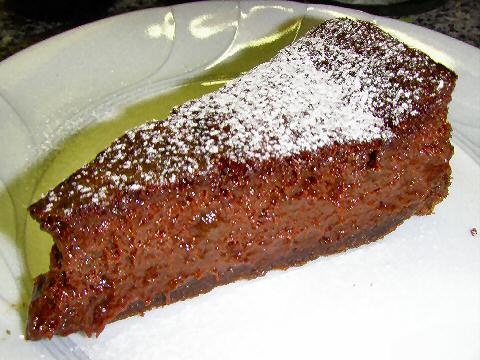
Finally, I turned the pudding into a pudding cake of sorts. I used the cocoa crust I’ve been experimenting with and talked about in numerous posts recently. For the filling, fresh rhubarb being unavailable, I used stewed, sweetened rhubarb that I can find from Patagonia (900 grams), mixed it with a bittersweet chocolate ganache (600 grams), mixed in four egg yolks and a teaspoon of powdered mace, and then whipped the six egg whites (two extra from making the crust) until stiff and folded them into the chocolate and rhubarb mixture. I baked this “cake” at about 350°F for roughly 50 minutes, until it was still wobbly in the center but relatively firmed up – I wanted a pudding-like texture, but not so soft that it would just collapse when cut into. A simple “yum” is all I can say about it…
Copyright © 2026 SaltShaker. This feed contains copyrighted photos and text from SaltShaker. If you are not reading this material in a feed aggregator or by e-mail subscription, the site you are viewing may be guilty of copyright infringement. Please contact [email protected] so that I can take appropriate action.
Plugin by Taragana
]]>There is an element of truth in every idea that lasts long enough to be called corny.”
– Irving Berlin, Composer
Buenos Aires – One of the things I get asked about most with Casa SaltShaker is “do dishes ever just turn out terrible?” or something similiar to that. After all, often, especially when I’m in the kitchen playing around with a cuisine I don’t know well, it’s total experimentation. To a certain extent that may be mitigated by using traditional recipes, but then there are those weekends of whimsical themes, like this last one, where we celebrated the 120th birthday of the famous composer Irving Berlin. I hadn’t stopped to think about it when picking the theme, sort of building on our past Carmen Miranda, Bette Davis, Anna Magnani birthday dinners, but they have recognizable personalities and something that could be played on for a dinner theme. Good old Irving was more of a behind the scenes guy, even if well known. It was his work, not his personality that shone through.
My first thought was to look through many of his lyrics and come up with a dinner theme from that, and indeed he mentions many thing in various songs… but it just didn’t feel like it was coming together. In the end, I decided to look back at the year of his birth, 1888, where I was able to find inspiration in the “new foods” that were introduced in the U.S. that year: tomatoes, grapefruits, Thomas’ English Muffins, Log Cabin syrup, canned pineapple, canned corned beef, Cream of Wheat, Fig Newtons, Coca Cola, Dr. Pepper, and Oysters Rockefeller. I didn’t use all of them, but picked out a few that led to ideas for a dinner, which was, overall successful, but at least from my perspective in the kitchen, left more room for improvement than what I’m happy with. So, away we go…
We started off dinner with a classic martini – gin and vermouth, though not that whisper of vermouth that these days passes for the cocktail – a properly made traditional martini, depending on who you ask, has somewhere between a 7:1 and 3:1 ratio of gin to vermouth, and mine fall somewhere in between. A twist of fresh lemon peel as a garnish, get everyone’s appetite whetted, and we were on to the first course. Oysters Rockefeller, a now classic dish from Antoine’s restaurant in New Orleans, is one of those secrets that has never been revealed. Lots of folk have come up with guesses as to what constitutes the classic, but they’re all just imitations of the original. Mine, perhaps even more so. Instead of oysters on the half-shell, which are, strangely, hard to find here (all the seafood markets seem to have this penchant for removing the oysters from their shells and packaging them in small bags, I went with oysters that were poached in their own liquid in the oven until just set, and then served with a puree, almost like a pesto, of roughly equal parts of watercress (not spinach!), celery leaves, tarragon and parsley, some green onions, a fresh chili, salt, pepper, butter, a splash of anise liqueur, and just enough cream to smooth it out. It wasn’t the bubbling, broiled version, but tasty in its own right. Still, the presentation lacks alot over the original.
On to a soup, inspired by Cream of Wheat, canned corned beef, and tomatoes (which were not really a new food stuff, but amazingly, were not introduced as a consumable fruit/vegetable until just 120 years ago in the States). The base of the soup was simply chopped onions and celery, and some finely diced pastrami (no corned beef available here) from a nearby butcher shop. I cooked those in a little bit of butter until soft, and then added in wheatberries (without the husk), cooked for a few more minutes, than topped it up with a couple of pureed tomatoes and enough water to fill the pot. I left that to cook over low heat until the wheat was cooked through and had absorbed most of the liquid – added a little more water to give it a soup-like consistency, seasoned it with salt and pepper, and that was that. Really quite good, and one of the two dishes that I thought were quite successful for the evening.
Next up, my least favorite dish. Based on one I’d made before where it was far more successful – my “oyster mushroom mcmuffins“, but this time, no oyster mushrooms available in the market. I decided on pine mushrooms, and rather than cooking them the same way, cooked them with chilies and molasses, as I’d done for our Pi dinner using a mix of mushrooms. Somehow, they just didn’t turn out right – they stayed very wet, and started to fall apart when cooked. Also, I couldn’t find my old recipe for homemade english muffins, and resorted at last minute to Alton Brown’s recipe that I pulled off the net. Those didn’t turn out right either – very dense. The sauce was fine, but as a whole, the dish was one of my least favorite dishes I think I’ve made for Casa S during our two year history…
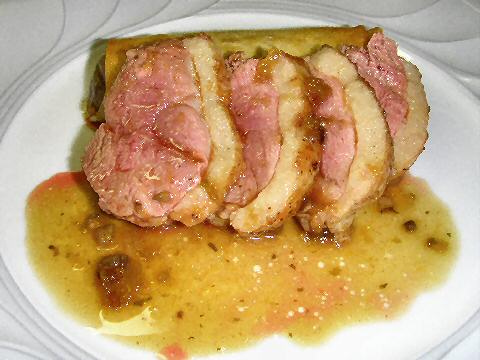
Thankfully, the main course made up for it – at least for me. I found a source of nice, plump duck breasts – really quite expensive, coming in at 64 pesos a kilo, each breast was huge, however, and ran at about 375 grams (13 ounces) – enough to make two portions. I pan seared them and then finished them in the oven to somewhere between rare and medium rare – truly the perfect temperature for good quality duck breast – and all but two of our guests went with that, it was easy enough to quickly cook the other two’s portions a bit more in a skillet. To go with them, and the inspiration for the dish, a reinterpreted Fig Newton – phyllo dough wraps filled with a cooked down mixture of preserved figs, onions, garlic, thyme, and red wine. For the sauce, some reduced chicken stock (duck would have been better, but I didn’t have any on hand, ya know?) infused with a bit of the same mixture and some fig coffee (a coffee substitute made from roasted and dried figs). Yum.
Finally, my normally quite successful cheesecake. This time flavored with pink grapefruit juice and a splash of campari and topped with a sweetened, reduced syrup from the liqueur Punt e Mes. Good, but not one of my best cheesecakes. Everyone seemed to enjoy it immensely, maybe I was just feeling a bit off with two courses that I already wasn’t happy with… hmmm…
Copyright © 2026 SaltShaker. This feed contains copyrighted photos and text from SaltShaker. If you are not reading this material in a feed aggregator or by e-mail subscription, the site you are viewing may be guilty of copyright infringement. Please contact [email protected] so that I can take appropriate action.
Plugin by Taragana
]]>“Songkran, the most vigorous of Thailand’s festivals, was the official Thai New Year until 1941. Formerly tied to the movement of the sun, modern Songkran takes place from 13-15th April. Songkran began as a ceremonial bathing of Buddha images as part of a new year’s spring cleaning ritual. However, it has degenerated over the years into a free-for-all water fight in which the streets are filled with revellers armed with water guns, jars and buckets.
– Richard Greaves, Festivals in Thailand
Buenos Aires – It was clearly time for our second annual Thai/Cambodian New Year’s festival dinner. First of all, the dates were right, and second of all, last year it was so popular that we had to add an extra dinner and nearly another. This year, the response wasn’t quite so vigorous, and, in fact, only a few locals came, the two evenings were almost entirely peopled by visitors to the city. Actually, I’ve been noticing that recently – perhaps we’ve become a “been there, done that” location for many who live here, it’s hard to tell – I keep hearing from people about how they’re going to come again, or come for the first time, I’ve got people here who I consider to be good friends who have yet to make an appearance at one of our evenings, despite repeated promises to do so (I’ve long ago stopped even bringing it up with them, it feels like a waste of my time and probably annoys them at some level). They’ll either get here or not, but I don’t quite get the continual promises to show up, especially when I’m not asking. Hey, you’re not interested, you’re not interested. We’ll keep having fun with the people who are. Now, back to Southeast Asia, and a dinner that I was quite pleased with. Far more unusual, I think, in terms of the dishes, than last year’s menu. Oh, and it was just coincidence, I think, that I’d just checked out one of the local Thai restaurants.
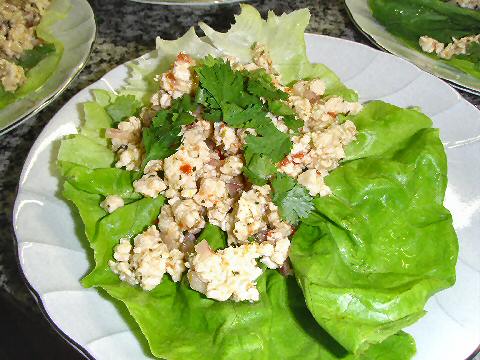
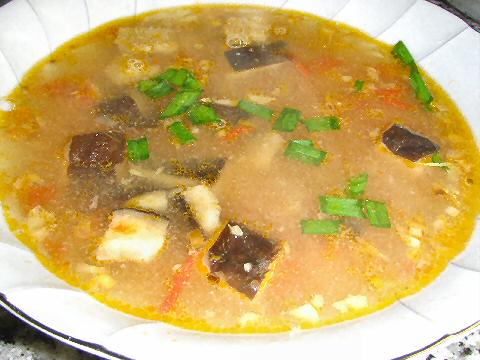
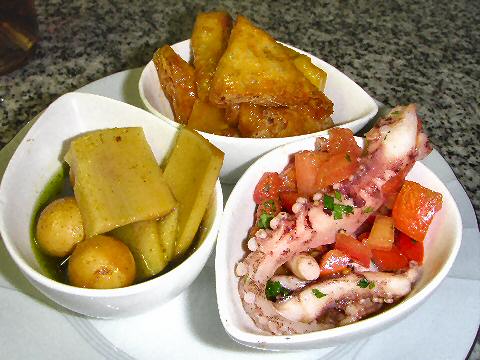
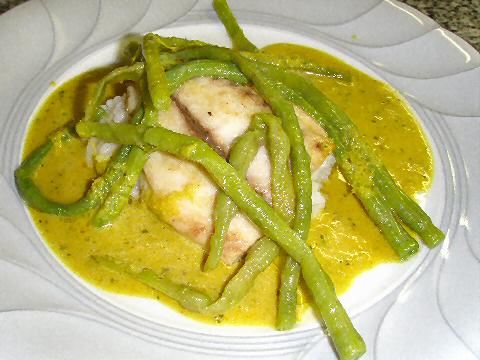
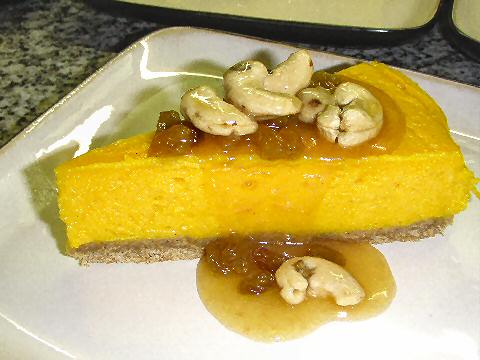
So, hmmm, next year, Songkran doesn’t fall on a weekend… I guess we won’t have a third annual feast…
Copyright © 2026 SaltShaker. This feed contains copyrighted photos and text from SaltShaker. If you are not reading this material in a feed aggregator or by e-mail subscription, the site you are viewing may be guilty of copyright infringement. Please contact [email protected] so that I can take appropriate action.
Plugin by Taragana
]]>The egg standing myth was born with an article penned by Annalee Jacoby in the March 19, 1945 issue of Life magazine. Ms. Jacoby was on assignment in China at that time, when she witnessed a peculiar Chinese ritual. In China, the first day of spring is called Li Chun, and they reckon it to be roughly six weeks before the vernal equinox. America is odd in that we say that Spring begins on the equinox, since a season is three months long. According to Chinese legend, it is easier to stand an egg upright on what they call the first day of spring (which, remember, is in early February for the Chinese). Ms. Jacoby was in the capital city of Chunking on Li Chun when a crowd of people came to balance eggs. It must have been quite a sight, and so she wrote about it for Life. Ms. Jacoby evidently reported that the event occurred on the first day of spring, but it was never said (or else it was conveniently forgotten) that the first day of spring in China is a month and half before the first day of spring as recognized by Americans! The legend now states that you can only stand an egg on end at the equinox. The biggest blooming of the legend happened on March 20, 1983, when Donna Henes, a self-proclaimed “artist and ritual-maker”, got a hundred people in New York City to publicly stand eggs up at the vernal equinox. This event was covered by the New Yorker magazine, and the article was published in the April 4, 1983 issue. At 11:39 p.m. (the exact time of the equinox), Ms. Henes stood an egg up and announced “Spring is here.” Even the New York Times was duped; a few years later, in an editorial on March 19, 1988, the headline “It’s Spring, Go Balance an Egg” appeared. Two days later, the Times ran a picture of people standing eggs up at the World Trade Center.”
– Lady Dairhein, April
Buenos Aires – We balanced no eggs (though some got quite evenly distributed within a cheesecake) on the equinox, which for us, here in the southern hemisphere, is the autumnal rather than vernal, i.e., the “official” start of fall, not spring. Known to the druids as Alban Elfed, it’s also called the Autumnal Equinox, Chumash, Cornucopia, Feast of Avalon, Festival of Dionysus, Harvest Home, Harvest Tide, Mabon, Night of the Hunter, Second Harvest Festival, Wine Harvest, Witch’s Thanksgiving; and the first day of autumn. For us, it was an excuse to showcase some fresh produce that has just come into the markets.
We started off the evenings with a Harvest Moon cocktail (we’ve started adding cocktails during that awkward milling about getting to know each other period at the beginning of the evening – we’re keeping them small, as we already know there are five glasses of wine coming up – little shots of something fun, an idea for which I thank Diego Felix), the cocktail a blend of tequila, orange and pineapple juices, triple sec, and a splash of grenadine. From there, we sat down to a little started of a roasted Williams pear – peeled, cored, cut in half, some slits cut along the fat end so the halves could be fanned out, then coated in butter and a little coarse salt, roasted in the oven, with a finish under the broiler to lightly brown them, and served with an arugula and walnut pesto.
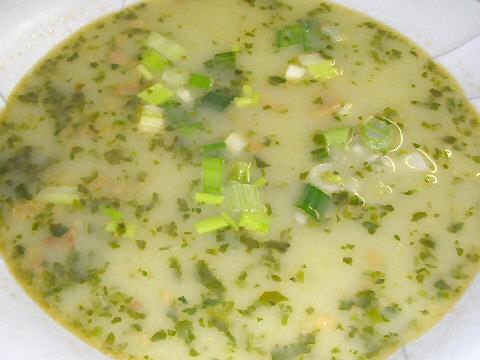
Next up, a dish that gave me a little trouble the first night – and I have to admit I wasn’t thrilled with the way it turned out – the flavors were all there, but the texture of the soup was… stringy. I’d made a nice batch of white chicken stock flavored with dill seed, and to that I’d added and cooked handfuls of fresh watercress and a good amount of smoked salmon. Then I’d pureed the whole thing, and to serve it, added a bunch of chopped green onion. Very simple, but the watercress just didn’t puree well – too much of the stems left in, and the salmon, while providing flavor, just disappeared – plus, the whole thing turned an odd shade of grey from the pinkish orange of the salmon blending with the green of the watercress. On the second night, I made a fresh batch of stock, and then off the heat dropped in a large quantity of watercress – leaves only, not a speck of stem. I then used the immersion blender to just cut the watercress into small bits. I hand chopped the smoked salmon fairly finely, and simply mixed it in. No additional cooking – just the heat of the stock more or less poaching the watercress and salmon. I also added a splash of cream at the end, just enough to give the broth a lighter, whiter color in contrast. It comes out much prettier, the texture is delightful, and the flavor is still there. Oh, and seasoned with white pepper and smoked salt.
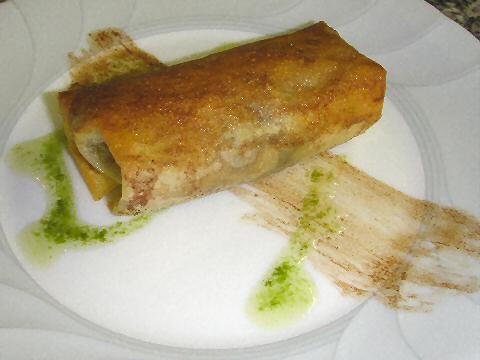
Don’t ask me where the idea for this came from. I was sitting there thinking about doing something with a whole bunch of fresh portobello mushrooms that had come into the market and got to thinking about flavors that go with them. Somehow or other, chocolate came to mind – and I started thinking about the Portobello and Aztec Chocolate soup I made way, way back at the beginning of Casa SaltShaker’s existence – and then the hit of the mushroom strudel that graced our Transnistrian dinner – you see where these things come together, right? Then it became a matter of thinking about various flavors, and looking over various recipes, and then, well, I ended up chopping and sauteeing the portobellos in butter and olive oil with some finely chopped dry rosemary and a handful of sunflower seeds, more for texture than anything else. When cooled, I wrapped them in phyllo dough that was brushed with… cocoa butter. Now, not the cocoa butter that you slather on your body when you want to brown up all beautiful like you’ve been on the grill, but a mix of melted butter, unsweetened cocoa powder, and salt. The wrapped packages went into the oven (a little more of the butter brushed atop), baked until golden brown, and then served atop a “paint stroke” of the cocoa butter and a squiggle of some basil oil (fresh basil pureed with a neutral oil, left to infuse, and then strained). Let’s just say that all that worked… really well.
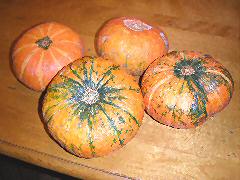 Not to give shortshrift to the rest of the dinner, but, I baked some fresh trout fillets in butter and served them up with a roast tomato and wine sauce, pretty much a dish I’ve done before – though the trout were not crusted with pumpkin seeds as they’d been the first time around, and the sauce was flavored with fresh tarragon which has just come into season – I threw that into the blender while the rest was pureeing. On the side, some beautiful fresh squash, or pumpkins… I’m not sure exactly, but when I told my vegetable guy I wanted to slice them and fry them up, he highly recommended these – so I peeled them, seeded them, sliced them into thin wedges, and sauteed them in butter and green onions, and served that alongside the trout. And, finally, we finished up with a delicious sweet potato cheesecake, though instead of topping it with whipped cream, I dusted it and the whole plate with a mix of cinnamon and sugar.
Copyright © 2026 SaltShaker. This feed contains copyrighted photos and text from SaltShaker. If you are not reading this material in a feed aggregator or by e-mail subscription, the site you are viewing may be guilty of copyright infringement. Please contact [email protected] so that I can take appropriate action.
Plugin by Taragana
]]>