“OPA’LIA, a Roman festival in honour of Opis,a which was celebrated on the 14th day before the Calends of January (Dec. 19th), being the third day of the Saturnalia, which was also originally celebrated on the same day, when only one day was devoted to the latter festival. It was believed that Opis was the wife of Saturnus, and for this reason the festivals were celebrated at the same time. The worshippers of Opis paid their vows sitting, and touched the earth on purpose, of which she was the goddess.”
– William Smith, D.C.L., LL.D., A Dictionary of Greek and Roman Antiquities, 1875
Buenos Aires – With the success of our series of Italian cooking classes, the cuisine has been on my mind much more lately, so it won’t come as any surprise that I’m trying out recipes here and there during our Casa S dinners. On to the food….
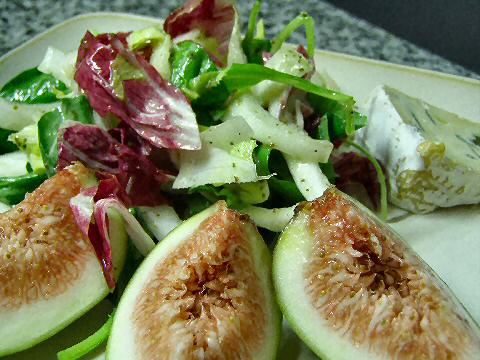
This is a minor change to past versions of an insalata romana, one of my favorite salads – with the tri-color (Italian flag) leaves of arugula, endive and radicchio, accompanied by fresh figs and blue cheese. The only change – I guess it’s the holiday season and a certain amount of missing “roots” – I’ve been experimenting with recipes for salad dressings – I grew up in a household where we always had salad with dinner, and usually an array of dressings (Kraft and Wishbone, of course) to choose from – one of my favorites was always Italian – this version a blend of cider vinegar, olive oil, water, garlic, onion, sugar, oregano, thyme, basil, parsley, celery seed, salt and black pepper.
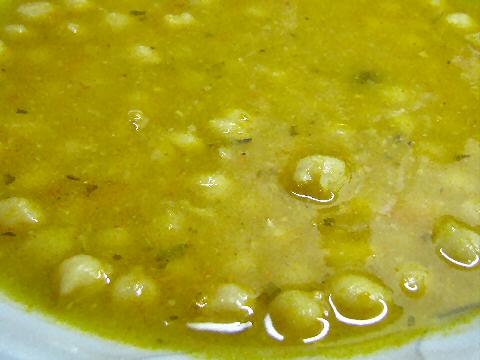
A simple soup in which I sauteed minced garlic, rosemary and oregano with crushed anchovies, then deglazed the pan with white wine and reduced it a bit, added tomatoes and water and let it simmer away. Meanwhile I had soaked chickpeas overnight and then cooked them separately until soft – adding them to the soup. The first night I pureed the whole soup, the second night I pureed it prior to adding the chickpeas and left them whole – I liked that better….
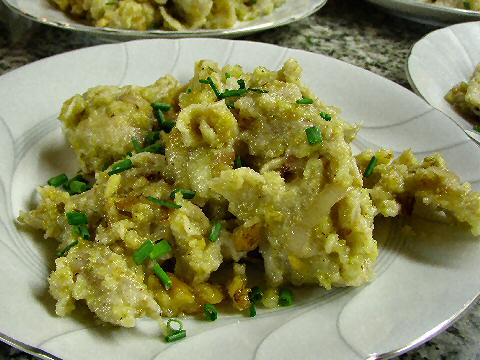
Again two versions – homemade whole wheat pasta both nights, something we’ve been playing with in the classes – the first night tagliatelli – thin ribbons, I thought they seemed a little too delicate for the sauce, which was sweetbreads coated in cornstarch and cornmeal and fried in olive oil along with lots of chopped shallots and walnuts. The second night I tried maltagliati – just random forms – it seemed too much the other direction, almost overshadowing the sweetbreads – something in between the next time….
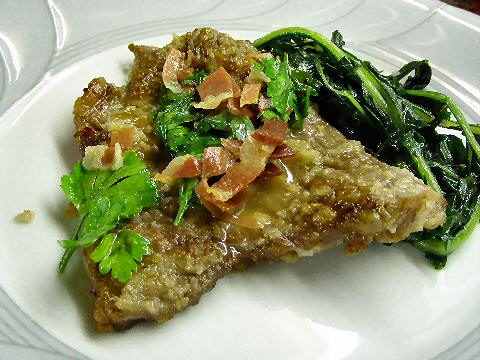
A simple veal piccatta – traditional style topped with lemon juice, parsley and prosciutto. Served up with garlic sauteed chicory – some people liked the chicory and ate it all, others just pushed it around the plate. Oh, and on night two, two folk showed up who’d made their reservation the day before and assured me that they “ate everything, no restrictions” – apparently, mentioning that he was a vegetarian didn’t seem worth mentioning – hmmm… didn’t mention the anchovies in the soup – nothing I could do about it anyway, pasta without the sweetbreads, just the walnuts and shallots, he seemed to like that, the veal, not much I could do at that point, a little extra chicory – which he turned out not to like, and I had a few loose vegetables around – carrots, onions, peppers, which I sauteed up quickly and tossed atop the chicory. I don’t get it – if someone has a dietary restriction that’s that… restrictive, why not mention it? Sure, I might have said no, but, probably not, I usually try to accommodate requests like that when I can – and he would have had a far better meal.
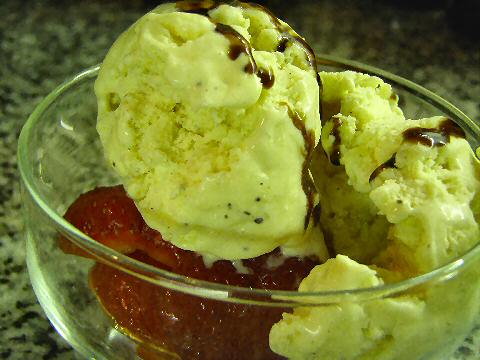
This was a hit – a traditional Roman dessert of gelato made from risotto rice – the rice is cooked in cream, cinnamon and sugar until al dente, then mixed with creme anglais, chilled, and then churned in an ice cream maker – it’s kind of like a frozen rice pudding, only richer. I scooped it over strawberries that had been macerating in berry liqueur and then drizzled a little balsamic caramel over the top.
Copyright © 2026 SaltShaker. This feed contains copyrighted photos and text from SaltShaker. If you are not reading this material in a feed aggregator or by e-mail subscription, the site you are viewing may be guilty of copyright infringement. Please contact [email protected] so that I can take appropriate action.
Plugin by Taragana




 ]]>
]]>“First things first, but not necessarily in that order.”
– Doctor Who
Buenos Aires – There was much speculation, much buzz, much questioning… just exactly what were we going to do at Casa SaltShaker to celebrate 45 years since the pilot of Doctor Who aired – celebrating the longest running science fiction show on television – a show that every sci-fi technogeek nerd has watched untold episodes of – except me. It was very odd. I got all excited about the idea as a theme – it’s one of those wacky ones that basically make no constraints on what I do in the kitchen, they’re more of an excuse to simply play around with pots and pans (okay, a faint hint of English thrown in to this one, but very faint) – and then I realized, here I consider myself a sci-fi type of guy – it’s what I read for enjoyment most of the time (I’ve had a running subscription to Asimov’s Science Fiction magazine since its inception in 1977 – it’s one of only two magazines that I’ve kept my subscriptions to after moving to BA!), my preference in films and television, this particular one started up when I was five years old and has therefore been running consecutively with me most of my life, and… umm… err… I’ve never seen the show. I didn’t even know what it was about. Really. I think I’ve caught a few minutes of various episodes here and there, but no more than that. Crap. Now I have 45 years worth of episodes to start downloading and watching… not that I did that prior to this last weekend, but they’re now on my download list.
So, enough about all that – on to the food, right?
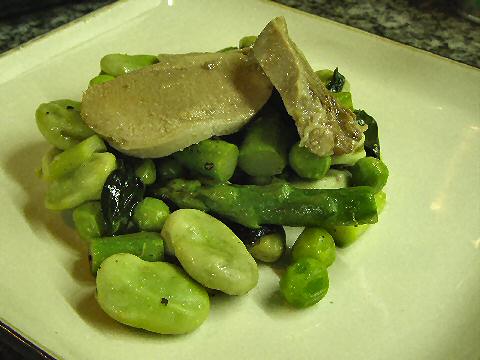
For the soup, I decided on a chowder. I’m not sure why. It’s really more of a cold weather soup, and it’s steamy hot here right now. But, I made a chowder, and to give it that slight britishism, it’s a curried chowder. The broth – in a pot, I simmered together: 1 pear, 1 onion, 3 cloves of garlic, 2 bay leaves, 4 sprigs of thyme, a teaspoon of curry powder and one of turmeric. When nice and flavorful I pureed it in the blender and then strained it. Meanwhile, I sauteed together: diced bacon, potatoes, carrots and celery, and finely chopped shallots, flavored with fresh thyme and bay leaves. When the vegetables were starting to soften, I poured a cup or so of white wine over the mixture and cooked it until the liquid was mostly absorbed or evaporated. Then I poured the broth over it all, brought it up to a simmer, cooked it until the vegetables were done. I added about a pound each of chopped mussels and clams, cooked for just a minute or two, and then finished the soup with about a cup of heavy cream. Really good, but really, much too heavy for this time of year.
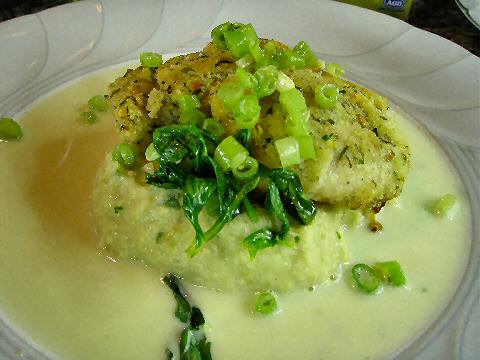
Next, I was thinking about the English dish cauliflower cheese – yeah, it’s about as appetizing most of the time as those boil-in-the-bag cauliflower and cheese sauce things I grew up with. Maybe less so. So I turned it inside-out. Remember those baked, puffed, golden agnolotti from our recent northern Basque dinner – I filled the agnolotti with cheese – mostly cheddar, with a little mozzarella and parmesan for balance – and then made a cauliflower cream to serve it with – a head of cauliflower cut up in florets, a large white onion, some coriander and sweet paprika, and cover the whole thing with milk, simmered until the cauliflower was soft, then pureed the whole thing – it becomes a medium-thick sauce. Season with salt and white pepper, ladle on the plate, place a couple of baked agnolotti atop, a few scattered chives…
Now, I’m off to watch eight zillion episodes of Doctor Who….. well, not really, I’m off to research a couple of articles coming up….
Copyright © 2026 SaltShaker. This feed contains copyrighted photos and text from SaltShaker. If you are not reading this material in a feed aggregator or by e-mail subscription, the site you are viewing may be guilty of copyright infringement. Please contact [email protected] so that I can take appropriate action.
Plugin by Taragana
]]>“The history of intellectual growth and discovery clearly demonstrates the need for unfettered freedom… the right to think the unthinkable… discuss the unmentionable, and challenge the unchallengeable…
To curtail free expression, strikes twice at intellectual freedom… for whoever deprives another of the right to state unpopular views… necessarily deprives others of the right to listen to those views.”
– C. Vann Woodward, Pulitzer Prize winning historian, of the American South
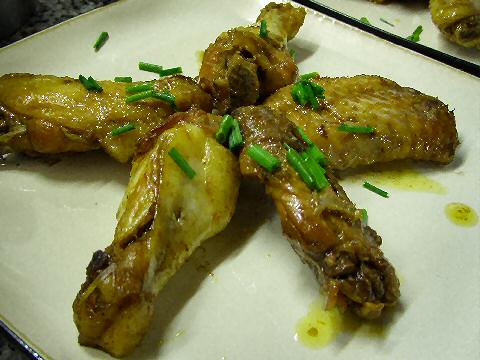
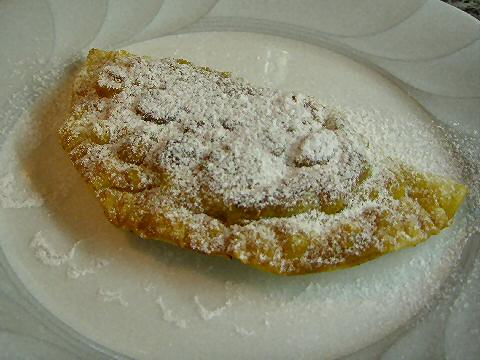
Buenos Aires – Joining the ranks of our centenarians is Comer Vann Woodward, one of the preeminent historians of the United States during the 20th century – with a specialization in race relations south of the Mason-Dixon Line. Woodward was born and raised in Arkansas, so that gave us a starting point for our Casa S dinner – it’s not one of the first states I think of when I start thinking about American regional cooking, but like the other 49 states, it has its unique quirks, flavors, and recipes. Game, fresh trout, tomatoes, watermelons, and fried pies all popped up time and again in researching ideas – it didn’t take long to come up with an Arkansas inspired menu – quite probably nothing that would be directly recognizable (other than the fried pie) at your average roadside cafe outside of Little Rock, but we didn’t hear any complaints…
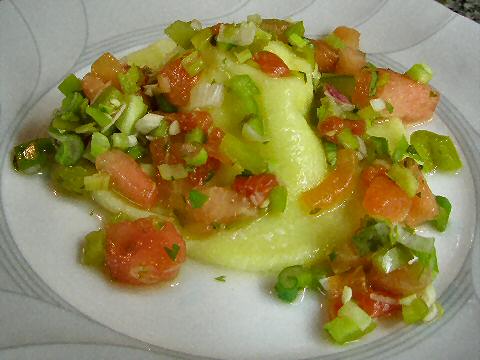
The second course, our soup, you’ve seen before – with Arkansas reputation for good tomatoes, I thought about the wonderful sun-dried tomato soup that I’d made a couple of months ago for our umami dinner.
The main course was a minor twist on the oven roasted trout that I’ve made before with the charred tomato sauce – the trout were skewered in a ring shape, then drizzled with olive oil and baked in the oven – no pumpkin seed crust. Underneath, some buttermilk mashed potatoes (I had the suero, or whey, from making the ravioli handy – I used most of it in the tomato soup, but kept a cup or so to flavor the potatoes, and then the sauce drizzled around.
Copyright © 2026 SaltShaker. This feed contains copyrighted photos and text from SaltShaker. If you are not reading this material in a feed aggregator or by e-mail subscription, the site you are viewing may be guilty of copyright infringement. Please contact [email protected] so that I can take appropriate action.
Plugin by Taragana
]]>“As Jupiter reached opposition earlier this week, it put on a spectacular show of cannibalism for anyone viewing with modest telescopes. Planetary specialists around the world have been watching with bated breath as a cataclysmic encounter between Jupiter’s Great Red Spot (GRS), Oval BA (Red, Jr.), and the newly discovered Little Red Spot (LRS) unfolded at the beginning of July. Though encounters such as this are relatively common on the gas giant, this event was greatly anticipated because the LRS was strong enough to dredge up material from deeper within Jupiter’s atmosphere, imbuing it with the same reddish color as the GRS and Oval BA.”
– Sean Walker, Sky and Telescope
Buenos Aires – It’s strange how different themes don’t necessarily interconnect in my mind sometimes. At least to me. Here I was, with the Epulum Jovis, the ancient Roman festival to the god Jupiter, on my mind, which led me to think about the infamous January Red Dinner (January 12, 1997) back in New York that, while not involving Jupiter directly, had simply used an image of that planet’s red spot as a background for the printed menu. So, I started thinking about a “red dinner” again, and it never occurred to me until around a day or so before the dinners that we’d just offered up a red dinner to celebrate the tenth anniversary of the Red Hat Society. Thankfully, there’s more than enough red food to go around. The menu, eleven and a half years ago, more or less, was:
1994 Domaines Ott Château de Selle Rosé
Tomato Water & Lobster Risotto with Red Currants & Pistachios
N.V. Champagne de Venoge Princesse Rosé
Red Cooked Red Snapper, Jicama, Bamboo Shoots & Oyster Mushrooms
1993 Domaine Vacheron Sancerre Rouge
Braised Oxtail, Grilled Radicchio and Pickled Red Grapes
1975 Mastroberardino Lacryma Christi del Vesuvio Rosso
St. Andre & Cheshire Cheeses
1961 Château Citran Haut-Médoc
Sweet Tomato & Black Walnut Tart
1976 Parcé & Fils Banyuls “Domaine du Mas Blanc”
Keeping in mind that this was a different era in my life, those dinners were shared with a select group of close friends, once a month (and I was earning a near six-figure salary), the original menu could, at best, serve as an inspiration for a Casa SaltShaker dinner (lobster here, after all, only available flown in frozen and at the mere price of 400 pesos a kilo, or $182 per pound… and the wines… well, as I said, it was a different era, not to mention country). So, on with the show…
Now, the guests at Casa SaltShaker had one clear advantage over those who attended the Epulum Jovis. They got to eat. In the ancient festival, it is said, the rest of the gods were formally invited to a banquet, where they lay about on soft pillows carefully placed near to the table, which was set with a sumptuous feast. However, being gods, they did not ingest food, so they had servants who sat down and ate on their behalf. While a nice little nap on comfy pillows sounds delightful… lucky servants, no?
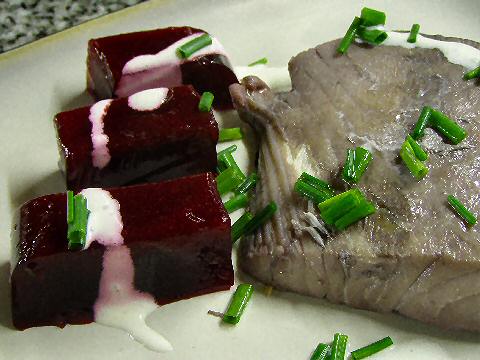
Red snapper, out of season. Red mullet, wasn’t looking so good in the fish stores. But hey, the fish is being poached in a red wine court bouillon regardless – I decided on palometa, one of my favorite local fish. Poached, chilled, and served up with a beet and wasabi gelee (now that I’m getting the hang of gelees, you might have noticed I’m having fun using them), which by itself would have made a delicious little starter – peeled and coarsely chopped beets simmered in water with a little salt, pepper, and wasabi powder, strained, gelatin added, poured into a sheet pan and chilled. A little semi-whipped cream with salt and pepper and some chopped chives completed the dish.
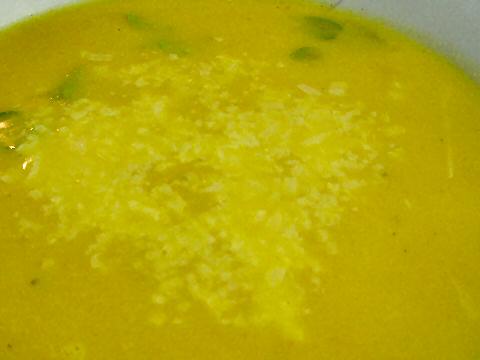
I decided to combine the prosciutto and red pepper into the soup rather than serve the former as a separate bread. A solid soup base of onions, celery, carrots, plenty of chopped prosciutto, and a mix of smoked, sweet, and hot paprikas, sauteed until lightly golden, then topped off with water and brought to a simmer. Meanwhile, I blackened a bunch of red bell peppers over a flame, peeled and seeded them, and then added them to the soup. I let it all simmer for awhile and then pureed it with the hand blender. To serve, I mixed in oregano leaves and topped the soup with a little grated reggianito cheese.
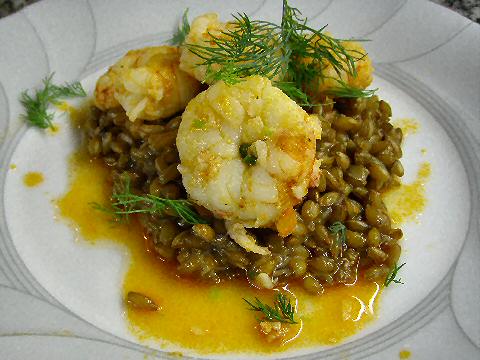
This was the most interesting dish for me, and, I think, for many of the guests. Starting from that lobster and tomato water risotto, I found myself thinking about a shrimp risotto. But then, not risotto, I wanted something… dark… like a brown rice risotto… no, wait, what about something like shrimp on rye toast… no, better, pumpernickel toast… but not toast, I was thinking about risotto… hey, what about “deconstructing” the pumpernickel…? I mean, my friends Aki and Alex having been playing with pumpernickel pastas… I think… This took a little experimenting to get right, I’ve never worked with rye grains before, I wasn’t even sure I could cook them up like a risotto (and, it turns out, you can’t really, unless you have hours to stand in front of the stove stirring – they need to soak overnight and then simmer in lots of water for a couple of hours to get plump and soft). So, soak them I did, in cold water, then into a pot I put lots of chopped shallots, just a pinch of salt, some pepper, plenty of caraway seeds, and a splash of oil and cooked until the shallots were soft and just starting to color. Then I added the drained rye grains, some cocoa powder and a dollop of molasses, topped it up with a good amount of water, brought it to a boil, and left it to simmer, covered, until the grains were getting soft, took the cover off, and continued cooking it until the water had evaporated. To serve, I reheated it and added in some whipped cream cheese with shrimp (one of those lovely flavored cream cheeses from the supermarket), and seasoned it with salt and freshly chopped dill. I sauteed up some prawns with chopped hot peppers, garlic, and dill seed, and, there you have it – shrimp on pumpernickel toast… deconstructed.
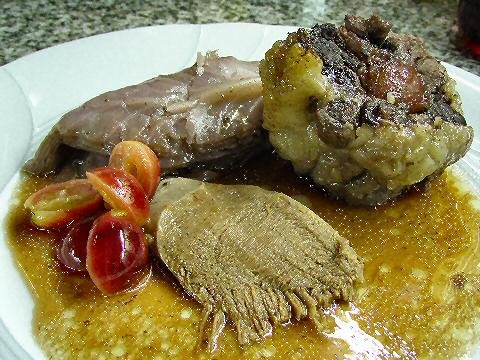
You might have noticed that I’ve been serving up a bit more of the offal, those cuts of meat that aren’t as popular, “variety meats” as I’ve seen them termed. I was thinking about that original oxtail dish with the radicchio, but the latter looked anemic in the market, so I picked red cabbage, but not grilled, I decided to braise them together… and hmm, we were so successful with the tongue a couple of weeks ago that why not add one in to the mix – in fact, I saw an interesting looking braised dish of oxtail and tongue in one or another of my cookbooks, though I went with my own recipe – layered into the stockpot – wedges of red cabbage, the tongue, and the oxtails. Dropped in a couple of bay leaves, some slices of ginger, a crushed head of garlic, a couple of onions, some peppercorns and juniper berries, and salt. Added a liter of red wine and then topped it up with water, brought it to a simmer and let it go for 5-6 hours. Then I removed the meats and cabbage and put them in a covered roasting pan to stay warm – brought back to hot in the oven when dinner rolled around. Meanwhile, strained and skimmed the braising liquid, and reduced it from its couple of liters down to a couple of cups to concentrate the flavors and make a nice “gravy”. Some pickled red grapes (same recipe as on the Red Hat dinner), and that’s dinner!
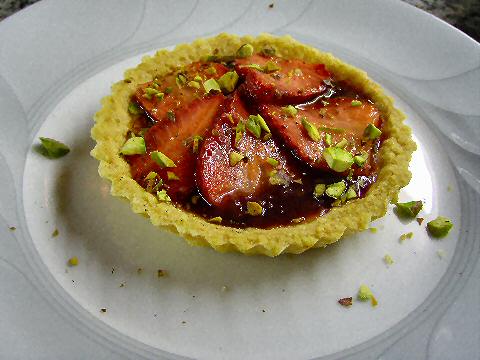
Tomatoes aren’t in season right now, at least not really sweet, ripe plum tomatoes like I’d used in the original dinner’s dessert. I thought about something like a cherry clafouti, as I’d been talking about one with a friend who’s now visiting for the week, but cherries, likewise, not in season. Strawberries have just come into the market – not overly sweet, but sliced and marinated in kirschwasser and sugar they come out brilliantly. The dough, a simple pate brisèe – 5 parts low gluten flour, 4 parts butter, 1 part sugar, pinch of salt, all mixed together to get a crumbly texture, and just enough water to get it to come together as a dough, lightly chilled, then molded into buttered tartlet forms, baked until golden, left to cool. Filled with mixed berry jam, topped with the sliced, marinated strawberries, and chopped, toasted pistachios. Done. All Hail Jupiter!
Copyright © 2026 SaltShaker. This feed contains copyrighted photos and text from SaltShaker. If you are not reading this material in a feed aggregator or by e-mail subscription, the site you are viewing may be guilty of copyright infringement. Please contact [email protected] so that I can take appropriate action.
Plugin by Taragana
]]>A CARTOON in The New Yorker many years ago depicted a disgruntled little girl confronted with a mysterious substance on her dinner plate. Though assured by her mother that it was broccoli, she remained unconvinced. ”I say it’s spinach,” she insisted, ”and I say the hell with it.”
– Marian Burros, NY Times, 12/22/82
Buenos Aires – It’s my own fault. I told you all many months ago that I wouldn’t fall for this again. Yes, it’s the evil vegetarians. They’ve struck one more time. A series of requests over the last month or so from local and soon to be visiting folk of the vegetable-based lifestyle to please, please, please hold another of our vegetarian dinners. Promises all around to reserve, attend, enjoy… I scheduled the weekend six weeks in advance, let them all know… and waited, and waited… and not one, once again, not one of those folk who’d pleaded, made a reservation. Top that off with the three parties of vegetarian folk (not amongst the requesters), seven people in total, who did reserve, who all cancelled their reservations within the last 48 hours before the dinners, and here’s the thing. We’re not planning any more vegetarian dinners. Period (okay, unless of course I just feel like planning one). I’ve gone through this routine half a dozen times in the last 2½ years. I will still continue to provide vegetarian options when it works for the menu planned for the evening, I’m happy to do that, we will continue to have vegetarian dishes as part of the menus, but I’m not going to arrange the dinners, the public ones anyway, around the same group of people who don’t show up, time and again.
So what we did do, was a last minute change of theme. The dozen folk remaining who were split between the two nights of the planned dinners had all told me that if we were to change away from a completely vegetable based menu, they certainly wouldn’t object. I recontacted them, made sure that they were all fine with a seafood based menu, and put together a menu around a trio of personal favorites that I’m working on “perfecting”.
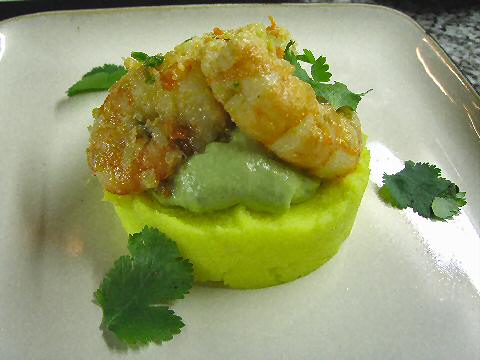
First up, our causa de langostinos is pretty much at the point where I want it. It’s not really a causa, it’s more just based on the idea. The base this time a mix of potato, zucchini, olive oil, lemon, and yellow pepper. The avocado layer of avocado, lime, cilantro, and banana. The shrimp sauteed in shallots and jalapeños. The latter two I think are at the point I like them – the jalapeños pair better with the banana guacamole than rocotos do. The base, I’m going to go back to the blend of potato, zucchini, milk, butter, lemon, and thyme. The olive oil, while great in a traditional causa, is too apparent in this version, and I like the addition of the zucchini and thyme for texture and flavor. Presentation-wise, I like the dish better with the guacamole atop the potato layer, but I also like the idea of something sandwiched in the potatoes, giving it some color. Maybe splitting the potatoes and half of them with yellow pepper and half with red…
Our soup was a vegetable one, with fresh, beautiful green beans in the market I couldn’t resist another stab at the Portuguese style green bean and mint soup from pretty much exactly a year ago.
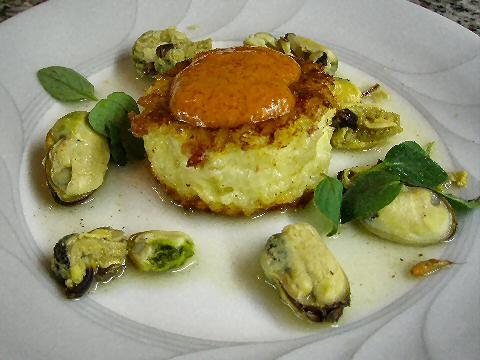
On to the hot appetizer, and one of my true favorite dishes that I’ve put together over the last few years – peppered mussels with risotto cakes, made from risotto alla salernitana. More mussels this time, and a smaller risotto cake – just playing with the balance, and also the mussels were significantly smaller than the ones I found on previous renditions of this dish. I added a bit of piquillo pepper puree atop, an addition that works nicely, and flavored the dish with oregano instead of thyme, which I think works a little better. Fresh marjoram would be great…!
Our main course, baked hake with two sauces – a green bell pepper and herb sauce and a fried garlic oil – the photo from the first time around on this dish does the plate more justice, and details of the recipe are on the linked post.
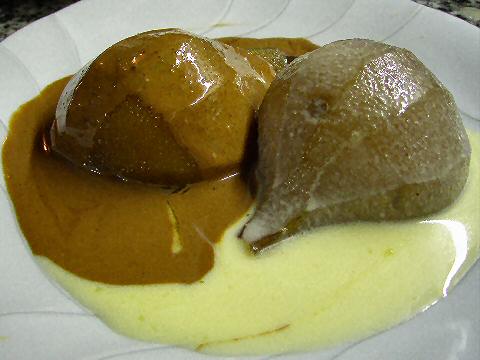
I noticed that fresh Bosc pears have just come into the market – perfect little hard pears for poaching. I peeled them, cored them, and poached them in water with molasses and whiskey until just softened, and then left them in the liquid, kept warm, for several hours to marinate. The warm sauces – white chocolate, cream, and milk infused with green tea and dried pineapple; and semi-sweet chocolate, cream, and milk infused with hibiscus flower tea. A little messy to serve, but the flavors are there…
Copyright © 2026 SaltShaker. This feed contains copyrighted photos and text from SaltShaker. If you are not reading this material in a feed aggregator or by e-mail subscription, the site you are viewing may be guilty of copyright infringement. Please contact [email protected] so that I can take appropriate action.
Plugin by Taragana
]]>“The absolute neutrality of Switzerland as a political principle is generally dated from the year 1674, when the Federal Diet declared that the Confederation, as a body, would regard itself as a neutral state and intervene on neither side in the war which had just broken out.
Edgar Bonjour, Swiss Neutrality, Its History and Meaning
Buenos Aires – Like the multi-function knife that the country is famous for, the cuisine of Switzerland is noted for it’s varied influences. Sandwiched in a mountainous region where it is bordered by Germany, Italy, France, Austria, the local cuisine picks up techniques, elements, and ingredients from all of those, making for a mix of interesting dishes. Now, did we offer up a fondue? No. Not even a raclette, though I gave it serious thought. Instead, I tried to pick a variety of dishes from the different regional styles of Swiss cookery. Interestingly, the dinner, held on the weekend of Switzerland’s independence day, attracted three visitors from the country (separately); so I had to apologize for any changes I might make to their grandmothers’ recipes in advance.
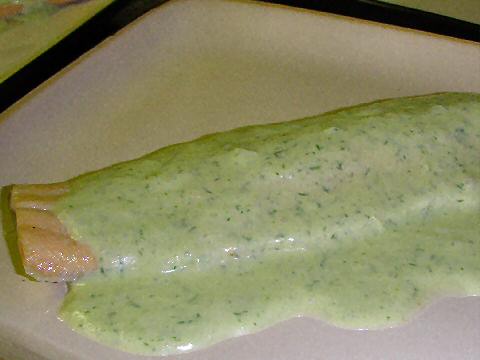
We started off with a truite au bleu, or chilled poached trout. I poached the fillets in a simple court bouillon – water, red wine vinegar, slices of lemon, carrot, celery, and onion, sea salt and black peppercorns. Then I chilled the fillets and topped with a simple fresh dill cream – sauteed shallots in butter until soft, deglazed with Torrontés (rather than Riesling), and then pureed that with cream and lots of fresh dill. Be careful at this point – the second night I ran the blender too long and the cream turned to butter – so we served the trout with a quenelle of dill butter atop.
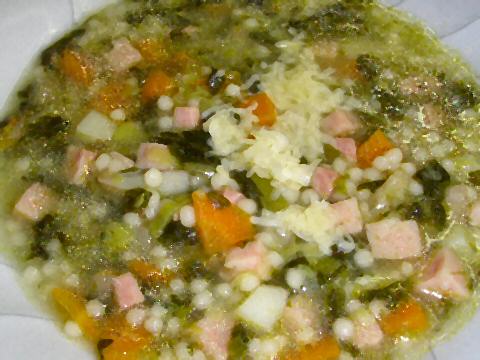
As usual, the soup was pretty much the hit of the evening (maybe we should just open a soup restaurant?). I found only a few references to a Chalet Soup, but what I found sounded delicious. The original recipes called for an herb and onion infused milk into which were later placed vegetables and ham. I decided to go for dairy-free, given that there was alot of cream and cheese in other parts of the meal. From there, it was roughly equal parts of diced ham, leeks, carrots, and onion all sauteed together until just starting to turn golden. I added diced red potatoes, skin on, and chopped spinach, topped it off with water, added freshly ground black pepper, and let it cook until the potatoes were done, then added just a small amount of small round pasta here called municiones, cooked until they just started to swell and let the whole thing sit off the heat for an hour or two to blend the flavors. Reheated for service, seasoned to taste, and a little grated gruyere on top of each serving.
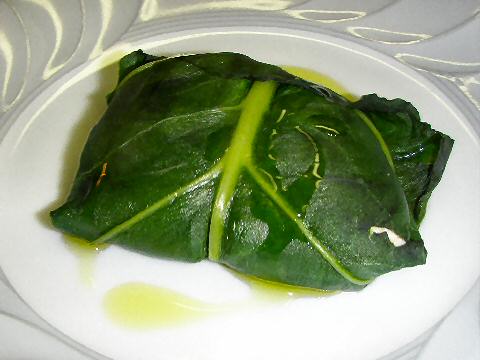
A simple dish, but really, really good… blanched and shocked swiss chard leaves, then wrapped them around a scoop of cream cheese (homemade of course) that I’d pureed with sauteed bacon and garlic. Then for service, baked the packets in the oven to turn the cream cheese molten, and drizzled the plate with green lemon oil.
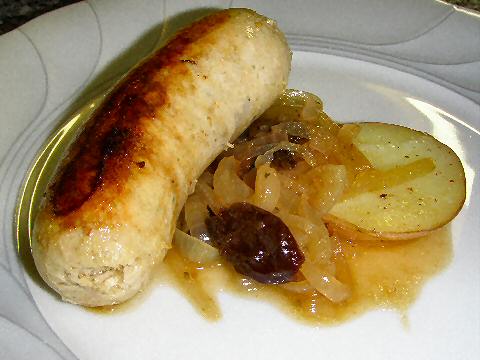
On to the main course, to which one of the Swiss visitors proclaimed “finally, a real Swiss dish” – he’s from the German influenced part of Switzerland. Boudin Blanc – a blend of chicken breasts and pork loin, in roughly equal proportions, medium grind, along with a pureed blend of cream that was heated and infused with white onions, orange peel, fresh thyme and parsley, powdered bay leaf, cardamom, salt and white pepper. Then I mixed in a bit of breadcrumbs to that and let them soak up some of the liquid. I mixed the whole mess together and added a couple of beaten eggs. Then I used the hand blender to really blend it together well (a food processor would work too, in batches, depending on how much you’re making). I stuffed the casings with the mixture, then poached them until just cooked through in salted water. Finally, for serving, browning them in a hot frying pan and then putting them in the oven to finish cooking through. I served them up with slices of roasted potato and an onion and prune compote – sliced onions cooked in butter and oil until lightly browned, then the prunes, black pepper, a splash of vinegar, and chicken stock added and let the whole thing cook until most of the liquid was evaporated.
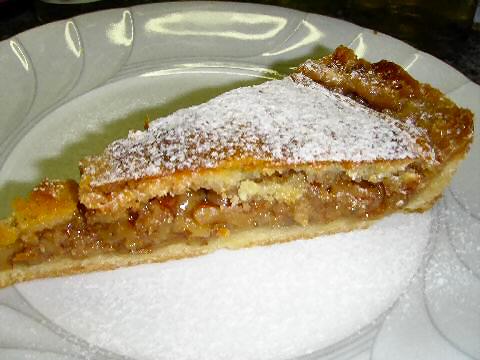
And, finally, I took a shot – not that I don’t often take shots, but in this case, I’ve actually never seen nor tasted this dessert – though certainly some similar ones. No credit for the recipe, I followed an online recipe for Engandiner Nusstorte to the letter and it turned out beautifully. My only touch was a little powdered sugar sifted over the top. Absolutely delicious, and I’m glad to add another dessert to my repertoire! Comments from the three Swiss folk – “this is exactly what engadiner nusstorte should be” and “I don’t usually like most engadiner nusstortes, but if they were all made like this I would – this might be the best one I’ve ever had.” Kudos to the recipe author!
Copyright © 2026 SaltShaker. This feed contains copyrighted photos and text from SaltShaker. If you are not reading this material in a feed aggregator or by e-mail subscription, the site you are viewing may be guilty of copyright infringement. Please contact [email protected] so that I can take appropriate action.
Plugin by Taragana
]]>