“Well, basically, there was this little dot, right? And the dot went bang and the bang expanded. Energy formed into matter, matter cooled, matter lived, the amoeba to fish, to fish to fowl, to fowl to frog, to frog to mammal, the mammal to monkey, to monkey to man, amo amas amat, quid pro quo, memento mori, ad infinitum, sprinkle on a little bit of grated cheese and leave under the grill till Doomsday.”
– Johnny (David Thewliss) in Naked
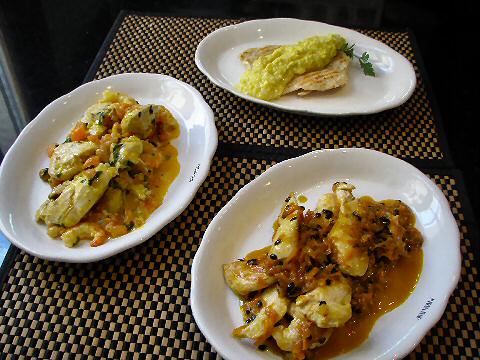
Buenos Aires – The week began with fowl – chicken in particular – the plan had been one chicken and one duck dish, but lack of good duck and one other key ingredient for the recipe that my Brazilian cooking professor wanted to teach me negated the latter. Instead, we talked about it and then prepared three different traditional styles of chicken – the originally planned xinxim de galinha, chicken stewed in cashew and tomato sauce; a pollo con molho de choclo, or grilled chicken breast in a creamed corn sauce; and pollo con maracujá, chicken in a passionfruit and carrot sauce. All delicious! I’m disappointed that this was the last of the four session course (I do recommend it for anyone local, and am happy to provide the info for contacting Eduardo – you’ll need to be fluent in either Spanish or Portuguese…).
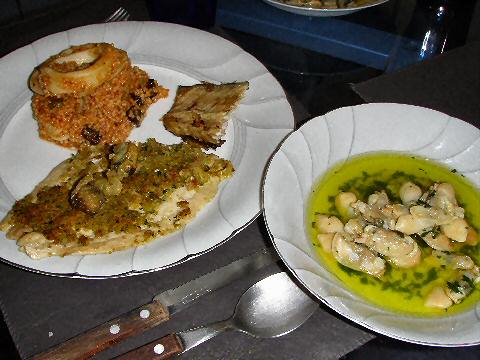
Here at Casa Saltshaker, group two worked their way through a quintet of contorni recipes – the braised endive, the peppers in bagna cauda, and the fried fennel from the previous week, plus a twist on eggplant parmesan using tiny little baby eggplant, and roasted porobello mushroom caps filled with pumpkin seeds and garlic. That was all yesterday. Today, group one launched their way into filleting fish and then making a trio of dishes – olive oil poached razor clams, Mario Batali’s “sicilian lifeguard” calamari, and my own breaded pomfret with a green olive, bacon, and chili topping. New photos, of course, on the flickr stream. Group three is waiting in the wings to start towards the end of the month after group one winds down, and meanwhile, I’m thinking through various ideas for the next series of classes… I’m happy to consider suggestions if you’re interested in a particular topic.
Copyright © 2026 SaltShaker. This feed contains copyrighted photos and text from SaltShaker. If you are not reading this material in a feed aggregator or by e-mail subscription, the site you are viewing may be guilty of copyright infringement. Please contact [email protected] so that I can take appropriate action.
Plugin by Taragana




 ]]>
]]>“Rice is a beautiful food. It is beautiful when it grows, precision rows of sparkling green stalks shooting up to reach the hot summer sun. It is beautiful when harvested, autumn gold sheaves piled on diked, patchwork paddies. It is beautiful when, once threshed, it enters granary bins like a (flood) of tiny seed-pearls. It is beautiful when cooked by a practiced hand, pure white and sweetly fragrant.”
– Shizuo Tsuji, Chef and cookbook author
Buenos Aires – Moving swiftly along with our class schedule, this week our first group simmered their way through a trio of grains – we looked at the different types of risotto, polenta, and farro, and had our way with a Saffron-Asparagus Risotto flavored with Gremolatta, a slow cooked Polenta with Cremini mushrooms and homemade Italian sausage, and a bubbling pot of Wheatberries with a Quartet of Spring Vegetables. Thus ends our carbo loading – next week on to vegetable side dishes.
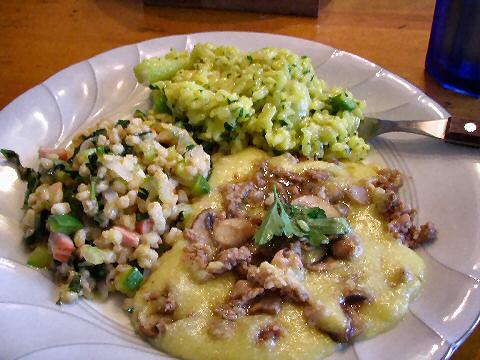
More detailed pictures on our Flickr page.
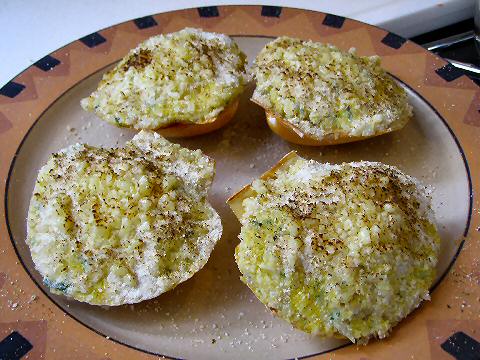
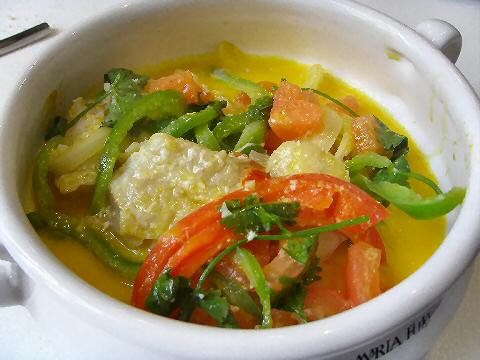
On my side, I swam my way through a duo of Brazilian classic fish dishes – casquinha de siri and moqueca de peixe, both delicious – Henry insisted on more moqueca after sampling, so I whipped up a version using calamari that evening, simply because I had some….
Copyright © 2026 SaltShaker. This feed contains copyrighted photos and text from SaltShaker. If you are not reading this material in a feed aggregator or by e-mail subscription, the site you are viewing may be guilty of copyright infringement. Please contact [email protected] so that I can take appropriate action.
Plugin by Taragana
]]>“…a man that can’t quickly throw together a meal is always going to be dependent on someone else to feed him, be that his wife, girlfriend, or McDonald’s. Dependency is not an admirable trait in a man. You don’t want to be the guy that has to turn to frozen pizzas just because your finer half decided to have Cosmos with the ladies.”
– Scott Kustes, guest blogger on The Art of Manliness
Buenos Aires – I know I don’t really have to convince anyone reading this blog that it’s worth learning how to cook something… well. Or maybe I do. I know I don’t need any convincing, and as long time readers know, I’m always up for learning and/or teaching something new.
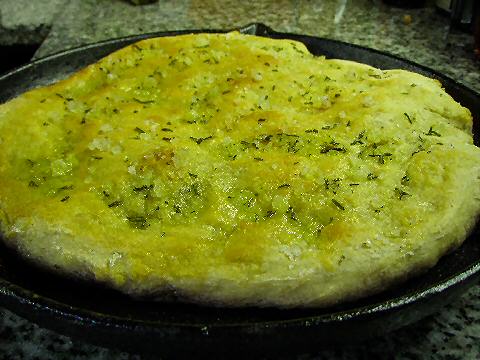
The first session of class number three in our Color Palate of Italy program came off without a hitch – well, only one person showed up for the class, but hey, we had a good time! The class session was on pizza and related dishes – we made a grilled pizza topped with radiccheta and parmigiano, a traditional style Sicilian pizza with pecorino and anchovies, a rosemary and sea salt topped foccacia, and a piadina filled with sauteed vegetables drizzled with a tomato vinaigrette. More photos here.
Now, you know I’m not standing around doing nothing in between classes. I made arrangements with a local Brazilian chef to spend some time with him in his home kitchen, learning a few of the secrets of Brazilian cuisine. While I’m not going to reveal any of his recipes, as he plans to be offering public classes in the near future (more details when they’re available), I’m happy to share a few photos of what we made.
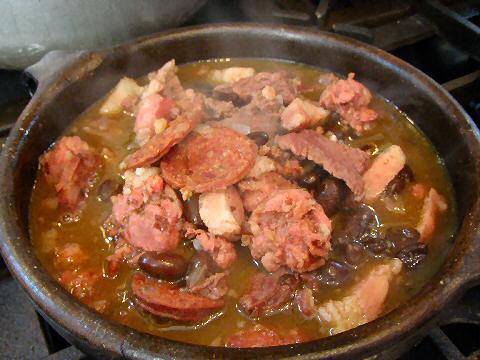
We started off with a couple of bean based dishes, beans being quite important in Brazilian cooking. First up, a feijoada, the national dish of Brazil. You might remember my first attempt at the dish – let’s just say that while I may have been in the ballpark, it’s likely I was in the back of the bleachers….
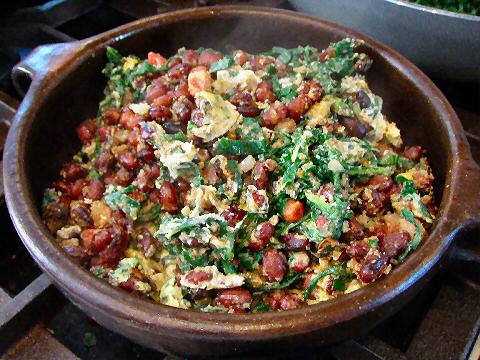
Henry and I had tried this dish at a Brazilian restaurant here that’s now closed, feijao de tropeira, sort of a bean and greens scramble, accompanied if you like by a fried banana. While I noted that I wasn’t wowed by the dish when we had it, I loved this one, and it’s oh, so simple… really.
On to other classes – I had a request for a “basics of local cooking” class – a one session look at empanadas, locro, and chimichurri – what could be better than all that? I’ve currently got one class scheduled with spaces available (as of posting this anyway), but am open to repeating it on another day and time.
Copyright © 2026 SaltShaker. This feed contains copyrighted photos and text from SaltShaker. If you are not reading this material in a feed aggregator or by e-mail subscription, the site you are viewing may be guilty of copyright infringement. Please contact [email protected] so that I can take appropriate action.
Plugin by Taragana
]]>I speak: Portuguese, German, French, English, Spanish, Italian, Esperanto, some Russian; I read: Swedish, Dutch, Latin and Greek (but with the dictionary right next to me); I understand some German dialects; I studied the grammar of: Hungarian, Arabic, Sanskrit, Lithuanian, Polish, Tupi, Hebrew, Japanese, Czech, Finnish, Danish; I dabbled in others. But all at a very basic level. And I think that studying the spirit and the mechanism of other languages helps a great deal in the deeper understanding of the national language [of Brazil]. In general, however, I studied for pleasure, desire, distraction.”
– João Guimarães Rosa, Novelist
Buenos Aires – Okay, the man was literate. In more than one language. He is also considered, by many, if not most of those in a position to say such things to have been Brazil’s greatest 20th century novelist. How could we not celebrate his 100th birthday here at Casa SaltShaker? And, so we did – with a tribute to the cuisine of his home region of Minas Gerais, Brazil.
It turned out to be an odd, and strangely not well attended weekend. We’d planned a Thursday and Friday evening, having planned the Thursday around a visiting acquaintance from the States who had to leave on Friday, plus a private dinner planned for Saturday that later got changed to Monday. We had nine reservations for each night, not uncommon up until the last minute, we almost always get calls from locals or hotels the last day or so – Wednesday afternoon, two people cancelled for Thursday, and I awoke that morning to find another e-mail from a party of four cancelling as well, leaving us with only three people, my acquaintance and her two friends – leaving us to cancel on them. Friday, one person cancelled mid-day, but a young lady called in the afternoon and filled that spot. However, four locals, two women friends and a couple, separate reservations, simply never showed up for dinner after confirming (and never responded to phone messages or e-mail after the fact). So, five people sat down to dinner on Friday, and, I think, had a good time, even if it wasn’t quite the fiesta they expected. And, of course, on our end, it sucked financially, and after last weekend with two cancellations an hour before dinner and six no shows out of twenty-four reservations (virtually all porteños, and mostly women, interestingly – and something that several local friends told me was likely to start happening now that we’re getting more local press and seeing more local customers – okay, you told me so), let’s just say the piggy bank isn’t looking happy.
We started out with a simple Salada de Chuchu, or Chayote Salad, the vegetable (or is it a fruit?) peeled, sliced, simmered in salted water until just starting to soften and then chilled and dressed with a vinaigrette made with white wine vinegar, extra virgin olive oil, garlic, onion, parsley, salt and pepper. The spices really highlight the sweetness of the chayote and it was a very refreshing salad. From there, we moved on to a Caldo de Peixe, a fish soup in coconut broth – the broth made by simmering together coconut milk, celery, yucca root, ginger, oregano, mint and bay leaf for about 40 minutes, then pureeing it, straining it through a fine sieve, and then adding diced fennel and tomatoes, minced hot peppers, and some diced fish (I used boga, a very flavorful local river fish). Seasoned it at the end with salt and some chopped mint and oregano.
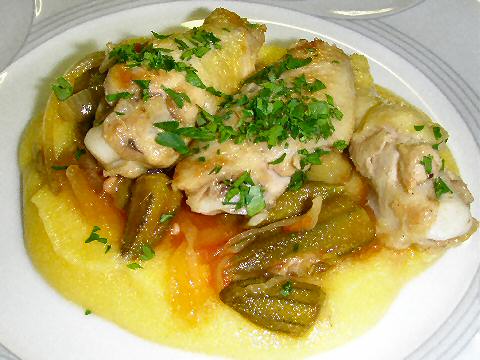
This was my favorite dish, Frango com Quiabo e Angu, generally translated as “Chicken with Okra and Mush”, the latter, however, being soft polenta. I saw a variety of versions, using everything from whole chicken breasts to thighs, to chicken feet. I decided to go with wing sections, which I marinated in lime juice, salt and black pepper for a couple of hours, then sauteed them over high heat in a mix of peanut oil and butter. The polenta was just simply prepared, and finished with butter and salt. The vegetables were a mix of okra (no fresh available at this time of year, but the Middle Eastern markets carry okra that’s preserved in brine, so I soaked them in fresh water for a little while, and was careful about how much salt I added at the end), along with crushed plum tomatoes, and thinly sliced onion all simmered together in a little bit of chicken stock, and a little parsley to garnish the dish.
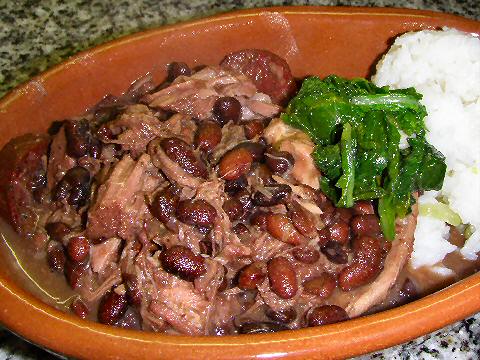
This dish generated a bit of both pre and post dinner controversy. I received, amazingly enough, half a dozen recipes from various readers of SaltShaker, all offering me their advice on how Feijoada, arguably Brazil’s national dish, should be properly made. Not one of them agreed with the other, and online and cookbook research merely extended the disagreement, as has my past experience eating the dish, not one version of which has been the same as another. In the end, I settled on a simple stew of mixed meats and black beans (despite admonitions to use either white or brown or red beans), the latter soaked in water overnight, then in a big stockpot I cooked up some diced bacon, beef rib roast, spare-ribs, and cured chorizos with onions and celery, until the meat was lightly browned. The I added the beans and a bouquet garni along with water to cover, brought it all to a boil and then turned the heat down low and let it simmer for about six hours – which generated the post-dinner controversy, well, really just from Henry, who insists that in his experience of feijoada, the meat should not be falling apart tender, and that also I should have had about 2:1 beans to meat rather than the other way around (on that, he’s probably right for the traditional dish, but then, he’s from a rice and beans kind of place where meat is the accent, I’m from the reverse). I served the stew up with white rice flavored with mild peppers, some sauteed turnip greens with garlic, and a side of hot sauce made with coarsely blended rocoto peppers, red onion, garlic, lemon juice and salt.
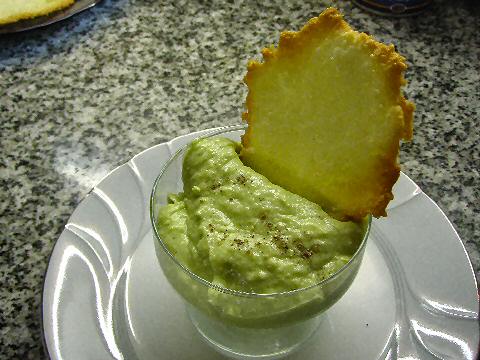
I was intrigued by this classic dessert, just because it’s so out of the ordinary. Crema de Abacate, or Avocado Cream – turns out its really, really good! I mashed together six ripe avocados, the juice of half a dozen limes, and a half cup each of confectioner’s sugar, shredded coconut, and cream. I decided it wasn’t smooth enough so I used the hand-blender on it to get it nice and smooth. I also decided it needed something to go with it, and a coconut tuile cookie sounded just about right – and, amazingly enough, the infamous Gordon Ramsey has a great recipe for coconut tuiles that fit just what I was looking for – 50 grams butter, 85 grams finely ground coconut, 85 grams confectioner’s sugar, 25 grams flour, and 2 egg whites, all mixed together, spread thin on a silpat and baked until golden brown on the edges. A later thought would have been to make them larger and turn them into a little cup to fill with the avocado cream. Oh, and just for a bit of “garnish” I dusted the top of each dish with a pinch of ground cardamom.
Copyright © 2026 SaltShaker. This feed contains copyrighted photos and text from SaltShaker. If you are not reading this material in a feed aggregator or by e-mail subscription, the site you are viewing may be guilty of copyright infringement. Please contact [email protected] so that I can take appropriate action.
Plugin by Taragana
]]>“It takes an endless amount of history to make even a little tradition.”
– Henry James, Writer
Buenos Aires – The other night, Henry and I were in the mood for something a little different, and decided to check out another of the Brasilian spots on my list, having crossed one spot off the list already. So, off we trotted… well, if the cab had had a horse in front of it rather than a taxista, I suppose we’d have been trotting, to the far reaches of Palermo. Now, we’d called first, to make a reservation, and the man on the phone, while friendly, made a grand (verbal) show of “trying to fit us in”. We got there at about 9:30, and there was one other couple in the room, who were just finishing their coffee. During the time we were there, over about two hours, another couple, and a party of three came in. Maybe the guy on the phone was just trying to decide if they really wanted to bother staying open. Strangely, the guy sitting behind the counter and answering the phone… well, not that it rang while we were there, looks just like the pictures of the chef of the place. He never got up to go in the kitchen. That said, we enjoyed, thoroughly, our dinner at Maria Fulô Resto, Cabrera 5065, 4831-0103 – and it’d be a real shame if this place closed up for lack of business. [As of mid-2008 this restaurant has closed. The chef, whom I took some Brazilian cooking classes with, has moved back to São Paolo.]
 I actually thought it might be fun to once again try out a couple of the same dishes I’d prepared in our Brasilian seafood dinner, as I did at the other place, but the dishes at Maria Fulô are, for the most part, different. I’m guessing that they’re simply from another part of the country. I only spotted one of the dishes I’d prepared, the Casquinha de Siri, and immediately selected that as my appetizer. A good sized portion of crabmeat, though, like the other spot, packed with a lot more breadcrumbs than crab, and, strangely, instead of being served up in a crab carapace, was served up broiled atop a scallop shell. I guess they’re more durable and reusable…
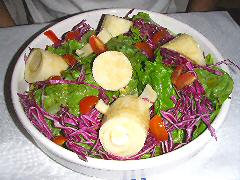 Henry opted for something a bit more basic, and feeling in the need for some green leafy stuff in his life, ordered the salada fresca do dia, which, while described, just from the name, as the fresh salad of the day, is actually laid out in detail on the menu, so probably doesn’t really reflect much daily change. It was huge – and I ended up helping him eat it, easily a main course size all by itself, with plenty of greens, tomatoes, red cabbage, and a whole lot of hearts of palm, which he’s not fond of, so I got to have them. Best part about it, a really good vinaigrette made from passionfruit juice, or concentrate, it didn’t specify, but they’re just starting to come into season, so I’m guessing the latter unless the chef found a source where he could get them early… but then again, as noted, it’s listed that way on the menu (which doesn’t look like something reprinted on a regular basis), so… do the math, as they say.
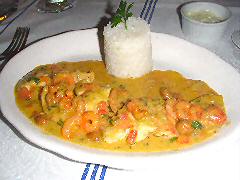 Since they didn’t have the vatapá that I was hoping to try, I ordered what appeared to be… the next best thing. Actually, the dish caught my eye immediately when I was reading the menu – just from the name – xinxim de galinha. How can you pass up something with two X’s in the title? It turned out to be a really delicious saute of chicken with a rich shrimp and cashew based sauce that I wouldn’t hesitate to order again. Not to mention, I see this one being tried out at home… Chicken and Shrimp, together, that’s my kind of food.
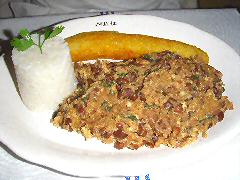 Henry’s was, at least for me, less successful. He enjoyed it, and it was what he was looking for – I think it sort of fits into the category of Latin American Comfort Food – much like mac and cheese might be for us, something with rice and beans as the core of the dish. Feijao de Tropeira is described on the menu, quite accurately, as red beans scrambled with chard, eggs, optional bacon (he ordered without), and taro root flour, accompanied by a breaded and fried banana and white rice. Yup, that’s pretty much what it was. For me, a bit bland and uninteresting. The bacon might have added an edge to it, but really, for me, what it needed was some sort of spice, or a hot sauce to go with it. I was actually surprised he didn’t order some hot sauce, as he usually likes stuff spicy as well, but he seemed to enjoy it as is, saying it reminded him of dishes his family used to make in Perú. A cultural “to each his own”.
We skipped dessert, neither of us having a speck of room for it, though things like the passionfruit mousse and the coconut flan with cherries stewed in red wine syrup sounded really good, if not overly traditional. The place is, perhaps, a touch pricey, though no more so than most restaurants out in that part of Palermo. The ambiance is casual and relaxed, service was attentive (though hard to say how it would have been had their been more people there), and the room is pretty. There’s also a small garden patio in the back for those who want to dine al fresco.
Copyright © 2026 SaltShaker. This feed contains copyrighted photos and text from SaltShaker. If you are not reading this material in a feed aggregator or by e-mail subscription, the site you are viewing may be guilty of copyright infringement. Please contact [email protected] so that I can take appropriate action.
Plugin by Taragana
]]>“The virtue of authenticity is that it doesn’t change in the course of time.”
– Eric Hauser, public relations
Buenos Aires – I’ve been meaning to check out the little Brazilian spot off the corner of Plaza Palermo Viejo for some time now. Our recent dinner featuring dishes inspired by Brazilian seafood recipes brought it to mind again – and off we went for lunch last week. Me leva Brasil, Costa Rica 4488, 4832-4290, is a charming little spot, with a few tables outside in nice weather, and a sort of thrown together homey ambiance inside. While friendly, the staff are remarkably inattentive, enough so that a gentleman who appeared to be the owner, more than once went to the bar where the waiter was hanging out and told him to take care of something on one table or another that he’d simply not paid any attention to – like taking an order, clearing plates… The menu is a relatively short affair, listing maybe half a dozen appetizers, a dozen main courses, and a few scattered items of local fare, like hamburgers or sandwiches. The bulk, however, is Brazilian food – mostly, I gather, from the Bahia area. It’s also in Portuguese, with passable translations into Spanish in small print below each item. [Closed in 2018]
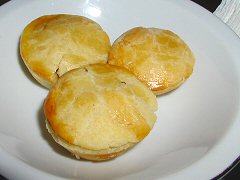 We started off with a plate of empanadinhas, or, I gather, after the fact, “small” empanadas – which they were… we selected the shrimp ones, the other offering being cheese – they’re more like a mini pie with a top crust – in this case filled with a little stew-like mixture that included small bits of shrimp. I must say, that while tasty, they were a little lacking in both inner substance as well as size… especially for eight pesos… when the three of them probably added up to the size of a typical Argentine empanada that would cost only around two. They definitely could have used more shrimp… and more… well, everything. Served up with a nice bottled hot sauce on the side, which I did enjoy.
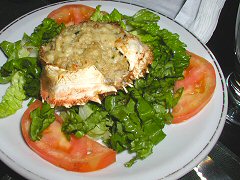 You may or may not remember (or have just looked at) my reinterpretation, sort of inside out, of the Casquinha de Siri, or as monikered at this spot, Caixinha de Siri. This, I’m sure, is far more authentic – on the other hand, one might note that the entire crab shell is about the same size as one of the tomato slices. Once again tasty, but once again disappointing in terms of quantity. I know crab is expensive here, but for twelve pesos this was really skimpy. Also, honestly, it was packed with more breadcrumbs than anything else, and took over half an hour to arrive (the empanadinhas arrived within a few minutes of our ordering). I’ll stick with my version, thank you very much.
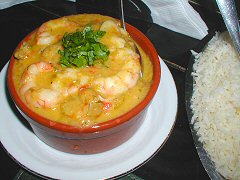 This was the dish I was most interested in tasting, a Vatapá. It’s the one I based the risotto on, and that our Brazilian guests told me “captured the flavors really well” – so I was truly curious – especially as it’s a dish I’d never actually tried before making it. Now, assuming that Me leva Brasil makes it relatively authentically, and it does look the way the dish was described in several of the recipes I looked at, it’s more of a stew of shrimp and fish – plenty of each in this case – I’ll give them that the main courses, in quantity, definitely outdo the appetizers. It seems, and I’m basing it on this one version, that the base is all pretty much the stuff that I used – and the flavor was quite similar, though I think they used more of the dende oil than I did – the flavor was much stronger, and so was the intensity of the color – along with the fish, which seems to be cooked down almost to a paste. Then the shrimp are tossed in with this – I’d guess, like I did, that they were cooked separately and then added at last minute. Really quite good, and although I loved my risotto version, this traditional stew is one I’d order again without question.
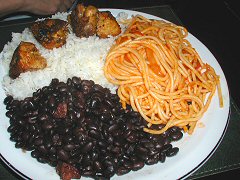 Okay, it’s fried chicken. It’s not fried chicken the way you or I probably think of fried chicken (given the majority of my readers), but it’s what it is. It’s not fried in a crust, it’s marinated and then fried until the chicken itself is a bit on the crispy end of things on the outside, and sort of tender and falling apart inside – it might be that they’re deep frying it, just without a breading. There wasn’t a huge amount of the chicken, but sufficient, and it was served with a mountain of carbs, as you can see – rice, spaghetti, and really good black beans. Make that excellent black beans. I’d order just a plate of the rice and beans as a side to anything else I try there in the future.
So, overall, generally good ratings on the food and ambiance, a bit iffy on the service, and, given the style of the place, a bit on the pricey side – lunch running us nearly 80 pesos. Still, it’s one of the few Brazilian spots in town when you’re in the mood for something different.
Copyright © 2026 SaltShaker. This feed contains copyrighted photos and text from SaltShaker. If you are not reading this material in a feed aggregator or by e-mail subscription, the site you are viewing may be guilty of copyright infringement. Please contact [email protected] so that I can take appropriate action.
Plugin by Taragana
]]>