“No matter how good the entree is, the entire dinner falls apart if the side dishes don’t add up.”
– Anne Braly, Chattanooga Times Free Press
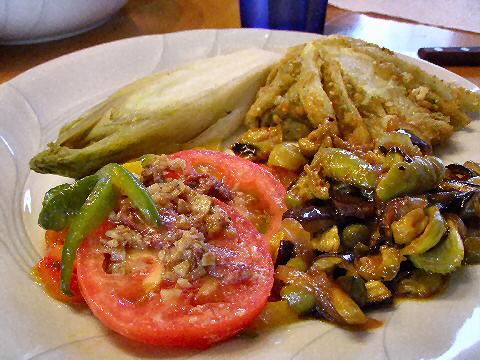
Buenos Aires – Just the roundup on this week’s classes – our Color Palate of Italy session 5 came off without a hitch and with a quartet of i contorni, or side dishes – deep fried fennel with a pistachio and pecorino breading, slow cooked endive with garlic and basil, roasted peppers bathed in a traditional anchovy and garlic bagna cauda, and the sweet and sour eggplant stylings of a classic Sicilian caponata. Full pix, as each week, on my Flickr page.
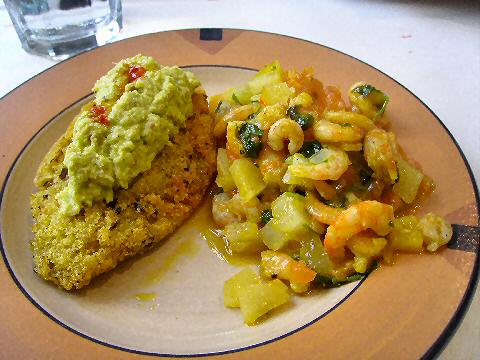
And, in my own studies, Brazilian cooking this week covered acarajé com vatapá and bobó de camarão.
Copyright © 2026 SaltShaker. This feed contains copyrighted photos and text from SaltShaker. If you are not reading this material in a feed aggregator or by e-mail subscription, the site you are viewing may be guilty of copyright infringement. Please contact [email protected] so that I can take appropriate action.
Plugin by Taragana




 ]]>
]]>“We shall reign with righteousness, for the benefits and happiness of the Siamese people.”
– Oath of Accession for the Thai king
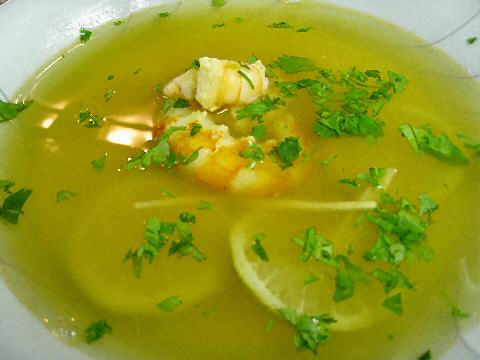
Buenos Aires – Look, he wasn’t feeling well, wasn’t even able to deliver his annual birthday address to the nation the night before his birthday festivities, so we didn’t count on him to show up for dinner. He would have been welcome. Bhumibol Adulyadej, better known as King Rama IX of Thailand, turned 81 this weekend. When it comes down to it, he’s more or less the guy who is the sequel to the well known “The King and I” – taking over when Yul Brunner’s real-life counterpart departed this globe. I decided on a seafood and vegetable dish dinner – I’d had several requests from visiting pescetarians and hey, I like seafood and vegetables too.
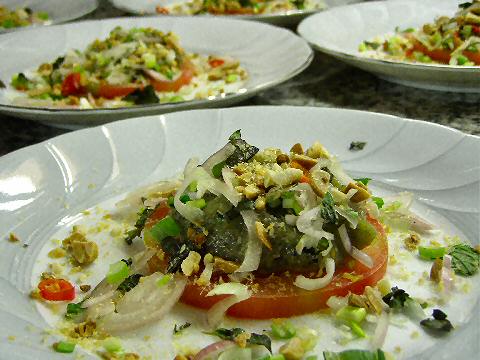
The next course, I played around with two dishes I’d done before for a previous Thai dinner – just two of the three middle dishes – the fried tofu sauteed up in oyster sauce and chili oil atop grilled pineapple – I stacked five squares of the tofu in a cute little tower, and then drizzled the tower with a reduced balsamic caramel. The squid dish I made with squid rings rather than tentacles, which was much better received – I also beefed up the spice a little with a mix of ground black and red peppers.
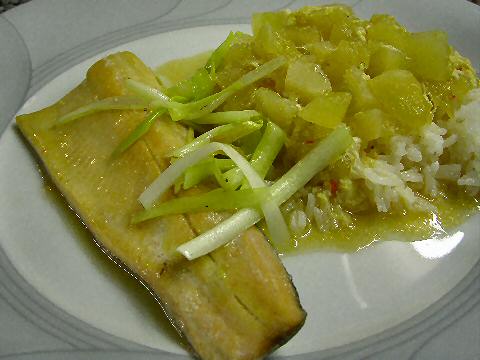
The dessert, from the same dinner as linked above, a butternut squash tart with a cashew caramel that worked out beautifully.
I have no idea what our distant friend Bhumibol was dining on, or if he was even up for a good dinner given his illness, but hopefully he would have appreciated ours had he joined us.
Copyright © 2026 SaltShaker. This feed contains copyrighted photos and text from SaltShaker. If you are not reading this material in a feed aggregator or by e-mail subscription, the site you are viewing may be guilty of copyright infringement. Please contact [email protected] so that I can take appropriate action.
Plugin by Taragana
]]>“Most turkeys taste better the day after, my mother’s tasted better the day before.”
– Rita Rudner, comedienne
Buenos Aires – Just to set your minds at ease, we did indeed celebrate Thanksgiving here. Not in Casa S, but we headed over to friends’ in San Telmo for a turkey dinner with the fixin’s. While there’s no domestic turkey raising going on here in Argentina, or at least not at a commercial level, there is in Brazil, and frozen turkeys are brought in by the truckload around this time of year for Thanksgiving, Christmas, and New Year’s holidays.
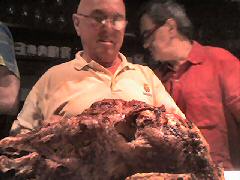
Our master carver, and host, contemplates the 8 kilo (nearly 18 pound) turkey….
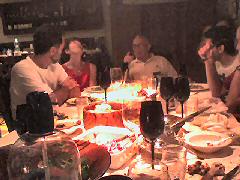
A table full of good friends….

And Henry, stuffed fuller than the turkey, after his first Thanksgiving feast.
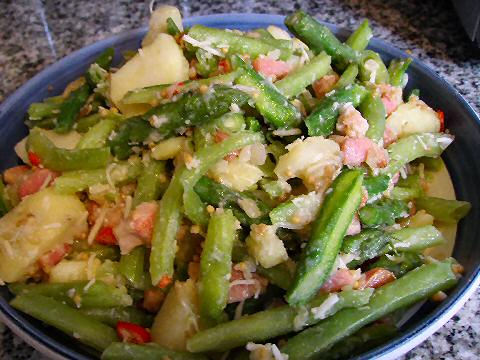
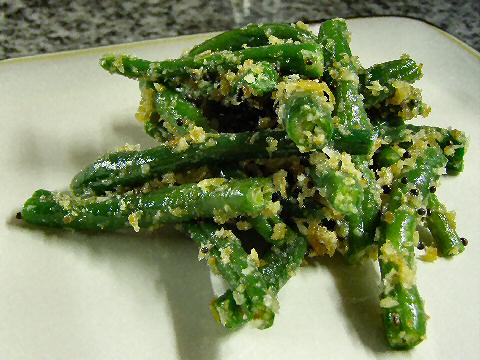
1 kilo green beans, topped and cut into segments
1 kilo asparagus, peeled and cut into segments
1 kilo potatoes, boiled, peeled, and cut in bite size pieces
Blanch the beans and asparagus until just softening, then drain and shock under cold water.
2 packets of peanut drink powder (this is the tough one, it’s a Thai drink mix that comes in a bag of little packets, it’s a mix of ground roasted peanuts and sugar – I find it in Chinatown – not that hard, you just have to make the trip…)
½ cup of shredded coconut
½ kilo smoked bacon, diced
4-5 shallots, sliced thin
¼ cup of yellow mustard seeds (black are fine too with this recipe)
4-5 jalapeños or other medium hot peppers, sliced thinly
½ cup neutral oil
salt
In a saute pan, start cooking the diced bacon over medium heat until it starts to brown. Add the oil and the mustard seeds and cook until they are popping away. Add the shallots and cook until limp. Add the rest of the ingredients and cook, stirring fairly steadily, until the coconut just starts to turn golden. Pour over the mixed vegetables, toss, let cool. Season with salt to taste.
Obviously, that makes a whole lot – you can cut the ingredient quantities down as need be. Bacon optional for those who want a vegetarian version, and adjust away on the hot peppers to make it either less or more spicy.
Copyright © 2026 SaltShaker. This feed contains copyrighted photos and text from SaltShaker. If you are not reading this material in a feed aggregator or by e-mail subscription, the site you are viewing may be guilty of copyright infringement. Please contact [email protected] so that I can take appropriate action.
Plugin by Taragana
]]>“In a country of more than 1 billion people, with 16 official languages and myriad ethnic influences, there is no singular “Indian” cuisine. Instead, hundreds of culinary styles co-exist, each shaped by a unique confluence of geography, history, climate and religion. Each of India’s 28 states and seven union territories has its own specialties. Many American diners are familiar with dishes like chicken tikka masala, lamb saag and tandoori shrimp–specialties that have become the lingua franca of Indian cooking in America. Those northern Indian foods dominate menus in the United States, leaving many customers uninformed about the rich regional variation in Indian cooking.”
– Erica Duecy, Western Indian Cuisine, Nation’s Restaurant News
Buenos Aires – There were so many possibilities for this past weekend’s dinner themes – Italian for Ferragosto, Chinese for the Olympics, Korean Liberation Day, VJ Day, Mother’s Day in Costa Rica, Indian Independence Day… it had been quite some time since we’d last offered up a “sub-continent” dinner, and I happen to like Indian food quite a bit, and besides, it was my friend Belli’s birthday, he’s Indian, and the owner of a local Indian restaurant. That was the one. But which Indian cuisine? We’d gone north before, with our Kashmiri dinner last October, and similar cuisine from neighboring Pakistan the previous March. I thought about splitting things up and offering one course from each of the five major regions of the country, but in the end, decided to focus on just one – but which? Leaving off the north, I randomly… more or less… picked the west, and from there decided on one dish each from five of the more interesting sounding cuisines of the area.
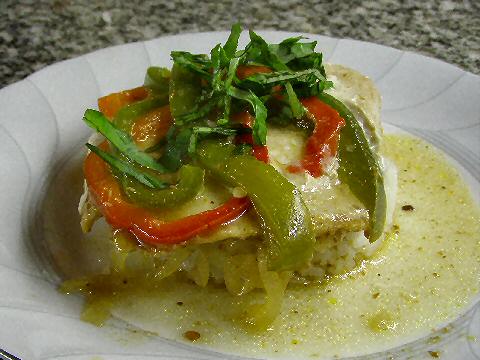
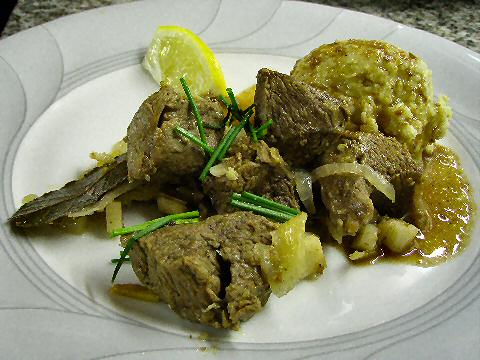
Next up, a dalitoy from the canon of Saraswati cooking. I was originally going to use yellow lentils, but couldn’t find anything but brown or red. I considered using yellow split peas, but then suddenly spotted packages of small yellow pulses labeled “green bean insides”. I assume these are the removed and dried seeds of green beans like those above, so I immediately had a bit of a sequential flow going, you know? Into the blender with several green and red chilies, some ginger, several cloves of garlic, a teaspoon of turmeric powder, enough oil to fry it all in, and just enough water to smooth the whole thing to a smooth paste – figuring it will evaporate right away, which it does. Into the soup pot with this paste, which within a minute or so begins to fry up beautifully, and turns a deep golden yellow color. I added a kilo of the bean seeds, topped the pot up with water, and cooked until they were done, stirring occasionally. Salt to taste, sprinkle with a good amount of chopped cilantro, and there you have a yummy green bean innards soup!
Many Indian desserts leave me asking “why?” It’s not that they’re not good, they’re just so different from my background that sometimes, especially texturally, they just don’t resonate. I’d decided on a coconut cardamom pudding, which I scooped into pre-baked phyllo tart shells and then topped with sliced bananas and pineapple, a drizzle of honey and a sprinkle of powdered sugar. I like the flavors, but the texture for me falls somewhere around that of a slightly softened gummi bear. Several people really liked it, others clearly weren’t as thrilled – I don’t think I’d make it again, though I might work on something that incorporated those flavors…
Copyright © 2026 SaltShaker. This feed contains copyrighted photos and text from SaltShaker. If you are not reading this material in a feed aggregator or by e-mail subscription, the site you are viewing may be guilty of copyright infringement. Please contact [email protected] so that I can take appropriate action.
Plugin by Taragana
]]>“Before the Spanish banned Inti Raymi in 1572, this winter solstice festival was the biggest event on the calendar of the Awantinsuyu Incan empire. It occurred at the time of the sun’s rebirth (around June 24th on our calendar) in Cuzco, Peru, the Inca capital. Native residents gathered to honour the Inca, the first-born son of the sun god. They fasted for days, then sacrificed llamas and feasted, imbibed chicha and chewed coca, asking the sun to return the following year and make the crops grow. When the Spanish banned the festival as a pagan and therefore Satanic ritual, it went underground.”
– G.A.P. Adventures
Buenos Aires – Last week being the annual celebration of the Andean New Year, Inti Raymi, the Festival of the Sun, or however one wants to put it, noting, of course, that on the calendar of “my people” we’ve got nearly 243 years over this one… just sayin’… we thought we’d celebrate with one of our ever-popular Peruvian dinners. We decided to focus on inspirations from the south of Peru and the communities around Cusco and Puno, where we spent a little time last year. We didn’t sacrifice any llamas, nor eat any guinea pigs, I haven’t quite talked Henry into making our own chicha, though I’m getting there, and although coca leaves were procured, he used them earlier in the day more as an incense or offering, presumably to keep us on good terms with the Sun god here in Casa S.
We started off with a dish called Capchi de Setas, an interesting amalgamation in name (capchi being in Quechua and setas being in Spanish), which sort of fits the traditional mash-up that is the dish. Essentially, it’s a scramble of crushed potatoes and mushrooms. I fancied it up slightly by making a tart shell and filling it with the mixture – which I made by sauteing sliced portobello mushrooms with garlic, onions, ají rojo, salt and cumin and then mixing that with pureed potatoes and some butter beans (favas are more traditional, but not in season right now). Instead of chopped hard boiled egg, I bound the whole thing together with lightly beaten eggs, added some chopped huacatay, crumbled some fresh farmer’s cheese over the top and then baked them in the oven. We served them up with some hot sauce of hot yellow and green peppers finely chopped in vinegar.
We’ve both had fantasies about the sopa incaica that we had last year in Puno at the restaurant Coca Kintu, and while I’ve had success at finding references to the soup in various Peruvian food literature, at best I’ve gotten descriptions of the dish – I haven’t found a recipe for the traditional version, and the owner of the restaurant, while he thanked me for my kind compliments, has ignored requests for their recipe. So be it. Based on my notes from the evening and what I’ve found, I came up with a passable imitation, though definitely less complex than the one we tried there. Still, it was delicious – in a pot, I simmered some finely diced potatoes, white onion, and minced hot peppers with a good amount of quinoa until nearly cooked through. At that point, I added pureed tomatoes, some milk, and, a quinoa slurry – hmmm… essentially I soaked a small amount of quinoa in roughly double the amount of water for several hours, then ran it through the blender until it was completely liquefied. Pouring that into the simmering soup, it immediately thickened it up just like using flour or cornstarch. I seasoned the soup with some chopped quirquiña and huacatay, adjusted the salt, and away we went.
Finally, we finished off with a Cusco Chocolate Cake – purely inspired by the flavors of a local bonbon of chocolate, honey, nuts and quinoa flour. Thanks go out to Beatrice Peltre and her blog La Tartine Gourmande for her Amaranth, Quinoa and Dark Chocolate Cake – I more or less followed her recipe, though using only quinoa since I didn’t have any amaranth, and trying it one night with walnuts and the other with almonds. Cut it into triangles and presented it with one lying down and one standing. To top it, I glazed it with a simple tangerine glaze (tangerines are in season right now, so I’m enjoying them while they last) – ½ cup of fresh tangerine juice, basically two tangerines, 1 egg white, and 250 grams (just over half a pound) of confectioner’s sugar all whisked together to create a pour-able glaze.
Copyright © 2026 SaltShaker. This feed contains copyrighted photos and text from SaltShaker. If you are not reading this material in a feed aggregator or by e-mail subscription, the site you are viewing may be guilty of copyright infringement. Please contact [email protected] so that I can take appropriate action.
Plugin by Taragana
]]>“Everybody has a plan to save the Middle East. That guy with the bumper sticker does. Most of your friends do. Neocons have a plan. Peaceniks have a plan. Likudniks have a plan. The Bush Administration certainly thinks it has one, and we’re told the Democrats are working on theirs. Tom Clancy imagined deploying the Vatican’s Swiss Guards to keep peace on the Temple Mount. Oakland Raiders owner Al Davis told the Contra Costa Times in July that he knew how to fix the situation—but he kept the details to himself. The policy debate resembles my family’s Thanksgiving dinner conversation after I knock a glass of red wine onto my mother’s white tablecloth: everybody has an idea about how to fix it, everybody is eager to share their thoughts, many ideas sound superficially plausible, and it’s difficult to distinguish among competing solutions.”
– PolicyMatters.net
Buenos Aires – I vaguely remember some famous statesman being quoted once to the effect that most international conflicts, in the end, are settled over dinner – i.e., at some point, the conflicting sides have to sit down at the table and have a conversation – and its usually eased by having food on the table. I can’t find the quote, and I don’t remember who said it, but it makes sense to me. Now, of course, there’ve been many dinners, both big public affairs, and probably a good number of small, intimate private ones, aimed at solving the “crisis” in the Middle East. Clearly, they haven’t served the right menu yet. No guarantees that we did either, nor was it really our intent, but given my recent series of classes in the cooking of the region, which, in answer to the folks who’ve been inquiring as to “whatever possessed you to take a class at the Club Sirio?”, came about because I really like the cuisine of the area, and I recently acquired a copy of Aromas of Aleppo: The Legendary Cuisine of Syrian Jews by Poopa Dweck. Oy, I feel for her – I mean, not to put too fine a point on it, and no doubt where she grew up in Aleppo, Syria her name didn’t cause much commentary, but I have no doubt that in Deal, New Jersey, where she lives now, it just might…
My point, however, is that “middle eastern” or “arab” cooking doesn’t mean “islamic jihad” and suicide bombers blowing up hors d’oeuvres. The region encompasses muslims, jews, christians, and probably the odd hindu or buddhist; and a dozen and a half countries, many of which are locked in various “other” conflicts, or not – Egypt, Israel, Jordan, Lebanon, Syria, Saudi Arabia, Yemen, Oman, UAE, Qatar, Bahrain, Iran, Iraq, Azerbaijan, Armenia, Georgia, Turkey, and Cyprus… there was lots of play room. On to the food, which was drawn from ideas garnered in the class, the aforementioned book, a couple of others that I already had, and a few ideas thrown in passively by the internet.
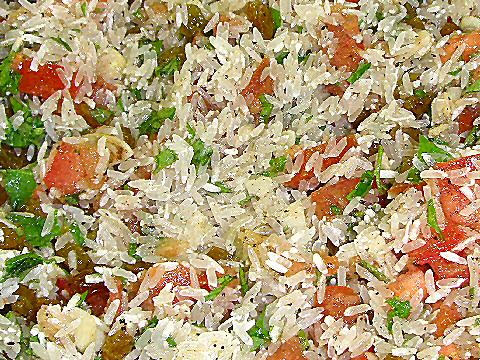
We made stuffed grape leaves in class… or watched them being made anyway. Traditional meat and rice filling and all that, and someone in class piped up with “what about vegetarians?” Well, while he didn’t have a recipe to hand out, Chef Abdala threw back a sort of “hmm… well, there’s this really delicious, cool filling you could make from: rice, almonds, golden raisins, tomato, cilantro, cardamom, baharat, coffee, and olive oil…” He left it at that and moved on, but I scribbled it down thinking it sounded interesting… First off, “baharat”? He referred to it a few times during classes, but passed it off as “a mix of spices, don’t worry about it, you can use allspice”. Interesting, as it turns out, and in fact, Poopa, our erstwhile author, uses allspice throughout her recipes – I wonder if its because baharat is hard to find in central NJ? The mixture, as it turns out, is readily available in middle eastern markets here – and looking it up it’s a blend of nutmeg, black pepper, coriander, cumin, cloves, cinnamon, cardamom, paprika, and chili powder. To me, it doesn’t taste anything like allspice. Oh, and wait, coffee? Yup, he assured us on being questioned, that some freshly ground coffee in the mixture was a good thing – okay then. I winged it, as I generally do, and came up with this filling – note that the rice is raw – it’s just rinsed briefly in cold water…
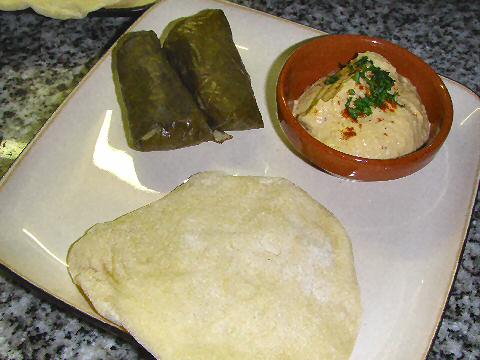
… and then about a heaping teaspoonful went into each grape leaf, then I rolled them up – being careful not to overfill them, nor roll them too tightly – remember, the rice is going to swell up to nearly three times its size when it’s cooked. I like the method of cooking them too – line a pot with slices of tomato, then put the grape leaf packets in a ring, side by side, around the outer edge, wedged in pretty well together. Then fill the center with vegetable stock and a few crushed garlic cloves, put a heavy plate in to hold them in place and under the liquid, bring the pot to a simmer and cook for about 40 minutes. I served these cold, but they’re good hot as well. Alongside, a take on the Aleppo version of hummus, bringing in a bit of Turkish flavor – I made a blend of chickpeas (just cooked, and the skins removed – not canned, though I’ve tried that and it works well for this recipe too), olive oil, salt, lemon juice, tahini (sesame paste), garlic, cumin, and in place of Aleppo pepper, which as far as I know isn’t available here, I used some urfa-biber, a mildly spicy smoked Turkish pepper that I picked up a package of on my last trip to NY. Given that we hadn’t covered pita bread in class, I decided to defer to the internet and a recipe that, as assured, works out “perfectly”.
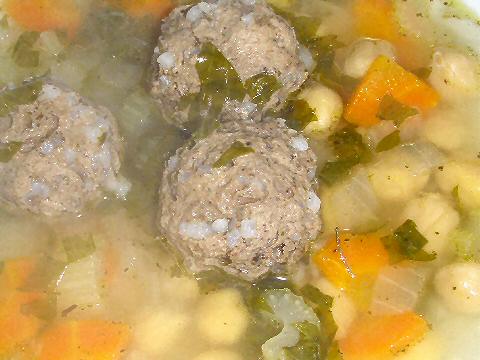
Sticking with the book for a moment, though combining two different recipes, a simple vegetable soup (celery, carrots, chickpeas (hmm, that was my addition, not in the original recipe, but I cooked too much for the hummus…), garlic) and flavoring it with lemon (juice and grated rind) and mint, and then meatballs made of ground beef (better to grind you’re own…) with some dry rice, baharat, cinnamon, and salt mixed in. Packed tightly into small meatballs and then simply dropped in the simmering soup and left to cook until the rice is done. Delicious! I loved the combination of flavors in this one, and it drew a couple of rave comments from guests.
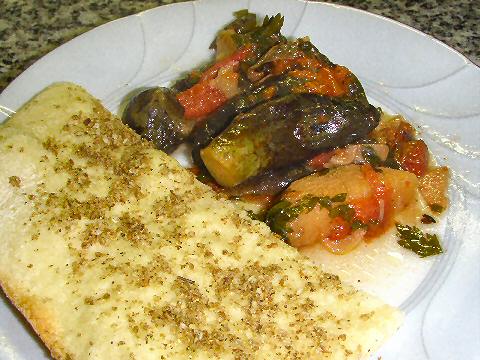
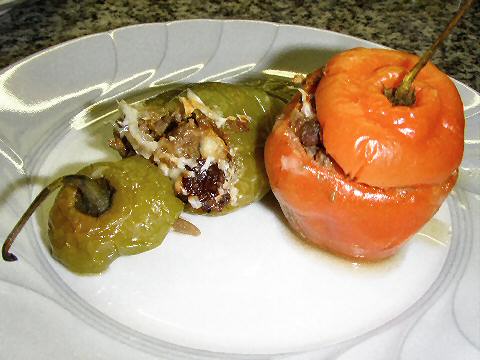
This is my own twist on a couple of different dishes from different places. Traditionally, small eggplants are hollowed out and filled with a meat or vegetable stuffing, then layered with quince in a pot, cooked slowly for a couple of hours in the oven in a bit of stock, and then served topped with candied quince. I took out the latter as too sweet, but I got to this recipe because quinces and baby eggplant are in the markets this last week or two. I decided to simply braise them together with the spices that would normally have gone into the meat filling, just without the meat. So into a pot went the cleaned and destemmed baby eggplant, then I topped those with slices of quince, tomato, and white onion. Seasoned with good amounts of mint, allspice, cinnamon, garlic, some sugar and salt, olive oil, the juice of a lemon, and some pomegranate molasses. I covered it and cooked it slowly for a couple of hours, and it comes out great! Since I was playing with some spice mixture ideas, I spotted an Egyptian one called dukka, which I modified only in leaving out yet more chickpeas, and simply made a mix of sesame, coriander, cumin, thyme, mint, and salt, and then a quick flatbread that I rolled out really thin, topped with the spice mixture, and baked until it was chewy with just crispy edges.
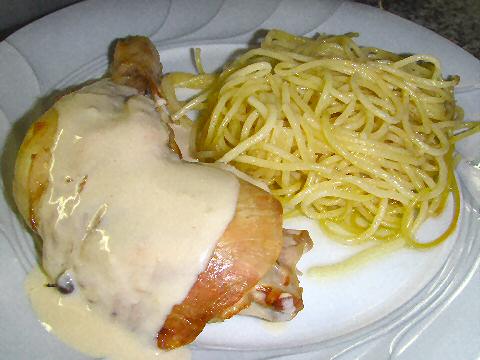
Okay, not thrilled with the presentation, thrilled with the flavor. I’ll work on the former. The chicken leg/thigh combination skinned (save the skin, preferably in one big piece), and then marinated for about ten hours in a shawarma marinade – very typical throughout Israel, Lebanon, Jordan – white wine, vinegar, lemon, dried chili peppers, allspice, salt (all blended together) – and then quickly sauteed in a pan just to lightly brown the outside. Meanwhile, I cooked some spaghetti until it was just barely al dente – you want this on the undercooked side. Tossed it with some olive oil and then put it into little casserole dishes line with the chicken skin (for flavoring and to help brown the spaghetti a little was the idea, turns out it prevented the latter but added a whole lot to the former). Set a chicken piece atop each little casserole and into the oven to finish cooking, letting the meat juices drip into the spaghetti, which does crisp up a little bit, but not as much as I was hoping for. Flipped the spaghetti out onto the plate aside the chicken, removed the piece of chicken skin, and voila. At the very least it needs to be sprinkled with a little chopped parsley, no?
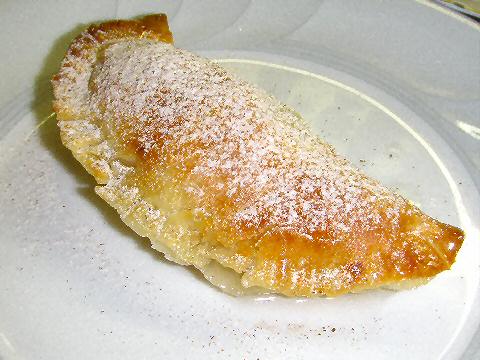
Taking off from a traditional dessert that involves little mini-empanadas filled with plain ricotta, then deep fried, and soaked in syrup and then served cold. I decided to go with a full sized empanada filled with our homemade ricotta that I’d sweetened a bit and added raisins and walnuts to. I baked them instead of deep frying them, then soaked them in a syrup made from sugar, water, lemon, cinnamon, cloves, and orange blossom water (pretty much right out of the class), topped them with a mix of cinnamon and sugar and served them up hot. They’re also really good the next day, cold, with coffee in the morning… trust me.
So, our little contribution to middle eastern multi-culturalism. To the best of my knowledge, no one attended who’s going to have much say in the solving of any conflicts in that part of the world, but, hey, you never know…
Copyright © 2026 SaltShaker. This feed contains copyrighted photos and text from SaltShaker. If you are not reading this material in a feed aggregator or by e-mail subscription, the site you are viewing may be guilty of copyright infringement. Please contact [email protected] so that I can take appropriate action.
Plugin by Taragana
]]>