Time is the measure of business.”
Francis Bacon, Sr., English Philosopher and Lawyer
Buenos Aires – You know that moment when something in the back of your mind says, “this is a mistake…”. Not quite loud enough to be a shout and frighten you into a flight response, but just enough to set things on edge. That happened several months ago, when I wandered into a little loungy space near to the Recoleta Cemetery & Entertainment Complex (it really is all one, even if they pretend there are several separate entities involved) that advertised “sushi libre” on a little sandwich board out front. I’m almost always game for all you can eat sushi, but something said, “no…..” in a voice trailing away like it had leapt over a cliff. The friends I was with apparently weren’t salivating at the thought of unlimited pieces of raw fish as much as I, and we up and left. Then, this past Sunday, when all of my local friends, really, all of them, were either being slugs at home or had other plans, or at least claimed such nonsense, I found myself wandering the ‘hood late in the evening, looking for a bite to eat. Henry was off to La Plata for a day or two, I’d been indoors working most of the day, and I was feeling sort of, poor me… and there was this warm, inviting, red glow, and the sandwich board. And so, I found myself at Business, Guido 1936, 4801-1844. [This place has closed and been replaced by something equally innocuous looking and frightening.]
My brain didn’t do the mistake thing off the bat, it waited until I was seated on a comfy banquette, a tall, cute waiter in attendance, looking around at walls cluttered with Americana that invoke a road trip down Route 66. It waited until I’d made a vague attempt to actually read the menu, printed in miniscule yellowish white lettering on glowing red plastic, in a room lit by reddish orange lights. Had I had my reading glasses with me I couldn’t have read this – there’s not enough light to provide contrast between the letters and the background. My waiter concurred, with a sigh, that he generally has to list off a good number of the items that they offer because no one can read the damned things. That settled, I’d already more or less decided beforehand on a sushi libre, it’s what drew me in in the first place – though, as a couple of them passed my table, I note that they offer hamburgers that seem to be about an inch thick, with real buns… so maybe one day… – and then I realized I was seated right next to the sushi station, a little three sided box of Ikea style shelving, a little more than waist high, behind which, now, a young man came to make sushi. No refrigerator, no water to wash up, just shelves… and that was when my hindbrain started its protest.
And yet, I paid it no mind, instead, watching, fascinated, as this youngster proceeded to start onto various sushi plates… and realized that at least, he wasn’t storing the fish on the shelves… he was actually running back and forth to the kitchen about every 10-15 minutes for more pieces of salmon… and it was pretty much just salmon. There was an occasional bit of pseudo-crab, and there was lots of cream cheese, and a bit of avocado, but there was mostly, as usual, salmon. And he had some damp cloths to wipe his hands on, which he did replace now and again through the evening. But still… there it was… that trailing scream to run… and I didn’t. I’d ordered the “sushi libre especial”, the difference from the “sushi libre clasico” being that the especial includes sashimi. Not much of it, especially given the 15 peso or so price differential, but I didn’t know that upfront – save your money, or insist on more sashimi perhaps – and it did indeed begin to arrive.
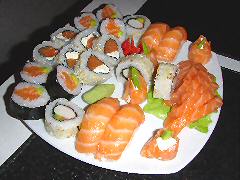 Now, it was a slow process. I’ve watched many a sushi maker make sushi in front of me. I honestly don’t think I’ve ever seen it take quite so long. Oliver, over at Argentina’s Travel Guide kindly offered up that maybe his sense of time lapse was altered due to hunger, but no, really, I’ve never seen anyone move so slowly and deliberately making pieces and rolls of sushi. I’d estimate my first plate took him a minimum of 15 minutes, possible 20, and we’re not talking anything elaborate. A plain salmon roll, a salmon and cream cheese roll, a salmon and avocado roll, a couple of pieces of salmon sushi, a half dozen slices of sashimi, and part of a crabstick roll. I’m not really complaining, I was warm and cozy, I had a magazine to read, the music in the background was good – a bit of cacophony from one table of six people not far from me who were of the sort who seem to feel the need to shout to each other, hoot and holler, despite being no more than a couple of feet apart, you know, the sort who in their late 20s still think it’s roll on the floor hysterical to blow coke threw a straw at each other – and I do mean the bubbly drink.
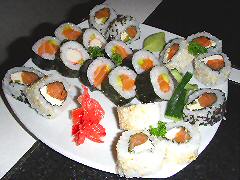 And once it arrived, it was passably good. The salmon was fresh, the rice was properly made, it was a good portion, and I made my way through it relatively quickly and methodically. Then I settled back to read a little bit more, figuring the waiter would get around to me shortly and I could order another roll or two. And he did get around to me, about 15 minutes later, when he removed my first plate and deposited another not much different from the first, without a word. And, I realized, as I was about halfway through the second plate and thinking, okay, this is just a trifle too much food, that the sushi-man was already hard at work on another platter. I waved and got his attention and told him that really, fifty some pieces of sushi was quite sufficient, thank you much, and a third platter was not necessary… he sighed, and put the couple of already made rolls back in one of his plastic bins and carted it back to the refrigerator, I hope. The waiter seemed equally surprised, and perhaps a bit disappointed, I don’t know, maybe they had a bet going on how much I would eat – but he offered me dessert, which I declined, and then a coffee, likewise, and we settled on a cup of tea while he figured out the bill – set price, remember, but that took another 20 minutes…
So, overall, Business offers okay sushi (and maybe hamburgers), there’s far better to be had, and certainly both more variety, and faster service. But on a drizzly, cold night, when all your friends have simply abandoned you…
Copyright © 2026 SaltShaker. This feed contains copyrighted photos and text from SaltShaker. If you are not reading this material in a feed aggregator or by e-mail subscription, the site you are viewing may be guilty of copyright infringement. Please contact [email protected] so that I can take appropriate action.
Plugin by Taragana




 ]]>
]]>“What kind of restaurant makes you cook your own food?”
– Bill Murray, in Lost in Translation
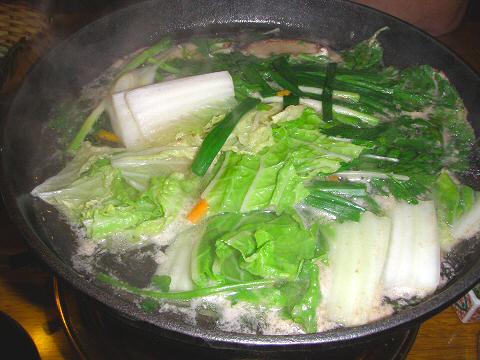
Buenos Aires – Home again, home again, dancing a jig… sorry, channeling Mother Goose for a moment there. After catching up on some sleep, unpacking, getting back in the swing of things, etc., I had phoned my friend Michael to see if he wanted to head off to a puertas cerradas Japanese restaurant that some guests of ours had told me about. He was game, I made the reservation, and we were all set to go. Then someone phoned from the place about an hour before we were to head there to say that they’d decided to cancel “the event” for the evening and would we consider coming next week instead… we would, though we were disappointed. In its stead, we headed to another of the Japanese spots that’s been on my list for awhile, one we’d poked in and looked at about a year ago – lots of little separate curtained off rooms, waitresses in kimonos, all very quiet and tranquil… we secured a reservation and at the appointed hour found ourselves situated at a large, highly polished table with a gas burner atop. Shabu-shabu is the specialty of Nihonbashi, Moreno 2095, 4951-7381, in Congreso. What is shabu-shabu you might ask? I’ll get to that in a moment, but first we had to put on our traffic cone orange full body aprons that the place uses in place of napkins… I understand the reason for the apron – this style of eating can be a little messy – but how about a napkin too – the aprons just aren’t absorbent enough to use successfully. At least they bring hot damp towels both before and after the meal. [Closed permanently during the pandemic]
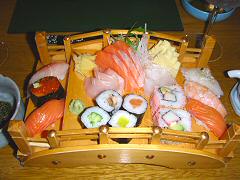 We kicked off the meal with a bit of sushi – sharing the combo sushi platter, which comes with a nice array of different fish, and, I think the first time I’ve seen it in Buenos Aires, ikura, or salmon eggs. The sushi menu also lists uni, the love it or hate it butterscotch pudding textured and colored sea urchin roe, but they didn’t have any in house last night – they must have it relatively often as our waitress had to go ask if there was any available for the evening. The sushi combo is presented very prettily on a small wooden bridge… the one drawback to sharing it is that it’s designed as a one person main course,
 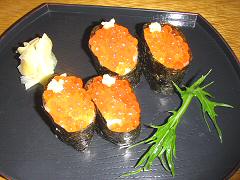 and most of the items on it are presented as single pieces… we did the back and forth “you pick one” and then “I’ll pick one” routine. The ikura was such a treat that we decided to order another round… not an inexpensive proposition as it turned out at 9 pesos a piece. Overall though, the combo is a decent deal (50 pesos) given the quality of the sushi, which is very good – not quite up to what I had at Yuki a few weeks back, and of course, my thoughts are tainted by truly spectacular sushi had in New York while on vacation, but still quite good.
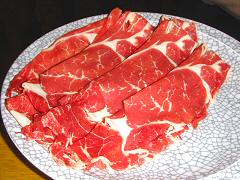
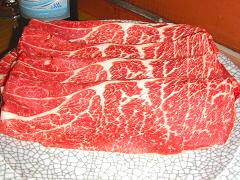
Nihonbashi offers a choice of two different types of beef for your dipping pleasure… straightforward Argentine beef, and Argentine raised Wagyu beef, the famed Japanese cattle that are raised to provide Kobe beef. [A note: last year, in November, in a financial protectionist move (however, claiming cultural reasons), the Japanese Ministry of Agriculture declared that Wagyu wasn’t just a designation of the breed of cattle, but also indigenous to Japan, and that although for years the Japanese have been selling the cattle to overseas ranchers, they didn’t want anyone outside Japan ever using the term Wagyu again. The rest of the world, unsurprisingly, has simply ignored this declaration.] These two photos should offer up a sense of the difference in the beef – the Wagyu, on the right, showing the “marbling” of fat that it’s famous for.
Copyright © 2026 SaltShaker. This feed contains copyrighted photos and text from SaltShaker. If you are not reading this material in a feed aggregator or by e-mail subscription, the site you are viewing may be guilty of copyright infringement. Please contact [email protected] so that I can take appropriate action.
Plugin by Taragana
]]>“And that’s the world in a nutshell – an appropriate receptacle.”
– Stan Dunn
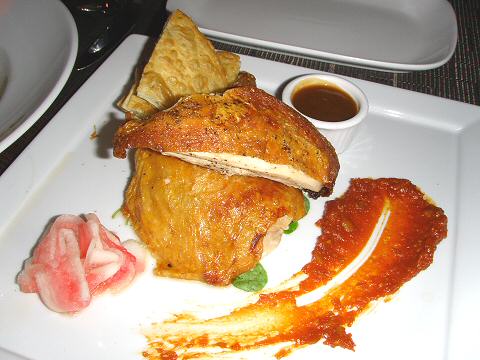
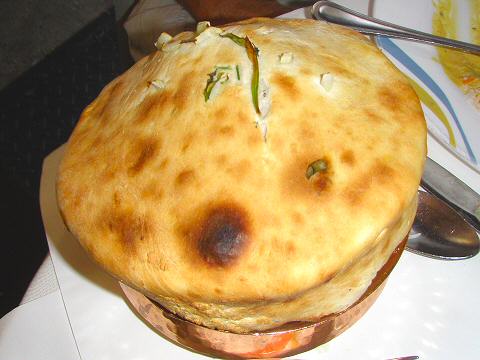
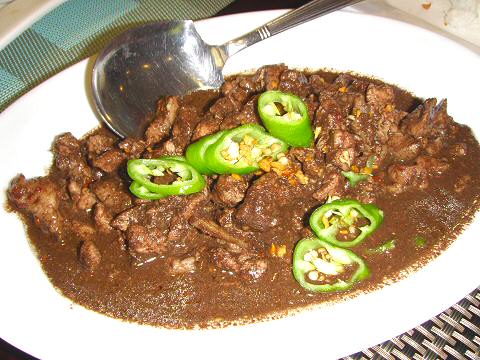
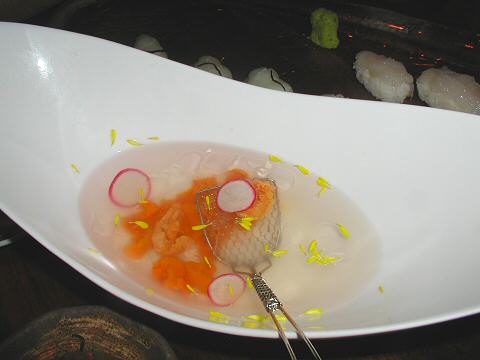
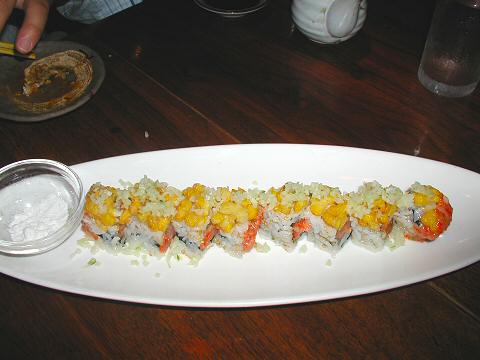
New York City – My initial impulse, looking back over a week’s worth of dining out, is to do a quick overview and point out some high and low points, and move on, returning to Buenos Aires, which is, as I’ve been informed via several e-mails over the last few days, what people come to SaltShaker looking for… my apologies, though not really – my blog is about food, wine, and life – mine, in general, and I’m not always in BsAs. But still, I’m looking at photos and notes from meals at Felidia, Cookshop, Momofuku, Sakagura, Ten, Porterhouse, Monkey Bar, Banjara, Grand Harmony, and Grill 21 – plus wandering the streets snapping photos, meeting up with friends, seeing a couple of movies… I know that as the next few days pass on my return home, the details are going to begin to fade, and there are going to be other things that clamor for attention. So, I’m going with my initial impulse… which means giving somewhat short shrift to places that probably warrant more… it just means I’m going to have to be pithy and concise… or something in that vein. I’m going to skip two from the list above – Cookshop I’ve reviewed before, and Grand Harmony is just one of those huge dim sum spots, nothing special, which we only went to because my fave spot is no more.
Now, a couple of thoughts about New York these days… you can’t go while you’re on a budget. You really can’t. Beyond getting to spend time with friends, and staying with a couple of them, and thereby saving on astronomical hotel bills, I budgeted pretty much all my money for dining out, and still aimed, for the most part, for less expensive spots. But I was bored most of the time, honestly. There wasn’t anything I wanted to see or do that didn’t cost way too much money, like theater or other events, where these days the cheap seats can often be three figures. It doesn’t mean one can’t figure out a way to do it – and I’m sure I missed out on some opportunities that I could have taken advantage of, but, I simply didn’t. Mea culpa. I already mentioned seeing Ratatouille… the other film I saw was the release of the new movie Transformation: The Life and Legacy of Werner Erhard – which was a fascinating look back at one of the most influential people in the late 70s “transformation movement” (yes, I took the est training, and a variety of other things, and even worked for the man at one point, briefly). I thought it was a very fair portrayal, covering both positives and negatives, and it’s well worth seeing if you don’t know much about that whole time period and movement.
Copyright © 2026 SaltShaker. This feed contains copyrighted photos and text from SaltShaker. If you are not reading this material in a feed aggregator or by e-mail subscription, the site you are viewing may be guilty of copyright infringement. Please contact [email protected] so that I can take appropriate action.
Plugin by Taragana
]]>
Copyright © 2026 SaltShaker. This feed contains copyrighted photos and text from SaltShaker. If you are not reading this material in a feed aggregator or by e-mail subscription, the site you are viewing may be guilty of copyright infringement. Please contact [email protected] so that I can take appropriate action.
Plugin by Taragana
]]>“Yuki is the real thing – that’s the place that wouldn’t even let us in the door way back on a Saturday night. Monday nights no security guard, they just buzz you in. Quiet – I went at 8:30, maybe 15 people eating in dining room, three at sushi bar, took a place at the bar, looked at the menu, looked at the display of fish and shellfish, watched the chef, Kazuo, for 2-3 minutes, looked at him and said “omikase”, i.e., “your choice”. He beamed like a kid in a candy shop. He paraded half a dozen plates in front of me one after the other spectacular – sashimi, sushi, and a grilled fish – some stuff I haven’t even seen here in Buenos Aires before. We talked about the fish, we talked sake (decent brand, lightly chilled, 24 pesos, and served traditional style in the little wooden box), they clearly have regulars, both argentine and japanese. I suddenly realized I hadn’t asked or specified a price and started to get worried, but then saw they accept cc’s and decided what the hell – and it turned out to be a non-issue – plenty of food, spectacular food – 90 pesos. His father opened the place 40 years ago when they moved to BA from southern Japan, when he was just a kid. When he was old enough, he went back and went to school for sushi chef training in Osaka, then returned to work with his father, and then took it over a few years back. This isn’t a fly-by-night newcomer!”
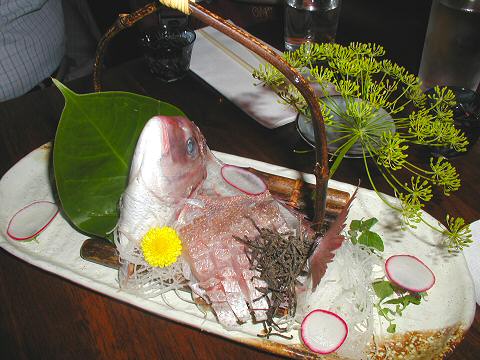
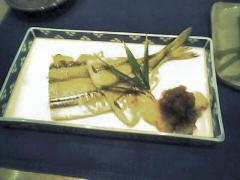
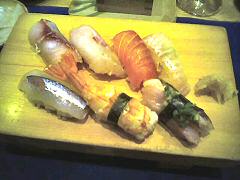
 Buenos Aires – I scribbled off the above missive to a local friend about five minutes after arriving home from my first time at Yuki, Pasco 740, in Congreso, 4942-7510. I don’t really have a lot to add to it. I could go into detail, I suppose – things like thinly sliced caracól, or giant sea snail ; or the panapea, a geoduck clam, shaved into a delicate ponzu sauce; or perhaps the pejerrey amarillo, the saltwater relative of the local river fish pejerrey, that only comes on the market once a year for a few weeks; or maybe just the thick slices of lightly seared bonito, lined up in rows… nah, there’s no need to go into any of that. Let’s just say that for an hour and a half I didn’t miss the sushi bars of New York… Apologies for the pictures, I didn’t have my camera with me, just a phone with the resolution of a pinhole camera shot through a coke bottle bottom… and these have been photoshopped to death… [Closed in 2016]
Copyright © 2026 SaltShaker. This feed contains copyrighted photos and text from SaltShaker. If you are not reading this material in a feed aggregator or by e-mail subscription, the site you are viewing may be guilty of copyright infringement. Please contact [email protected] so that I can take appropriate action.
Plugin by Taragana
]]>“In and of itself ritual is meaningless and therefore open to endless interpretation.”
– Kenneth Dean, Author, Lord of the Three in One
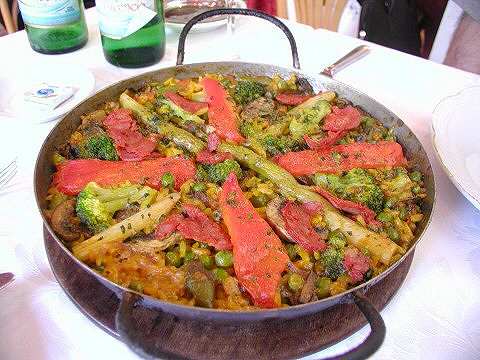
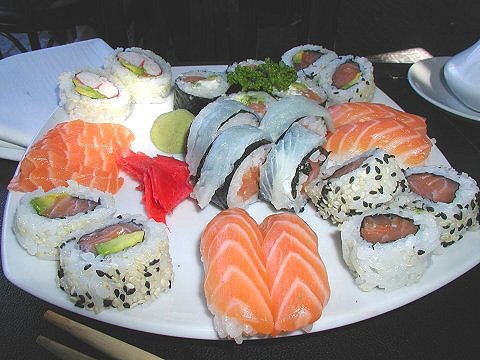
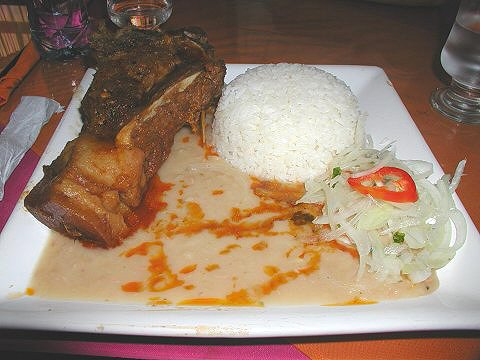
Buenos Aires – I know you’re all eagerly awaiting the writeup on our two evening exploration of Pakistani food at Casa SaltShaker, but it will keep until, most likely, tomorrow. Instead, a trio of mini-reviews of recently checked out spots for dining.
Copyright © 2026 SaltShaker. This feed contains copyrighted photos and text from SaltShaker. If you are not reading this material in a feed aggregator or by e-mail subscription, the site you are viewing may be guilty of copyright infringement. Please contact [email protected] so that I can take appropriate action.
Plugin by Taragana
]]>