“The effects on memory of the most pleasant dish, the first and last dishes, a rising vs. falling hedonic profile, and the time spent eating a dish were evaluated for similarity to effects seen in memories of pain. Across the three studies, there was consistent evidence for duration neglect (no effect of increased duration/exposure of the favorite component), and some weak evidence that patterns rising in liking are preferred to those falling in liking. In all three studies, there was no evidence for peak, primacy or recency effects. The existence of duration neglect implies that, with respect to memories of a meal, small portions of a highly favored dish will have roughly the same memorial effect as large portions.”
– Elizabeth Rodea, Paul Rozina, and Paula Durlach, Abstract from a scientific study
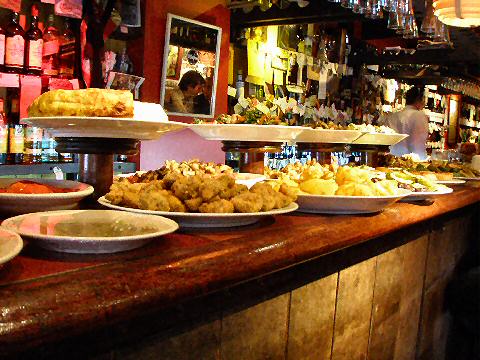
Buenos Aires – All that scientific gobbledygook above pretty much means that a trio of scientists convinced some research department to fund their restaurant forays, with a focus on buffets, tapas, dim sum, and the like. Probably a few regular sorts of meals too. The upshot of it is that a bunch of small plates of things you really like gives you as much pleasure, or more, especially if you try several things you really like, than one or two large portions of something you really like. You remember appetizer crawls, don’t you?
I’ve mentioned Tancat, Paraguay 645, in Centro, 4312-5442, before, but never got around to reviewing it. In a way, there are two Tancats. There’s the tapas bar, pictured above – and truly, the best way to experience this is to plop yourself down on a barstool and start pointing – some of this one, some of that one, mix a few of those in… wash it all down with a glass or two of wine, and waddle on out into the night. The other, is to sit at a table. Here, the tapas become problematic. Not that you can’t order them, and we have – though the best way requires walking over to the bar and pointing at things and then going back and sitting down. Trying to order tapas off a menu… sucks. It’d be like dim sum without the carts.
At the tables, we have a tendency to order one or two favorites – at lunch the other day we started off with a plate of boquerones – nice and light and vinegary – perhaps not as good as those at El Trapiche or Damblee, but just fine, and followed quickly on by some roasted eggplant, some baby squid… but by the time those had been thought of we were on to regular menu items, and the table ended up with a couple of bowls of decent gazpacho – the pureed sort, which isn’t my favorite, but they make up for it by bringing little side bowls of croutons and chopped peppers and onions to put some “chunk” back in the mix; and then a mushroom risotto, a braised cut of solomillo, or pork loin, and one of the day’s chef specials, a small platter of portobello caps stuffed with smoked salmon and topped with a creamy cheese sauce.
No question the food is good at Tancat, and the prices aren’t bad for the downtown neighborhood. Personally, I prefer the tapas bar and a casual nibble, or two, or three, or….
Copyright © 2026 SaltShaker. This feed contains copyrighted photos and text from SaltShaker. If you are not reading this material in a feed aggregator or by e-mail subscription, the site you are viewing may be guilty of copyright infringement. Please contact [email protected] so that I can take appropriate action.
Plugin by Taragana




 ]]>
]]>“The Día das Letras Galegas (Galician for “Galician Literature Day”) is a holiday in Galicia, a region in northwest Spain. This holiday has taken place on May 17 since 1963 when the first event was held to commemorate the centenary of Cantares gallegos, the first work written in the Galician language by Rosalía de Castro (1837–1885), who later became one of the most important poets in the history of Galicia. Cantares gallegos was published on May 17, 1863. Since 1963, each Galician Literature Day has been dedicated to a different writer in the Galician language. This writer must be dead, and is chosen by the Real Academia Galega (Royal Galician Academy).”
Buenos Aires – I can’t say that we made any real, or imagined, contribution to Galician literature this weekend. We didn’t read any, look at any, or, for that matter, I don’t think we really even thought much about this year’s honoree, Xosé María Álvarez Blázquez, who was born in 1915, died seventy years later, and in-between wrote poetry and prose, of which, I didn’t find anything translated into English that I might be able to share with you. And, of course, the translation would somewhat defeat the purpose of the day. So, instead, we ate food inspired by the traditions of Galicia… with my own odd twists, of course.
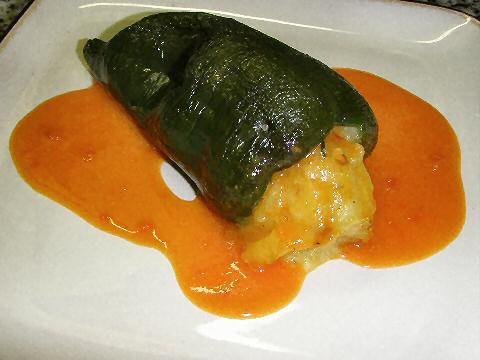
There is a traditional dish of white beans and chestnuts cooked in the oven with a little bit of broth to make not so much a soup as a side dish. I took the idea and simply turned it into a soup. I made a vegetable stock with all the usual sorts of things that go into it. Then, cooked some celery and onions in a little olive oil, added pre-soaked white beans and the vegetable stock, and rather than whole chestnuts (which are hard to find here and prohibitively expensive when you do), a chestnut puree (unsweetened). Then just cooked it all until the beans were done, salt and pepper to taste. From there, it was on to a twist on the classic empanada de berberechos, which, like the more well-known empanada de gallego is normally made as a large pie, either round or rectangular, and then cut into pieces to serve. I took the filling – berberechos (cockles, or small clams), fire blackened red peppers, tomatoes, onion, salt and pepper – and wrapped it in phyllo dough, then baked them in the oven to finish. I had picked up some tomatillos, which are a sort of Mexican green tomato, only not exactly, and pureed them with a little garlic, salt and pepper, and then cooked the puree over low heat until thick.
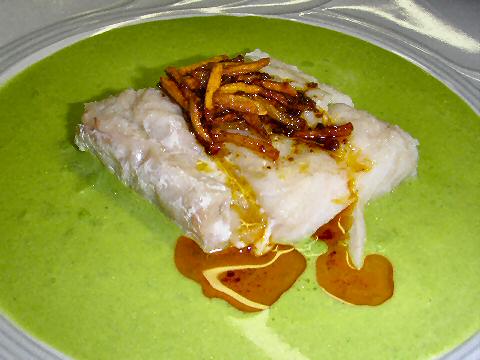
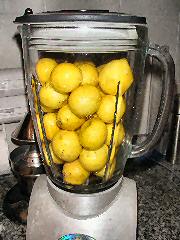 And, finally, dessert. A quesada reina, reinterpreted more as a cheesecake… sort of. It’s unsweetened, and gets its sweetness from powdered sugar coating it. It’s actually pretty simple. I made ricotta and then blended that with a little bit of rice flour, eggs, a pinch of salt, and a spoonful or two of cinnamon. Nothing more. Baked in a springform pan until lightly golden and set. Then cooled, chilled, topped with powdered sugar and slices of kiwi (the traditional appears to use kiwi and maraschino cherries, the latter being something I decline to use – see here, towards the bottom). I had made some limequat marmalade the other day which I thought would pair nicely with this, and it did. I promised the last time I made limequat marmalade to show you a picture of limequats… so here they are, ready to be blended into a coarse puree for making the marmalade – gives you a sense of how much smaller than a lemon they are…
Copyright © 2026 SaltShaker. This feed contains copyrighted photos and text from SaltShaker. If you are not reading this material in a feed aggregator or by e-mail subscription, the site you are viewing may be guilty of copyright infringement. Please contact [email protected] so that I can take appropriate action.
Plugin by Taragana
]]>The singular remarkable fact about the Basques is that they still exist.”
– Mark Kurlansky, The Basque History of the World
Buenos Aires – Leandro “Koko” Egozcue is not a name that’s familiar to everyone who dines in Buenos Aires, but it’s a name that ought to start being so. He’s the young and quite talented chef behind the restaurant Burzako, México 345 in Monserrat (right near the edge of San Telmo), 4334-0721. The restaurant, with cuisine based in his family’s ancestral Basque traditions, is not named after anything “over there”, but for the town of Burzaco, just about 16 miles south of Buenos Aires, where he lives. While in his early 20s, he headed over to Basque country, in Spain, and spent a couple of years working with famed chef Martín Berasategui, who he considers his mentor. The style of the cooking at Burzako is much more traditional, even rustic, than that, but it’s easy to see that he learned his lessons well – Berastegui is known for spending countless days working on each dish to get it just the way he imagines it before putting it on the menu. Egozcue’s food, while more down home, still shows that level of care and balance – one dish after another was simply delicious. [This place has closed.]
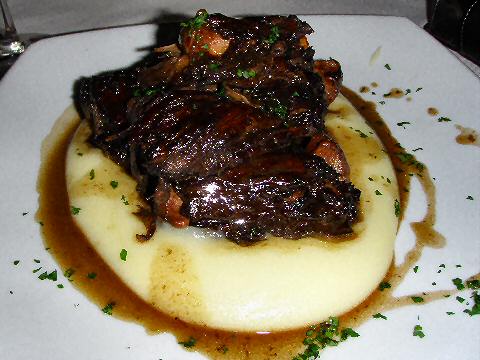
A trio of us dug into plates of small baby squid, perfectly tender and accompanied by caramelized onions, and mildly fiery piquillo peppers stuffed with ham and cheese – oozing melty goodness all over the plate. Then we moved on to the main courses, which are huge portions that will leave you incapable of movement (and unfortunately unable to even think about sampling desserts), but so good that you cannot not finish them. A squid ink risotto chockful of lightly charred chunks of octopus and squid was laced with drizzles of fresh, green olive oil that added a wonderful nuance to the dish; braised lamb bondiola (neck/shoulder cut) with wild mushrooms was so soft you could eat it with a spoon; and the chef’s specialty, an amazingly rich and flavorful oxtail braised in red wine and served over the smoothest potato puree I think I’ve ever encountered was so good I really didn’t want to share it with my dining companions, though, in order to try their dishes, which they were happily digging into, I had to give up some.
The space is as barebones as can be – brick walls, some of them casually painted in white, few decorations. The waitresses are friendly and helpful, and happy to make recommendations for dishes (after, of course, the obligatory “everything’s good” cry). It gets a trifle noisy, with not a single soft surface in the room other than the diners and the food, but we didn’t find it annoyingly loud, since most of the noise was the happy buzz of customers digging into their food. Their website is a bit over-designed, and would benefit from the addition of offering up the hours that they’re open – which are Monday and Tuesday lunch only, Wednesday through Saturday lunch and dinner.
Copyright © 2026 SaltShaker. This feed contains copyrighted photos and text from SaltShaker. If you are not reading this material in a feed aggregator or by e-mail subscription, the site you are viewing may be guilty of copyright infringement. Please contact [email protected] so that I can take appropriate action.
Plugin by Taragana
]]>“Vegetarian has long been used as the human equivalent of herbivore, which — along with carnivore — has traditionally been applied to nonhuman animals, for the good reason that vorare means not simply ‘eat’ but ‘eat like a wild animal’ (hence devour). The ending -arian generally denotes a conscious adherence, in contrast to the genetic programming implied by -vore. But then, who cares about tradition anymore…?
– Cory Lubliner
Buenos Aires – In my post the other day I talked a bit about the back and forth battle between the Argentine government and the ranch/farm owners that’s been going on. It continued yesterday with a major rally of support for Cristina Kirchner held in the Plaza de Mayo… and then it hit me – all the back and forth trading of insults and argument has been, for the most part, not just civil, but reasoned… no, better, measured… calculated. I don’t want to be labeled as a conspiracy theorist, but I’m going to be one for the moment. I’ve nearly convinced myself that this entire thing is a conspiracy. Bear with me… For the last several decades, president after president has declared the Argentine national diet of beef, beef, and more beef to be one of adherence to tradition in opposition to sensible eating – that the diet needs to be improved, to include other meats such as chicken and fish, and far more vegetable and grain products. Without fail, they’ve been resoundingly ignored if not booed. Cristina’s smart. Smarter, I think, than we’ve been giving her credit. Here’s the theory, and you can see it coming… she makes a deal with the ranchers to do a bunch of saber rattling, they get into all sorts of name calling and basically take the populace’s attention away from the fact that there’s no beef to be found in the markets and restaurants – or maybe she just provokes it all one-sided and they’re not in on it…. Everyone is so busy taking sides and arguing that they’re oblivious to the fact that they’re eating chicken, fish, and vegetables (though, I did, with amusement, witness a 70-something year old woman railing against the butcher in one of the local supermarkets, decrying how she and her family were going to starve to death because there was no meat – meanwhile the butcher trying to point out the chicken, fish, etc…. to her response of “that stuff isn’t fit for humans to eat!” – She was convinced he had beef hidden away in the back to help his family and friends survive, and by god, she was going to have some of it…).
It turned out purely coincidental that I’d scheduled this week to celebrate the centennial of the Lliga vegetariana de Catalunya – really, I wasn’t in on the conspiracy and had no idea that beef wouldn’t be around this week, as many of our guests accused me of – not that we serve much beef to begin with. I actually entered into the idea with a bit of trepidation – regular readers know that I’ve not been thrilled with the response to our vegetarian meals – not that people who come don’t enjoy them, but despite the regular e-mails I get asking for more vegetarian meals, the people who write me never actually show up. It was the same case this week – except, lots of other people came – non-vegetarians, voluntarily submitting themselves to an evening of non-meat eating. Shock of shocks – we filled two nights quickly and had enough demand to filll a third!
With only one exception no one seemed to have a problem with an evening of dining on Catalan vegetarian dishes – I did get a near last minute cancellation from a party of four, who had begged for a reservation just a week or so earlier, and then cancelled with “We didn’t read about the menu for your venue next Saturday 29th, but now we realize that is a vegetarian meal and we are so not vegetarians. I’m sorry, but if you could reschedule us will be nice, if not it’s O.k., but unfortunately we are not in the mood for wasting the opportunity of your cuisine with that particular menu”. Maybe I shouldn’t find that offensive, but I do, and guess what, you wasted your opportunity (like we only offer people one shot???) and no, we won’t be rescheduling you – this IS our cuisine. Not to mention they clearly hadn’t checked things out before reserving – despite having assured me in advance that they’d looked at the theme and menu for the evening – we only filled two of their four spots because of the lateness of their cancellation… that pisses me off, you know?
We opened up the evening with a Clover Club cocktail – I think I forgot to mention a few weeks back that we’ve started serving up a little welcome cocktail at the beginning of the evening while people are standing around getting to know each other. Now, why a completely obscure cocktail like this one? First, because I like obscure, you know? Second, I spotted several references to the cocktail experiencing a revival in the “finer bars” of Barcelona recently. Could be just nonsense, but that’s what called my attention to it. It’s a blend of gin with fresh lemon juice, raspberry liqueur (or syrup, but I had liqueur on hand), a dash of bitters, and an egg. Normally, the classic uses just a little bit of egg white, to give it a foamy texture, but then there’s a version called a Royal Clover Club that uses the yolk. I decided to try it with the whole egg – it works really well, making a very rich, creamy cocktail. And remember, I was whipping up a batch for a dozen people, so one whole extra large egg wasn’t overkill…
On to the food, which as best I can tell, everyone enjoyed thoroughly. We started off the evenings with an escalivada amb romescu (I’m going to use the Catalán names when I know them) – a simple appetizer of roasted vegetables – eggplant, green peppers, onions, and tomatoes – served up with my version of the area’s famed romesco sauce. For that, I char, in the oven, red bell peppers, medium hot poblano peppers, and tomatoes, roughly 2:1 in quantity, then blend those with garlic, toasted almonds, a little bread for thickening it, olive oil, red wine vinegar, and some anise liqueur – I had a bottle of ouzo on hand. Salt and pepper to taste. It’s a great sauce, and better the day or two after you make it, so best to whip it up a day early…
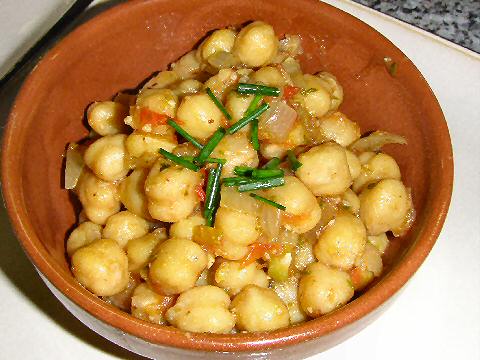
Next up, I think what turned out to be the majority of people’s favorite dish of the evening. I know we made extra and ate every chickpea that was to be had. The dish, cigrons amb tomiquet, or chickpeas with tomato – deceptively simple sounding, but wow, what flavors! I soaked the biggest chickpeas I could find in water overnight and then simmered them in vegetable stock for about half an hour until just al dente. Meanwhile I made a sofreito, sauteeing finely diced onions until lightly browned, then adding a paste made from several garlic cloves, a handful of parsley leaves, and some toasted hazelnuts. Cooked those together for a minute or two and then added chopped plum tomatoes, a spoonful of sugar, and a bunch of saffron threads. Cooked that all until the liquid had evaporated and it became almost pastelike. When ready to serve, I drained off most, but not all, of the stock from the chickpeas, mixed in the sofreito and the juice of a couple of lemons. Seasoned to taste with just salt. Really, if you like chickpeas, you have to try this one.
On to the soup (except the first night where I served the soup before the chickpeas, but we decided that since the main course had butter beans in it, serving two legume courses back to back felt a bit off), and a sopa de boléts, or Bolete Soup – boletes being a particular class of mushrooms. In particular, Catalunía is famous for its rovellón and pine mushrooms. The pine mushrooms were particularly beautiful, the rovellóns were a bit broken up – so what I did was made a base similar to a panade, since the classic Catalán soup used an onion base and a slice of bread in the bottom of the bowl – I slow cooked the onions, fried the bread in butter, and combined them, but instead of using milk as the soaking liquid, I simmered the rovellóns in water and then blended that right in with the onions and bread. Then I quartered or halved the pine mushrooms, depending on their size, and sauteed them in olive oil with lots of garlic and some saffron. I added those to the soup base, and just added enough water to make sure it wasn’t too thick. It had a great, earthy flavor that really captured our early fall weather…
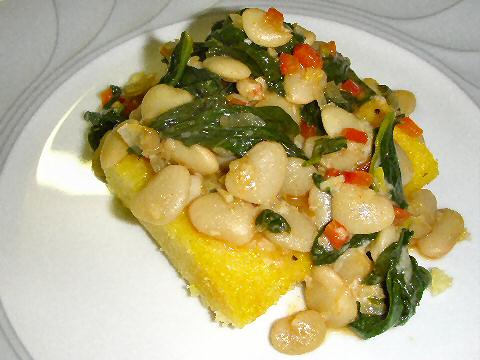
The main course was, once again, deceptively simple, proving that sometimes what looks like a simple dish turns out better than all the complicated maneuvering that one can get wrapped up in. I made some polenta, seasoned with butter, tarragon, salt, and black pepper. I poured that into a baking pan that was lined with buttered parchment paper, smoothed out the polenta to about an inch thick, let it cool, and then refrigerated it for several hours until it was firm. Then I flipped that out onto a cookie sheet, peeled off the parchment paper, cut the polenta into squares and brushed it with some softened butter, sprinkled with salt and pepper, and broiled it – both to reheat and to form a top crust that was lightly crunchy. To serve, I sauteed garlic, red bell pepper, hot yellow lemon peppers, onions, and smoked paprika in plenty of olive oil until lightly golden. Then I added a large amount of fresh spinach leaves and cooked them down until they’d completely wilted, added in a good quantity of butter beans (only canned available here, so rinsed well and drained), covered the pan and let everything cook together for about ten minutes. To finish I added grated manchego (salty sheep’s milk cheese) and sherry vinegar, salt and pepper to taste. I ladled that, liquid and all, over the polenta squares. Interestingly, the smoked paprika, and I used a good amount of it, makes the dish taste almost like it’s got bacon or sausage in it.
We finished off with a crema catalán – more or less a very soft pudding with a broiled sugar top. Ideally, I need to get a small torch and do this more like a creme brulee, keeping the pudding reasonably firm, but I put them under the broiler and they got very soft, almost like a pourable custard – still, we all loved them, and who knows, maybe it’s better this way? For this, I simmered 6 cups of milk with the peel of three lemons for a few minutes, then let it sit for about ten minutes to infuse. Meanwhile, I whipped a dozen egg yolks with a teaspoon of cinnamon, two teaspoons of vanilla bean paste, three tablespoons of cornstarch, and two and a quarter cups of sugar, until it was light and fluffy. I strained the milk and then slowly poured it into the yolk mixture while continuing to beat it in the mixer. Then poured the resulting mix into a saucepan and over low heat, cooked it until it was nice and thick – though keep it just short of a boil or it will get lumpy. I ladled that into ramekins, cooled it, chilled it to set firmly, and then sprinkled with a teaspoon of sugar each, and put them under the broiler until the sugar was lightly browned.
Copyright © 2026 SaltShaker. This feed contains copyrighted photos and text from SaltShaker. If you are not reading this material in a feed aggregator or by e-mail subscription, the site you are viewing may be guilty of copyright infringement. Please contact [email protected] so that I can take appropriate action.
Plugin by Taragana
]]>“Stunningly simple in preparation and extremely true to pure flavors, Catalan Cuisine is one of the world’s most overlooked culinary treasures. From staples like pa amb tomaquet (bread slathered with fresh tomato and drizzled with olive oil) to the Catalan dish par excellence Botifarra amb Mongetes (Catalan sausage with beans) to the revered wines of the Priorat, your average person doesn’t know much about Catalan cuisine at all; indeed some people don’t even know there is such a thing.”
– from EatCatalunya.com
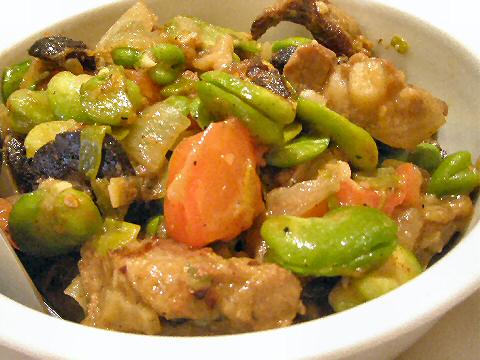
Buenos Aires – It’s been on my list for quite some time. There are plenty of Spanish restaurants here in the city, most of them focused on the cuisines of either the Galicia region in the northwest on the border with Portugal, or the Basque region along the northern border with France. But I’ve been hearing good… no, great… things about Casal de Catalunya, Chacabuco 863 in San Telmo, 4361-0191, and it was time. It wasn’t planned as the time – originally a little group of us were going to troop off there, but I was in San Telmo to check out a restaurant offering Mendozan cuisine for an article I’m writing, only to find that it’s long closed, and realized that I was only a couple of blocks away. So, I met up with my friend Barbara there for lunch one day last week. The restaurant is housed in the Catalan cultural center, along with a museum, social hall, and various offices. It’s a beautiful room, spacious, white tablecloths, clearly a lot of attention to detail went into it. Lots of wine everywhere (no Chianti that I noticed… but there was a large bottle of Brunello on display, strangely, given that it’s from Italy as well). Excellent, attentive, and very friendly service.
We started off sharing a basket of very good breads – and we really did eat most of them they were so good, served up with garlic cheese, then a plate of papas bravas, little cubes of fried potatoes that were served with more of the same cheese and some mildly spicy pepper sauce, and then the dish above… one of those moments that make me sit up and notice. This is one of the dishes mentioned in the quote above – Botifarra amb Mongetes – and I would be happy to just go back and have that dish, a glass of wine, and then maybe another dish of the same. It was just dead-on perfect flavors – fava beans, tomato, a black sausage of sorts, and bits of stewed pork, all with a mix of herbs and spices that just sang.
Our main courses were quite good as well, but truly didn’t stand a chance after that appetizer. A platter of grilled langostinos, some of the largest I’ve seen here – plump, juicy, sweet… each skewered, rubbed in spices, and grilled to perfection, and a deep bowl of squid ink risotto topped with tender chipirones, baby squid, that was delicious… if perhaps a too large portion of the risotto itself – easily shareable by two people. We were passed by by a couple of waiters carrying cochinillos, roast suckling pigs, to a table of businessmen having lunch near to us – I wish I’d had the camera at the ready, it was quite the parade – and the men looked very happy – and the suckling pig, so tender that the waiters used the side of a plate to separate it into serving pieces, deftly cutting and then scooping right onto the plate.
We were stuffed, and didn’t go on for dessert, but this will be a spot to go back to for a nice evening out with a group of friends. It’s a bit on the pricey side – the potatoes, appetizer, two main courses, and two bottles of water running us 80 pesos apiece with tip, but it was worth it.
Copyright © 2026 SaltShaker. This feed contains copyrighted photos and text from SaltShaker. If you are not reading this material in a feed aggregator or by e-mail subscription, the site you are viewing may be guilty of copyright infringement. Please contact [email protected] so that I can take appropriate action.
Plugin by Taragana
]]>It’s interesting how this whole thread revolves around fusion with Asian elements only. In Spain we have perhaps the earliest pioneer of fusion cuisine in Europe, Abraham García of Viridiana (he’s been doing it for more than 20 years, much earlier than the actual appearance of the word ‘fusion’ to define the movement). Perhaps because of his influence, Spanish fusion tends to be widely encompassing – its main elements being Spanish, Italian, French, Chinese, Japanese, Thai, Moroccan, Turkish, Mexican and Peruvian, with a Scandinavian dollop here and there. It doesn’t always work, but when it clicks it gives a glimpse of the future (as is the case with fusion everywhere, of course). It seems to me that, outside Spain, fusion cooking isn’t making a great splash in continental Europe – but I may be wrong, of course.”
– Victor de la Serna, El Mundo del Vino, on eGullet
Buenos Aires – It’s not like no one has ever cooked Spanish-Japanese fusion food before, in fact it’s probably relatively common in the world of multicultural mixing. So I wasn’t exactly on thin ice by proposing a menu that combined elements from Navarra, Spain – Friday being the start of the San Fermín festival, the annual bull versus drunk idiot race – and Japan – the annual Tanabata star festival, officially starting on Saturday, at least based on the Gregorian calendar. Two dozen eager campers arrived between the two nights, looking for an unusual and interesting experience, and, I think we managed to provide just that.
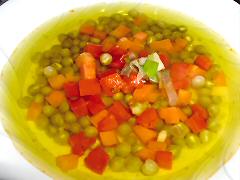 Kicking things off, I wanted to go for something like a miso or dashi based soup. In a bit of surfing about the net I spotted a note from reviewer William Grimes about a dish at a restaurant called Aleutia (that I’m pretty sure is no longer in business) offering lobster in a saffron dashi. The lobster being out of the question here (occasionally available, imported and frozen, at 400 pesos a kilo, or about $60 a pound), but I liked the idea of a saffron dashi – and it’s really simple to make – dashi being a broth made from dried bonito shavings and kombu seaweed, and then a simple addition of some powdered saffron to the mix and a bit of salt to perk it up. I thought about doing it with a whole paella thing going on – vegetables, some shellfish, and maybe even trying out that puffed saffron rice that we did in class – and I may do something like that in the future after working on the rice a bit – but we were having two other seafood dishes on the menu, so I went with a simple vegetable “garnish” of fresh peas, carrots, peppers, and green onion, something like what might be found in a paella. This might be a better soup for a warmer day – it was very tasty, but in retrospect, I think it was probably too light for a cold winter evening meal.
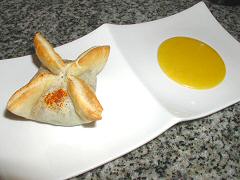 I wanted to do something with bacalao, or salt-cod, but it’s also prohibitively expensive here, and sold in whole sides of fish – I only needed a little – so I went with fresh cod instead. I was thinking along the lines of a cod fritter of some sort, with a nice Japanese dipping sauce – my favorite miso mayonnaise tamago-no-moto popped immediately to mind. But I’m not a big deep-fried food kind of person – on occasion yes, perhaps sitting by the seashore with a cold beer in my hand – the rest of the time, not so much. And while potatoes are a classic accompaniment in cod mixtures, since we were, as you’ll see, about to do a bit of potato on the next course, I decided that a touch of sweetness from batatas, the local yams, was the way to go. The filling – yams cooked with lots of garlic, add in the cod and a good amount of chopped parsley, salt, and shichimi powder to give it a little kick and add an additional Japanese touch. Encased in empanada dough, just made into a different form, and served up with the sauce – 3 egg yolks, juice and peel of a lemon, a ¼ cup of white miso, and about a cup of olive oil. Seasoned with salt and white pepper. Great combination!
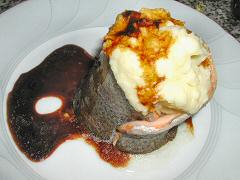 This was prettier in person, or in fish, than in the photo. Such is life – I tried a couple of shots and none of them really showed off the reflections of the salmon skin, and the, if I may use a Rachel Ray-ism, yumminess of the dish. The fish – simply deboned, lightly salted, and then coiled up with the skin on the outside, and put in the convection oven with the broiler on until just cooked. Topped with a heaping scoop of mashed potatoes with plenty of butter and cream, and a nice dose of wasabi powder, and salt. Then a simple ponzu sauce – juice of one orange and one lemon, a splash of white wine vinegar, soy sauce, bonito flakes, and salt to balance – warm it up and drizzle it over the dish – or just over the potatoes… we got lots of compliments on this one!
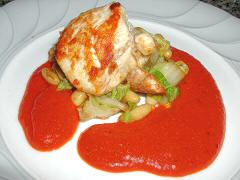 An entry on the Zagat’s Survey for a restaurant called Joe’s, in Venice, California, listed Crispy Chicken, Purple Yams, Baby Bok Choy Truffle Soy Brown Butter, Miso Piquillo Puree as a menu item – $27. Kudos to Joe’s for suggesting the idea that became this dish, even if I have no idea how they, in particular do it – the idea sounded delicious. The chicken – white breast meat coated in cornstarch and salt and then sauteed in a mix of olive oil and butter until it had a nice browned and lightly crispy coating. Sitting atop a saute of akusay, or Chinese cabbage, Japanese cabbage, Napa cabbage – you pick – with pochas, the small white beans from Navarra, cooked down in brown butter and finished with a splash of soy – I may never make cabbage and beans in any other way again, I could just eat a bowl of that it’s so good. Surround it with a simple puree of piquillo peppers, white miso, a splash of honey, and salt to balance. Henry asserts it’s the best chicken dish I’ve ever made. I’m not sure I’d agree, but it was pretty darned delicious.
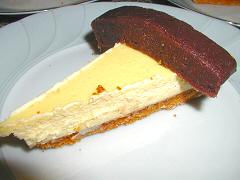 Last year for San Fermín I made a manchego cheese based cheesecake with marmalade topping. I really liked the cheesecake itself, though I couldn’t find any manchego when I went out looking, so I decided on a lightly salty goat’s milk cheese as a substitute, and it worked out really well – I do have a thing for a touch of salt in my desserts… I paired it up with a red bean paste – I realize that the Japanese have other desserts, but this one’s kind of ubiquitous, and it gave me a chance to play with making the stuff – which turns out to be pretty easy – rinse and then cook up some adzuki beans until they’re soft (you can soak them overnight first, but truthfully, they cook so fast anyway it’s kind of irrelevant). Then drain them, return them to the pot, and add ¾ the quantity of white sugar as the original volume of beans (e.g., in this case, 2 cups of uncooked beans, 1.5 cups of sugar), and cook them over low heat, stirring regularly to it doesn’t burn, for about 30-40 minutes – until it gets to a very thick paste consistency. Add a bit of salt, just under a teaspoon in this case, mix well, and leave to cool. After it was room temperature, I spread it out to about a ¾” thickness between layers of plastic wrap, and put it in the refrigerator to firm up a bit – it’ll still be soft and paste-like – if you want that more yokan texture that’s sort of a slightly rubbery feel, you have to add agar-agar or gelatin. Have to work on the presentation, but the combination of flavors was great.
Copyright © 2026 SaltShaker. This feed contains copyrighted photos and text from SaltShaker. If you are not reading this material in a feed aggregator or by e-mail subscription, the site you are viewing may be guilty of copyright infringement. Please contact [email protected] so that I can take appropriate action.
Plugin by Taragana
]]>