poultry – SaltShaker https://www.saltshaker.net Casting a little flavor (and a few aspersions) on the world of food, drink, and life Tue, 25 Aug 2020 16:44:59 +0000 en-US hourly 1 https://wordpress.org/?v=7.1 https://www.saltshaker.net/wp-content/uploads/2020/05/cropped-favicon-32x32.jpg poultry – SaltShaker https://www.saltshaker.net 32 32 French Africa https://www.saltshaker.net/20081202/french-africa https://www.saltshaker.net/20081202/french-africa#comments Tue, 02 Dec 2008 17:40:48 +0000 https://www.saltshaker.net/?p=1679 Read More French Africa]]>

“French speaking countries in Africa have always enjoyed a special relationship with their former colonial master. French influence in those countries remained strong even after independence, with currencies tied by a fixed exchange rate to the French franc, military agreements allowing the stationing of French intervention forces in Africa, and a strong presence of French companies in Francophone territories.”

– Emmanuel Wongibe, editor, Radio Deutshe Weller International

Buenos Aires – Fifty years have passed since the fall of French Equatorial Africa, splitting apart into separate states, tossing off the yoke of French colonial masters. Likewise in the neighboring Congo, and not far away in western Africa, in Mauritania. It seemed as good a moment as any to explore the flavors that spring from the combination of African tradition with French colonial cuisine.
Trout and Millet Cakes
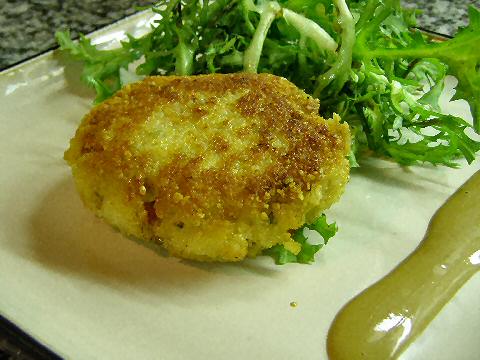
Starting off in the nation of Chad, two key ingredients struck my fancy – dried smoked trout, as a way of preserving them, and millet, a cereal grain that one rarely sees used outside of vegan cooking. In fact, several people I mentioned it to seemed to think it was only for use as bird feed, but no, millet is actually quite nutritious and delicious! I decided to go with fresh trout and millet, and make something approximating a crab cake. First I cooked the millet – a quick and easy boiling process, taking no more than about 10-15 minutes. I let it cool and then mixed it with chopped fresh trout, onion and red bell peppers, minced garlic and basil, a little hot paprika, lemon juice, smoked salt, pepper, and some beaten egg. All mixed together well, then formed into patties, rolled in breadcrumbs, and left to sit in the refrigerator for a couple of hours to firm up a little. I fried them in a mix of butter and oil, served them with a salad of frisee and arugula tossed with just a little olive oil, and on the side, a spicy sauce made of green tea, tahini, ginger, soy sauce, lemon juice, molasses, and ground habanero pepper.

Chilled Cucumber Mint Soup
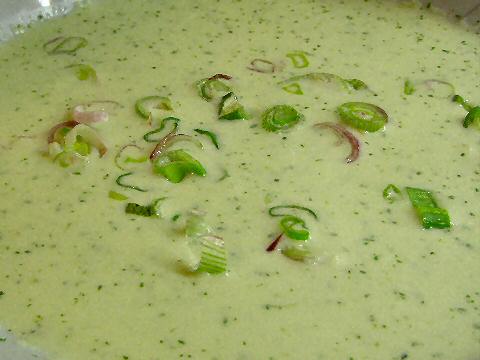
Moving on to Gabon, and starting with the idea of a simple salad, I gather made of little more than crushed or grated cucumber with chilies, garlic and vinegar. As usual, we like to offer up a soup, and with recent hot weather, a cold cucumber soup sounded like a good move. Into the blender went peeled cucumbers, ginger, garlic, lots of mint leaves, and a very small chili pepper. I pureed that, added “half-and-half” here that means adding equal parts of milk and cream, seasoned to taste with salt and white pepper, and served it simply topped with chopped green onions.

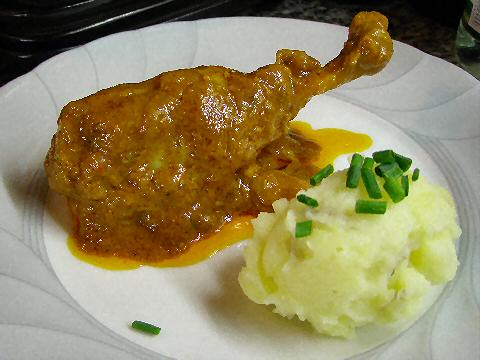
Braised Duck Legs in Tomato Peanut Sauce
While the judges on Top Chef last season may have poo-pooed the idea of combining tomatoes and peanuts in a sauce, I have to assert it was just the particular dish they were dealing with. African cuisine abounds with dishes that use both, from soups to stews to sauces. Starting from a traditional dish of the Congo that uses chicken stewed slowly in just such a combination, I decided to up the ante slightly and use duck. I separated duck legs into their two sections, browned them with some onions in a little oil, then covered them with water, covered the pot, and let them simmer away over low heat for just over an hour. I removed the legs to one side, and into the pot went some white wine, plenty of cayenne pepper, about a cup of tomato paste and an equal amount of pure peanut butter, a little nutmeg and black pepper. Turning the heat up high, I cooked that all down until the sauce was reduced by about half, stirring regularly to make sure the peanut butter doesn’t lump together and burn. For service, the duck legs went back into the sauce, reheated to just a simmer. While traditionally served with yuca root, it’s out of season here, and what’s available is fibrous and/or rotting – so simple mashed potatoes on the side did the trick.

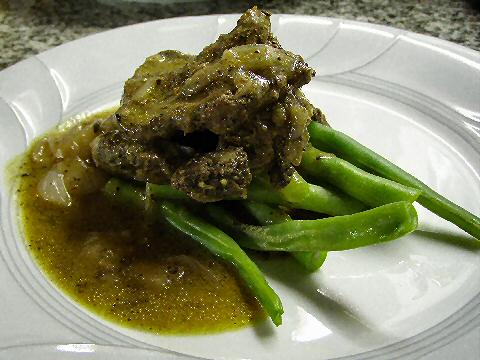
Coconut Pepper Beef
Mauritania has a quite different cuisine from the central African countries we’d started with. Having a more Arabic influence, and, in fact, that’s the major language of the country, as opposed to French in the other three, much of the food is reminiscent of dishes I’ve seen from Morocco. One, quite different, caught my eye – a beef dish stewed in coconut and mixed peppers. I decided on a style more like a traditional pepper steak – I ground together black pepper, allspice, coconut, and salt, and rubbed the beef with it. I left that to sit for several hours. In a dutch oven I sauteed thin wedges of red onion in a mix of olive and dende (palm) oil, then added the beef and cooked to lightly brown. Topped up with a little water, I turned the heat down low and let the beef (rib-eye steak) braise for about 45 minutes until nice and tender. Removing the beef to the side, I thickened the remaining liquid with a beurre manié, a paste of equal parts butter and flour (which helps stop the flour from clumping, and adds richness to the finished sauce), and served the beef, onions, and sauce over some blanched and then sauteed green beans.

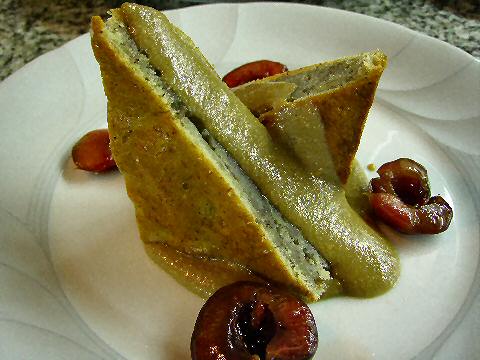
Banana Cake with Brown Sugar Cream
Finishing off, without a fifth country to explore (at least one that was celebrating 50 years of independence), I decided on a simple banana dessert. A sheetcake cut into triangles (1¾ pastry flour, 2¾ teaspoons baking powder, ½ teaspoon salt, 1?3 cup cream cheese, 2?3 cup sugar, 1 teaspoon cinnamon, ½ teaspoon mace, ½ teaspoon nutmeg, 2 eggs, 4 very ripe bananas – all whipped together and then baked in a hot oven until puffed and brown). Over and under the cake, a simple sauce made from boiling together ½ cup cream cheese, ½ cup butter, 1 cup brown sugar. A few kirsch marinated cherries rounded out the dish.


Copyright © 2026 SaltShaker. This feed contains copyrighted photos and text from SaltShaker. If you are not reading this material in a feed aggregator or by e-mail subscription, the site you are viewing may be guilty of copyright infringement. Please contact [email protected] so that I can take appropriate action.
Plugin by TaraganaFacebooktwitterredditpinterestlinkedinmail ]]>
https://www.saltshaker.net/20081202/french-africa/feed 2
Who? What? Where? When? How…? https://www.saltshaker.net/20081125/who-what-where-when-how https://www.saltshaker.net/20081125/who-what-where-when-how#comments Tue, 25 Nov 2008 13:08:49 +0000 https://www.saltshaker.net/?p=1641 Read More Who? What? Where? When? How…?]]>

“First things first, but not necessarily in that order.”

– Doctor Who

Buenos Aires – There was much speculation, much buzz, much questioning… just exactly what were we going to do at Casa SaltShaker to celebrate 45 years since the pilot of Doctor Who aired – celebrating the longest running science fiction show on television – a show that every sci-fi technogeek nerd has watched untold episodes of – except me. It was very odd. I got all excited about the idea as a theme – it’s one of those wacky ones that basically make no constraints on what I do in the kitchen, they’re more of an excuse to simply play around with pots and pans (okay, a faint hint of English thrown in to this one, but very faint) – and then I realized, here I consider myself a sci-fi type of guy – it’s what I read for enjoyment most of the time (I’ve had a running subscription to Asimov’s Science Fiction magazine since its inception in 1977 – it’s one of only two magazines that I’ve kept my subscriptions to after moving to BA!), my preference in films and television, this particular one started up when I was five years old and has therefore been running consecutively with me most of my life, and… umm… err… I’ve never seen the show. I didn’t even know what it was about. Really. I think I’ve caught a few minutes of various episodes here and there, but no more than that. Crap. Now I have 45 years worth of episodes to start downloading and watching… not that I did that prior to this last weekend, but they’re now on my download list.

So, enough about all that – on to the food, right?
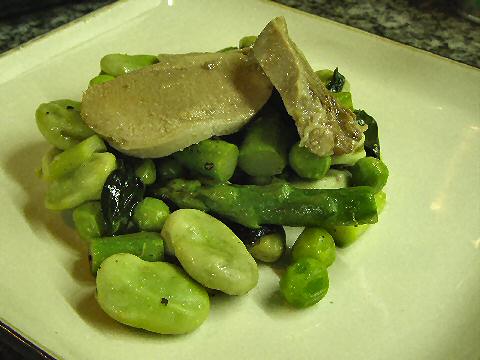
Poached lamb’s tongue with spring vegetables
Lamb’s Tongue. Yes indeed, the tongue of the lamb. Hey, you didn’t object when I made veal tongue for the Romanian dinner… did you? It sounded Englishish…. Poached Lamb’s Tongue. Besides, my meat supplier called me up and said, “You know those lamb’s tongues you wanted when all I could give you were veal tongues? I found some, I have five kilos of them, they’re yours if you want them.” I took three kilos. I cooked them exactly the same way – the veal ones came out so well – and so did these. This time, however, I served them warm atop a medley, or perhaps a ragout, of spring vegetables – asparagus, fava beans, peas – all blanched and then sauteed in olive oil with a couple of handfuls of fresh mint and basil leaves.

For the soup, I decided on a chowder. I’m not sure why. It’s really more of a cold weather soup, and it’s steamy hot here right now. But, I made a chowder, and to give it that slight britishism, it’s a curried chowder. The broth – in a pot, I simmered together: 1 pear, 1 onion, 3 cloves of garlic, 2 bay leaves, 4 sprigs of thyme, a teaspoon of curry powder and one of turmeric. When nice and flavorful I pureed it in the blender and then strained it. Meanwhile, I sauteed together: diced bacon, potatoes, carrots and celery, and finely chopped shallots, flavored with fresh thyme and bay leaves. When the vegetables were starting to soften, I poured a cup or so of white wine over the mixture and cooked it until the liquid was mostly absorbed or evaporated. Then I poured the broth over it all, brought it up to a simmer, cooked it until the vegetables were done. I added about a pound each of chopped mussels and clams, cooked for just a minute or two, and then finished the soup with about a cup of heavy cream. Really good, but really, much too heavy for this time of year.

Next, I was thinking about the English dish cauliflower cheese – yeah, it’s about as appetizing most of the time as those boil-in-the-bag cauliflower and cheese sauce things I grew up with. Maybe less so. So I turned it inside-out. Remember those baked, puffed, golden agnolotti from our recent northern Basque dinner – I filled the agnolotti with cheese – mostly cheddar, with a little mozzarella and parmesan for balance – and then made a cauliflower cream to serve it with – a head of cauliflower cut up in florets, a large white onion, some coriander and sweet paprika, and cover the whole thing with milk, simmered until the cauliflower was soft, then pureed the whole thing – it becomes a medium-thick sauce. Season with salt and white pepper, ladle on the plate, place a couple of baked agnolotti atop, a few scattered chives…
Reimagined Chicken Kiev
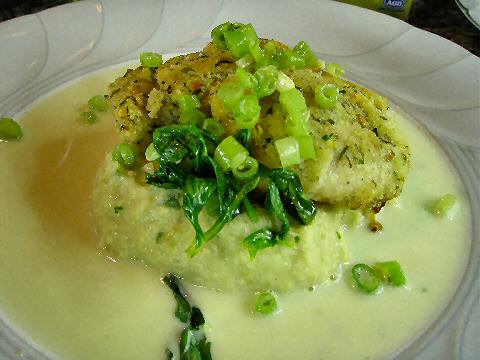
As long as I was turning things inside out, why not do the same for that classic London hotel dish, the Chicken Kiev – a retro food if ever there was one. Okay, the original is something to behold – a chicken breast, breaded and fried, that when you cut into it releases spurts of melted butter because it’s been stuffed with butter, garlic and parsley until it can’t hold any more… usually served with some mashed potatoes and overcooked green beans. At least that’s the way I remember it. So, pound the chicken breasts thin, dip them in flour seasoned with salt, garlic and parsley, then into beaten egg, then into breadcrumbs seasoned with the same. Sauteed quickly to brown them and finished in the oven. Underneath, a green and white bean puree – soak and then cook those big white butter beans, here called pallares (unless you can find them fresh) – when they’re almost done add fresh green beans and a handful or two of celery leaves. Cook until done, puree, season with salt and pepper. The sauce, simmer the cloves from two heads of garlic in two cups of chicken stock, finish with a few knobs of butter (if you want it thick, you could mix a little flour in too, but I didn’t want it to be that heavy), and lots of chopped fresh parsley. Scattered across the top, finely sliced green beans sauteed quickly with chopped celery leaves.

Sticky Toffee Pudding
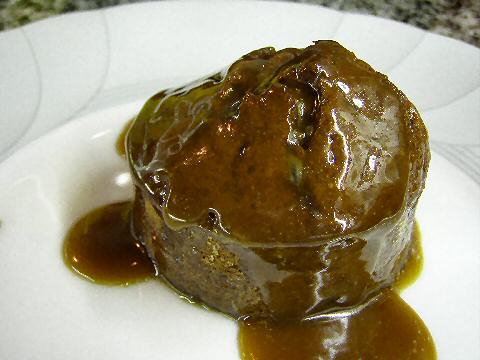
The one real nod to British cooking, and some things are best left as is – a Sticky Toffee Pudding. Not my recipe(s). The cake part, from chef Gale Gand, and the sauce part from the Food Network’s archives. Why the split? A couple of different comments on both sites, and other sites, that liked Gale’s cake in particular, but weren’t as thrilled with her toffee sauce, and vice versa for the other – someone even made a comment that they were going to try exactly what I did – and it worked out really well.

Now, I’m off to watch eight zillion episodes of Doctor Who….. well, not really, I’m off to research a couple of articles coming up….


Copyright © 2026 SaltShaker. This feed contains copyrighted photos and text from SaltShaker. If you are not reading this material in a feed aggregator or by e-mail subscription, the site you are viewing may be guilty of copyright infringement. Please contact [email protected] so that I can take appropriate action.
Plugin by TaraganaFacebooktwitterredditpinterestlinkedinmail ]]>
https://www.saltshaker.net/20081125/who-what-where-when-how/feed 2
Take a Bite out of History https://www.saltshaker.net/20081120/take-a-bite-out-of-history https://www.saltshaker.net/20081120/take-a-bite-out-of-history#comments Thu, 20 Nov 2008 19:49:41 +0000 https://www.saltshaker.net/?p=1587 Read More Take a Bite out of History]]>

“The history of intellectual growth and discovery clearly demonstrates the need for unfettered freedom… the right to think the unthinkable… discuss the unmentionable, and challenge the unchallengeable…

To curtail free expression, strikes twice at intellectual freedom… for whoever deprives another of the right to state unpopular views… necessarily deprives others of the right to listen to those views.”

– C. Vann Woodward, Pulitzer Prize winning historian, of the American South

Buenos Aires – Joining the ranks of our centenarians is Comer Vann Woodward, one of the preeminent historians of the United States during the 20th century – with a specialization in race relations south of the Mason-Dixon Line. Woodward was born and raised in Arkansas, so that gave us a starting point for our Casa S dinner – it’s not one of the first states I think of when I start thinking about American regional cooking, but like the other 49 states, it has its unique quirks, flavors, and recipes. Game, fresh trout, tomatoes, watermelons, and fried pies all popped up time and again in researching ideas – it didn’t take long to come up with an Arkansas inspired menu – quite probably nothing that would be directly recognizable (other than the fried pie) at your average roadside cafe outside of Little Rock, but we didn’t hear any complaints…
Buffalo River Wings
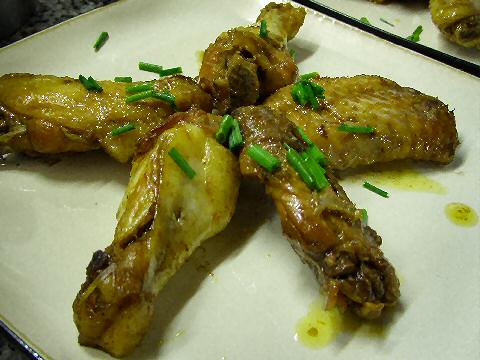
Now, I’d venture to guess that we’re all familiar with buffalo wings, those red spicy hot finger-lickin’ good bites of chicken with a little ranch or blue cheese dressing on the side. But how many of us knew about Buffalo River Wings – presumably a tongue-in-cheek name reference based on the national river that flows through northern Arkansas, and a completely different take on this epicurean delight. While I’ll always be one of the first in line for something spicy hot, these have a more sweet spicy tang that everyone seemed to enjoy. A little messy, like the other style, but they disappeared fast. Cut about 4-5 pounds of the wings into their separate joints – set aside the wingtip section (I stuck them all in the freezer to use for chicken stock), and then brown the other two sections (the drumstick-ette and whatever one calls the two-boned other one) in a deep dutch oven. Combine a cup of soft brown sugar, a cup of soy sauce, ½ cup of rum (the original recipe called for brandy, but I didn’t have any cooking brandy on hand), 1 tablespoon each of dry mustard powder, ground chipotle pepper and ground ancho chili peppers. Pour over the wings, mix them up, cover and simmer over low heat for about two hours – stirring them up every now and again. After somewhere between an hour and an hour and a half, take the cover off so that the liquid evaporates down to a glaze – it also prevents the wings from completely falling apart (which almost happened on the first night as I waited too long to remove the lid).

The second course, our soup, you’ve seen before – with Arkansas reputation for good tomatoes, I thought about the wonderful sun-dried tomato soup that I’d made a couple of months ago for our umami dinner.
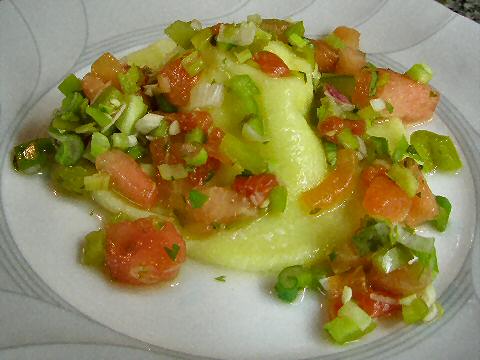
Ricotto Raviolon with Fire & Ice Salsa
I spotted several references to “modern Arkansas” cuisine that talked about Fire and Ice Salsa – I presume it’s a twist on some sort of classic recipe, though I didn’t find that information – or maybe it’s just a twist on the idea of a salsa given the Arkansas penchant for watermelons. The raviolones, or large ravioli, are filled with a mix of homemade ricotta that I flavored with a bit of white miso paste and some shichimi, or seven-spice powder, then boiled up after being left to dry for an hour or so. The salsa was a mix of diced watermelon, green bell pepper, and green onion with finely chopped cilantro, garlic, and jalapeño peppers, a good dash of lime juice, and some salt. I warmed the salsa up to ladle over the ravioli. The watermelon makes a refreshing stand-in for tomatoes, and it can actually be hard to tell the difference unless you know what it is. The pasta dough, by the way, which I realize I forgot to give the recipe for the other week when I made agnolotti, is a mix of 1¾ cup of pasta flour, 1 whole egg plus 6 egg yolks, 2 teaspoons of olive oil and just enough milk to get it to come together – roughly 2 tablespoons, but it will vary depending on the absorbency of your flour.

The main course was a minor twist on the oven roasted trout that I’ve made before with the charred tomato sauce – the trout were skewered in a ring shape, then drizzled with olive oil and baked in the oven – no pumpkin seed crust. Underneath, some buttermilk mashed potatoes (I had the suero, or whey, from making the ravioli handy – I used most of it in the tomato soup, but kept a cup or so to flavor the potatoes, and then the sauce drizzled around.
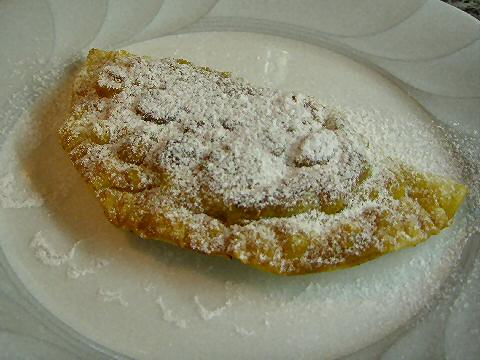
Fried Peach Pie
The final note for the evening, a Fried Peach Pie – probably should have whipped up some vanilla ice cream to go on the side, or maybe something lightly spiced like cinnamon or nutmeg. The dough, pretty much the same as an empanada dough, but with sugar filling in for salt – 1 pound of cake flour, 6 tablespoons of neutral oil, 1 egg, 2 teaspoons of sugar, and just enough hot water to get it to come together into a soft, easily knead-able dough. Let it sit an hour, then roll out small nuggets into rounds, fill with a mix of diced peaches that have been cooked down in butter, brown sugar and nutmeg, then cooled – fold it over to create a half moon shape, then fry in very hot oil until brown and lightly puffed on both sides. Sprinkle with powdered sugar and realize that this is what Hostess Fruit Pies® only dream of being.


Copyright © 2026 SaltShaker. This feed contains copyrighted photos and text from SaltShaker. If you are not reading this material in a feed aggregator or by e-mail subscription, the site you are viewing may be guilty of copyright infringement. Please contact [email protected] so that I can take appropriate action.
Plugin by TaraganaFacebooktwitterredditpinterestlinkedinmail ]]>
https://www.saltshaker.net/20081120/take-a-bite-out-of-history/feed 2
Straddling the Pyrenees https://www.saltshaker.net/20081113/straddling-the-pyrenees https://www.saltshaker.net/20081113/straddling-the-pyrenees#comments Thu, 13 Nov 2008 21:34:52 +0000 https://www.saltshaker.net/?p=1550 Read More Straddling the Pyrenees]]>

“We still think of ourselves as Basques”, says Mme Pitchoauajue. “Until I went to school at the age of seven, I couldn’t speak a word of French.”

– Graham Simmons, The Basque Way

Buenos Aires – Although it was suggested, I did not wear a proper French Basque Beret to celebrate “National Day” in the northern Basque country, i.e., the French side of the Pyrenees. We hear a lot about the Spanish Basque side of things, and all the high falutin’ restaurants along the coast and up into the mountains there, but we rarely hear about what’s happening in the southwest of France. So, how could I pass up the opportunity to play with some classic flavor combinations from the countryside? Even if I wasn’t wearing a beret.
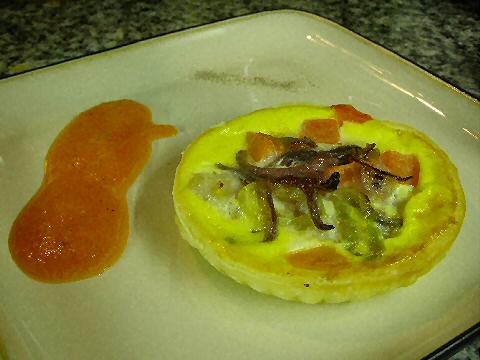
Basque cod tartlet with spicy pepper sauce

Although it would have been more traditional to use bacalao, or salt cod, in this dish, I was feeling inspired by an array of fresh fish at the local pescadería, including a trio of beautiful fresh, whole cod, just ready to be filleted. My first idea was to fill some fresh piquillo peppers with some sort of cod preparation, but none were to be had this last week. A bit of thinking, and I decided on small tartlets filled with cubes of fresh cod, diced tomato, and thin strips of lemon zest. Added to that, some frying peppers and red onion, sauteed in a little olive oil, and then the whole thing topped with a scoop of beaten egg and milk, then baked until lightly browned. On the side, a puree of red bell pepper, orange juice, a small chili pepper, cumin, and salt.

If you’ve been reading SaltShaker for awhile, you’ve seen several iterations of panade, a slow cooked onion and bread soup. There was a very interesting looking Basque recipe for a garlic soup, and somehow, I sort of put them together – following the exact same procedure as for the onion panade, but using about 3 full heads of garlic, the cloves thinly sliced. What a great garlic soup!!!
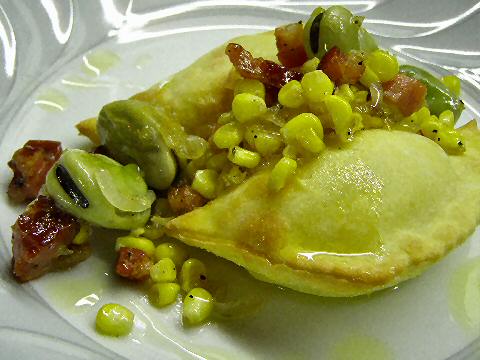
Baked agnolotti with fava bean ragout

This was a fortuitous accident. It started out with the idea of a fava bean filled ravioli, well, really, a half ravioli, an agnolotti, with a sort of trout cream sauce. But I got to doodling, and decided to put the trout inside the agnolotti – it’s a simple mix of homemade cream cheese, smoked and fresh trout, a little salt and pepper. The agnolotti dough was a basic egg yolk pasta. I decided to make a saute of fresh fava beans and corn with shallots, bacon and chives tossed in – lots of olive oil. Now here’s the accident. I laid the agnolotti out very carefully on silpats, those lovely non-stick sheets. They stuck. I couldn’t remove them without tearing them to shreds, so boiling them up instantly became out of the question. Now, it happens that I like baked pastas of various sorts, and I figured – they’re already on the baking sheets, and at least once they’re cooked, even if they’re still somewhat stuck to the silpats, I can slip them off with a spatula. Turns out they puff up almost instantly, brown, unstick, the filling solidifies a bit, almost like a ricotta type filling. Delicious, really delicious. This one goes in the cookbook!
Basque chicken

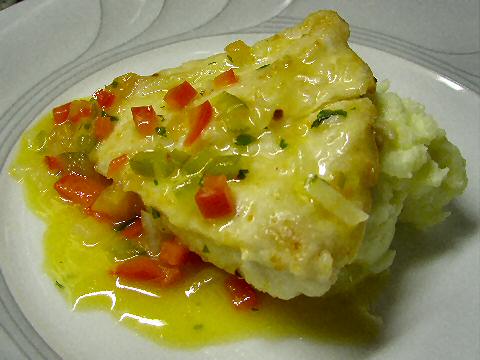
This is more or less a deconstruction of a traditional poulet a la vasca, or Basque-style chicken. Normally it’s a slow cooked braise of pieces of chicken with potatoes, peppers, onions, tomatoes, in a white wine and olive oil combination, thickened with a little flour. I separated the components – mashed potatoes instead of whole, finished with lots of cream and butter. Atop those, sort of a chicken milanesa – pounded thin breast of chicken dipped a couple of times in a mix of flour, salt, and cayenne. The sauce, slow cooked onions, green and red peppers, all diced up fine, in olive oil, then tomatoes added towards the end of the cooking, a good couple of splashes of white wine, and then thickened with a paste of butter and cornstarch, cooked just until the sauce was the consistency I wanted.

Finally, a fairly straightforward cheesecake using our homemade cream cheese, but substituting roughly half of the volume with a fresh goat’s milk cheese. Atop, a warm kumquat and cinnamon marmalade.

See, I didn’t need a beret….


Copyright © 2026 SaltShaker. This feed contains copyrighted photos and text from SaltShaker. If you are not reading this material in a feed aggregator or by e-mail subscription, the site you are viewing may be guilty of copyright infringement. Please contact [email protected] so that I can take appropriate action.
Plugin by TaraganaFacebooktwitterredditpinterestlinkedinmail ]]>
https://www.saltshaker.net/20081113/straddling-the-pyrenees/feed 2
Spring Simplicity https://www.saltshaker.net/20081111/spring-simplicity https://www.saltshaker.net/20081111/spring-simplicity#respond Tue, 11 Nov 2008 13:02:31 +0000 https://www.saltshaker.net/?p=1523 Read More Spring Simplicity]]>

“We all have hometown appetites. Every other person is a bundle of longing for the simplicities of good taste once enjoyed on the farm or in the hometown [he or she] left behind.”

– Clementine Paddleford, food writer, journalist

Buenos Aires – One of the pluses of a private dinner at Casa SaltShaker is that it’s generally less experimental. We all know that kitchen experiments sometimes work well and sometimes not so much – and our regular public dinners get a little of each. It’s part of the process, part of the fun – sure, if something’s a particularly complicated dish I’ll play with it in advance, but quite often, the folks trying my dishes at these dinners are trying my first one or two stabs at a new dish or new variation. So far I haven’t had to go for any last minute emergency take-out…. Generally, for the private dinners I pick from favorites or dishes that worked out particularly well, or the customer picks from dishes that they’ve read about here that sounded especially good. Still, if things are left to me, I try to put in at least one new twist or new dish entirely, even on those menus.

We’ve become particularly popular with various folk from the U.S. embassy here in BsAs, and have had many of them at dinners, and several have booked private functions, including this last week, when they held a goodbye party for one of their number who is heading off to a new posting. Four of the dishes I selected from some favorites – an oyster mushroom coca, with a more classic pizza crust, a pink gazpacho, pollack (instead of hake) in roasted green pepper broth topped with fried garlic, and a chocolate lemon kiss tart. But, snuck in there as the main course, I decided on a simple chicken and pasta dish, just to celebrate the produce now arriving in the markets.
Chicken with Casareccia Primavera
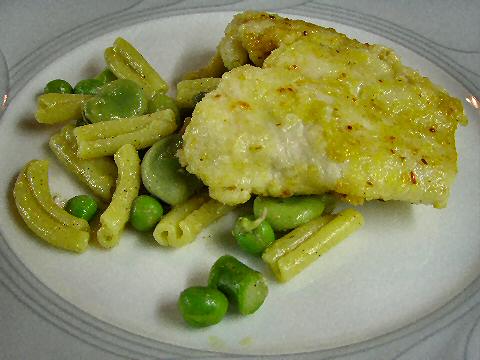
The chicken is boned chicken breasts, pounded flat, and then dusted in a mix of flour, salt, and cayenne pepper – a couple of times so it builds up a nice little coat (wait 10-15 minutes between coats), and then pan fried in butter and oil. Below it, a simple pasta, casareccia, a Sicilian “twisted tube” – really more of a scroll, looked at from the end is “S” shaped. This was tossed with blanched fresh fava beans, peas, and asparagus which I then cooked until they were done in brown butter, finishing it up with a dollop of white miso and some freshly ground pepper. Not quite a “classic” pasta primavera, but the flavors of the vegetables simply evoked spring.


Copyright © 2026 SaltShaker. This feed contains copyrighted photos and text from SaltShaker. If you are not reading this material in a feed aggregator or by e-mail subscription, the site you are viewing may be guilty of copyright infringement. Please contact [email protected] so that I can take appropriate action.
Plugin by TaraganaFacebooktwitterredditpinterestlinkedinmail ]]>
https://www.saltshaker.net/20081111/spring-simplicity/feed 0
In the Middle https://www.saltshaker.net/20081110/in-the-middle https://www.saltshaker.net/20081110/in-the-middle#comments Mon, 10 Nov 2008 12:34:20 +0000 https://www.saltshaker.net/?p=1518 Read More In the Middle]]>

“The Federal Republic of Central America, also known as the United Provinces of Central America, was a short-lived state in Central America, which consisted of the territories of the former Captaincy General of Guatemala. An experiment in republican democracy, it existed from July 1823 to 1840. It was intended to be a federal republic modeled after the United States of America…. The republic consisted of the states of Guatemala (which initially included a large part of what is now the Mexican state of Chiapas), El Salvador, Honduras, Nicaragua, and Costa Rica. (Panama was still part of Colombia at the time.)”

– Wikipedia

Buenos Aires – There was nothing in particular about the weekend that inspired a Central American themed dinner, simply whim. I’ve been exploring some of the cuisine from the various countries that make up “Central America” (now seven countries rather than the “original” five, Panama and Belize having been added in later on). The fact that the short-lived Federal Republic had five member states made it easy to fit into a five course tasting menu, you know?
Sardine stuffed potatoes
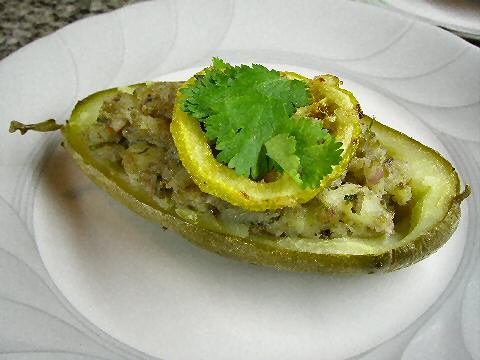
This just goes to show how far afield my “inspirations” sometimes get. I started from a Salvadorean dish of yuca frita con pepesquitas – fried tapioca root with fried baby sardines atop… I had in mind something like the fritto misto that I’d recently had in New York at Scarpetta. But, as it turned out, the yuca in the markets here was all dried out or rotting, so that idea quickly got dumped. I’m also, when it comes down to it, not a big fan of fried foods, especially for Casa S dinners – it’s hard to manage the quantities we need to put out a dozen plates when deep-frying in a saucepan. So then I thought, potatoes. But I was already leaning away from frying, and come on, fried potato chips and sardines? A bit of thinking about it and I decided to stuff the potatoes with sardines – I simply baked the potatoes, cut them in half lengthwise, scooped them out, and mixed the potato with mashed cooked sardines, some chopped rosemary and parsely, lemon juice, chopped chilies and onions. I topped each with a fried lemon slice, so I got in a little frying in the end. Back into the oven to get them nice and hot and served.

pozole
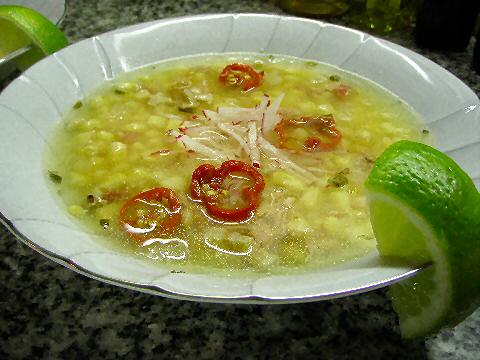
There are more versions of pozole or posole out there than I care to count – not only national and regional differences, but probably from house to neighboring house – so whether or not this one is particularly Costa Rican is, perhaps, in question. The one thing they have in common is a base of corn… after that, all bets are off. The first night I used fresh yellow corn, but it just wasn’t quite the way I wanted it, the second night I used dried, hulled white corn, soaked it overnight and then used it in the soup. The stock was made with onion, garlic, diced bacon, and a couple of chicken thighs (which I later fished out, skinned and boned, and chopped up, adding the meat back into the soup). When those are all lightly browned, I added in the corn and a good amount of oregano. Then I topped it up with water and let it simmer away for a couple of hours until the corn was done and the flavor was where I wanted it. Simple salt and pepper seasoning, topped with julienned radishes and pickled baby bell peppers, with a wedge of lime for a bit of citrusy zip – traditional tico toppings.

Pipian de pollo
Heading to Guatemala, I decided on a pipian de pollo, sort of a cousin to a Mexican mole dish. The chicken is simply dusted in flour, salt and cayenne, and pan roasted until done. The sauce – I toasted green squash and sesame seeds until lightly golden, then added cinnamon, guajillo chili powder, onions, tomatoes, cayenne, cloves, salt, pepper, and a little bit of chocolate. Cooked that all together for about half an hour, then pulsed it a few times in the blender to give a coarse sauce. We served it over rice, dusted with some cayenne flakes.

Baleada super special reinterpreted
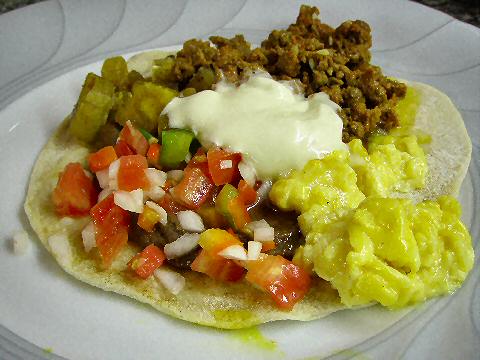
In the Honduras there’s a traditional fast food snack called a baleada, so named for its shape, like a bala, or bullet – more or less, it’s like what we think of as a burrito, with, as I understand it, only one closed end. There are numerous versions, though at its base there is the basic baleada, a flour tortilla filled with refried beans, then there’s the “special”, that adds some basic condiments and cheese, and then there’s the “super special”, which can add any or all of plantains, scrambled eggs, chorizos, and more. For presentation’s sake, I decided to go open-faced, and divide the tortilla up sort of like a quattro estaciones pizza. I made the fresh tortillas, topped them with refried red beans and a bit of cheese, then in the four cuadrants put, respectively, fried plantains, salsa criolla (chopped bell peppers, tomatoes, onions), soft scrambled egg, and beef chorizo sausage (the beef isn’t traditional, just a whim), then topped all that with a dollop of homemade sour cream. I love these – my kind of street food – though perhaps a more elegant presentation is in order… if I can figure one out.

Beef Chorizo1 kilogram of bife de cuadril (rump roast), ground coarsely
2 teaspoons salt
4 tablespoons ají rojo powder (mild red pepper)
¼ teaspoon powdered cloves
2 tablespoons smoked paprika
2 cloves of garlic, minced
1 teaspoon oregano
3½ tablespoons cider vinegar

Mix all the ingredients together and let sit in the refrigerator, covered, for at least 4-5 hours – overnight is better. You could then stuff sausage casings if you wanted, I was using just the sausage meat, so sauteed it as it was at that point.

Roasted Strawberry & Almond Cheesecake
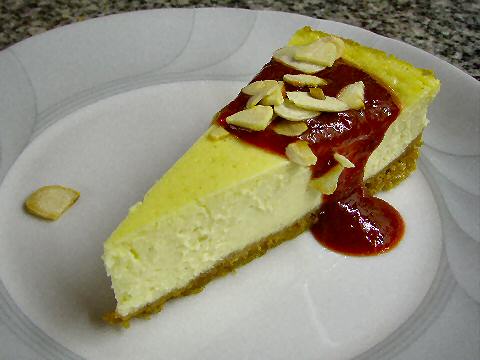
Finally, on to a simple, basic cheesecake, using part sheep’s milk cheese, as this was inspired by a requesón, which is a sheep’s milk tart. Normally made with an almond crust and topped with sliced strawberries, I went with a simpler cookie type crust, then topped it with a roasted strawberry sauce and toasted almond slices.

Overall, I’d say most folk were quite happy with dinner – I know we were.


Copyright © 2026 SaltShaker. This feed contains copyrighted photos and text from SaltShaker. If you are not reading this material in a feed aggregator or by e-mail subscription, the site you are viewing may be guilty of copyright infringement. Please contact [email protected] so that I can take appropriate action.
Plugin by TaraganaFacebooktwitterredditpinterestlinkedinmail ]]>
https://www.saltshaker.net/20081110/in-the-middle/feed 1