“Human beings make life so interesting. Do you know, that in a universe so full of wonders, they have managed to invent boredom?”
– Terry Pratchett, Author
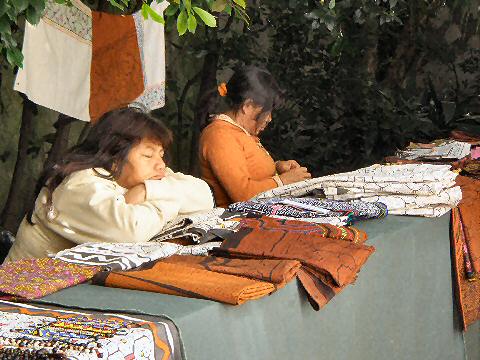
I’ve mentioned before that we offer cooking classes here at Casa SaltShaker. In the past, it’s primarily just been a simple, if you want to learn how to make something in particular, let me know, we’ll schedule a time, and we’ll do that – and we’ll still have that option available. But one of the most common requests I get is to know “what’s on your class schedule coming up?” And since we’ve never had a class schedule, it’s been tough to give that one a solid answer, you know? That’s all about to change. We’re going to start offering a series of classes for 1-3 people at a time (and if there’s more interest, we’ll work out more than one day/time to offer the same class) – both single session classes as well as multiple session ones.
There is now a page accesible in the right-hand column of the blog, easy to look at and see what’s coming up, along with a detailed description of each class.
Now, it may seem like an ambitious first class, but I had a recent request from a young gentleman here in town to learn “the basics of Italian cooking”. As he put it, while he can follow a recipe and cook something for dinner, he finds himself feeling like an artist who doesn’t have or understand the color palate. So the first offering is going to be a ten session, yes, ten session, hands-on Introduction to Italian Cooking – during each of which we’ll end up producing 2-4 dishes, and sitting down together and enjoying them. I haven’t finalized the times with the original requestor yet, though I think we’re be aiming at Tuesday morning carrying into lunch – as I said, if there’s enough interest, we can schedule this for another day and time as well.
If joining us for the Color Palate of Italy strikes your fancy, drop me a line and let’s organize the class(es). If something else is on your mind – let me know that – whether you want me to setup an individual class for you, or add it to the public schedule – let’s get cooking!
Copyright © 2026 SaltShaker. This feed contains copyrighted photos and text from SaltShaker. If you are not reading this material in a feed aggregator or by e-mail subscription, the site you are viewing may be guilty of copyright infringement. Please contact [email protected] so that I can take appropriate action.
Plugin by Taragana




 ]]>
]]>“Whoe’er has gone thro’ London street,
Has seen a butcher gazing at his meat,
And how he keeps
Gloating upon a sheep’s
Or bullock’s personals,
as if his own;
How he admires his halves
And quarters–and his calves,
As if in truth upon his own legs grown.”
– Thomas Hood, 19th century poet and humorist
Buenos Aires – One of the most common areas of questions I get is about the cuts of meat here in Argentina. The usual comes from an expat, looking for a particular cut of meat that they remember fondly from back home. Or sometimes it’s a visitor simply trying to figure out what part of the animal they’re ordering off a menu. And here’s the rub, as they say, beyond different names because it’s a different language, they’re simply not the same cuts of meat. Think of it this way – if I put a block of clay in front of you and tell you I want it divided into eight pieces that don’t have to be equal in size or form, I’m going to get a different division from every person I do that with. And, culturally, traditional ways to cut up an animal have come to vary from place to place – not just Argentina. Look, for example, at these first two diagrams (lifted and modified from answers.com, though I have the feeling they got them from elsewhere) – the “primary” cuts of beef in the U.S. and Britain (each primary cut gets further broken down into secondary cuts):
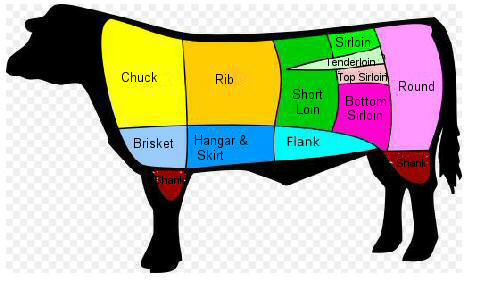
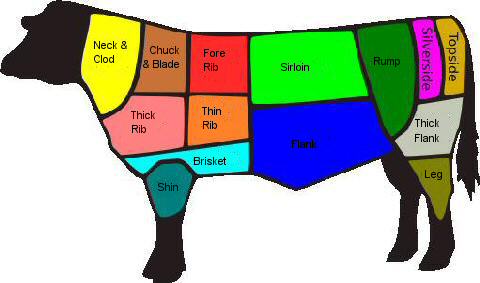
The first diagram is that of the primary cuts we’re used to in the U.S. (with a minor alteration, where I have “Hanger and Skirt” is tecnically referred to as the “Plate”). The second diagram is the same animal cut the way it would be cut in Britain. You can see that the animal is simply divided up in a very different manner, let alone different terminology. That’s not to say you can’t roughly approximate a particular steak between one country and another, but it would be hard to get the exact same thing.
Moving on to Argentina, the primary cuts look like this:
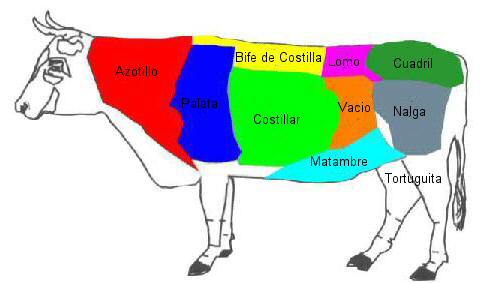
Now as I mentioned, these are just the primary cuts – for example, if one starts along the spine of the animal, moving from about midway through the azotillo and on through the bife de costilla, the individual cuts are the aguja, bife ancho, & bife angosta. The cuadríl is divided into the cuadríl, colita de cuadríl, & peceto. The costillar is split into part of the bife de chorizo and various rib cuts, while the paleta, continues down to the falda and then into that white space in front of the matambre. Inside of that, surrounding the diaphragm, is the entraña, or hanger steak. The ever popular bife de chorizo runs basically the same as a U.S. tenderloin, along the bottom of the lomo and on into the top of the costillar, basically forming a giant chorizo, or sausage, shaped cut that is on the inside of the ribs.
The most common cuts you’ll see in steakhouses, and their closest U.S. equivalents, since those are the ones I’m most familiar with (keeping in mind that they are almost all served boneless here), are:
asado de tira – ribs, but cross cut in strips (with bone)
bife de lomo – sirloin
bife de chorizo – tenderloin
cuadríl – rump steak
entraña – hanger steak
ojo de bife – rib-eye
peceto – top round, the “best” end of it is essentially a filet mignon
vacio – flank steak
falda – skirt steak
matambre – flank steak where it continues across the belly
Three other terms to know, though only two that you’re likely to see on a menu – ternera is a calf that is 1-2 years old, novillo is a male calf that is 2-3 years old (there is some overlap of the categories as the grading is partially by weight), vaquillona is a female calf, 2-3 years old, but I’ve never seen that on a menu, though very occasionally in a butcher shop.
Obviously there are more cuts here and there that aren’t diagrammed or explained, but hopefully this gives a good basic overview, and gives a sense of why it’s so hard to answer the question when someone asks for a direct translation.
Copyright © 2026 SaltShaker. This feed contains copyrighted photos and text from SaltShaker. If you are not reading this material in a feed aggregator or by e-mail subscription, the site you are viewing may be guilty of copyright infringement. Please contact [email protected] so that I can take appropriate action.
Plugin by Taragana
]]>“‘Calmness,’ said Aaron quietly, ‘is a drink we can buy in the bar next door. Come.'”
– from One More For The Road, by Ray Bradbury
Buenos Aires – Virtually everyone who visits this town, and many who live here, comment regularly on the bus system. Apparently buses are the theme of the day, as my friend Sally has written up what she considers to be the difficulties in using buses in Costa Rica – perhaps we’ll start a trend. She enumerated many of the difficulties, most of which are duplicated or at least similar here – though I think they have it made. They have a bus map, drivers who give change, and electronic sensors, which I won’t even touch upon. We have the Guia T, a booklet that takes… some getting used to. I’ve mentioned it before in passing, but never really described trying to use it. The book is divided into three sections. Number 1 – a listing of every street in town, alphabetically, sort of – since many streets here are named after people, sometimes the streets are listed by first name and sometimes by last name, you have to check both… and, of course, since many streets signs, and people in general, refer to the streets only by last name, you might not know the first. The listing tells you on which map pages a range of addresses on that street will appear. In theory, though it’s often wildly incorrect. Number 2 – the maps, and the most useful part of the booklet in general, purely to have a pocket sized map book with you of the entire city (there are also two larger sizes available for those who want more detail). The maps, 30 some pages of them, are a grid breakup of the city, and each map is further broken down into 24 additional grid boxes. Each map has a page facing it with the same 24 grids, and ostensibly, each facing gridbox has a list of every bus line that passes through that box – not to say exactly where, but that it passes through that area. Sometimes the list is correct, sometimes not, and there are almost always at least a few bus lines that simply don’t make it into the grids. Number 3 – the bus listing. Supposedly every bus line contracted to the city, though it isn’t – there are often lines that are left out for one reason or another. It’s a simple listing of each bus route with a street by street rundown of where the bus line goes, each direction (and some bus lines have multiple routes, just to make it easier…). It’s often simply wrong, having buses running one direction on a street that’s one-way the other direction (not that I’d put it past some local bus drivers to do so).
Beyond the Guia T, you simply take your chances. When I first visited Buenos Aires a few years ago, it was common to find that bus stops were completely unmarked, or, eventually, you’d find out that they were marked by a small, couple of inch rectangle with a number on it tacked to a nearby house or tree or lazy dog that wasn’t expected to move much. It’s gotten better, and I find that most stops are marked in a somewhat more obvious fashion, at least in the center areas of town. Often, they even give some indication of the route the bus will follow from that point on – once again not always correct, but comforting to know they’re thinking of us.
You must have coins to ride the bus. Bus drivers do not, will not, provide change, and the machines do not accept bills, and, there’s no bus pass system (except for school kids and the retired, they get a discount and have to show their pass in order to get it – though they still have to have the coins for whatever amount it is they’re paying). You do have to either tell the bus driver where you’re going to so they can decide how much to charge you, or tell them how much you’re going to pay and let them decide if they’re going to accept your word (the choices are basically 75 centavos for short trips, 80 for longer, and $1.25 for anything that crosses the city limit) The machines vary between half a dozen different designs as to how you put your money in and retrieve your change and ticket, and sometimes, there will be a guy standing at a bus stop selling the tickets and actually giving change – you are, of course, trusting that the guy you’re handing money to is a legitimate bus company employee and is giving you the ticket you need. And, in a few places, mostly at the major stations, there are little booths for some of the more popular lines where you have to buy your tickets. They’re not always next to their associated bus stop.
A good part of this chaotic system, which amazingly enough functions pretty well once you get used to it, is that each bus line is run by a different company – contracted to the city to cover a certain route – and this explains why each bus line has a different color scheme for their buses, plus why things often just change – a company may decide they prefer to run the route slightly differently than their original contract, and simply do it. I’ve also seen bus drivers look ahead at traffic and just decide to “go around” one area or another. It also explains why there are no bus transfers between routes.
And, the biggest complaint one hears – that the bus drivers drive like maniacs here. It’s almost universally true. It’s amazing there aren’t more bus related accidents, these guys are slamming their feet down on accelerators and brake pedals with abandon, yelling out the window at this car or that other bus (remember, they’re rivals), sometimes stopping at bus stops, sometimes not (if you’re at a bus stop you have to flag down the bus when it comes or, if no one has signaled to get off the bus, it will simply pass you by). I’ve been told that the flagging system is to stick your hand in the air, generally in an upward direction – if you stick your hand out more or less pointing down, or below the horizontal, it’s to flag a taxi, not a bus, and the bus driver may just ignore you. Getting off, if there isn’t a line of people waiting to get on, is an exercise in daring, as the bus drivers open the door “when movement slows to below 5 km/hr”, but do not actually always stop – you very likely will have to exit while the bus continues to move, and if you’re not quick about it, the driver will start to accelerate while you’re still deciding on whether or not to leap to the pavement below.
Beyond getting me to my destination, there’s one thing I dearly love about these buses – the drivers decorate them. Sometimes very elaborately, and often with some theme. It would be worthy of a study of some sort. The other day I saw one that perfectly sums up the bus ride experience here…
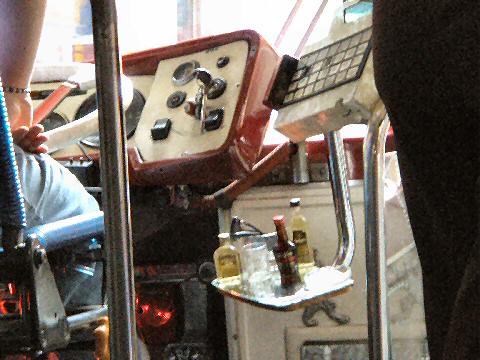
…and yes, those are real bottles.
Copyright © 2026 SaltShaker. This feed contains copyrighted photos and text from SaltShaker. If you are not reading this material in a feed aggregator or by e-mail subscription, the site you are viewing may be guilty of copyright infringement. Please contact [email protected] so that I can take appropriate action.
Plugin by Taragana
]]>I had fallen victim to what is called, by its detractors, food porn … the shows made now are full of exacting, intimate, amplified and exaggerated beauties. It’s not erotic, I can confirm – that’s not why it’s called food porn. It’s just unreal. You will never meet a Playmate of the Month; you will never eat the red, juicy tomato that you see on ‘Barefoot Contessa.'”
– Bill Buford, in the New Yorker
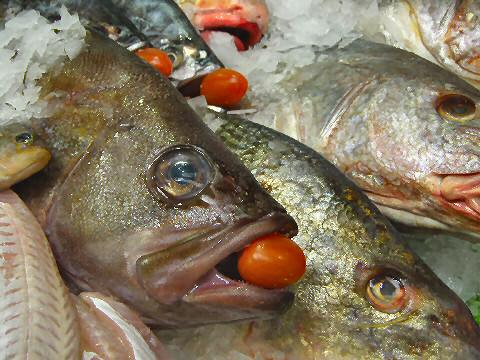
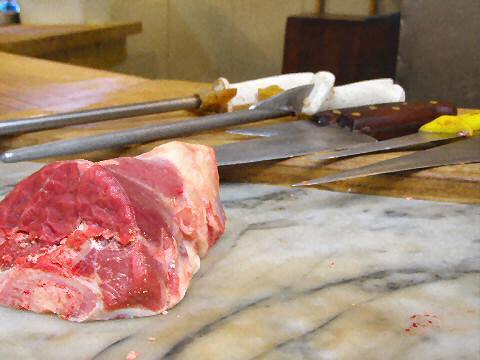
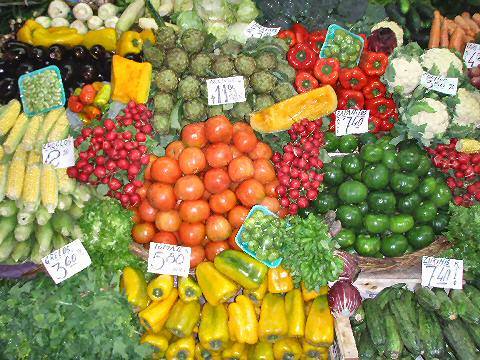
Buenos Aires – Yesterday was a day for wandering the Mercado del Progreso, which since my first visit a year and a bit ago has become a regular spot to head out to shop, when I have the time. It is a bit “out there”, nearly verging on violating the precepts of “shop and eat local” – but then I don’t subscribe to those precepts anyway. I met up with Grant, from What’s Up BA?, for a bit of looking around, poking at things, and snapping photos. He quickly discovered that his memory card was missing from his camera, and he being the better photographer of the two of us, I turned mine over to him to get some good shots both for myself and for his site. So, this trio of photos that struck me in particular are his work – you can see the better “eye” for composition if you compare to my shots of the market on my first visit. I also have a better camera than I did then, which helps immensely.
I picked the fish and meat ones because they’d actually caught my eye and I asked him to compose shots of the two of them – he came up with interesting angles that I probably wouldn’t have – it’s something for me to work on, no doubt! I can usually imagine the shot that I want, I just have to figure out how to actually take it. The vegetable one is his own choice, I just liked the riot of color.
Copyright © 2026 SaltShaker. This feed contains copyrighted photos and text from SaltShaker. If you are not reading this material in a feed aggregator or by e-mail subscription, the site you are viewing may be guilty of copyright infringement. Please contact [email protected] so that I can take appropriate action.
Plugin by Taragana
]]>But a little milk, butter and cheese are acceptable because no harm is done in obtaining them.”
– Sri Sathya Sai Baba, Indian Spiritual Leader
Buenos Aires – Yesterday was all about cheese. In fact, it started a week or so ago, on a re-visit to Chère Sophie with our friend Rick, and after lunch meeting Didier, a French cheesemaker, who has relocated to Córdoba, where he’s busily turning out excellent Brie, Camembert, and Chèvre that he’s selling here, mostly to restaurants. In the course of our discussion, I mentioned that I was interested in the basics of cheesemaking, and maybe being able to churn out a simple ricotta or stretch a mozzarella, at home, but didn’t know much about the process. He gave some basic tips, like that rennet, the stuff you use for curdling milk into cheese, is available at local pharmacies, dispensed, sans prescription of course, by the pharmacists. It’s so… 1950s.
But, more importantly, he clued me in to a place here in town where he said I could get all my questions answered, as well as buy any equipment and supplies needed to make cheese. Questions being the most important thing to start with, I headed out on a jaunt that ended me up on the far reaches of Almagro… a nice little walk for the afternoon, I needed the exercise, at Casa Buggé, Venezuela 4013, where I was confronted by what looked like the entrance to a simple garage… car parked in it and everything. I stood there wondering if I’d been sent on a wild rennet chase, when a tall man popped out of a door off to one side, glanced at me, and asked if he could help. I asked if this was the place, and he affirmed it… I squeezed in past the car and found myself in a warehouse filled with everything that one might need to process dairy products into not only cheese, but probably anything else made from milk. Patricio, as it turned out was his name, and I chatted a bit, I think I was more of a diversion from his day than anything else, he doesn’t really have much in the way of supplies for the home cheesemaker, his smallest milk kettle being a 50 liter one (13 gallons), and selling his rennet and other supplies in everything from 1 to 5 liter size bottles, but he gave me what turned out to be two pieces of crucial information…
Piece #1: A recommendation to go see Carmine, an “old Italian guy” (who isn’t really all that old, in fact he’s probably only a couple of years older than me, so there!), at San Miguel, Chile 1955 – almost dead on the corner where the barrios of Balvanera, San Cristobal, Monserrat, and Constitucion meet, just slightly into the Balvanera side, whom he said could probably be far more help. While that turned out not to be true, as Carmine’s view of the cheesemaking world is that it’s something you must apprentice to when you’re very young, and work at for many years before, I suppose, you’re even allowed to touch the milk, he did turn out to be both charming, and, most importantly, a maker of artesanal Italian style cheeses, which he sells right there from a counter in front of his cheesemaking operation – fresh ricotta, mozzarella, caciocavallo… sheep’s milk, goat’s milk, cow’s milk cheeses… smoked cheeses… flavored cheeses… and, artesanal pastas. The place is a true find… and in short order I found myself in possession of a small wheel of slightly aged sheep’s milk cheese, a scamorza, and a slab of “cremoso, more or less like stracchino”… [Update: 7/17/08 – I recently heard that San Miguel had closed down due to some major health problems on Carmine’s part, and walking by it appears to be true, the place is shuttered and there’s no sign as to why. A shame, this had become a regular spot to visit, and Carmine had started to supply me with high quality milk to make my own cheeses.]
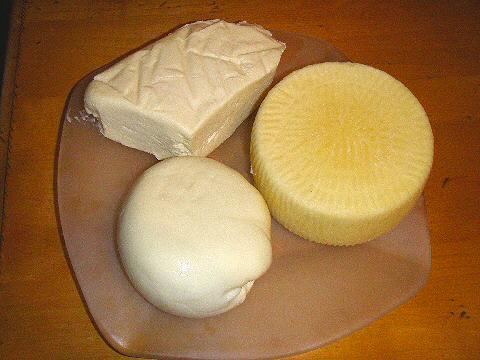
Piece #2: This has the potential of being great fun… Patricio also referred me to Hector, whom I called in the late afternoon after tasting all my cheeses, and who turns out to run a small school out of his home, where he teaches the basics of cheese making, sausage making, meat curing, and various other preserving techniques. Now, I’m going to hold off on all the contact info for him for the moment, because I want to at least attend one session and get a sense of whether or not this guy is worth recommending. So, I’ve signed up for his basic cheesemaking class – it’s all done on an individual (he’ll teach up to 3 people at a time, kind of like me and cooking classes, there’s just limited room at home) basis, so next Tuesday, I’m off to Villa del Parque for my first lesson in how to help milk take a stab at immortality. More to follow…
Copyright © 2026 SaltShaker. This feed contains copyrighted photos and text from SaltShaker. If you are not reading this material in a feed aggregator or by e-mail subscription, the site you are viewing may be guilty of copyright infringement. Please contact [email protected] so that I can take appropriate action.
Plugin by Taragana
]]>