“Everyone loves this recipe, which they know from Chinese restaurants as ma po tofu. It’s a versatile dish, which here is served over crispy rice. You could also serve it over noodles. For a change, I sometimes like to fry cooked rice until it’s crispy and sprinkle it on top instead.”
– Masaharu Morimoto in “Morimoto: The New Art of Japanese Cooking.
Buenos Aires – I remember back in cooking school, “they” told us that there were a few simple basics that were “the test” of a good chef. Of course, this came from the French classic technique background of training – if memory serves me right, it was a vinaigrette, and omelette, and a roast chicken. I’m sure that when you step outside of classic French technique, other strong culinary traditions have their own tests. And, I think, we all have our own personal litmus tests when we go into a restaurant of a particular ethnic background. For me, in Chinese restaurants, while of course dependent on what part of China the cooking represents, as there are major variations, it usually comes down to something spicy – kung pao chicken, ma po tofu, orange beef – all being among my favorites, plus dumplings. Gotta have the dumplings.
So, we’d stumbled upon a sleek, gleaming new Chinese restaurant up the block from my eye doctor, where I’d just had the earpieces replaced on my glasses, and decided to give it a whirl – 862 Restaurante, at Uruguay 862 in Centro. Whereas most Chinese restaurants here seem to be overrun with kitsch and posters and such adorning the walls and every nook and cranny, this one is simply decorated in soft pastel peach and off-white, with minimal other decor. There were no customers, despite being the height of lunch hour, in a busy business district, which could be a bad or good sign – either the food is simply not good, or, it’s not to local tastes, which might imply the possibility of being more authentic. As it turned out, we were simply a little earlier than the neighborhood supports, at least in the middle of summer, and the place got busier over the next hour. [This place has closed]
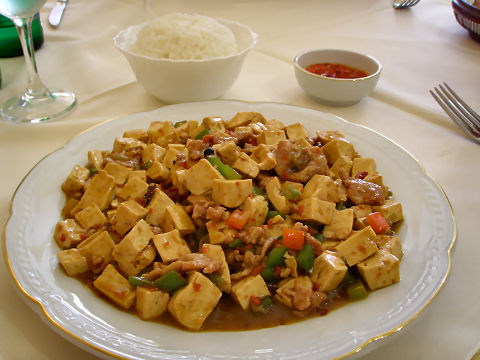
Service was a bit scattered, our waitress, not Chinese, had no clue what any of the dishes were, and we had to not only say them, but point to them on the menu, at which point she painstakingly copied down the words on her little pad, excrutiatingly slow letter by letter. Probably new, but still, left to flounder about on her own by the Chinese woman sitting at the back staring into a computer screen (what is it with the staring into the computer screen thing here – you can count on in almost any restaurant that that’s what the manager or owner will spend your entire meal doing – occasionally tapping at a key or two or moving the mouse?). How hard is it to bring one bottle of water with gas and one without, and remember that much? Our waitress couldn’t. Or to bring our food to our table instead of someone else’s and vice versa. At some point a young Chinese woman came out of the kitchen and started helping keep things organized, and service got immediately better, something that screen-staring woman should have been doing from the start. Still, assuming that our waitress sticks with it and learns the menu, she was pleasant, and things may improve all around. Sink or swim….
Recommended, definitely.
Copyright © 2026 SaltShaker. This feed contains copyrighted photos and text from SaltShaker. If you are not reading this material in a feed aggregator or by e-mail subscription, the site you are viewing may be guilty of copyright infringement. Please contact [email protected] so that I can take appropriate action.
Plugin by Taragana




 ]]>
]]>“And I find chopsticks frankly distressing. Am I alone in thinking it odd that a people ingenious enough to invent paper, gunpowder, kites and any number of other useful objects, and who have a noble history extending back 3,000 years haven’t yet worked out that a pair of knitting needles is no way to capture food?”
– Bill Bryson, Writer
Buenos Aires – Having grown up in a nice Jewish Midwestern family, chopsticks were, of course, second nature. I think we started to learn how to use them pretty much at the same time we went off the baby food spoon and onto the fork. And later, moving to New York, it seemed completely second nature to most of the population, many of whom demand chopsticks in any type of Asian restaurant, despite the fact that not all Asian cultures use them (while they’re the standard in China, Japan, Korea, Taiwan, and Vietnam – the Thais, for example, use “western cutlery”, except for noodle soups, where the soup is dipped up with a large spoon held in the left hand while the chopsticks are used to grab the noodles – demanding chopsticks in Thai restaurants is simply… a sign of ignorance – in fact, with the exception of Vietnam, chopsticks are not the standard in any Southeast Asian country). Here in Buenos Aires, even in Chinese restaurants, chopsticks are not the norm – they’re always available at such places, but tend to be by request rather than the first thing on the table.
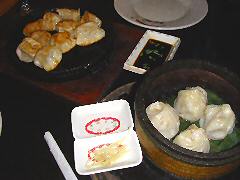 This, however, is not true at Palitos (which literally means “little sticks”, and although technically chopsticks are called palitos chinos, most just drop the adjective), Arribeños 2243, in Barrio Chino (Belgrano). Here, chopsticks are brought along with the food, and not those little break-apart throw-away flimsy wood sorts, but cleaned and carefully wrapped plastic versions – nice and long, and sturdy. I’ve heard about this place from several friends, and for whatever reason haven’t popped in there – but I was in chinatown with a friend and we were looking for some special vegetables for this weekend – and there it was, so in we went. Strangely, one of the first things to catch my eye was the te frio con café – iced tea with coffee – and no, on inquiry, it wasn’t a misprint – and I had to try it – it’s a large glass of sweetened ice tea with a shot of espresso in it – which just sounds odd, and you know what? It’s delicious. I had two. We ordered up a round of potstickers – a bit greasy, and strangely crisped on all sides rather than the usual crisp on one side and steamed on the others, but very good flavor. The panecillos al vapor were, for me (my friend disagreed) less interesting – turning out to be basically steamed dumplings – we were expecting steamed pork buns (the stand at the Chinese New Year festival was right out front of Palitos, and those were really good, so we’d been hoping… and panecillos translates as little buns). Maybe it was just the disappointment of not getting what we thought we were…
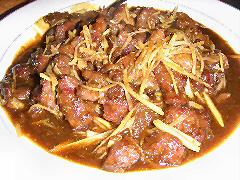 It’s unusual in BsAs to see venison on menus, pretty much anywhere except the Patagonian restaurants. But Palitos offers up a half dozen different preparations. They also offer a variety of other meats – mostly aquatic, like frogs’ legs and various fish and shellfish that aren’t normally seen on local Chinese menus. It caught our eye, and though a little pricey (the venison dishes all ranged in the AR$35-45 range), we had planned on just one main course to split. And it was a decent sized if not huge portion, and really quite good – plenty of ginger, a nice rich gravy – the venison bits ranging from very tender to a bit chewy, so they clearly went with the “parts is parts” approach. We liked it. But I want to go back and try something that’s more of a “staple” dish – maybe a nice kung pao…
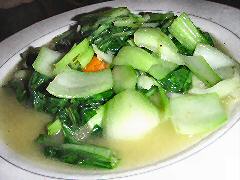 We hadn’t planned on anything else, but then the two Chinese guys at the table next to us, who’d ordered the lunch special (bit bowls of noodle soup), ordered a plate of sauteed akusai (bok choy), and the way they were attacking the plate got our attention. We ordered a plate – some green vegetables never hurt, right? Really wonderful – actually my favorite part of the lunch – the bok choy having been lightly grilled first so it had a slight smokiness, and then tossed in a light sauce with a whole lot of garlic. Don’t miss this one on the side of whatever else you’re eating. Now, as I said, I want to go back and try some other dishes – off the bat, this doesn’t beat out Lai-Lai, which to date is my favorite Chinese restaurant on the strip (and hmmm, has that great sauteed akusai with dried shrimp… can we try the two dishes side by side?), but I do want to give it another chance, and where else in BsAs am I going to get iced tea with a shot of espresso?
Copyright © 2026 SaltShaker. This feed contains copyrighted photos and text from SaltShaker. If you are not reading this material in a feed aggregator or by e-mail subscription, the site you are viewing may be guilty of copyright infringement. Please contact [email protected] so that I can take appropriate action.
Plugin by Taragana
]]>My time as President is fast coming to a close. For me, it has been a rare opportunity to make a difference and is the completion of one stage in my life’s mission. For Taiwan, these past eight years, though just a small stretch in the endless stream of history, have been an important stage in its history that has enabled us to reach a higher plateau as we continuously strive to strengthen and deepen democracy, create a more prosperous, advanced society, and realize social equity and justice. This stage of our great journey will soon come to a close. This administration will work hard to the very end, but there remains much to be done by my successor. I believe that the torch of democracy and progress will be passed on smoothly. As it is passed on from one administration to the next, its flame will burn with ever-greater brilliance and continue to guide Taiwan towards a new era of wellbeing and renewal that will create unlimited possibilities for future generations. In closing, may our nation enjoy good fortune in 2008! And a Happy New Year to you all! Thank you!
– excerpt from President Chen Shui-bian’s 2008 New Year’s Day Address
Buenos Aires – It is traditional on the Lunar New Year in both China and Taiwan to receive hong bao – lucky money – a red envelope containing some amount of cash given by family members to the elders and the children of the family. Not having any family here except Henry, and he away in Peru, and I’d prefer he didn’t think of me as an elder anyway, I received no hong bao. I did, however, head with a friend to Barrio Chino for the day’s festivities (it occurs to me that here, barrio chino is a misnomer, since given the makeup of the local population, it is probably more correctly barrio taiwanés) – something I’ve missed the last three years in a row (2005, I was here on vacation and didn’t even know about chinatown, 2006, I simply forgot about it until late in the day and by the time I got there, it was all over, and 2007, we were away in Peru). Turns out, I didn’t miss much.
I can’t speak for those past years, but this year anyway, they cordoned off two blocks of Arribeños, but only kinda sorta… they left cars parked along one side of the street, which meant the food and knickknack stands got shoved out into the middle of the street, which was teeming with people – many of whom, based on what I overheard had had no idea that there was a chinatown in Buenos Aires (and I’m talking about locals, not visitors), and apparently had found out because of an announcement in the papers. The far end was further roped off into a small rectangle, in which 5-6 people were preparing to to a small scale version of the famed Lion Dance – the rectangle was surrounded by spectators waiting to get a glimpse of this, and glimpse was pretty much all anyone was going to get – it was just too packed with people. So we wandered the block and a half of food stalls, nibbling on various skewers of things, springrolls, steamed buns (really good steamed buns too), tea eggs, and what have you. A good percentage of the food offered was not Chinese or Taiwanese in origin, but seemed to be catering to local tastes – I don’t believe I’ve ever seen quite so many deep fried battered hot dogs in my life, and sure enough, watching, I’d say the majority of locals sampling foods completely ignored the Chinese offerings and went for things more familiar. And I’m pretty sure that the two of us were among a mere handful who made any use of the hot sauce that various stands were offering.
It was fun, but too little to do and too many people to deal with. We got out of there after about an hour.
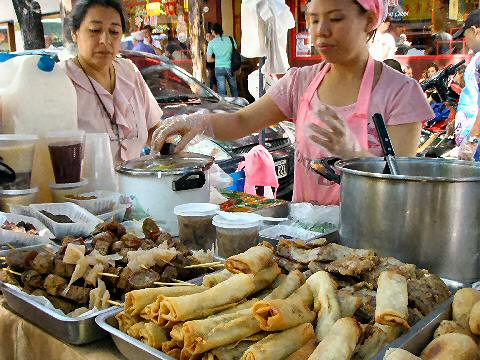
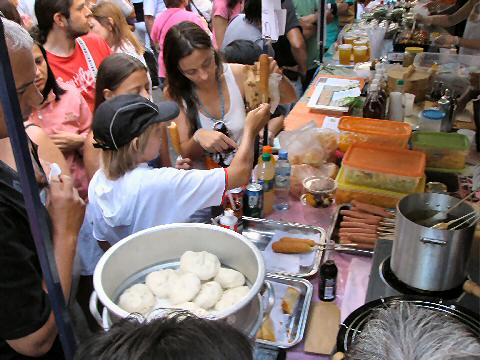
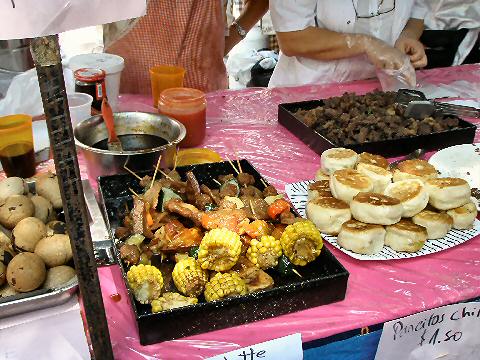
Happy Year of the Earth Rat, 4705!
Copyright © 2026 SaltShaker. This feed contains copyrighted photos and text from SaltShaker. If you are not reading this material in a feed aggregator or by e-mail subscription, the site you are viewing may be guilty of copyright infringement. Please contact [email protected] so that I can take appropriate action.
Plugin by Taragana
]]>I am the emperor, and I want dumplings.”
– Emperor Ferdinand I, 16th Century Austrian monarch
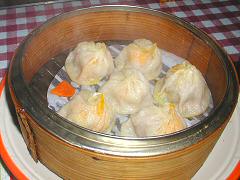 New York – Okay, everyone talks about Joe’s Shanghai when it comes to soup dumplings in New York. No question they’re good, but I find them just a bit too… soupy. For me, I like the restraint shown in the less liquidy, delicate, and concentrated flavors of the crab soup dumplings that come out of the kitchen at Shanghai Cuisine, 89 Bayard Street at the corner of Mulberry. In fact, it’s probably my favorite Chinese restaurant in all of Chinatown. In particular I like that there are numerous unusual dishes – things like duck tongue, chicken feet, some fascinating vegetable plates (try the lightly sauteed black mushrooms and baby bok choy – you’ll be ready to go vegetarian). It doesn’t mean that I’m going to order all the offbeat stuff on a regular basis, but I like that they’re there, just in case I’m feeling that adventurous. But truly, you can’t not order a steaming basket of half a dozen lightly gooey balls filled with fresh crabmeat, a little pork, and just enough broth to burst in your mouth.
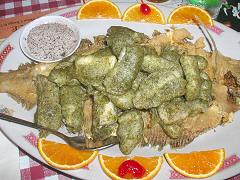 After that, you could move on to many different main courses – they have a double cooked pork that’s truly amazing, but my all time favorite is this whole flounder that’s been split into bite sized pieces and battered in a crispy, near tempura style batter flavored with a briny dry seaweed, and served up with a soy vinegar mixture and a dish of salt and ground pepper on the side. On top of that, the remaining fish bones and meat on them are deep fried in a plain batter and are just as delicious to pick at as you go. Of course, we all know that anything is delicious deep fried – but hey, this is simply a spectacular dish. Skip the maraschino cherries… please… though the orange slices are a nice end of meal touch. Shanghai Cuisine offers up a full bar, a nice selection of beers, and a very pleasant, if slightly fast paced environment.
Copyright © 2026 SaltShaker. This feed contains copyrighted photos and text from SaltShaker. If you are not reading this material in a feed aggregator or by e-mail subscription, the site you are viewing may be guilty of copyright infringement. Please contact [email protected] so that I can take appropriate action.
Plugin by Taragana
]]>If it looks like a duck, and quacks like a duck, we have at least to consider the possibility that we have a small aquatic bird of the family anatidae on our hands.”
– Douglas Adams, British Comic Writer
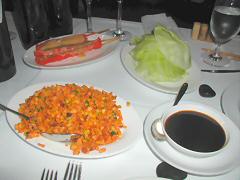 New York City – Here’s the thing. It was about the duck. The Peking Duck to be exact. The appetizers were just fine – a delicious, if vibrantly pink-orange chicken satay, and some very nice little lettuce wraps with some sort of chopped meat, vegetables, and a thick, gooey dipping sauce. The place – pretty – white tablecloths, nice glassware, modern Chinese decor, cute sommelier… hmmm… really cute sommelier, if a tad on the young side. Lunch with a good friend from my days in the NYC wine biz to show him some wines from Mendoza that he might be thinking of importing. The place – Philippe, 35 East 60th Street – Philippe Chow, of the long famous Mr. Chow’s “re-do” – his relatively new spot serving up modern Chinese cuisine. And it’s all about the duck – sure they have other stuff on the menu, but they prominently display, feature, and practically beg you to go for either the 4 or 7 pound duck (the latter presumeably being either some sort of steroid enhance monstrosity, or the serving of two ducks at the same time), for the not bad prices of $48 or $65, serving either two or four people.
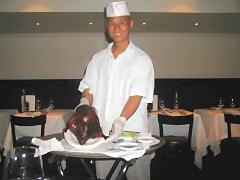
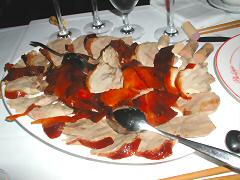
The duck is presented, beautifully lacquered and hot, by one of the smiling cooks – ours nearly lost his composure when the duck slipped from his hands and headed floorwards, but he caught it by a drumstick before it plunged over the side of the cart. He then carved it into perfect slices, laid out beautifully on a plate, and served up with a large steamer basket of delicate pancakes, some plum sauce, and vegetables. It looked like way too much food, but it wasn’t more than about ten minutes later before we sighed, sat back, and looked longingly at the empty platter.
What can I say, go there, order Peking Duck, you won’t regret it.
Copyright © 2026 SaltShaker. This feed contains copyrighted photos and text from SaltShaker. If you are not reading this material in a feed aggregator or by e-mail subscription, the site you are viewing may be guilty of copyright infringement. Please contact [email protected] so that I can take appropriate action.
Plugin by Taragana
]]>A general overview of culinary history and trends reveals that, for the most part, areas that tended to spice heavily were areas in which the fresh food supply was not as reliable as in places that traditionally used a lighter hand in their use of spices. The climate of Sichuan is conducive to faster food spoilage. This, particularly in the past, made necessary food preservation techniques that themselves left behind a strong flavor, such as salting, pickling, drying, and smoking. Thus, spices served to mask the flavors of less than fresh foods and those that have been preserved by methods that affect their natural flavors. In addition to masking certain flavors, the use of hot spices, such as chili peppers, tends to be more common to hot climates, as the sweat that they can produce is thought to cool the body.”
– Kirsten Hawkins, food & nutrition expert
Buenos Aires – There are many Lai-Lai’s in the world – a dumpling restaurant in Houston, a Mongolian eatery in Phoenix, a dim sum joint outside my hometown of Ann Arbor, a top Chinese spot in Ontario that specializes in vegetarian food, a Nepalese-Tibetan restaurant in Kathmandu, Taiwanese in Singapore, a couple of islands, travel agencies, the list goes on and on. Now, depending on which characters in Chinese represent the word “lai”, it could have many different meanings, and unfortunately, I forgot to scribble down the characters (and neither character on the awning, as best my dictionary seems to indicate, is a version of the word “lai”)… next time… because there will be a next time that I go to Lai-Lai here in Buenos Aires, at Arribeños 2168 in Chinatown. But amongst the various possiblities… river, bamboo, to come… and, given the cuisine, the possibility of the name of a mountain in the Szechuan province… because a good portion of the menu at Lai-Lai is Szechuan in origin.
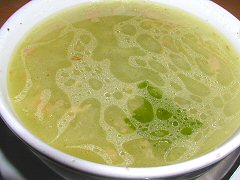
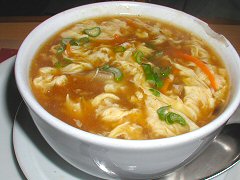
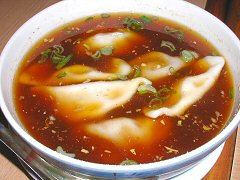 The space is L shaped, and upfront has the ambiance of a cafeteria… as you move into the back part of the L, towards the kitchen and bar, suddenly the lighting is subdued, the tables have cloths, and the space is filled with local Chinese clearly enjoying their food and chatting back and forth between tables – it’s clearly a community dining spot. We immediately spotted the differences from most of the menus along the strip, as dish after dish is marked picante, and many were dishes that we hadn’t seen on other local menus. We started off with a couple of bowls of soup – an excellent seawood soup – perhaps a touch too much oil in the mix, but packed full of flavor and a mix of different seaweeds; and a hot and sour soup that was worthy of at least half the name – it was hot, as in picante as well as temperature – the sour was a bit subdued for our tastes, but a splash of rice vinegar and it perked right up. As long as we were in the mood now to try some spicy stuff, when we spotted the Szechuan dumplings (on the menu as something like empanaditas chinas picantes, we couldn’t resist. The dough on the dumplings was a bit chewier than I normally like, but pretty close to right on, the filling packed with pork, garlic, and green onion with just a touch of chilies – more picante from garlic than anything else, and the broth delicious. I’d be happy with just a couple of bowls of these!
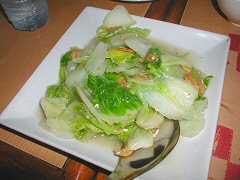
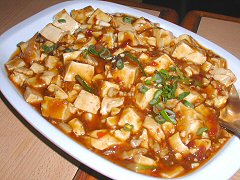
For main courses we decided to go on the light side, and also to get one spicy and one not spicy dish. So, a searingly hot and perfectly cooked ma po tofu, easily one of the best versions of this I’ve tried, and not just here in Buenos Aires, but in any Szechuan restaurant I’ve tried. On the other hand, I have this soft spot for sauteed greens with dried shrimp – I love the flavor combination, and this platter of akusai, or Chinese cabbage, was exactly what I’ve been wishing for. As I said, there will be more trips to Lai-Lai.
Copyright © 2026 SaltShaker. This feed contains copyrighted photos and text from SaltShaker. If you are not reading this material in a feed aggregator or by e-mail subscription, the site you are viewing may be guilty of copyright infringement. Please contact [email protected] so that I can take appropriate action.
Plugin by Taragana
]]>