“The natural progress of things is for liberty to yield and government to gain ground.”
– Thomas Jefferson
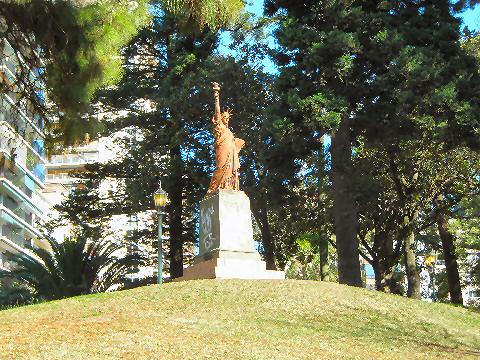
I’ve done a bit of digging, and there’s, not surprisingly, contradictory information out there. Some things aren’t in dispute – this replica was actually designed and cast under the guidance of the original designer, Frédéric Auguste Bertholdi, and was arranged to be brought to Buenos Aires by the French artistic foundation “Du Vall d’Osne”, whom are also responsible for many works of art and fountains throughout the city that were created by French artists and gifted to Buenos Aires at various points. As best I can determine, this was not the original intended site, though the information is a bit sketchy. In 1888 the construction of the new Palacio de Correos (Central Post Office) along Av. Alem in the Centro area was begun, though it was not completed until forty years later in 1928. The original plans called for the facade of the building (designed by French architect Norbert Maillart, who also designed the Palacio de Justicia, or Federal Courthouse, more commonly called the “Tribunales”; and the CNBA, or Colegio Nacional de Buenos Aires) to be crowned by works of Bertholdi, replicas of his famous sculptures from other parts of the world, including the Statue of Liberty as its centerpiece. That never came to pass, as over the four decades the plans were repeatedly changed.
The data in the government online catalog is clearly incorrect – it lists the location of the statue as being Av. Berro between Av. Sarmiento and Av. Casares, which is essentially the back of the Japanese Gardens and part of the Plaza Sicilia end of 3 de Febrero Park. I took a walk along there, though I was fairly certain there was no Lady Liberty hidden away in a grove there, and indeed she’s not – in the center of the plaza, more or less, there is the workshop for the city’s Monuments and Artwork Department – where, since 1985, statues and such have been sent to be repaired – possibly at the time of the entry in the database the statue was in for its 1986 refurbishing. The data also indicates that the reproduction is 152 feet in height – not likely, that’s the height of the actual statue on Liberty Island in the Hudson River (without its base – just the statue itself). Though I can’t find a date that the statue was originally placed in Barrancas del Belgrano, it’s likely it was right around the time of the park’s inauguration in 1892 or shortly thereafter, based on when Bertholdi would have been around, when the foundation was doing most of its work, and dates of some of the other statues in the park. The statue is clearly once again in need of at least a bit of cleanup as it is covered with graffiti.
Copyright © 2026 SaltShaker. This feed contains copyrighted photos and text from SaltShaker. If you are not reading this material in a feed aggregator or by e-mail subscription, the site you are viewing may be guilty of copyright infringement. Please contact [email protected] so that I can take appropriate action.
Plugin by Taragana




 ]]>
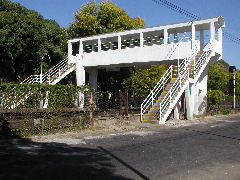
]]>The angled street basically forms the southern and eastern borders of barrio Villa Ortuzar with, successively, Chacarita, Collegiales, and finally Belgrano. All in about 18 blocks. The first six blocks of 14 de Julio are relatively uninteresting for the wanderer. They run along the train tracks that run along one side of the Chacarita cemetery. So to one side all that is visible are train tracks with a high concrete wall – to the other a six block stretch of mostly small warehouses, auto repair garages, and a few small homes. It’s a tree-lined street, relatively well maintained. But truly, the most interesting thing I spotted other than the occasional person out walking, was the pedestrian crossing over the tracks.
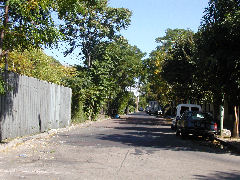
Once you cross the main avenue of Triunvarato, the entire character of the street changes. Small, charming, single family homes, both row house type and a few detached type, are well kept, painted in a variety of pastel colors – green, pink, blue, yellow. There’s not a lot of older architecture evident, either this neighborhood is relatively new, i.e., within the last 50 years or so, or it’s just been renovated and a lot of the old architectural flourishes were removed. As the street goes on, and you reach the part that borders on Belgrano, the homes become larger and larger, and quite elegant. This western stretch of Belgrano has some of the nicest streets and homes in all of Buenos Aires, and is worth a wander in and of itself.
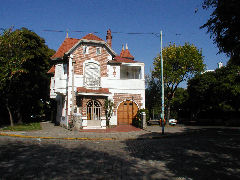
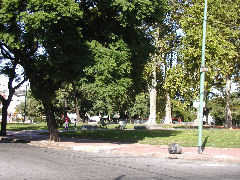 One plus, shortly after starting down this stretch, I discovered this small park – Plaza 25 de Agosto – so although it wasn’t on my list to check out, I got to add another date to my list of those explored. I’m guessing that it’s in commemoration of the day that the Argentinian legislature created what are known as the Laws of August 25th – consisting of three parts, the Ley de Unión which turned the loosely knit provinces of Argentina into an official union; the Ley de Independecia which annulled an agreement with Portugal and Brasil for some sort of incorporation; and the Ley de Pabellón which created the official flag of Argentina as it exists now.
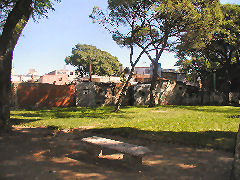 Along the way I took a couple of side wanders to look at the neighborhood. In doing so, I stumbled across Plaza Antonio Malavia – a sort of basic neighborhood park, interesting in that one whole side of it forms the back end of a strip of row houses – so a look at the back side of homes that usually one can only see the facade of. Once again, I have no idea whom Antonio Malavia was, and an internet search revealed nothing. Perhaps one of my regular readers can help out?
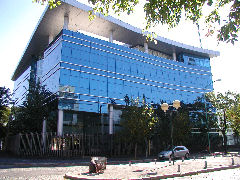 I also came across this completely incongruous blue curved glass modern structure. No signs on any of its four sides indicated what it was. That address comes back to the new offices of Vital supermarkets. Much nicer than their supermarkets. Maybe they should spend some of that money on fixing up the places where people shop…
My wander complete, at least for the moment, I headed off to a bit of lunch… to be continued.
Copyright © 2026 SaltShaker. This feed contains copyrighted photos and text from SaltShaker. If you are not reading this material in a feed aggregator or by e-mail subscription, the site you are viewing may be guilty of copyright infringement. Please contact [email protected] so that I can take appropriate action.
Plugin by Taragana
]]>I launched into this fanciful idea yesterday with a foray along about half of the street 3 de Febrero, a date that has come up before in relation to the Parque 3 de Febrero. I have to admit that I’m not entirely sure why this date is important. Originally I thought it was that nearly 130 years ago, in 1876, Argentina and Paraguay signed an official treaty defining the frontier between the two countries and ending Argentina’s occupation of a portion of Paraguay following the War of the Triple Alliance. Also known as the Paraguayan War, it was fought from 1864 to 1870, and was the bloodiest conflict in Latin American history, and the second bloodiest conflict that occurred on the American continent. It was fought between Paraguay and the allied countries of Argentina, Brazil, and Uruguay. This still seems like an important date to name a street and/or park after.
However, on February 3, 1852, General Juan Manuel de Rosas, “the Restorer of Law and Order,” and his troops were defeated by the centralist unitarios under General Justo José de Urquiza at the battle of Caseros, ending a long conflict between that centralist faction and the federales that Rosas represented.
Not only that, but going back a bit further, on February 3, 1813, General José Francisco de San Martín, “the Liberator” of Argentina, engaged Spanish royalist troops along the Paraná River, the first major battle in the war for independence.
I’ll stick with the treaty idea, but I’m perfectly willing to find out otherwise.
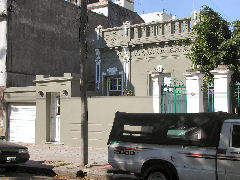
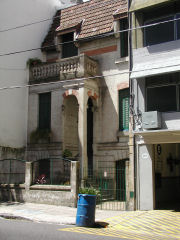
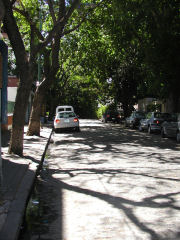
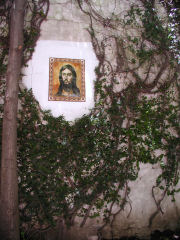 The street 3 de Febrero begins in the 700 block at this vine-covered northwestern wall surrounding the Instituto Geografico Militar in Palermo, part of a large Army related complex. A tile mosaic of that famous spiritual leader guy I can never remember the name of because he’s so obscure in Catholic countries looks over the beginning. From there, the tree-lined street continues to the northwest through the barrios of Belgrano and Nuñez, covering 42 blocks to the city limits. I headed out at a brisk pace, figuring I had a fair amount of ground to cover, but almost immediately slowed to enjoy the beautiful architecture of the area. There is a mix of styles, ranging from old colonial style homes to modern sculpted styles. Most of the buildings are two-story, but they are intermixed with apartment buildings that range up to about 7 or 8 stories. In the Palermo section there are several embassy or embassy-related buildings, including Libya and Italy (Italy officially lists its embassy elsewhere, but I stood in front of and took a couple photos of a building that purports to be the Italian embassy – you can see it’s garden entrance below).
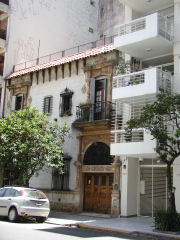
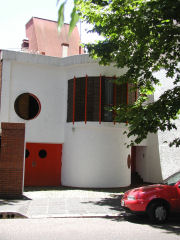
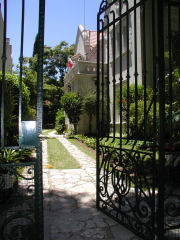
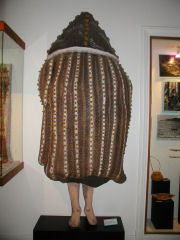 The area has high security, and virtually every apartment building had armed guards, I’m guessing that there must be a fair amount of embassy staff living in the area (there are numerous other embassies in the neighborhood on other streets). As I moved into Belgrano the character of the neighborhood became more relaxed, and while still well kept, clearly not as “high maintenance” of an area. Right on the line between the two barrios I made one of those serendipitous discoveries that I so enjoy – the Instituto Nacional de Antropología y Pensamiento Latinoamericano, a government cultural organization that offers classes, films, and various events related to the pre-colonial period of Argentine history. It also included the small, but very well designed Museo Nacional del Hombre, which showcases various crafts, tools, and art from the indigenous cultures of Argentina, including things like this re-creation of a Tanu whale spirit costume.
The street ends in a cul-de-sac in the 2500 block, requiring a walkaround to continue on the other side of the tracks. After my museum stop and a bit of lunch, I decided this was enough for the day, the balance of the street will remain for a future jaunt.
And lunch? Just to throw in a touch of food. There was very little in the way of anything besides some scattered coffee shops and pizza places along my walk. At the corner of Juramento was a large porteña style restaurant called Salvame Maria, but it just didn’t grab me. 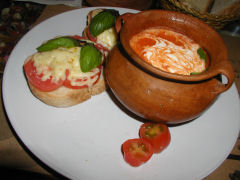 Right around the corner on a side street I spotted Ohana, Zavalía 2132, a “gourmet deli.” It was a casual little sandwich, soup, and salad shop, something I should have kept in mind when ordering. I started with a quite good cream of tomato soup accompanied by two excellent tomato, basil, and mozzarella bruschetta, and a basket of really good breads. Unfortunately I followed that up with a grilled lemon chicken – which consisted of a dried out and extremely overcooked half-breast of chicken, one small wedge of lemon, and a mound of lukewarm grilled vegetables. I like the place, it’s quite pretty (check out the tables if you go, loved ’em) but I’d stick with the sandwiches (that everyone seemed to be enjoying) and soup.
Copyright © 2026 SaltShaker. This feed contains copyrighted photos and text from SaltShaker. If you are not reading this material in a feed aggregator or by e-mail subscription, the site you are viewing may be guilty of copyright infringement. Please contact [email protected] so that I can take appropriate action.
Plugin by Taragana
]]>