“A human being may form different notions in the world. Some people think spicy food is good, some think sour food is, some like sweet food, and some like bland. Those are all tendencies of one’s own making. Even if a comedy is playing in Manhattan, there are still a whole lot of people who don’t like it and criticize it. That’s how human beings are.”
– Li Hongzhi, founder of the Falun Dafa
Buenos Aires – I’ve recently been working on a series of interviews with local chefs who are reworking traditional Argentine cuisine. They’re tired of the reputation for bland, meat and potatoes food that the country has, and want to show the world, or at least visitors to this part of it, that there are Argentine chefs capable of using something more than salt and a few dusty, dried herbs. It got me thinking that outside of a couple of special requests for private dinners, we’ve never offered up an Argentine menu at Casa SaltShaker – we’ve always said that there are enough restaurants in the ‘hood serving local food that we want to put something different on the plate. On the other hand – there aren’t a whole lot of places serving up Argentine food with much zip – so for our end of the year weekend dinners I decided on… Argentine cuisine if they actually used spices….
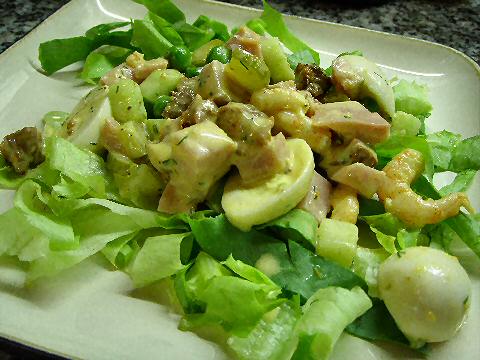
One could argue that the term “Russian Salad” is too generic to be defined, and there are certainly a number of versions of it, depending on where you are in the world. Here in Argentina, it’s been dumbed down to the blandest possible potato salad, a version that if you were to serve it at a picnic in the Midwest, where I grew up, a place not noted for its amazingly spicy cuisine, you’d be laughed off the property. Boiled potatoes, carrots and peas – really boiled – usually to the point of near mush – and a close to equal amount of mayonnaise to “bind” it all together. Why not spoon the Hellman’s directly out of the jar?
Arguably, the “original” Russian Salad, which at the time was called the Salade Olivier, was invented by French chef Lucien Olivier, at the Hermitage restaurant in Moscow, where it was a composed platter of cold meats and vegetables – generally particular choices that were considered delicacies, such as veal tongue, grouse, caviar, crayfish, smoked duck, gherkins, fresh soybeans – that changed seasonally, and were bound with a mayonnaise type dressing – however, just enough to lightly dress the salad. No boiled potatoes, which at the time were considered food for the poor. In the spirit of that original salad, I composed one of strips of butter and oak leaf lettuces topped with a mix of diced ham, longaniza and cantimpalo sausages (both peeled and then sauteed briefly), shrimp, hard-boiled quail eggs, sweet gherkins, cucumbers, capers, and fresh peas, all bound with a bit of a homemade “Russian” dressing – a mayonnaise style blend of egg yolks, good red wine vinegar, mustard, olive oil, worcestershire sauce, chili sauce, parsley, celery seed, salt and pepper.
In the winter, locro is a popular stew here, something I’ve talked about many times and even presented my own recipe for. There are also vegetable and fish versions of the stew, though not nearly as popular. Still, for summertime, a lighter style version seemed appropriate – so, aiming for something more soup like I made a corn stock (boiled corncobs in water for about 20 minutes), then boiled up some squash in it and pureed it to make a medium thick soup base. Meanwhile I sauteed diced bacon, onions, peppers, garlic, and the corn I’d cut off the cobs in a bit of butter, then added that to the soup base along with some finely chopped smoked trout. Finished off with a bit of smoked salt to add a little more smokiness and it came out as a great summer twist on locro.
Empanadas were a must at some point in the evening. One of our favorite spots in the area to order empanadas from, La Querencia, has a very nice eggplant and herb version that I’m quite taken with – still, it needs more zip. Having just made the smoked eggplant puree for our holiday dinner, I thought about that – and so, a couple of small empanadas showed up on each plate filled with charred eggplant puree, garlic, mint, and hot peppers, and a dipping sauce of a mango chutney on the side.
We’ve all seen, and eaten, more milanesas here than we care to think about, let alone admit to. I’m perfectly happy at many a lunch to have a pounded thin chicken version – breaded breast of chicken, topped with cheese and tomato, but I do long for something more – and also something that leaves the chicken juicy and flavorful rather than flat and leathery. So I left the breasts whole, cut a pocket into each and filled it with a mix of cremini duxelles (sauteed finely chopped mushrooms and shallots) and yellow bell pepper. Then, each breast got itself dipped in flour seasoned with salt and pepper, then into beaten egg, and finally rolled in a mix of breadcrumbs, hot paprika, and a Chinese spice mixture of black pepper, cinnamon, salt, and m.s.g. Rather than fry these, I baked them in the oven drizzled with a little olive oil, and served them up with some sauteed globe zucchini.
Finally, of course, no Argentine meal would be complete without some form of dulce de leche – and a cheesecake in which I substituted the lovely caramelized stuff for the milk that I normallly put in, seemed the perfect ticket. Dusted with cinnamon and sugar, the evening ended beautifully.
Copyright © 2026 SaltShaker. This feed contains copyrighted photos and text from SaltShaker. If you are not reading this material in a feed aggregator or by e-mail subscription, the site you are viewing may be guilty of copyright infringement. Please contact [email protected] so that I can take appropriate action.
Plugin by Taragana




 ]]>
]]>“The potato takes little care of lung and heart. It reaches the head, but only, as I said, the lower head, not the upper head. It does go into the lower head, where one thinks and exercises critical faculties. Therefore, you can see, in earlier times there were fewer journalists. There was no printing industry yet. Think of the amount of thought expended daily in this world in our time, just to bring the newspapers out! All that thinking, it is much too much, it is not at all necessary — and we have to thank the potato diet for that! Because a person who eats potatoes is constantly stimulated to think. He can’t do anything but think. That’s why his lungs and his heart become weak. Tuberculosis, lung tuberculosis, did not become widespread until the potato diet was introduced. And the weakest human beings are those living in regions where almost nothing else is grown but potatoes, where the people live on potatoes.”
– Rudolf Steiner, philosopher
Buenos Aires – There are those restaurants that everyone knows about, recommends, and no one writes anything new about. These are the sorts of places that show up in every guidebook, piece of hyperinflated promotional fluff, or casual mention – just because… everyone knows about them. Several in town come to mind – and perhaps I’ll eventually get to them all, but I may as well start with La Cabrera Norte, Cabrera 5127 in Palermo, 4832-5754, which is ever so slightly north, though perhaps more west, of La Cabrera sans more than that. And what does everyone talk about when it comes to La Cabrera? The side dishes. Oh, the steaks too, which, in a beef-centric culture like this are quite good as well. In fact, they’re better than quite good – I’d put the steaks at La Cabrera up there among the better ones in the city, and as you can see in the photo below, there was no wanting of forks to dig into them.
I was out last Sunday with a group of master sommeliers who’d flown in for a tour and series of seminars out in the vineyards of Mendoza, but they were spending a couple of days seeing Buenos Aires, dining out, and generally having a good time. Knowing a couple of them, and the person who organized the tour, I got myself attached to the group for the day, which is not only great fun when the people are (and anyone who knows sommeliers that have been around for awhile knows they know how to have a good time), but gets me a chance to pop in on places that I don’t frequent all that often. So here we were, eight MS’s, myself, and the PR person who’d put it altogether, and they shove the menus in my hands and say, “Choose stuff we’ll like.” No pressure, you know?
We had to give them a bit of the usual suspects and a bit of the off the wall stuff – so a round of chorizos, morcillas, chinchulines (the latter two – blood sausage and grilled intestines), and the weirdest looking provoletas I think I’ve ever seen – no, that’s not a sea monster crawling out of the ooze….
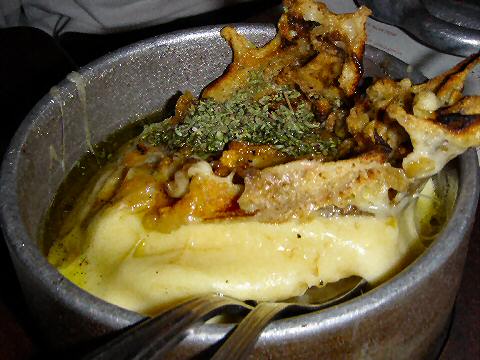
Then on to a couple of mounded salads, followed by a trio of steaks – entraña, bife de chorizo, ojo de bife (respectively, skirt steak, loin steak, rib-eye) – which, at La Cabrera Norte (and the non-norte spot as well), are simply huge – ten of us couldn’t finish the three steaks. So, while the menu can look pricey at first glance, given than each steak can easily feed 2-4 people, depending, you know?, it’s not really.
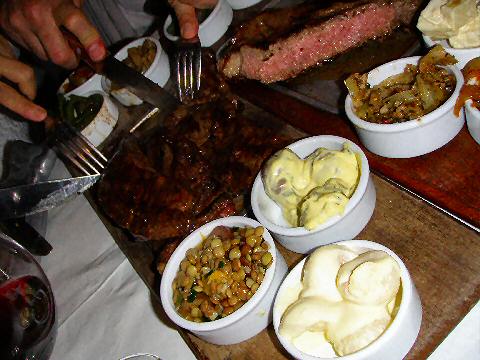
Now, the side dishes are not so much side dishes as little ramekins of stuff – starchy stuff. Each steak comes with a half dozen (not the dozens and dozens that most folk seem to hype) little ramekins – potatoes in mayonnaise, roasted potatoes, potatoes in some sort of eggy dressing, hearts of palm in mayonnaise, chambota (onions and peppers in oil), and lentils, all served room temp – each of which is a few forkfuls – which is not to disparage them, it’s plenty of food – but we’re not exactly talking about some sort of amazing accompaniments to the steaks. They’re good, but that’s about as far as I’d go. There’s also the ubiquitous chimichurri and salsa criolla, though the latter is served pureed, which is flavorful, but not my style. Personally, I’m more for just going for the steaks – the entraña is really excellent – and ordering another provoleta, and cholesterol be damned for one day every now and again. The french fries, which of course we needed to order, are simply okay – nothing special, and perhaps a little overdone and greasy. Plus they have this very strange dish called papas fritas criollas, which are basically french fries topped with a mess of soft scrambled eggs (which, no, don’t come with side dishes, we just set the bowl on the empty platter from one of the steaks). Odd, just odd, but the group wanted to try them – personally I like the provencal, with garlic and parsley, but hey, this was something different….
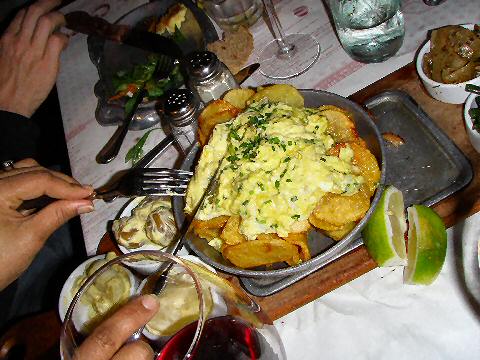
Overall, La Cabrera Norte gets high marks for food. The ambiance is a bit boisterous, and the place tends to be packed, at a lot of times, with tourists (Sunday afternoon I could hear enough English being spoken around the place to think I was back in Manhattan) – and the waiters all cater to that crowd. It’s not that you won’t find locals there, but more likely early on in the week in the late evenings….
Copyright © 2026 SaltShaker. This feed contains copyrighted photos and text from SaltShaker. If you are not reading this material in a feed aggregator or by e-mail subscription, the site you are viewing may be guilty of copyright infringement. Please contact [email protected] so that I can take appropriate action.
Plugin by Taragana
]]>“My family purchased vineyards in Napa Valley over 35 years ago, and I have been making wine for almost 25 years, with over 30 harvests under my belt. I was fortunate to make my own wines at Robert Pepi Winery with my father until the winery was sold in 1994. Since 1996 I have been a consulting winemaker mainly in Napa but also in Argentina and Colorado with success and as much fulfillment as I could hope for.”
– Robert Pepi, Jr., Winemaker
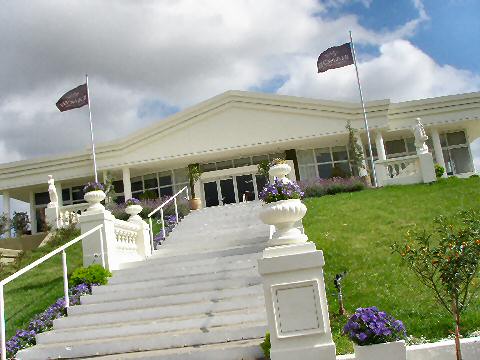
San Rafael, Argentina – So, let’s get down to business, in other words, jump right into the whirlwind that was our trio of days in Mendoza. We left off at the San Rafael airport with friendly greetings from the local constabulary – from there we headed in through the small terminal building where we were greeted by a driver who quickly whisked us off to the Valentín Bianchi winery – one of the larger producers around the country, currently offering up 15 million liters (20 million bottles) of wine a year and expanding to 18 next year, 70% of which is consumed domestically. The winery has been in business for 80 years and is still family owned by the fourth generation down from Don Valentín Bianchi, who made his way to Mendoza from Fasano, Italy (Puglia). Other than a very small amount of wine that is shipped in bulk to a distributor in Germany, who packages it as a bag-in-box release, all of the winery’s wines are bottled as fine wine.
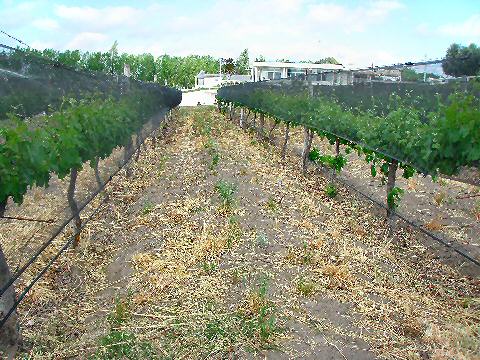
We started off with a short walk in the vineyards with Marcelo, the winery’s agronomist, who has been with the winery for 13 years – not uncommon in these parts, the winemaker has been there for 30 years, and many of the people who work there are 2nd and 3rd generation employees – one of the things I particularly liked hearing about was Bianchi’s commitment to their employees – they pay for everyone who has any contact with the winemaking process to go to technical and/or winemaking school before they begin working – many of them kids who have grown up on the estate.
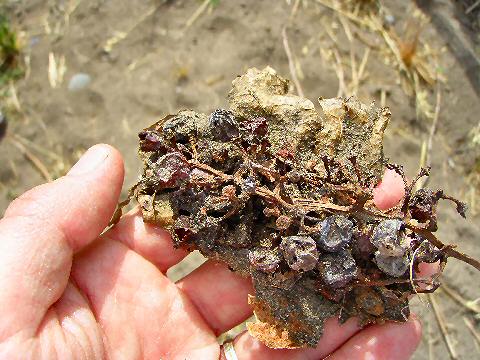
Back to the vineyards – 30% of Bianchi’s vineyards are certified organic, another 30% are in the process for certification, and they’re experimenting with some biodynamic vineyards as well. In between the rows of vines, they’ve planted barley, which apparently helps with water retention in the soil – who knew? These are some Semillon grapes that are affected by noble rot, botrytis, which we hear so much about in regard to dessert wines – this gives you a sense of just how ugly the intricate workings of some of this stuff is – these are a bunch that were left lying on the ground, so they’re a little more dried out than normal, but it’s pretty much what a bunch of botrytized grapes looks like.
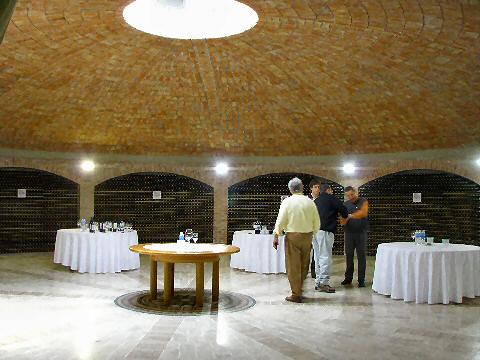
We continued on with Francisco, the winemaker, and a quick visit to the cellars. Francisco works closely with consulting winemaker Robert Pepi, Jr., from Napa. Hmm – facts and figures – 1700 barrels in the winery, 25% of them replaced every year. 15% of the winery’s production is barrel aged. The winery receives more than 100,000 visitors a year…. not all of them get to enter the underground tasting cellar (there’s a shop and tasting room up in the winery building where most people sample) – here we sat down to taste not only some of Bianchi’s wines, but those of two “visiting” wineries as well – El Rosal and Finca Los Alamos.
- Elsa Bianchi Chardonnay 2008 – touch of barnyard on the nose, bright, simple fruit, a bit of carbon dioxide prickle, and somewhat hot, or alcoholic finish – not one of my favorites
- Familia Bianchi Sauvignon Blanc 2008 – fresh, ripe melon, bell peppers, good acidity yet still quite smooth, a touch of residual sugar most notable on the finish – not bad at all
- Elsa Bianchi Malbec 2008 – red plums, dried leaves, a touch of pepperiness, dried cherries on the finish – simple, but eminently drinkable
- Familia Bianchi Malbec 2006 – the strangest note of horehound candies (both David and I picked it up, it’s one of those Michigander things we grew up with – Wikipedia says it’s best described as “berry flavored rootbeer”), black plums, candied violets, tannic finish – odd, but quite good
- Familia Bianchi Cabernet Sauvignon 2006 – almost more Cabernet Franc style, packed with green olive and dried weed flavors, black raspberry and a touch of graphite – I like Cab Franc, so while it wasn’t a typical Cab Sauv, I liked the wine
- Bianchi Particular Malbec 2006 – red plums, mixed spices, soft tannins, very heavy toasted oak notes, especially on the finish – in fact the oak dominated this wine to the point where I didn’t enjoy it
- Bianchi Particular Merlot 2006 – okay, I’m not even sure where to go with this one – take a ham and cheese sandwich, add chili peppers, and douse it in pure grain alcohol – even with the hint of red currants and the very soft, nearly non-existent tannins, this was not a pleasant wine, by any stretch
- Bianchi Particular Cabernet Sauvignon 2006 – it must be something with lunch meats – this was pure pimento loaf, topped with some green olives, a vague hint of red fruit and graphite, and very sweet oak tannins – not as unpleasant as the Merlot, but not going into my list of favorites
- Enzo Bianchi 2003 – the winery’s icon wine, a blend of Cabernet Sauvignon, Malbec and Merlot – needed time to open up and blow off a little carbon dioxide prickle that showed at first, then, black olives, a mix of red and black fruits, and an interesting blueberry note on the finish, soft tannins, toasted oak, all quite well balanced – and with time it opened up very nicely – quite good
Tanino Argentino is the venture of a trio of friends, not long out of business school (at least as I understood it), who apparently decided that opening a winery would be an interesting business model to explore – and I wish there was a polite way to say it, but let’s just say that wine is more than a basic commodity, and needs more skill brought to it than a spreadsheet. They bought the estate of the second oldest winery in San Rafael, reopening in 2004 under the label El Rosal, as an entirely export oriented winery – nearly 100% of their production goes to Brazil and the U.S. They produce 300,000 liters of wine (400,000 bottles), though the winery has the facilities to handle 1 million liters a year.
- Malbec Conclusion 2007 – unoaked, blackberry and black plum flavors, very high acidity, a bit thin, and bitter tar on the finish – not at all pleasant
- Malbec 2007 – black plums, black cherry cola, good acidity, a bit too heavy on the oak at the end – a rather sweetish, oaky Malbec, possibly fitting some consumer profile… somewhere
- Malbec Reserve 2006 – black fruit, cream, soft tannins, overly alcoholic and again, overly heavy on the sweet oak, especially at the finish – they seemed to be of the opinion that this style of wine is what the American consumer is looking for – a common refrain we heard from export oriented wineries over the three days – though each had their own idea of what constituted the right wine profile
Bombal, doing business under the label Finca Los Alamos, was started as an interesting project – the winery began as an opportunity for people to purchase barrels of personalized wine – and it continues with that as its primary business. The purchaser buys a barrel from a roster of choices, and ranging in price from $500 to $1450, and then selects the grapes to be made into wine and placed in the barrel – with the guidance, of course, of the winemaker, and then when the wine is bottled, it receives a somewhat personalized label (it’s the winery label with the purchaser’s name imprinted as “owner”). Recently the winery began producing a few wines for distribution, though the majority is not available commercially other than via the barrel program.
- Algodon Chardonnay Reserve 2008 – the reserve designation for a wine produced this year caught my eye immediately, the owner hemmed and hawed a bit and then admitted it was purely a marketing ploy – the wine, soft, tasting of baked apples and dark caramel, with a very oaky finish – not my style, but the sort of sweet, oaky Chardonnay that many seem to like
- Algodon Syrah-Cabernet 2004 – actually containing 20% Merlot as well, though not noted on the label, the wine is packed wtih blackberry fruit and pepper, soft, sweet tannins, toasted oak and coconut on the finish which is also a bit hot – not a favorite, but not bad
- Algodon Malbec 2004 – red plum, raisins, spices, tasting very overripe, quite hot finish – my least favorite of the trio
- Los Alamos Merlot-Cabernet 2005 – this wine was just plain wrong, all around – milk chocolate and toast dominated up front, then a very stewed, pruney quality, a ton of notable residual sugar, virtually no acidity, and a very oaky, cloying finish
- Los Alamos Cabernet Sauvignon 2005 – black raspberry, sweet tannins, slightly high alcohol, good acidity, over all pretty simple, not showing much in the way of depth or complexity, but pleasant enough to drink
- Los Alamos Cabernet Sauvignon 2004 – the best of the bunch, with bittersweet chocolate, red fruit, lots of spice, good acidity, and an interesting note that I can only describe as candied black olives
The following three are from the winery’s barrel program, three barrels that the owner of Bombal made for himself, or for use as examples of what they produce for prospective buyers.
We finished up with a luncheon spread in the upstairs offices – where we also noted that the weather was turning windy and cloudy – a quick call to our pilot revealed that he, too, was concerned, and his comment, “I can get you back safely, but it’s going to be a very rough ride.” had us on the phone to our Wines of Argentina coordinator, who dispatched a mini-van for the return trip – actually taking us less time door to door (since we didn’t also have to get to and from each airport) – and into Mendoza proper to check in to the Park Hyatt.
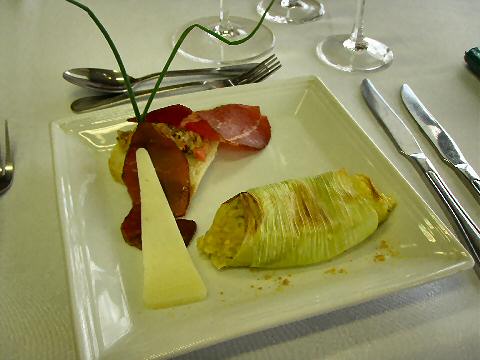
We started off with some hors d’oeuvres, then on to a humita more or less a sweetened tamale without the meat filling, accompanied by some air-cured beef. I’m not a big humita fan as I find them too sweet, but this one wasn’t over the top, and I did enjoy it.
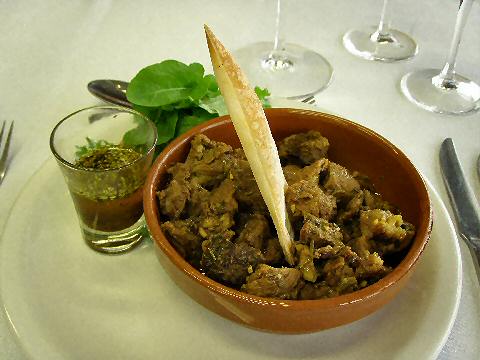
A stew that I hadn’t tried before, typical of mendocino cuisine, called carne a la masa – more or less, in normal presentation, a mildly spicy beef pot pie – this version with the crust removed and stuck in as a triangle of dough. Accompanied by a herby, mildly spicy chimichurri, which perked the whole dish up – one to experiment with!
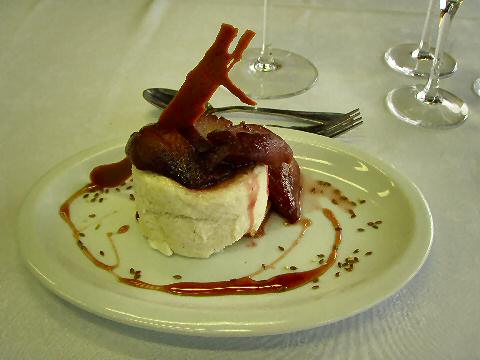
Dessert was simple, a vanilla ice cream topped with a Malbec-poached pear – we were a little stuffed, but nibbled our way through most of our desserts. The mini-van arrived, so we bowed out on coffee and headed back, leaving San Rafael in our rear-view mirror….
Copyright © 2026 SaltShaker. This feed contains copyrighted photos and text from SaltShaker. If you are not reading this material in a feed aggregator or by e-mail subscription, the site you are viewing may be guilty of copyright infringement. Please contact [email protected] so that I can take appropriate action.
Plugin by Taragana
]]>“The years from 1924 to 1933 were quite prolific and exciting for Borges. He founded several more literary magazines with varying amounts of success, and he contributed a variety of pieces to many existing magazines, most notably Martin Fierro. Ironically, his contributions to this magazine were to take an unexpected turn when the editors of the magazine decided to “invent” a literary feud. The publicity stunt involved two groups of writers – the aristocratic and intellectual “Florida” group, and the streetwise “Boedo” group, steeped in gaucho lore. Because of his European attachments and his reputation as an intellectual, Borges was assigned to the “Florida” group, a decision which he unsuccessfully appealed. He wanted to write common literature filled with danger and local color – but nevertheless his reputation had merited the “Florida” designation. Disappointed, he spent the next few years attempting to divorce himself from that image, and as a consequence he spent many hours exploring the less reputable areas of the city, talking with the hoodlums, learning the tango, and absorbing the Italian/Portuguese dialect.”
– Fervor de Buenos Aires: The Roaring Twenties
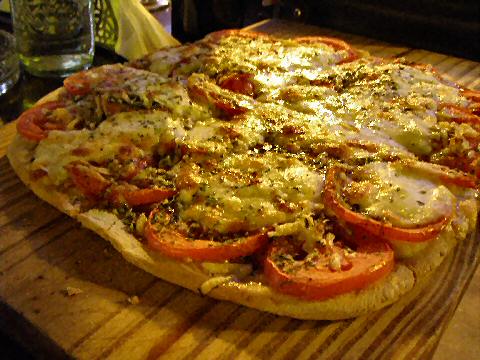
Buenos Aires – Literature or not, I can understand Borges’ desire to be part of the “Boedo” group than the “Florida” group. You may be able to shop ’til you drop along Florida Street, but there are far more interesting shops (including one of the city’s best little shops for hard to find tango sheet music and LPs at Av. Boedo & Av. San Juan) and restaurants both within the barrio of Boedo and along the avenue of the same itself. One of those spots is a charming, narrow café/bar at Boedo 878 called Pan y Arte, 4957-6702, which serves up traditional dishes of Mendoza, one of the few places in the city for those. There’s also a touch of an “organic” bent, with numerous vegetarian dishes offered up, and things like an eggless eggplant based mayo served with the bread, whole wheat crusts on the pizzas, etc. While not on the night of our visit, there are apparently tango and latin jazz shows on some nights, and a small, 45 seat theater in the space upstairs. [Closed]
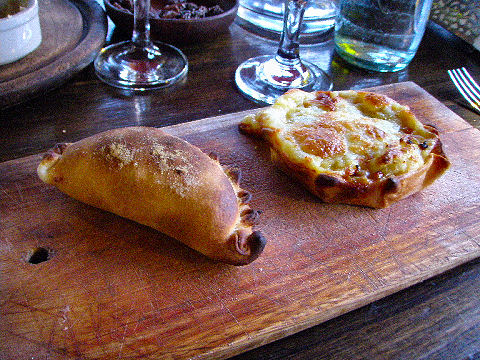 We started off with a selection of empanadas and pastelillos, the former good if not great (and so far, the only Mendozan style empanadas I’ve found in town), the latter like little mini shepherd’s pies, tartlets filled with ground beef, mashed potato and topped with melted cheese – really quite good and the better choice of the two. The wine selection is limited, mostly “usual suspects” from the bigger commercial wineries – a shame, a place like this with regional, artesanal cuisine could easily put a little effort into specializing in hard to find Mendozan wineries.
Copyright © 2026 SaltShaker. This feed contains copyrighted photos and text from SaltShaker. If you are not reading this material in a feed aggregator or by e-mail subscription, the site you are viewing may be guilty of copyright infringement. Please contact [email protected] so that I can take appropriate action.
Plugin by Taragana
]]>There are some oligarchs that make me want to bite them just as one crunches into a carrot or a radish.”
– Eva Perón
Buenos Aires – While I have been to quite a few events held in the garden or dining room of the Museo Evita, and toured the museum once a few years back (pre-blogging days), I’d never simply sat down to have a “regular” meal at the Museo Evita Restaurante, J.M. Gutierrez 3926, Palermo, 4800-1599. Since the museum was on “the list” for touring while my friends were in town over the last week, it seemed the perfect opportunity – a little lunch, and then Eva.
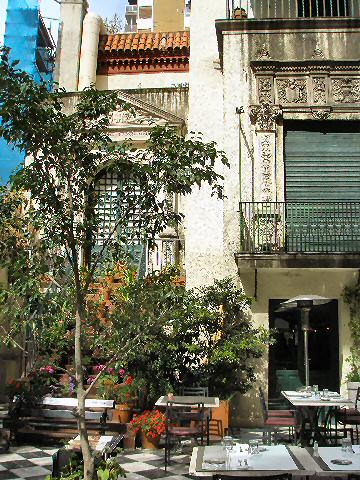
While the dining room is comfortable and well-appointed, the real draw of this place, when weather permits, is the beautiful courtyard garden. Thankfully, this last week was a delight for being out of doors, and we grabbed a table for five in a nice sunny spot. The waitstaff were immediately attentive, and continued to be friendly and helpful throughout lunch. Several of them speak English as well, which is a plus for those whose Spanish is less than fluent.
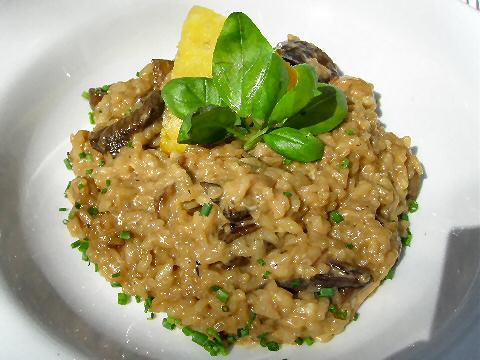
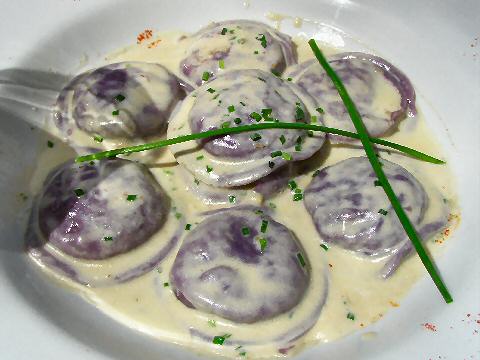
We started off with a couple of plates of rabas, or squid rings. For a change from the ubiquitous fried ones with mayo or lemon that are a staple of local fare, these were lightly seasoned and grilled, still tender, served up with a small side salad and some fresh lemon wedges. Perfect! Risottos and pastas are the mainstay of the menu, though not the only choices, however we were steered that way by our waiter. A mixed mushroom risotto, and another tinged vermillion with beets and topped with cubes of fried goat cheese, were both cooked to a proper al dente and loaded with flavor. The lurid purple lamb ravioli were packed with delicious meat and spices and served in a delicate cream sauce – the purple color, it was explained, came from beets as well, the color changing to a dark violet when cooked in salted water.
Desserts were likewise delightful – a pair of crepes filled with dulce de leche, beautifully presented with spun sugar decorations, an orange and vanilla custard, a cappucino mousse, and a frozen coffee and chocolate dessert more or less like a semi-freddo.
Lunch was moderately expensive – running us about 50 pesos apiece for a three course meal – and well worth it for the quality of the food and ambiance. All in all a delightful experience!
Copyright © 2026 SaltShaker. This feed contains copyrighted photos and text from SaltShaker. If you are not reading this material in a feed aggregator or by e-mail subscription, the site you are viewing may be guilty of copyright infringement. Please contact [email protected] so that I can take appropriate action.
Plugin by Taragana
]]>“Mind you, that’s not to say presentation is everything. At the end of the day, it really doesn’t matter how nice your coffee machine is. What counts is the quality of the service that you offer.”
– Peter Bolton-King, chief executive of the National Association of Estate Agents
Buenos Aires – I turn to my Roget’s Thesaurus… entry 674.17… superb, super [slang], superexcellent, supereminent, superfine, exquisite, magnificent, splendid, splendiferous, tremendous, immense, marvelous, wonderful, glorious, divine, heavenly, terrific, sensational; sterling, golden; gilt-edged or gilt-edge [both informal]; of the highest type, of the best sort, of the first water, as good as good can be, as good as they come, as good as they make ’em [informal], out of this world [slang]. Okay, quite a few of those are well over the top, so to speak, and truthfully, the word that came to mind was the title of this post, exquisite. A visiting friend from New York was in and we’d headed to a restaurant that my friend Alex, of Terroir has been recommending for a couple of months now. I hadn’t gotten there. Silly me. Alex is good with food. We entered the converted old brownstone that is now puratierra, 3 de Febrero 1167, in Belgrano, 4899-2007, and found ourselves to be the first to arrive (at nearly 9 p.m.) for the evening meal. [Closed]
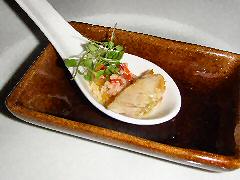
It’s tempting to just pick an illustrative photo, but would it be the cute little amuse bouche of bondiola… or the non-photo-ed trio of dips (hummus, carrot-grapefruit, vegetable cream) for the various freshly baked breads…
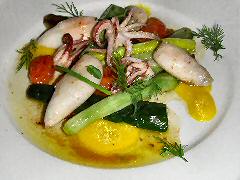
…or perhaps the tender as butter seppolini (baby squid) swimming happily about with their braised vegetables…
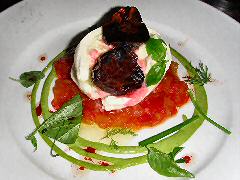
…or maybe the oozing fresh burratta perched atop its tomato compote and tagged with slices of roasted beets…
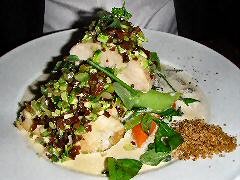
…or, better yet, the main courses, a succulently moist chicken breast, cascading with finely diced bits of zucchini and black olives in a bit of a garlicky foam…
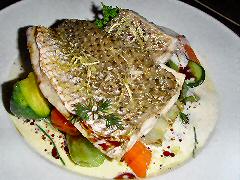
…or the perfectly grilled piece of corvina (sea bass) atop its roasted tomatoes, carrots, fennel…
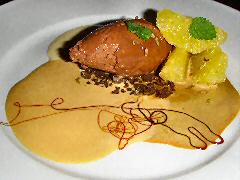
…no, wait, the desserts, that would be it, the bitter chocolate gelato with a trio of sauces – caramel, coffee, and cocoa, with scattered bits of sweetened cocoa nibs…
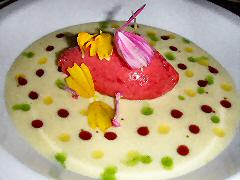
…or maybe the coconut and white chocolate soup with a scoop of fresh raspberry sorbet and dots of different herb and spice oils….
Better yet, the attentive, friendly service. Or the nicely lit, handsome room. Or the cozy, comfortable feeling of just sitting there and enjoying a glass of well priced wine off their well selected wine list.
Or perhaps, just to note that it was easily one of the top three meals I’ve had in Buenos Aires over the last three and a half years. [And, before you ask, Maat and Urondo are the other two of those three.] Definitely a special occasion place, as it’s a bit pricey – with a bottle of moderately priced wine it ran us 240 pesos for two – but worth every centavo (that my friend spent, since he, thank you Allan, picked up the check).
Copyright © 2026 SaltShaker. This feed contains copyrighted photos and text from SaltShaker. If you are not reading this material in a feed aggregator or by e-mail subscription, the site you are viewing may be guilty of copyright infringement. Please contact [email protected] so that I can take appropriate action.
Plugin by Taragana
]]>