In human life there is constant change of fortune; and it is unreasonable to expect an exemption from the common fate. Life itself decays, and all things are daily changing.”
– Plutarch, Greek Historian, Biographer, Essayist
Buenos Aires – Continuing on my series of Supreme Directors’ walks – we pick up, chronologically, though not geographically, with General José Casimiro Rondeau Pereyra – generally just referred to as Rondeau. Fittingly, perhaps, the street named after him is off in the southern barrios, punctuated by gaps, odd angles, the backsides of many buildings, and, not much of interest.
Likewise his life and career were checkered – born in Buenos Aires, moved shortly thereafter to Montevideo, where he went to school, returned to BA to enlist in the armed forces, and shortly returned to Montevideo to continue his military career. Captured by the British and sent to England, released when the British lost, went to Spain, fought in the Napoleonic Wars, returned to Uruguay to lead various campaigns, went to Peru to do the same, replacing “the Great Liberator”, José de San Martín as leader of the troops there. At age 42 he was elected in absentia as the third Supreme Director of the country, but refused to return to Buenos Aires, continuing to carry on his various military campaigns against the Spanish royalists in Peru – so Ignacio Álvarez Thomas was named acting Supreme Director and filled in for him during the entirety of his year’s term. After losing a couple of battles he was relieved of command, returned to Buenos Aires where he served briefly as provincial governor, and then was re-elected to the position of seventh Supreme Director, which he served as for about seven months until the government was toppled by a military coup. He returned to Uruguay where he led numerous military campaigns to eradicate the native population, was elected governor when Uruguay declared its independence from the rest of the union, until replaced by a rival, however, he continued to serve as the army’s general for the country, later as War Minister, and finally was killed during the siege of Montevideo in 1844, at age 71.
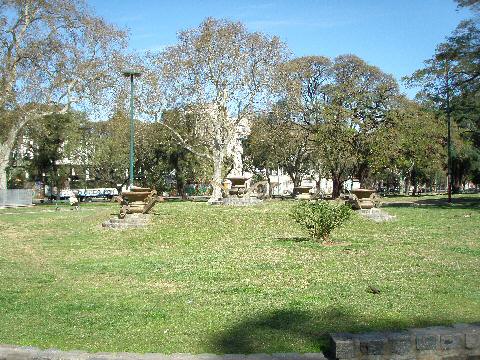
Our walk begins at Parque España, which technically isn’t along Rondeau, but is a good beginning point just a block away – named because at one point, the Spanish Embassy was located to one side of the plaza. The park, designed by Carlos Thays, and clearly at one time quite beautiful, was designed as the “southern botanical gardens” for the city, originally as the the Plaza de los Inválidos, or Invalids Plaza – so named because it was surrounded by half a dozen hospitals, several of which still exist. Today it’s a bit rundown, with a good number of homeless hanging about, as well as locals, and kids from the neighboring high school taking a break. The site was originally the home of the southern slaughterhouses for the city, connected with the nearby Mercado del Sur, the covered market that was originally on the site that is now Constitución Station. At one time there were half a dozen important sculptures in the park, most have been moved to the grounds of the nearby Centro Cultural del Sur and one to Parque General La Paz. I only noted this one remaining central sculpture, though various tour guides claim that a couple of the others remain in different corners of the park.
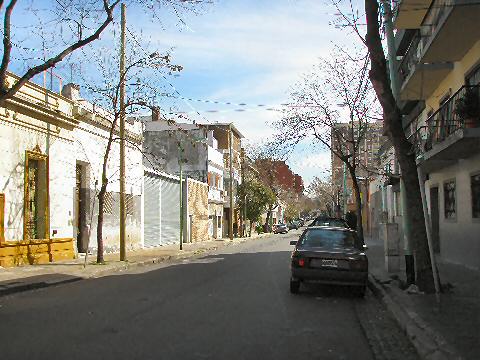
The street begins in the 1500 block, at Sáenz Peña, and is not particularly notable, mostly smaller one family homes with a few scattered apartment buildings.
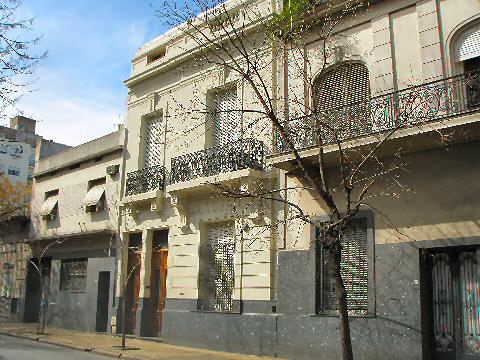
As I entered the second block, approaching the corner of Solis, I was immediately aware of the sweet aroma of chocolate, permeating the air. A bit of zigzagging about and on the cross street, and I found, along the block of Solis to the right, the offices of the Fenix Chocolate company, though the aroma was clearly emanating from a nearby building – I later found that the “factory” is at Solis 2022, just off the corner. I’ve heard the place is worth a visit if you can arrange it…
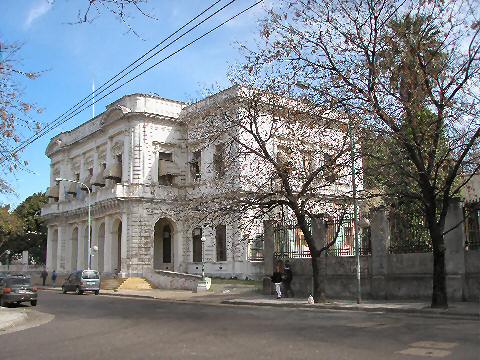
Within just a trio of blocks, Rondeau comes to its first gap, ending at the grounds of a Gastroenterology Hospital – quite a pretty building actually, though the newer additions on the grounds are basically ugly bunkers…
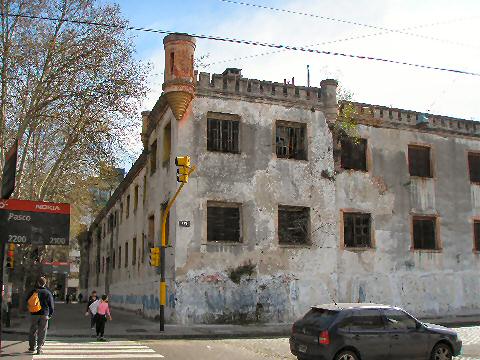
Picking up on the other side of the hospital, the first building you run into is the backside of the Caseros Prison which I mentioned on one of my Paint by Numbers walks…
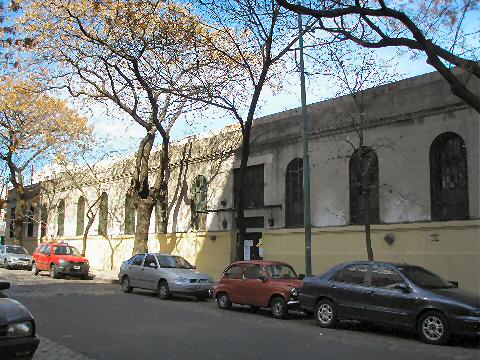
Another block on and the low, concrete block structure that is, I gather, a convent run school of some sort…
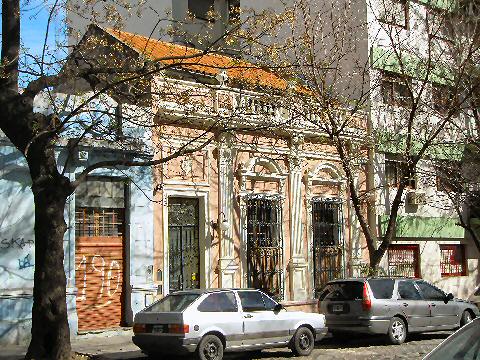
The street isn’t totally devoid of charm, though the homes that are most interesting standout precisely because they’re so out of character with their surroundings…
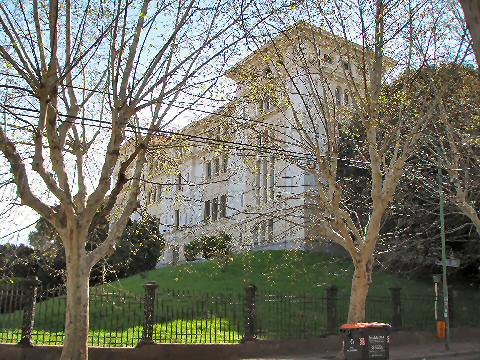
The side of the Instituto Bernasconi, also noted in the previous walk.
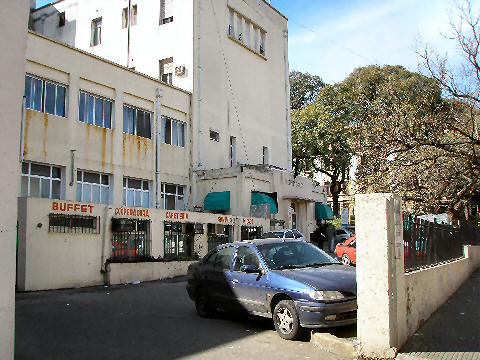
I suppose if one needed refreshment at this point one could stop at the comedor attached to the side of the Hospital Sarda, but I don’t think I would…
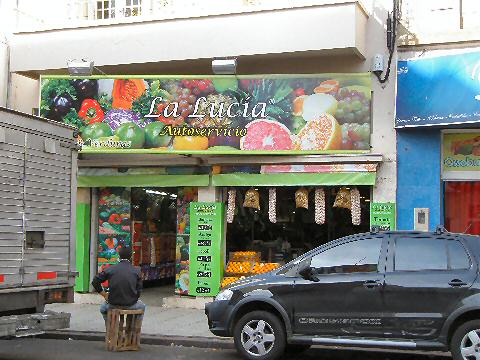
A moment’s side trip to the right on Av. La Rioja yielded up this interesting self-service fruit and vegetable market – not huge, but with great prices and selection – perhaps not worth the trip just for that, but an interesting side note.
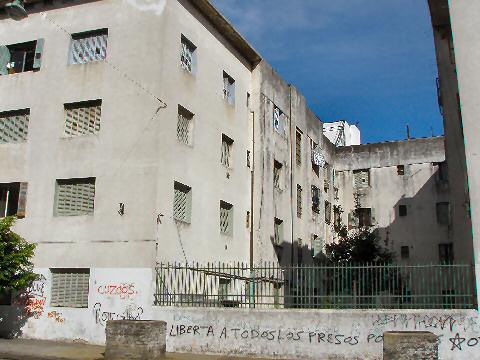
The back of the Casa Colectiva Patricios, a public housing project built in 1939.
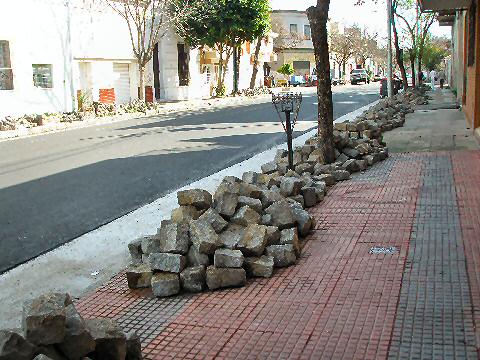
This has been going on all over the city – part of the new administration’s fix-em-up projects – the old cobblestones are being torn out and the streets paved. On Rondeau, from 3300-3500, plus the side streets were all underway.
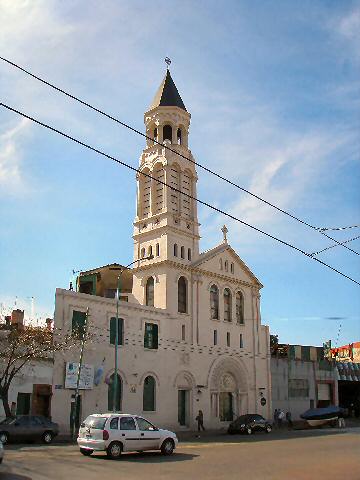
Rondeau reaches another gap, of about a block this time, where it crosses Av. Chiclana, an intersection where several streets come together. Nothing of great note here, though the pretty Instituto San Bartolome, which is an elementary and junior high school, stands out.
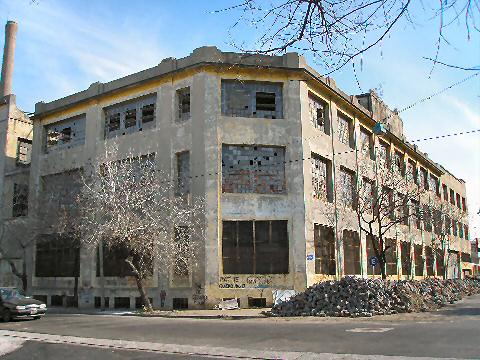
Within a few short blocks the street draws to an end at Av. La Plata, fittingly, perhaps, the last thing on the block is the abandoned hulk of the José Ferrarini factory, which at one time, though it declared bankruptcy in 2005 (my how it’s gone downhill in only three years) was one of the leading producers of metal wire in the city, if not the country.
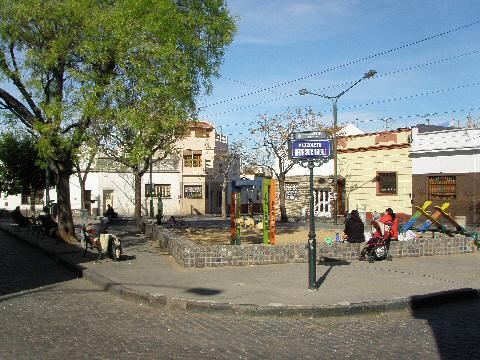
Though my “official” walk was at an end, I noted an odd street feature on my map just to the left of the street end – a small plaza surrounded by a small rectangle of streets, branching out in an “X” from the corners to a larger rectangle of streets. Sort of looks, in a two-dimensional view from above, like an emerald cut gemstone – regardless, I had to go peek, and found the pretty little Plazoleta Enrique Santos Discépolo, he having been a tango musician and composer who lived from 1901 to 1951. Quite popular apparently, with several well known compositions to his credit.
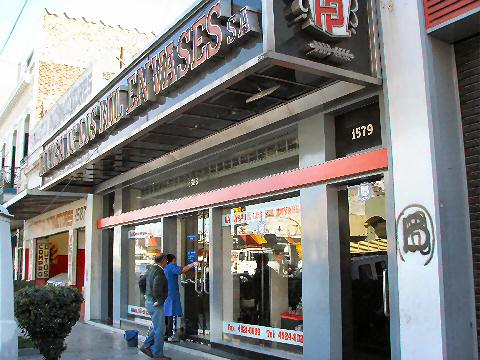
For the foodie, especially those who live here, perhaps the key thing to do is note La Casa de los Mil Envases, located a few blocks to the right along Av. La Plata at 1583, past the giant Carrefours San Lorenzo shopping center. If you need to can it, jar it, pack it in something, really, anything that is a container of any sort, from teeny tiny vials to big plastic boxes, in plastic, glass, and metal – this is the place to find it. Canning jars galore!
And, from there, just a few short blocks to the La Plata station on the E line…
Copyright © 2026 SaltShaker. This feed contains copyrighted photos and text from SaltShaker. If you are not reading this material in a feed aggregator or by e-mail subscription, the site you are viewing may be guilty of copyright infringement. Please contact [email protected] so that I can take appropriate action.
Plugin by Taragana




 ]]>
]]>“The same me that stands here now
When I think that all this stuff
Can make a life that’s pretty hard to take it in, that was me
That was me, ya, that was me!”
– Paul McCartney, final lyrics to That Was Me
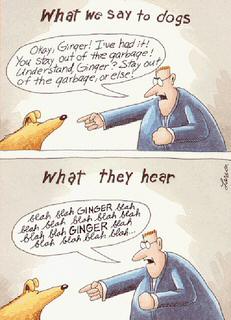 Buenos Aires – I wasn’t a member of the debate club in high school, though I thought about it. Swim team and water polo got in the way, you know? But I remember learning about how to debate in one class or another and my recollection is that it involved a structured, timed… argument – you know, sort of a point – counterpoint. Organized facts. Supporting evidence. I’ve seen a few political debates over the years, including between presidential candidates. What happened last night wasn’t one of them.
No, last night was a poorly choreographed series of campaign soundbites, with neither candidate paying all that much attention to what the other was saying, nor, often, to the question(s) being asked by the moderator. It was also one of the dullest points to date in what at one point looked to be one of the more interesting presidential elections in the last few decades.
Now, everyone has their own perceptions. In the course of e-mail exchanges today with various friends and relatives there are those who saw John McCain come out as a patriotic powerhouse, dominating the event with his clear, common sense views, while Barack Obama came across as a fumbling, smart-ass elitist who barely understood what foreign policy and economics meant, let alone what to do about them. Others saw a clear eyed, firm voiced young dynamo for change and the future who stood out against an aging, doddering war hero who, if he’s not senile, is on the fast track to it. Personally, I didn’t seen any clear winner – I saw a lot of posturing, a lot of talking, and not a whole lot of saying anything important. Here’s my re-imagined, and shortened (i.e., eliminating all the unnecessary fluff) version of the “debate”:
Moderator: Good Evening.
McCain: Good Evening Tom
Obama: I agree with Senator McCain, good evening, but I want to point out that I stood up in the Senate months ago and said good evening.
McCain: Senator Obama may have said that in the Senate, but there were also evenings where he didn’t say it. I’ve stayed true to the values of this nation and said good evening each and every evening for more years than he’s been alive.
Moderator: Perhaps we could move on to the economy.
Obama: I’d like to point out, as I have before, that I have a plan. It’s a plan for change, because I’m different from Senator McCain.
McCain: Look, we need to fix the economy, they tell me it’s in terrible shape, and that it’s Senator Obama’s fault. We have to stimulate business and we have to both cut and raise taxes. My plan is to simply veto everything, whether it costs money or not. I don’t know much more about it than that, but something has to be done.
Obama: I agree with everything Senator McCain said, except I’m the different one, and also the part about fault, it’s his fault, not mine, and I told people about this years ago and no one listened. So while I agree with everything else he said, my plan is different, we have to both cut and raise taxes, but not the same ones he’s talking about. Different ones. And I’m going to veto everything too, except the things I don’t.
Moderator: Let’s go on to foreign policy…
McCain: I have a running mate who’s made it quite clear that she has the qualifications in this area, dealing with two key foreign borders on a daily basis. And I’ve been in Vietnam, Afghanistan, and several other ‘stans that they made me try to memorize the names of that no one has ever heard of, and I know Senator Obama hasn’t been to any of them. I know about dealing with the evil empire.
Obama: The “evil empire”? I stood up in the Senate and said the evil empire went out when the Soviet Union fell apart. It went out with Ronald Reagan… Oh yeah, and I have a running mate too.
McCain: Ronald Reagan is my best friend. He is the best president this country ever had. We hang out together. And I heard that if Senator Obama gets elected he’s going to auction off the states that didn’t vote for him on e-Bay. Which, by the way, is a KGB plot. If you squint when you look at the e-Bay website it says KGB. Right there.
Obama: I never said what Senator McCain said, I just said I had a plan, and it’s different. From his. Whatever his is. Besides, I read some books by some really smart people…
McCain: They’re all friends of mine. They’ve been friends of mine since Senator Obama was in short pants. And the ones who aren’t friends of mine, our enemies, well I’ve met with them too. We’ve done shots together. Even the KGB guys. And that Iranian guy with the name that even he can’t pronounce…
Obama: Ahmadinejad
McCain: See, Senator Obama is out there showing off with big words that the American public doesn’t know or want to know. I’m a regular guy, I’m one of them. Oh yeah, and a maverick. I’m a maverick. I know that the record says I voted with Bush 90% of the time, but you don’t know how much I objected to it, even he called me a maverick, right there in the Rose Garden. And besides, I heard Senator Obama is giving that Iranian guy, and that Castro guy, and the Dear Leader of Korea… did you know North Koreans are shorter than South Koreans – that proves how oppressive their society is… I heard he’s giving them first bid on a couple of states….and maybe throw in Israel too.
Obama: I don’t know where Senator McCain is getting his information from, but I just want to point out that I stood up and told everyone something completely different, that I had a plan, only no one paid attention, and look where we’re at now.
Moderator: Perhaps the war in Iraq…
McCain: What war? We already won. We have the best troops. We have the best general. We’re just waiting for the right moment to come home. We’re coming home with honor and valor, and it doesn’t matter if we come home dead or alive. I’ve been there and I’ve met all the leaders. We had dinner. And tea. But not foreign tea. Senator Obama’s never been there. He’s never been anywhere. I heard that.
Obama: I’ve been lots of places, including some of those places Senator McCain is trying to pronounce. I told the Senate that we shouldn’t go to war, and now we have to end it. But did Senator McCain or anyone else listen to me? No, I don’t think so.
McCain: And I got a souvenir bracelet.
Obama: Me too, me too!
Moderator: Gentlemen, we’re out of time, any last words for the evening?
Obama: Just remember, vote for me, I’m different, I have a plan, and it’s different too… and, as I’ve said before, in front of the whole Senate, good night, just nobody paid any attention to me.
McCain: Senator Obama may have said “good night” to someone, somewhere, but I know those people, we did lunch, and they owe me some favors… if you get my meaning… so let me just be clear, that I’ve always said “good night”, every night, and meant it, patriotically.
Moderator: Zzzzzzzzzzzzzzzz….
Copyright © 2026 SaltShaker. This feed contains copyrighted photos and text from SaltShaker. If you are not reading this material in a feed aggregator or by e-mail subscription, the site you are viewing may be guilty of copyright infringement. Please contact [email protected] so that I can take appropriate action.
Plugin by Taragana
]]>“I think that I shall never see a billboard lovely as a tree. Indeed, unless the billboards fall, I’ll never see a tree at all.”
– Ogden Nash
Buenos Aires – The city of Buenos Aires has declared war on billboards, with the intent to remove some 60% of them, roughly 40,000, from the various barrios, calling it “visual pollution”. While I agree in principle that billboards on an in general basis are nothing more than an eyesore, I have to admit I would miss (should this ever actually come to pass) the amusement that some of them engender.
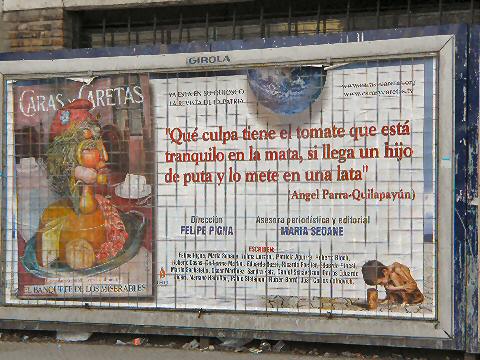
Indeed.
Copyright © 2026 SaltShaker. This feed contains copyrighted photos and text from SaltShaker. If you are not reading this material in a feed aggregator or by e-mail subscription, the site you are viewing may be guilty of copyright infringement. Please contact [email protected] so that I can take appropriate action.
Plugin by Taragana
]]>“In every phenomenon the beginning remains always the most notable moment.”
– Thomas Carlyle, Philosopher
Buenos Aires – Just a few random notes…
Disco, one of the local supermarkets, is three deep with people at the meat, i.e., beef, counter. With the 30-day suspension of the strike, people are battling over the packages of red meat like they’re stocking up for an impending war. There are actually shoving matches going on, and the store has a couple of their managers there just trying to keep tensions diffused. Shopping carts are being filled to overflowing with various cuts. What’s worse is, you have to figure that whatever meat is showing up here in the first days of the return of beef to the capital is whatever the ranchers had already butchered before the strike started, and had simply shoved into the deep freeze. And that means, given the quantity that people are buying, that they’re re-freezing stuff that’s already been frozen once – not a good move with meat – and the supermarket is covering themselves – they’ve got signs posted saying (in Spanish) “Do Not Refreeze or the Quality of the Meat will be Harmed”. Meanwhile, I noted that the corner butcher shop still has none – presumably the supermarket chains got the first wave of whatever is being shipped in.
Television ads have appeared in the last few days for a new pasta product from the pasta company, Luchetti, originally a Chilean brand, though they sold off their Argentine subsidiary to local interests here, years ago. The product, a boxed macaroni and powdered cheese – processed foods are starting to appear on the shelves of supermarkets more and more. I suppose some think this is a sign of moving into a more “first-world” market – convenience of making things (there are more and more pre-made, boxed foods appearing every week), for me, it’s a sign of the beginning of the end. Not like the apocalypse, but a clear move away from buying and cooking fresh ingredients for the sake of expediency. I’d have said that it was a result of the influx of American and European expats and tourists looking for familiar conveniences from back home, and perhaps they were the impetus in some way, but the folks I see stocking up their carts with this crap at the markets are all locals. Next stop, the obesity train…
Was out in Barrio Chino buying some ingredients for this weekend’s dinners, and laden with far more than I’d planned to buy – especially after I saw a display at one of the markets of freshly butchered tuna – a rarity here, and generally only in the markets for a couple of weeks here in early fall – and decided to take a cab. The conversation went something like this:
Never let it be said that prejudice is on its way out here…
Copyright © 2026 SaltShaker. This feed contains copyrighted photos and text from SaltShaker. If you are not reading this material in a feed aggregator or by e-mail subscription, the site you are viewing may be guilty of copyright infringement. Please contact [email protected] so that I can take appropriate action.
Plugin by Taragana
]]>“There is no symbolism for the “disappeared”. They were taken away without a trace. That was part of the terror tactic: the permanent anguish it caused the family. It is described like living with a ghost; they are not dead, but they are not alive either. The idea that some day they might return (although highly unlikely) does not allow for them to be dead. Keeping them alive and constantly present in mind does not allow for the survivors (the family) to continue living. One cannot mourn for a person who might possibly still be alive; how to move forward while maintaining the memory alive? Unlike the victims of the Holocaust, there are no monuments, no symbol (like the yellow star, the pink triangle); the “disappeared” have no meaning. They are referred to by their state of being, by a verb that was never active until now (someone is “disappeared” by someone else).”
– Analia Penchaszadeh, Youth Sourcebook on Sustainable Development
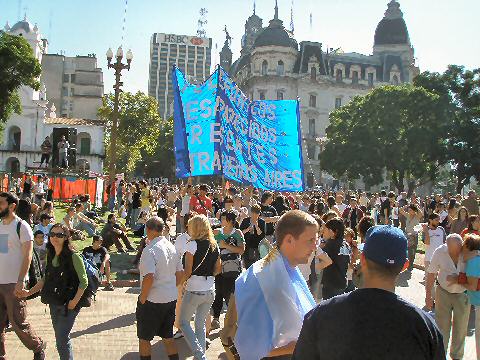
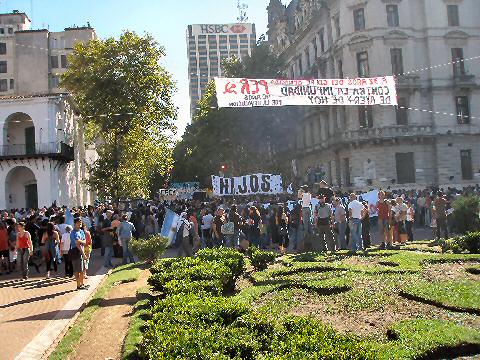
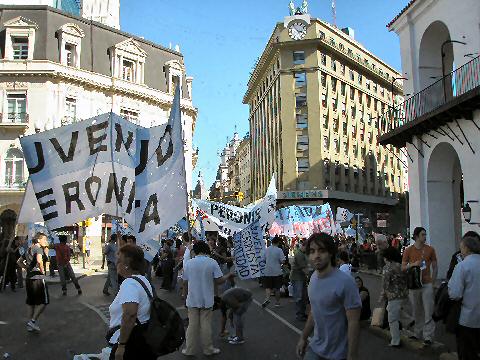
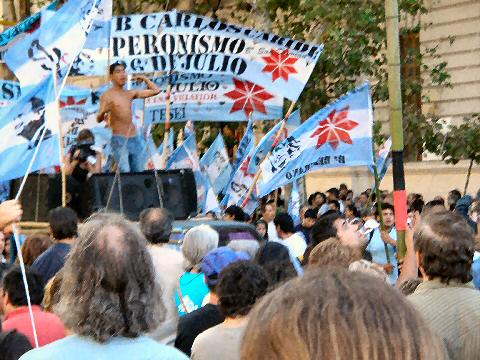
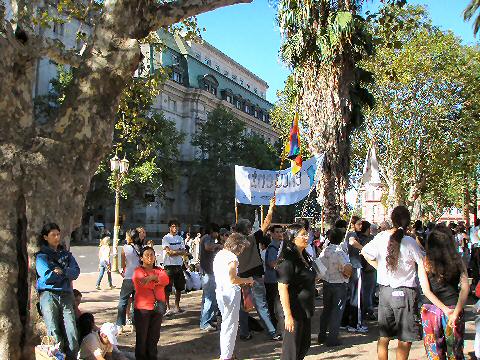
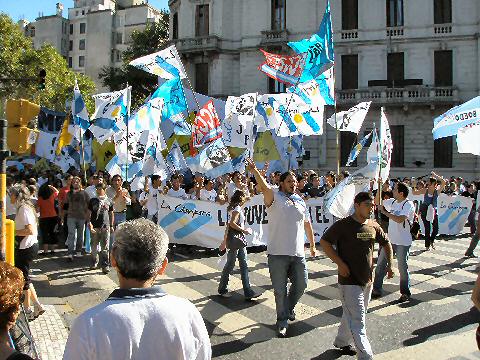
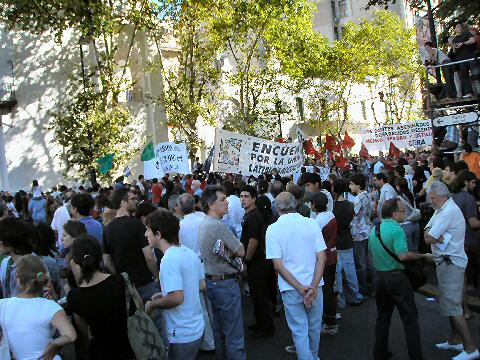
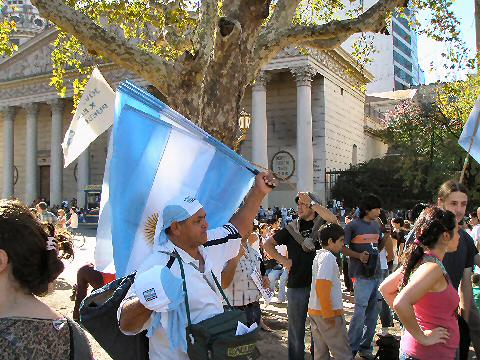
Buenos Aires – It’s been a noisy week here in town. Monday, extending an already long Easter weekend, started us off with the Día Nacional de la Memoria por la Verdad y la Justicia, or national day of memory for truth and justice – in commemoration of the military coup on March 24, 1976 that overthrew the government of Isabel Perón and added a whole new level of terror to living in Argentina at the time – disappearance. From 1976 until 1983, when democratically elected civilian rule was re-instituted a huge number of people, primarily those of left-wing politics, simply vanished – soldiers or police showed up at homes and dragged one or more family members away, children went out to play or to school and never returned – official estimates range from 9-11,000, while most human rights activist groups put the numbers at around 30,000.
A few of the children, now grown, have been found, mass gravesites have been uncovered, evidence of large numbers of people simply shoved from the side of military planes out over the ocean has come to light… and for years, the elected governments simply asked the population to “forgive and forget”. Only in recent years has there been an official push to both uncover the truth and prosecute those responsible. But, the people have been pushing for 20+ years – with the weekly “mothers” march at Plaza de Mayo that has become, for most visitors, simply an odd tourist attraction, to the annual march and rally that includes everything from music to political speeches to reading lists of names of the disappeared for hours on end. Like many marches, this one has, unfortunately, lost some focus – while the vast majority of people were clearly there with the spirit of the day in mind, there were also political groups simply there to push their own political agenda – a shame, as it dilutes the message of the day – I spent a couple of hours in the plaza, and chatting with various people it became clear that many had no idea what the event was about – it was just a day to get out and “protest against the government” for unspecified reasons.
The week continued with three evenings of cacerolazos – pot bangers – not a unique form of protest to Argentina, but one raised to an art form. Basically, people take to the streets, their balconies, their yards, banging on pots (cacerolas, or casseroles, which is where the name comes from) in a vaguely rhythmic pattern that goes on for hours, waxing and waning, but spreading throughout the city. This one centered on Recoleta, our neighborhood, where many of the owners of campos – the big farms – live. But it quickly became citywide, and even on to other cities as people heard about it – roughly from 8 to 10 p.m. each night, Tuesday through Thursday.
I can’t remotely do justice to the complexity of the situation, and, of course, there are two sides to this fight, like most. However, the nutshell version – the ranchers and farmers claim is that after the crash in 2001 they became the backbone of the country, keeping up the food supply at reasonable costs, and that the government has steadily increased taxes on them – both on their land and their products, and that the latest, and final straw, was a recently iincrease from 35% to 44% on export taxes that has been imposed as an effort to make exportation completely unattractive and keep domestic products in country.
The problem, from their view, beyond the outrageous amount, is that the tax is imposed on products, like soy, for which there is no domestic market (Argentina is the second largest producer of soy in the world, virtually all of it exported for cattle feed in North America and Europe) – not to mention it was imposed in the middle of the harvest season, long after everyone was committed to what they were growing and selling. So the ranchers and farmers have simply stopped shipping a large quantity of stuff – beef being the most noticeable – to the capital – tourists arriving are finding none of the legendary beef awaiting, and locals are trying to figure out what to do with a whole lot of chicken and fish that they’re not used to eating on a daily basis.
From the government side, if I’ve got this at all correct, the feeling is that the ranchers and farmers did this to themselves, by seeking more profitable export markets at the expense of producing for domestic consumption. They claim that the whole soy thing was a bunch of farmers trying to get rich quick rather than supply food to a hungry nation, that the soy (much of it genetically modified) is destroying the soil, and that they’re trying to force the farmers to replant crops that will be of use to feed the tens of thousands of people in the country who are starving. On the beef side, prices controls have been in effect for years, which is a way of keeping the national meat affordable for those who are poor, and, of course, if the controls are lifted and/or the high export taxes lifted, beef will simply become unavailable for a large portion of the population. Obviously, both sides of this are more complicated than these few sentences, and asking any individual Argentine seems to elicit a different answer as to exactly what’s going on, why, and what should be done about it. Time will tell.
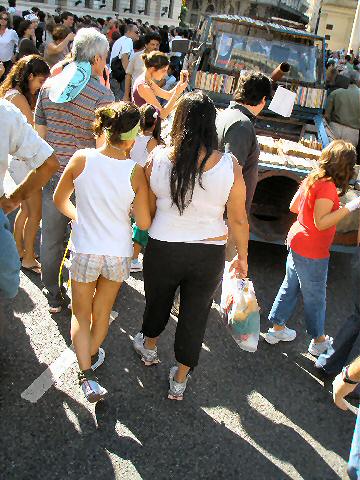
I’ll leave with a series of photos from the Monday rally and march…
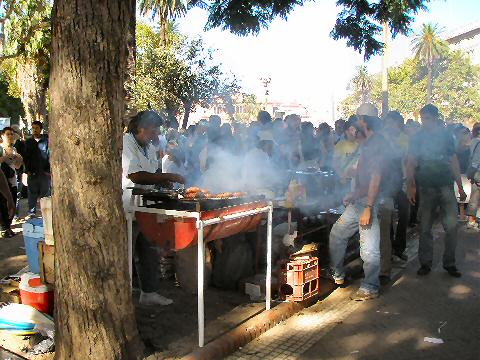
Of course, even at a memorial march and rally, someone has to try to make a quick buck…
Copyright © 2026 SaltShaker. This feed contains copyrighted photos and text from SaltShaker. If you are not reading this material in a feed aggregator or by e-mail subscription, the site you are viewing may be guilty of copyright infringement. Please contact [email protected] so that I can take appropriate action.
Plugin by Taragana
]]>“We are all in deep thought, hurting, wanting to say something that will help us understand. Whatever we have to say probably pales in comparison to what those who have gone on would say to us.”
– Eugene Habecker, President, Taylor University
Buenos Aires – It’s not all food, wine, and architecture you know. There’s a lot going on here in town that touches on other areas of life as well. There’s an organization here called Yok (street slang for “yo ok”, or “I’m okay”) that sponsors various Jewish cultural programs, learning opportunities, street festivals, and, philosophical debates. I occasionally head out to one or another, they can be quite interesting events. This last week, they sponsored a debate between local rabbi Sergio Bergman and Israeli philosopher and writer Gustavo Perednik – a sort of event I hadn’t tried out, just because of the difficulty of following it in Spanish.
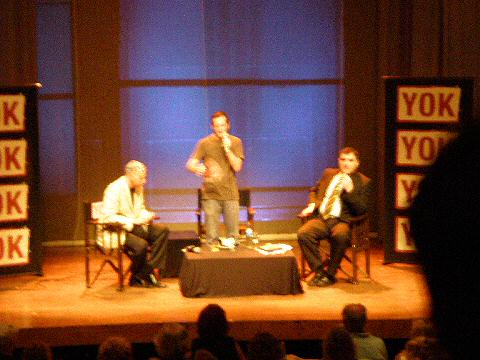
So, one thing that was noticeably cool for me was that this was the first time I’ve been to something like this, where there’s a fairly rapid back and forth, and the language delves into all sorts of arenas, is that I followed pretty much the whole thing, including the jokes. I don’t think I could have had a conversation like this, but then, I’m not sure I could in English at that pace either. It was also very interesting to see not just how many people were there – a couple of hundred were admitted to the theater where it was held and others were simply turned away because it was packed – but that the attendees ranged from teens to retirees. The topic of the evening “To be Jewish in Argentina Today”. There were four topics in particular that were held up as the focus of the debate on this theme – the security pilons that surround most Jewish temples and cultural centers – “security or symbol?”; cemeteries – “live jewish, die gentile”, referring to the lack of Jewish sections of most cemeteries; mixed marriages; and the Middle East – “war for peace?”.
The format quickly became not so much a debate as a duo of soapboxes – rabbi Bergman objecting the the five minute limit and back and forth between the two of them, claiming that they were not really debating anyway, since they pretty much agreed on everything but just approached things differently (turned out he wasn’t entirely right…) and so they should just talk. The moderator tried to object, pointing out they’d agreed to the format in advance, but was basically met by complete resistance, gave up, and let them each essentially give a series of speeches, one after another. I’m not sure I can boil two hours worth of philosophical speeches down to a few sentences, but…
Bergman’s take on things as I understood them – security of citizens is the responsibility of a country’s government, and that should extend to one and all, and what the Jewish community should be doing is getting the Argentine government to honor that commitment and provide security for everyone, and that any group taking on its own self-defense rather than the other approach is setting a dangerous precedent and heading down a slippery slope towards vigilantism. A similar view seemed to pervade the second topic – that just as cemeteries provide catholic chapels on their grounds here, they ought to provide the jewish equivalent, and, of course, while not an absolute requirement, it would be logistically easier if that were centered in a jewish section of the grounds, and while there exist jewish cemeteries here and there in Argentina, I kind of gathered he felt those were a cop-out, a way of not forcing “regular” cemeteries to live up to their obligations to everyone. On mixed marriages, his point seemed to be that they cause a loss of tradition and faith – that no matter the best intentions of a jewish parent in a mixed marriage, or even an agreement to teach their children in one or both faiths, the chances of the children understanding and/or carrying on the traditions and faith were slim. And, on the middle east, he mostly agreed with his debating partner who had spoken on the topic first, but centered it on the lack of involvement in the local jewish community in things like protests against the Iranian embassy, in followup to the Israeli embassy bombing sixteen years ago – that there was too much passive acceptance here and not enough action. He seems to be quite popular with the locals, I have to say I found his views to be a bit of wishful thinking in a lot of ways, and I found his overall demeanor to be pretty condescending towards the whole event – he spent most of the evening, including during his own speeches, text messaging on his cell, and even took and made a couple of phone calls.
Perednik was a bit of a firebrand – I gather he’s somewhat of a right wing columnist in Israel and a “hard-liner” in support of Israel and its policies. It’s actually sort of surprising that Bergman would have thought they’d agree on all topics. One thing, Perednik’s focus seemed to keep drifting back to Israel, and/or to the global Jewish community – he spent little time talking about anything local. On the topic of security measures, he felt that symbolism and security didn’t need to be separated, that the pilons and any other private security steps were both, and were necessary, and a community needed to defend itself, especially if no one else was doing it for them. He didn’t really touch on cemeteries. On mixed marriage, his view was that mixed marriage, while not a bad thing in itself, was a break in the continuity of the community – basically an end of the line with that person, because it was, at best, a 50:50 proposition, and probably lower odds, that the community line would continue through that family. Most of his time was spent railing on about the problems in the middle east, about the need to support Israel and its government in their approach to things, and in the fight against Islamist regimes (not Islam, he was quite clear he was talking about “2 or 3” countries where an Islamic fanaticism has created terrorist states) – in particular, Iran and Pakistan, and more locally, the support that Hugo Chavez has shown for Pakistan and anti-semitism – an area in particular he felt Argentines need to be approaching with the government here. He was definitely an engaging speaker…
…and then, of course, we got back to the important things in life and went out for pizza…
Copyright © 2026 SaltShaker. This feed contains copyrighted photos and text from SaltShaker. If you are not reading this material in a feed aggregator or by e-mail subscription, the site you are viewing may be guilty of copyright infringement. Please contact [email protected] so that I can take appropriate action.
Plugin by Taragana
]]>