“Under the… new hypothesis [of Continental Drift] certain geological concepts come to acquire a new significance amounting in a few cases to a complete inversion of principles, and the inquirer will find it necessary to re-orient his ideas. For the first time he will get glimpses… of a pulsating restless earth, all parts of which are in greater or less degree of movement in respect to the axis of rotation, having been so, moreover, throughout geological time. He will have to leave behind him—perhaps reluctantly—the dumbfounding spectacle of the present continental masses, firmly anchored to a plastic foundation yet remaining fixed in space; set thousands of kilometres apart, it may be, yet behaving in almost identical fashion from epoch to epoch and stage to stage like soldiers, at drill; widely stretched in some quarters at various times and astoundingly compressed in others, yet retaining their general shapes, positions and orientations; remote from one another through history, yet showing in their fossil remains common or allied forms of terrestrial life; possessed during certain epochs of climates that may have ranged from glacial to torrid or pluvial to arid, though contrary to meteorological principles when their existing geographical positions are considered -to mention but a few such paradoxes!”
– Alexander Logie Du Toit, Our Wandering Continents: An Hypothesis of Continental Drifting
Buenos Aires – With United Nations Day upon us, the simplest approach to a Casa SaltShaker dinner was to offer up one dish from each of the five continents. Now, yes, I know there are more than five – but we’ll start by eliminating any conversations about the Arctic or Antarctic as not having any particularly appealing cuisine for me to undertake preparing, and then Africa because, well, because I had to eliminate one more. In terms of various other versions of what constitute the official continents, I’m sticking with the five I learned growing up many decades ago, and I’m not budging. As to the dishes, I decided to pick from past favorites – with one exception, which I’ll focus on.
We began here in South America with a causa de atún from Peru. Regular readers have seen this one pulled out of the hat many a time, it’s a delicious yet simple dish to prepare and tends to be a crowd pleaser. From there, we moved to North America, and my twist on a classic creamy tomato soup, which some might recall involved a tad of gin…
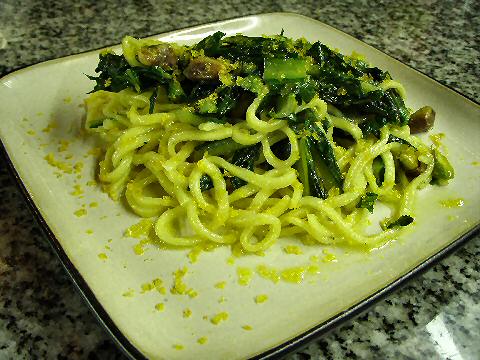
From there, we headed to Asia, in particular Pakistan, and shahi chicken, which is a dish that ended with almost everyone who attended the trio of dinners asking for the recipe. And, finally off to Australia and my version of inside-out lamingtons.
Now, hmm… I picked up half a kilo of bottarga while I was in Manhattan… I’ve now used… oh, about 2 ounces, if that… where do we go from here? Look for more upcoming fun!
Copyright © 2026 SaltShaker. This feed contains copyrighted photos and text from SaltShaker. If you are not reading this material in a feed aggregator or by e-mail subscription, the site you are viewing may be guilty of copyright infringement. Please contact [email protected] so that I can take appropriate action.
Plugin by Taragana




 ]]>
]]>Pakistani cuisine is as diverse as it’s people. Most of Pakistani cuisine has Afghan-Turkic-Iranian roots, a legacy of Muslim rule in South Asia, which got ‘Indianized’ due to the greater usage of spices; this is specially true for Pakistani Punjabis, Sindhis and Muhajirs (also Muslims in India); whereas Pakistani Pashtuns and Baluchese have retained their cuisine similar to our western neighbors. So in a wider sense Pakistani cuisine is a blend of our western (Afghan-Iranian) and eastern (Indian) neighbors, depending on the region and people, of which many have evolved into their own unique distinct characteristics. Meat is a major part of Pakistani diet, whereas vegetables and beans are as important. Wheat is also the main staple of Pakistani diet, whereas rice is also popular. The content of spices can range from very spicy/hot to mild, although spicy/hot seems more popular. In recent times some of the Chinese and American cuisine have also been adopted by a few segments of Pakistani urbanites as well.”
– Bushra J. Butt, Pakistani Cookery
Buenos Aires – One of the fun things about exploring cuisines that I’m not overly familiar with is the opportunity to learn a bit more about a place, a people, and their culture. For instance, I had no idea that “Pakistan” was an anagram for the original territories it encompassed – Punjab, Afghania, Kashmir, Sindh, and Tan/Stan (Balochistan/Tokharistan). Or, that the day we were celebrating here at Casa SaltShaker, Republic Day, is a mere sixty years old – i.e.,, that the country of Pakistan as a single entity has only existed that long. I did know that there were differences in comparison to Indian cuisine, though, of course, there’s no single cuisine of India, but just the simple difference between a Hindu and a Muslim country changes some of the ingredients used. For me, it was a great chance to try out some things – some more successful than others. While, given that I was fairly unfamiliar with the dishes, I tended to stick closer to “traditional” recipes than I normally do, I made some tweaks here and there, and, given the vast numbers of recipes for each of the dishes that I decided to offer, I have no doubt that the authenticity of some of these is a subject for debate, and/or conversations like “my mother never would have made this dish that way.” So be it.
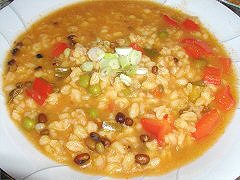 Right up front, I had no idea that I would be able to find mung beans in Buenos Aires, but sure enough, my faithful dietetica had kilos of them available. You may remember our recent look at some other wheatberry soups – here was an opportunity to try one quite different. It was also an example of a zillion recipes that contained very little in common other than a base of wheatberries and mung beans. It’s actually pretty simple to make – I soaked 2 cups of wheatberries, 1 cup of mung beans, and 1 cup of rice for a couple of hours in water. Then I sauteed a good quantity of chopped green onions and a diced red pepper until just softened. I added a teaspoon of masala ahumada, a smoked masala – as best I can tell the word more or less means “spice mixture” – in this case a premixed blend based on some sort of mild red chili, along with two teaspoons of ají rojo, a medium hot red chili powder. Once the aromas were developing nicely I added the grain mixture, sauteed for a minute or two, topped it off with a good quantity of water, brought it to a boil, then simmered it until the beans and wheat were cooked through – the rice, after soaking, seems to disappear and act more as a thickener. At the last minute I mixed in a some green peas for color (frozen are just fine – if you use fresh, add them early enough to cook them through). Season to taste with salt and, if needed, more chili – though it shouldn’t need it. This makes a large quantity – enough for about 16 people – so feel free, of course, to cut the recipe down in size. We paired this with our house sparkling wine, the Nieto Senetiner Extra Brut.
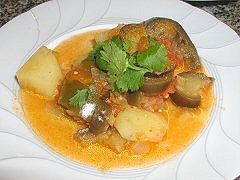 I knew I wanted to do at least one truly spicy dish during the course of the dinner. The most interesting one I found, or perhaps it’s because the two meat dishes that sounded truly amazing – well, sounded truly amazing, I decided on a spicy vegetable dish. Vegetable Masala it was to be. Now, assuming that “masala” simply means spice mixture or spicy, I’d guess that might explain the wide variety of versions I found. In the end, the version I went with, seemed much like a ratatouille, only quite picante. I sauteed 2 chopped yellow onions in olive oil until soft and translucent. Then added 2 teaspoons of chopped ginger, 1 teaspoon of sweet paprika, 1 teaspoon of salt, 1 teaspoon of ground coriander seeds, and 1 teaspoon of the masala ahumada mixture. I continued sauteeing for about 3-4 minutes until the spices were nicely developed. Then I added 3 thinly sliced green jalapeños and 2 chopped green bell peppers. I sauteed until those were softened, then added 4-5 chopped tomatoes and 4 peeled and diced potatoes and enough water to cover. I cooked this until the tomatoes had basically turned to mush and the potatoes were nearly cooked through. At that point I added 2 sliced eggplants that had been salted and drained for 30 minutes, and then rinsed (to get rid of the extra salt). Cooked that until the eggplants were cooked through as well as the potatoes. Garnished with cilantro leaves and served. On the first night it was a bit too spicy for some of our guests (I think I used an extra green chili or two because it seemed mild to me), so the second night I went with these quantities – and I think it’s actually better at this heat level – the vegetable flavors come through more clearly. This dish needed an aromatic and slightly off-dry wine to counterbalance, I picked the Don Cristobal 1492 Verdelho.
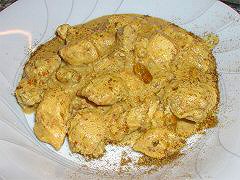 Sometimes, a dish is just a complete winner. I think everyone on both nights, including ourselves, fell in love with this dish. The flavors were just dead-on delightful and delicious. I made only two changes between the nights – the first night we had a guest allergic to garlic, but not onions and shallots, so I used shallots in the dish, the second night I used garlic. On the first night I used diced up whole chicken breasts, on the second, I diced up “chicken tenders” – those fillet strips attached to the breast. The latter made no different that I could discern in the dish, the former was actually noticeable, and I think I liked it better with shallots than with garlic, which, while still delicious, was more noticeable. First off, take about a cup and a half of raw cashews and soak them in water to cover for at least 30 minutes. Finely chop two large white sweet onions and saute in a good amount of oil until nice and golden brown. At that point add 1 tablespoon of garam masala (the recipe I have uses equal parts of ground cloves, cardamom, cinnamon, laurel/bay leaf, and nutmeg), 2 chopped shallots (or 3 garlic cloves, your choice), 1 tablespoon of finely chopped ginger, ½ teaspoon each of cayenne pepper, ground coriander seed, and turmeric, and 3 tablespoons of tomato paste. Take the cashews and the water they soaked in and puree them until smooth in a blender. Add 4-5 pounds of diced chicken breast to the pan and stir and saute until the pieces are well coated with spices and the outsides of the chicken are cooked and sealed. Add the cashew puree, a cup or so of golden raisins, ¾ cup of heavy cream, and just enough water to make sure the chicken has liquid to simmer in. Cover the pan and simmer over low heat for half an hour, stirring occasionally. Garnish with a bit more sprinkled garam masala. A nice heavier white, or a rosé works well with this – we used the Finca El Retiro Malbec Rosé which has a touch of residual sugar that matched the sauce in the dish nicely.
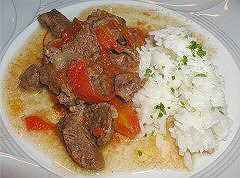 I feel, or felt, like I must apologize to the folks who came the first night of our Pakistani dinner for this dish. I pretty much followed the traditional recipe, and while it came out okay, I was completely unimpressed. Three or four of the guests simply didn’t eat it after trying it. Then again, the others did, and I’ve gotten good feedback on the dish, so it’s hard to say. It’s a lamb dish, with the lamb flavored with cinnamon and chopped limes, and then cooked in one pot with tomatoes and rice. It ended up being something that would have been okay to serve as a home meal, but had no elegance or finesse to it. On top of that, the limes imparted a bitter note to the rice – I don’t know if that’s traditional with this dish, my guess is more that it’s likely that the limes available here are simply different from the limes available in Pakistan – there are quite a few varieties out there in the world. So, the second night, I decided to just use the grated zest of the limes, without the pith and pulp, and also to cook the dish separately from the rice and serve them side by side. I think it worked out much better – the flavors of the spices melded beautifully and didn’t overwhelm the lamb, and the dish looked far more appetizing! And, everyone ate every bit of it. It’s actually a pretty simple dish to cook – I cut up four red onions in roughly 1/3″ slices (cut the onion in half from above and then lay the flat side down and cut lengthwise rather than crosswise into slices) and sauteed them in olive oil with 4-5 pounds of diced lamb. When lightly browned, I added 2 teaspoons of cinnamon, the grated zest of 2 limes, 1 teaspoon of cardamom, half a dozen chopped dried red peppers (the kind you use in Chinese cooking), and some salt. I cooked that for a couple of minutes until the spices developed nicely in the oil and then added six tomatoes cut the same way as the onions. Stir it up, cover it, and let it simmer for an hour until the lamb is very tender. Serve alongside or atop white rice. This needs a bold but spicy wine to go with it – I opted for the Finca La Linda Tempranillo.
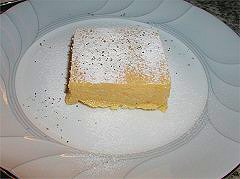 This dish was a fortuitous accident in some ways. One of our guests on the first night was allergic to all nuts except cashews and peanuts. I’d already used the cashews with the chicken, and I had two jars of peanut butter sitting in the cupboard… and this dessert normally uses almonds ground to a paste… Hmmm… I thought I’d give it a try. It was so good with the peanuts that I didn’t even bother the second night doing it with almonds, I remade it the same way. Melt 4 ounces of unsalted butter in a saucepan over medium heat. When melted, add 8 ounces of white sugar and stir to mix thoroughly. Add a pound or just a bit more of ricotta cheese (it comes in 500 gram size here, so about 17½ ounces), 1/3 cup of peanut butter, and a teaspoon of cardamom. Cook while whisking until it’s a nice smooth consistency. At this point add, in stages, 3 cups of powdered whole milk, whisking or stirring as you add it to incorporate it well. Continue cooking and stirring for another 5-6 minutes – the mixture will get fairly thick and start to sort of pull away from the sides of the pan as you stir. Pour it into a buttered baking dish so that it’s about 3/4″ deep. Let it cool, then chill it. It comes out more or less the consistency of a soft fudge – and I guess kind of tastes like a fudge made with ricotta and peanut butter… I topped the squares with powdered sugar and a sprinkle of cardamom. As most desserts seem to, this paired beautifully with the Finca El Retiro Tardío, a Sauvignon Blanc and Chardonnay late harvest blend.
Copyright © 2026 SaltShaker. This feed contains copyrighted photos and text from SaltShaker. If you are not reading this material in a feed aggregator or by e-mail subscription, the site you are viewing may be guilty of copyright infringement. Please contact [email protected] so that I can take appropriate action.
Plugin by Taragana
]]>