The test and the use of man’s education is that he finds pleasure in the exercise of his mind”
– Jacques Barzun, French educator
Buenos Aires – I think I did well, really. It was the last day of class, and I guess back on day one they’d said something about a final exam, though it just seems sort of odd to have a final exam for a class where all you did was sit there and watch someone prepare food and then taste it, but, I guess, looking back over my posts on the classes, they gave us a fair amount of information as well. But, they’d said that the exam was only for those who wanted continuing ed credit at the school for people who are in the long term professional chef program there – for the rest of us, it was unnecessary… then on the day of the test, they gave it to all of us “as an exercise”. So I was pleased that I was actually able to read and understand the exam – a dozen questions or so – and, I think, give relatively competent answers – I’m sure some of my spelling and grammar was off, but I think I got the concepts across. Following the exam, the instructors threw together a final menu, using a bit of all the techniques (other than liquid nitrogen – apparently no one wanted to deal with that again) just to show how one might put together a whole meal out of this stuff. We didn’t get any recipes, just a menu, so I’m doing this all from memory…
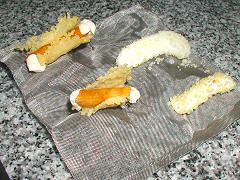
Two different “cheese snacks” – on the right, nubes de queso, which were a yogurt thickened with xanthan gum and gelatin and then put into a siphon, chilled, and piped as a foam into little logs, then when firmed up, coated with grated cheese; on the left, little crisps of melted cheese wrapped around puffed macaroni (cooked, dried, and then dropped in hot oil, much like the puffed rice dish a couple of weeks ago), and then the macaroni filled with an herbed ricotta. The former just odd, the latter quite good, if a bit crunchy – puffed macaroni don’t quite get the same texture that puffed rice does…
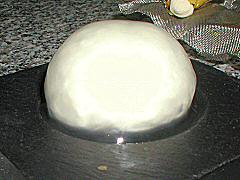
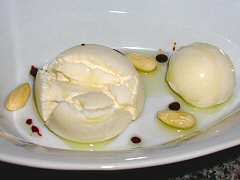
I have mentioned a couple of times one of my favorite cheeses, the burrata – a ball of freshly made mozzarella, sort of, with the inside left runny and creamy and buttery – an ethereal experience, bluntly. This isn’t it… it’s a pureed mixture of mozzarella, cream, and milk, that’s then scooped into a sodium alginate bath to form a gel around it – remember those olive juice fake olives? Interesting in some ways, but truly tasting nothing like a burrata. A travesty, at best.
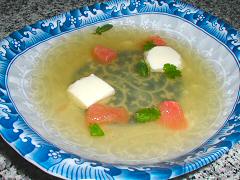
The sopa thai was interesting – essentially a clear broth made from all sorts of good thai herbs and spices – lemongrass, kaffir lime, cilantro, ginger being the most prominent – then strained, and with cubes of a gelled coconut milk and some segments of pink grapefruit. See, I kind of like that – it was really all made via much more classic techniques, with just the touch of the gelled coconut milk filling in for tofu cubes giving it an interesting twist.
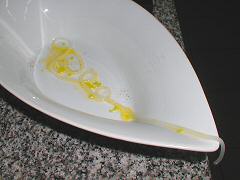
Although referred to as dos metros de spaghetti, it wasn’t two meters long – of course, one would have had to have tubing that was two meters long to do that… but it was probably a meter long – and used that technique of gelling a liquid inside a coiled piece of tubing – only this time, thankfully, not freezing it – the “spaghetti” made of a gelled butter flavored liquid, and then drizzled with more butter and cheese – the idea is just one strand, hanging off the end of the bowl, and you slurp it up without using a fork… A little much to do that – especially if it had really been two meters long…
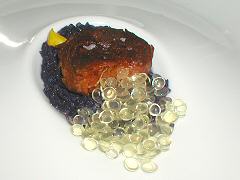
A nice interpretation of an osso buco – the meat cooked, boneless, via that vacuum packed and then slow cooked sous vide method so that it was tender, falling apart, and still more or less just medium rather than well done. Some red cabbage cooked down to a puree – nothing molecularly gastronomic about it – seasoned with a dab of mustard, and then little “lentils” – made of gelled prosciutto broth that was dripped out the end of a syringe onto a marble slab to form little rubbery droplets – flavorful, but texturally a little odd.
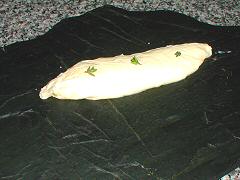
Though referred to as an omelette surprise, other than shape, there’s nothing omelette about it. You might have seen yuba, or bean curd skin, used in things like dim sum, it’s a skin made by heating soy milk and skimming off the… skin… that forms on top… this is the same idea, but done with regular whole milk. So these are very fine layers of curdled milk essentially, wrapped around a slightly gelled yogurt (I think it was yogurt) filling. Honestly not very interesting – might have been had they used some sort of truly interesting filling – since this was more or less the dessert – why not wrapping it around some fruits, or chocolate, or something sweet?
And thus ends an eight session visit into the basics of molecular gastronomy and what it’s all about. Interesting stuff, as you’ve seen, and some of it gives me ideas for various things to add touches to our dinners. We shall see where stuff pops up.
Copyright © 2026 SaltShaker. This feed contains copyrighted photos and text from SaltShaker. If you are not reading this material in a feed aggregator or by e-mail subscription, the site you are viewing may be guilty of copyright infringement. Please contact [email protected] so that I can take appropriate action.
Plugin by Taragana




 ]]>
]]>If it weren’t for Philo T. Farnsworth, inventor of television, we’d still be eating frozen radio dinners.”
– Johnny Carson
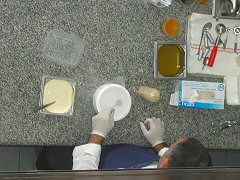
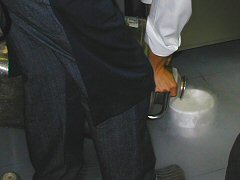 Buenos Aires – Liquid nitrogen is cold. Really cold. To paraphrase Wikipedia: “It is a cryogenic fluid which is potentially capable of causing instant frostbite on contact with living tissue. When appropriately insulated from ambient heat, liquid nitrogen serves as a compact and readily transported source of nitrogen gas without pressurization. Further, its ability to maintain temperatures far below the freezing point of water – it boils at -196°C or -320°F – makes it extremely useful in a wide range of applications…” One of those applications, as I have now spent an evening watching, is creating oddball frozen dishes. Oh, and by the way, that admonition about instant frostbite? Very true – bite into one of these items before it’s “warmed up” to somewhere around the temperature of regular ice, and you’re just asking for tissue damage to your tongue and palate, or pick one up with your fingers… well, you get the drift. Here our instructors are pouring out some into a styrofoam container where it sort of steams away – amazingly enough, it’s cold enough that even though contact with air instantly vaporizes it, it chills the air around it enough to stay liquid for a good length of time – a two liter container, open to the air, seemed to take close to ten minutes until it was all vaporized – giving time to make things with it… as we shall see. Obviously this is sort of a “don’t try this at home” – I’d imagine most folk aren’t up for a huge canister of liquid nitrogen being delivered to their doortstep anyway.
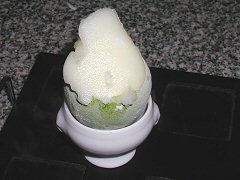
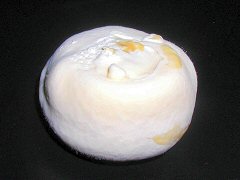
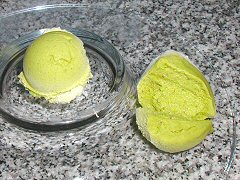
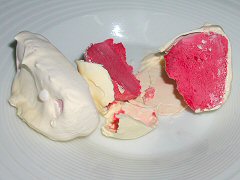
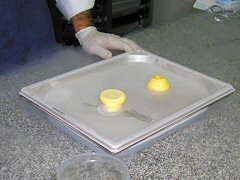
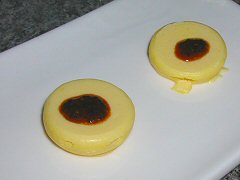
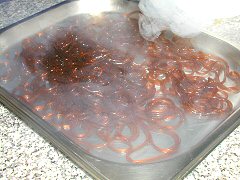
I’m not even sure where to really start with this. Most of it was a little repetitive in terms of what was being done, just showing us a few different versions. One method, ladling liquid nitrogen into a liquid as you whisk it, is a fast way of creating a supercold sorbet of sorts – something that’s particularly useful if you want to create an alcohol based sorbet, we had a caipirinha demonstrated to us – it became a frozen one, not slushy, but really frozen, that got scooped into the – also frozen – shell of a lime. Another involved taking a liquid and putting it in a spherical spoon, semi-submerging it to create a frozen shell around a liquid center, and then coating that (or not I suppose) with something else which is then also frozen onto it. It results in, well, a frozen shell with a liquid or soft center – a couple of examples a little cream covered fruit juice, a raspberry and cream bonbon of sorts, or just a sort of semifreddo of pistachio, or even using a siphoned foam, and dropping dollops of foam into the liquid nitrogen to form a shell around the foam, as they did with a garlic and almond based cream. Two of the more interesting ones were a sort of “blini” of passionfruit topped with a little spoonful of a coffee and basil seed “caviar” – where the blini are made by putting liquid nitrogen under a sheet pan so that it gets extraordinarily cold, and then freezing scoops of a fruit pulp for a minute or so on each side; the other being probably the most interesting if most difficult to make, a soy sauce based liquid with agar agar or gelatin that is injected, using a large syringe, into some looped flexible tubing, then lightly chilled until the gelling sets, and then using the syringes again, filled with air, which pushes the gelled “spaghetti” out of the tubes – kind of fun to watch, and surprising that it works so effortlessly. Then the spaghetti are dropped into the liquid nitrogen to become crisp and topped with an air made from ponzu sauze. It was a little intense in flavor for most folk – essentially we’re just talking gelled soy sauce topped with ponzu sauce… and, I think universally we agreed that we liked both the flavor and texture of the noodles when they were just gelled rather than frozen – if they were topped with something more interesting and just served at ambient temperature, they’d probably be pretty fascinating – sort of a reversal on something like a zaru soba. I leave the rest of this class to a series of pictures, which you can probably figure out what they are from my description above:
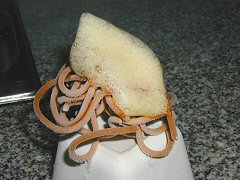
Copyright © 2026 SaltShaker. This feed contains copyrighted photos and text from SaltShaker. If you are not reading this material in a feed aggregator or by e-mail subscription, the site you are viewing may be guilty of copyright infringement. Please contact [email protected] so that I can take appropriate action.
Plugin by Taragana
]]>Changes to nature do not occur in a vacuum.”
– Kevin Lafferty, scientist
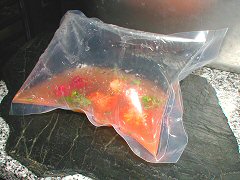 Buenos Aires – Though I know what Dr. Lafferty means, and I’m sure he went on to clarify this in regard to whatever he was talking about, he clearly hadn’t attended a class on vacuum cooking. Now, the first thought that popped into my head was the old Ron Popeil Daisy Seal-a-Meal. It didn’t involve a vacuum, just pressing out some of the air and then sealing the food for freezing, boiling, etc. – it was the ultimate do it yourself boil in a bag cooking – of course, it really never worked very well. I had one, I know. Still, it was ever present in my mind during last week’s class, as we explored primarily various techniques using a vacuum machine – a ridiculously large contraption the size of a small dishwasher that sucks all the air out of everything, collapses it all, seals it in a plastic bag, and costs thousands of dollars – just what every home cook needs around. Take, for example, this item, a papillote frio de tomate, or a cold paper pouch of tomatoes… which it isn’t… it’s a strangely labor intensive way of making marinated tomatoes that I didn’t quite get the purpose of. Note that it doesn’t seem to be vacuumed out, though it actually is – it was vacuum sealed with a small piece of dry ice in with the tomatoes, fruits, and herbs, which of course chills it down, and fills the bag back up as the dry ice vaporizes, leaving a vaguely hazy smoke in the bag – I gather the idea is to turn this out into someone’s bowl at the table – of course when the waiter cuts the bag, the smoke pours out… how festive. In the end though, other than the show, it’s just a bowl of cold marinated tomatoes, blueberries, and raspberries flavored with thyme and oregano.
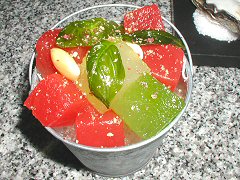 Staying in the marinated fruit world, these are two different preparations that are being presented together. What they simply are are cubes of melons that were dumped into a syrup marinade, and then semi-vacuum packed. Not quite all the air was taken out – apparently doing that would completely collapse the melons and you’d end up with mush, so they only brought the air pressure down to about a quarter of normal atmosphere – which ruptures cell walls, and allows the marinade to enter the cubes rapidly – essentially accomplishing a day long marinade in a matter of a couple of hours. The green melon was marinated in a syrup with basil and mixed peppercorns, the watermelon in a syrup with menthol candies that had been melted down and mixed with the syrup. I guess there’s the plus of time saving, and perhaps a bit more intensity of the marinade getting into the fruit… though honestly I couldn’t tell the difference from doing it the traditional way.
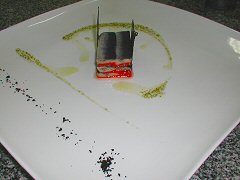 I guess I have to accept that a lot of this stuff is done just for presentation’s sake. This, for example, is a simple sardine and roasted pepper terrine. Flavor-wise, no different from any that anyone might put together in a terrine mold, cut into rectangles, and serve, garnished with whatever (in this case with a crumbled black olive caramel). The difference is in the, shall we say, tightness of the terrine – the sardines and peppers are layered in a rectangular mold that’s open on top and bottom, with a loose fitting cover on top and bottom – so when it gets vacuumed out, it all collapses evenly, with the covers pressing the terrine together smoothly. Definitely all about pretty, it doesn’t change anything in the way it tastes.
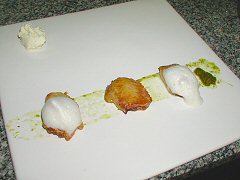 Okay, here it got a little more interesting – one of the main reasons that folks are doing vacuum packing is something called sous vide cooking. At its simplest, it’s cooking something at the temperature you want it to end up, slowly. So, for example, if you want meat to end up medium rare at 145°F, you cook it at that temperature. Now, if you did that in a standard oven, you’d end up with shoe leather as it dried out. Instead, you vacuum pack it with whatever spices and marinade you want, and then cook it in a water bath that’s held constant – of course, involving another piece of equipment – this big water pan with a paddle that keeps the water circulating and an electronically controlled heating system that keeps the water temperature exactly constant for as long as you like. Another big plus of this, because you’ve picked the final temperature, you can literally leave the meat or whatever in for as long as you like – it won’t overcook because the temperature never goes to that point, and there’s no air to dry it out. So you can toss something into it and leave it overnight or whatever. In this case, chicken wings in a Thai green curry marinade – cooked until well done, which then makes it easy to slip the bones out – so they’re served boneless, with a little more marinade, a five spice milk foam, and, of most interest honestly to me, homemade ricotta – which I now know how to make!
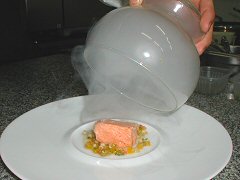 Beyond the technique above, this was about presentation of course. The salmon was cooked via the sous vide technique to come out a nice juicy medium, and infused with a vanilla marinade – interesting, though I thought a bit out of balance – not that vanilla and salmon don’t work together, just that the particular ratios used were a bit overpowering. It’s served with a reduced citrus juice, some chopped up mixed citrus fruits, and, a dome of smoke. The smoke is produced by this little gadget that’s sort of like a mechanized bong (not that I’d know anything about those)… it’s a little electric air blower with a nozzle to insert wherever you need to blow smoke… so to speak… and a bowl on top where you put wood chips or whatever it is you want to burn and creat smoke. Apparently easily available at hardware stores these days, though I’m not sure what other applications something like this would have. So here, they blow smoke into a big bowl, and then plunk it down over the salmon on the plate, and once again, the waiter will remove the bowl at tableside with everyone oohing and aahing as a puff of wood smoke is released into the room. I’m all a-tingle…
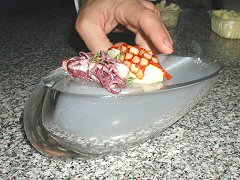 Staying with our smoky themes, this is a weird one… First off the “calamari parmentier” – What this is, and in a way kind of cool, is thin dowels of squid body that have been tossed in sweet paprika (too much of it if you ask me), and then lined up in a plastic bag and vacuum sealed, then they’re pressed together to form a sort of sausage shape, and cooked in that sous vide bath for about ten minutes, just enough to set the squid. When cooled and cut in thin slices crosswise, you get this kind of cool mosaic pattern from the squid and paprika coating… but all you can taste is the paprika. It’s garnished with a little mashed potato (according to the recipe colored with squid ink, but our instructor said he hates the color it turns out so he doesn’t use it), some sauteed baby squid, and herbs. Then it’s presented atop a bowl that’s been plastic wrapped and then filled with smoke via a teeny, tiny hole. What happens, and what he’s demonstrating here by tapping on the plastic, is that as you dig into this with your chopsticks or fork or whatever, little puffs of smoke arise from the hole in the plastic – giving the aroma and looking pretty. Of course, if you wanted to actually cut any piece of this, it’d be impossible, you’d have to transfer it to a plate… a bit too, ummm… foofy if you know what I mean.
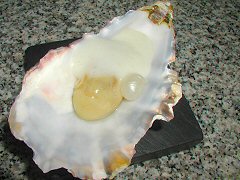 A fun presentation here – no vacuums, just some smoke. An oyster that’s served raw with a foam made from the oyster liquid and some prosciuto consomme – a nice bacon and oyster combination. Then a little “pearl” is made for presentation – from a mix of liquid smoke and oyster water, done using the whole alginate and calcium chloride techniqute I talked about a few classes ago. You end up with this sort of milky colored sphere, which gets enhanced by dusting it with a little silver dust or silver food coloring to make it shiny. And each person gets a cute little pearl – which tastes like smoked oyster water when you bite into it. Okay, I can get behind that one… it’s cute.
Next up… the deep freeze…
Copyright © 2026 SaltShaker. This feed contains copyrighted photos and text from SaltShaker. If you are not reading this material in a feed aggregator or by e-mail subscription, the site you are viewing may be guilty of copyright infringement. Please contact [email protected] so that I can take appropriate action.
Plugin by Taragana
]]>We may never understand the full story behind the snap, crackle, and pop, because finding money for experiments on cereal noises isn’t easy.”
– Corey Binns, Live Science
Buenos Aires – I realized I forgot to post up notes from the class nearly two weeks ago, along with last week’s which I knew I was behind on. So, it’s catch-up time – deadlines for paying jobs do tend to put one behind on their “fun writing”, i.e., the blog. Class number five was another texture class, in particular the texture of crunch. It was a class with some odd results, since the vast majority of what was being demonstrated was there specifically for its crunchiness, meant to be used in combination with other things down the line, but as a presentation, leaving us a bit… dry.
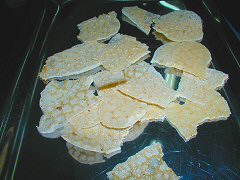
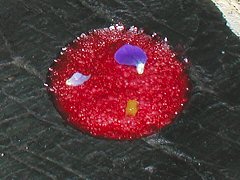
On the surface, these probably seem to be completely different, and in some ways they are. But, in one way in particular, they’re much the same – they’re both crispy, crunchy versions of foodstuffs that are normally soft and squishy. On the left, arlette iberica – the former a term I’ve never encountered, nor was I able to find “arlette” in any of my food references. I found a scattered few on the internet, all referring to a wafer thin sort of garnish, but I’m not sure exactly how one would define it. This, regardless, is a wafer of pig’s feet – the feet are soaked in ice water for a day, then cooked, the meat removed from the bone, then mixed with the fat from prosciutto, some water, and flour, and then cooked as paper thin sheets. You end up with a product that tastes pretty much like a classic chicharrón, though taking a huge amount more work, even if the end result is, perhaps, prettier. On the right, a crunchy wafer of raspberries, made from literally nothing more than pureed frozen raspberries with just enough water to smooth out the puree if needed. The puree is spooned out onto a silpat and cooked in a low heat oven very slowly until it dries out – passing first through the “fruit leather” stage, and eventually drying out more or less completely.
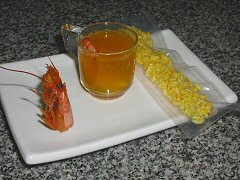 This was, in a strange way, a kind of interesting approach to a deconstructed paella. I’ll say up front that I’d much rather have a big steaming platter of freshly made paella in front of me, but nontheless, I could see that this had some potential for other possibilities. It’s very simply rice that’s been cooked in a saffron broth, then thoroughly drained, spread out on parchment paper on a sheet pan and dried out in an oven for six hours at about 175°F. Then, when completely dry, and it really has to be completely dry to work, it’s dropped into a deep fryer, or a pot of oil at high temperature, where it instantly inflates. For this presentation it was then sealed in a vacuum pack to be served alongside a shrimp broth with a couple of shrimp in it and the head on the side… and no, when you open the package and let the inflated rice drop into the soup, it doesn’t make a snap, crackle, pop sound – I’m guessing, based on the bit of science I could find about how rice krispies work, that it’s because the broth is hot rather than cold, and so the inflated rice cell walls don’t shatter the same way.
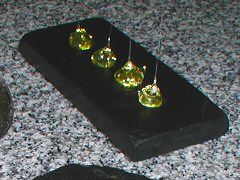
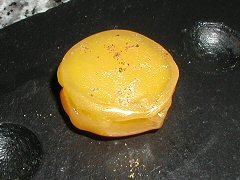
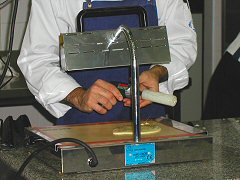
These are two also related items – a crunchy caramel outside filled with something liquid inside. On the left, teardrops of flavored oil, in this case sesame oil. The basic procedure, and unfortunately I wasn’t able to get any good photos of it, is that you liquify some isomalt, a type of sugar, and bring it to the stage where it’s more or less a light caramel, about 245-250°F. Have your flavored oil in a small spoon… Using a short piece of hard plastic tubing, maybe an inch or a little more in diameter, you dip it in the caramel, and then over a half-round mold, you drop the oil from the spoon into the center – essentially it’s like you’d blow bubbles through a bubble-making ring, only you’re using oil rather than air to form the bubble. You immediately sort of grasp the trail of caramel that comes off the ring to lightly pull it, which seals the bubble of caramel and makes a sort of teardrop shape. It’s clearly something that takes a lot of practice, and, of course, the liquid that goes into the center has to be something that won’t dissolve the isomalt caramel – so nothing water based. On the right, different use of a caramel – in this case a mix of isomalt, glucose, and standard icing fondant (1:1:2 ratio), spread paper thin to harden into little panes of caramel glass, and then, one is place atop a quail’s egg yolk, and remelted using a heat gun, the same kind one would use to dry paint or other sorts of things, you could probably even use a hair dryer on a high setting. When the sheet of caramel has molded itself to the top of the yolk, you let it harden a moment, and then carefully flip it over, not breaking the yolk, and repeat on that side – you end up with an egg yolk encased in caramel – a rather cute, if labor intensive garnish.
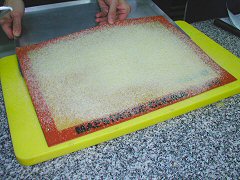
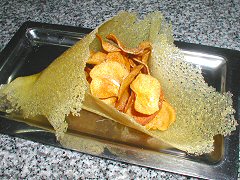
This is just crunchy all around. In the center, very simply, sweet potato chips. Deep fried, nothing special about their preparation, sweet potato chips, lightly salted. Around it is the “technique” we were out to learn – take some of those chips, prior to salting them, let them cool, and then process them into a very fine powder. Melt isomalt and glucose (1:3 ratio) and bring to about 320°F. Add some of the powdered sweet potato to it, it looked like roughly equal volume, and then let that cool. Process that into a fine powder and using a coarse strainer, spread a thin layer of the powder over a silpat. Throw it in the oven to re-melt the caramel, which forms a sort of tissue thin lacey cookie which can be molded into various shapes for presentation while it’s still warm. A lot of work to get something like that out of a sweet potato, but there’s probably no other way to do it.
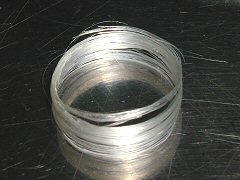
The last thing we looked at was making an olive oil thread – I’m going to have to admit, the recipe went by too fast for me, and it wasn’t in the written materials that we were given – but as best I was able to glean from talking to some of the other students, it was first a mix of 100gm isomalt, 25gm glucose, and 1.5gm Sucro-ester, brought to about 320°F; meanwhile 30gm olive oil and 1.5gm of a monoglycerine are heated in a microwave, then the two are beaten together, the oil mixture being slowly drizzled into the other while rapidly beating. After that, the whole thing is spread under a strong heat lamp to keep it more or less molten, and then a high speed drill with a plastic rod on it is used to pull a very fine thread out of the mixture. It was clearly a lot of work, and took a huge amount of effort just to get one coil of this thread, as it kept breaking during the spinning process.
Coming up on the next classroom report, how to use your vacuum…
Copyright © 2026 SaltShaker. This feed contains copyrighted photos and text from SaltShaker. If you are not reading this material in a feed aggregator or by e-mail subscription, the site you are viewing may be guilty of copyright infringement. Please contact [email protected] so that I can take appropriate action.
Plugin by Taragana
]]>The air soft as that of Seville in April, and so fragrant that it was delicious to breathe it.”
– Christopher Columbus, explorer
Buenos Aires – I know, you’ve been waiting for it. It’s not like I could take a class in various techniques and not try them out here and there. No worries that I’m suddenly going to stop serving our usual fancified home cooking though – at most these things will show up as touches, garnishes, mere ephemera. I had the opportunity to play around a bit the other night when we hosted a small private dinner. The owner of Sur de Los Andes winery wanted a place to showcase some of his wines to a small group of food and wine journalists (no pressure there, right?), and having been to Casa SaltShaker a few times, thought it would make a nice, relaxed venue in which to do so. A four course meal, the first three planned around five of his wines (okay, so he came with seven wines, and they were different from the ones we discussed, but we made it work), and full license to come up with anything that would both complement his wines, but also keep the writers’ interest.
I decided that I’d go with some things that I’ve done in the past for at least a couple of the courses, things that I like the way they turn out. You’ve seen my little shrimp, potato-zucchini mash, and banana guacamole dish – I used fresh scallops this time instead of shrimp, and since good, mature avocados are not in season right now, decided on a different sauce – settling on my fire-roasted tomato sauce (recipe in that same dinner), though making it without the hot pepper, and using a reduced sherry instead of reduced red wine. The second course was a a fairly quick and easy mole sauce with chicken that I make at home when I’m in the mood – it’s not a real traditional, long cooked mole with all sorts f seeds and nuts pounded into a paste – it’s a mix of sesame seeds, onions, garlic, ancho chili, nuts, chocolate, cinnamon, and salt, all blended with some olive oil in the blender and then cooked for about an hour over low heat. Usually I make this with turkey and carrots, which work well, this time I went with chicken and carrots, but separate the carrots out in long strands like spaghetti, blanched, and laid out like a nest underneath the chicken and some couscous (I don’t know, I just used couscous).
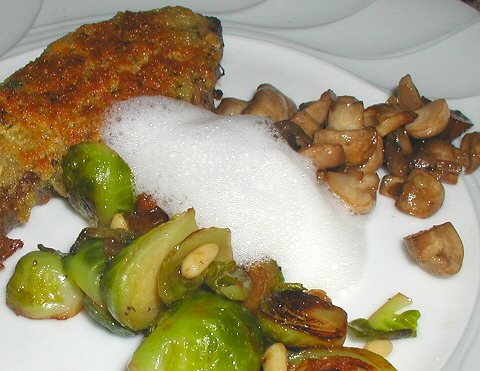
But then, for the main course, I knew I wanted to do something with beef. This was where his big gun wines were going to be shown. I started thinking about that lamb and wasabi dish that we’d done the first night of class, and from there it all sort of came together. I used lomo, or beef loin, and instead of wasabi, I had some fresh horseradish roots around, so grated those into the crust mixture (really just breadcrumbs, butter, the grated horseradish, and some salt), browned the beef, let it cool, spread the crust on it, and threw it under the broiler (I left it in slightly long after it was browned, just “resting” with the heat turned off, and the beef cooked more than I would have liked, but not overdone. I sauteed some mushrooms until they were lightly browned; I blanched some brussels sprouts and then sauteed them with pinenuts and raisins, and then… did he really do it? … yes, a foam. An air. It was a nearly last minute decision, I just suddenly thought about the idea, and I had more horseradish around, so why not a bit of horseradish air atop the dish as a garnish? And it worked – it actually added a nice spicy note to the vegetables in particular (the beef already had the horseradish in the crust), and looked kind of cool. And when I said “horseradish air”, everyone suddenly seemed to be paying attention. Go figure.
For dessert, it was my “lamington” cupcakes, from our Australia dinner – I like those…
So there, I’ve made my first “air”. Now back to our regular programming…
Copyright © 2026 SaltShaker. This feed contains copyrighted photos and text from SaltShaker. If you are not reading this material in a feed aggregator or by e-mail subscription, the site you are viewing may be guilty of copyright infringement. Please contact [email protected] so that I can take appropriate action.
Plugin by Taragana
]]>I search for the realness, the real feeling of a subject, all the texture around it … I always want to see the third dimension of something … I want to come alive with the object.”
– Andrew Wyeth, American realist painter
Buenos Aires – As I mentioned last week, our cocina de vanguardia class this week was focused on presenting a single (or actually, separately, several) ingredient in multiple textures, based on the techniques we looked at in the first trio of classes. It’s an interesting exercise – our instructors emphasized that it was unlikely that most of these would be served as a single dish in a restaurant setting, but I have to admit, a couple of them really could be, and probably would go over quite well. A couple of them, not so much. There weren’t any new techniques to talk about, so this is almost totally about presentation.
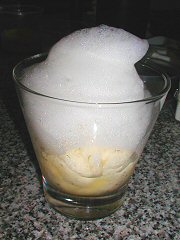 Leading off the pack was probably my least favorite – a simple, reinterpreted margarita. It wasn’t even that much of a reinterpretation, just using one simple touch of our bubble techniques. The base was a simple frozen margarita – lemon juice, tequila, cointreau, some simple syrup, and a touch of water added – it was all blended together and then frozen, and served more or less as a scoop of semi-frozen alcohol based sorbet (the alcohol prevents it from freezing completely solid, and gives you the texture you’re looking for). The touch of bubbles – an aire de sal, or salt air – a simple solution of saltwater with a little soy lecithin added to stabilize the bubbles – foamed with a hand blender and spooned over the top of the sorbet. Personally, I was never a fan of frozen margaritas anyway, preferring the classic liquid version of the drink with a nice salt rim. I’d also have done this with lime juice rather than lemon, but hey, it at least made for an interesting shot.
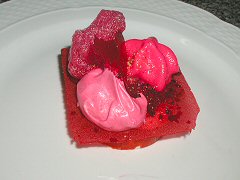 Now, it does happen that I love beets. And, I think this was my favorite of all the dishes prepared for the evening, and one I could actually see making an interesting, if odd, appetizer. At the base is a ring made of what is essentially “beet glass” – a mix of beets, sugar, and glucose that’s spread really thin on a silpat (silicone baking sheet), and then baked in a low heat oven until they make a sort of pliable, semi-translucent material. While still hot, strips (they used a stencil made of acetate to spread out the beet mixture) are made into a ring, about an inch in height and maybe two across, and then topped with a square of the same material (after both are allowed to harden). Atop that are a mix of various different things – a bit of beet gelatin, a cold beet foam, a baked beet merengue, a bit of beet granité, a cold yogurt foam (sour cream might be even more interesting), a beet air (same technique as the salt one above – just beet juice and some soy lecithin), and some scattered maldon salt, cracked black pepper, and red currants. Not bad actually – the merengue maybe a little too sweet for the rest of the dish, but that could be easily fixed.
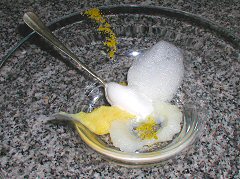 While I could see this dish being served as something like an intermezzo, or palate clearer, I can’t say it wowed me, though individually, the components could be put to great use on other dishes. It included small scoops of a lemon sorbet (I’m not clear why it needed gelatin and egg yolk added to make a sorbet, but so be it), a blanched pulp of the white pith of a lemon that had been sweetened but was still bitter, powdered dried lemon peel, a lemon air, and something called an emberré which I haven’t found a good translation of, but basically was a mix of lemon peel, sugar, water, lemon juice, all mixed into softened butter to flavor the butter – but it also meant a scoop of sweetened flavored butter on the plate – might be interesting (with less sugar) atop a piece of fish or chicken, as part of what was more or less a dessert, it was just weird.
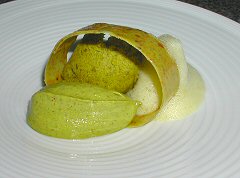 This was a pretty interesting dessert plate, and I could see serving it. It has a ring of a pistachio cookie, made fairly similarly to the beet glass above, a small cupcake made of a foamed pistachio, egg, sugar, and flour mix that’s foamed using a nitrous oxide canister – it’s foamed into a plastic cup and then cooked in the microwave for about 45-50 seconds, which just more or less solidifies the foam and makes a nice hot little cupcake. There’s a pistachio sorbet, some toasted pistachios, and a bit of a pistachio air. I liked this one quite a bit – there’s a nice interplay of textures – the cupcake was interesting, though in the end, I can’t say that texturally it was any different from a cupcake made in a traditional oven, just without any browning (and it wasn’t quite cooked through in the center, but another 10-15 seconds in the microwave it would have been). So the only real “cutting edge” technique was the bit of pistachio air. This was a lot more like a traditional dessert than most of what they’ve been showing us, maybe that’s why I liked it more?
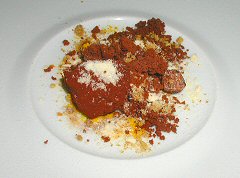 I have to admit, I just simply didn’t get this dish. It was referred to as tierra de chocolate, or chocolate earth, and it was, at least on the mouthfeel end of things, kind of like eating chocolate flavored dirt. Basically it’s a scattering of dried and pulverized peaches, a sort of semi-freddo of chocolate that was pulverized, a bit of crushed streusel topping, some caramelized hazelnuts that were likewise crushed, and a small ball of chocolate gelato rolled in bitter cocoa. The whole sensation was sort of dried out and not overly pleasant to eat – which made it hard to appreciate the flavors. I could have seen the first few things scattered around a nice quantity of the gelato, or accompanying something else entirely, but there just wasn’t enough of anything with a texture other than that of powder.
No idea what’s coming up next, they didn’t give us any hints… but stay tuned for me trying out a couple of the things we’ve learned on a private dinner this week…
Copyright © 2026 SaltShaker. This feed contains copyrighted photos and text from SaltShaker. If you are not reading this material in a feed aggregator or by e-mail subscription, the site you are viewing may be guilty of copyright infringement. Please contact [email protected] so that I can take appropriate action.
Plugin by Taragana
]]>