Life isn’t enough. One life isn’t enough for me. There aren’t enough days. Too many things to do, too many ideas. Every sunset upsets me because another day has gone by.”
– Nicola Lorusso, Mediterraneo (1991)
Buenos Aires – I mentioned recently that I’m accompanying a friend on her quest to research the various kosher restaurants here in Buenos Aires. I also mentioned the utter “meh-ness” of most of them (both here and elsewhere) that I’ve experienced. So though I’m gamely forging ahead on this quest with her, I have to admit to approaching the task with a certain level of trepidation – I’d be delighted to find a place that doesn’t fall into the “same old same old” category. This wasn’t it. We’d noted a cheery looking corner white space advertising itself as a “kosher bistro”, MediTerráneo, San Luis 2902 (corner of Ecuador), in Once, 4961-5137, and decided that at the very least, it had promise. It just hadn’t made the promise to us…. Closed
A few warning bells rang in my head when we entered the place on Thursday evening, and it was bleakly empty (and stayed that way until almost the moment when we departed, when a couple came in, he with a hearing aid turned up so loud that it was emitting an audible squeal throughout the room, she yelling at him to turn it down – he didn’t, at least much). The decor, for an ostensibly Mediterranean bistro, was odd – a stand of bamboo sticks dominating the center of the room, empty metal wine racks scattered about, even hanging from the ceiling, piles of various religious literature taking up space on counters and windowsills, peeling paint, and, as noted, devoid of life signs. Including staff. We hovered a moment in the entryway, and heard a bit of noise from down a side hallway – peering in, sure enough, there were a couple of men standing in the kitchen chatting – it took a moment to get their attention, but one joined us in the dining room, expansively waving his arm at the room to indicate our choice of seating (and a whispered “Do you want bread? If so, I have to go tell the kitchen.). He followed us to the table with menus, handed them to us and got out his order pad and pen, then stood there waiting for us to choose our selections. Each choice was met with a “that’s good, but…” followed by an upsell attempt – generally not in the same category (an 8 peso plate of babaganoush was met with a recommendation for a 25 peso sampler plate; a 26 peso plate of goulash and spaetzel with a recommendation for a 48 peso salmon). The other gentleman from the kitchen, perhaps the cook, it was hard to be sure, joined him at tableside, offering nothing other than little bits of encouragement – “yes, yes, that’s good” – to each choice, ours or the waiter’s.
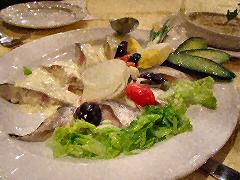 We settled on our plate of “eggplant caviar” (come on, it’s babaganoush) and a plate of side by side pickled and “creamed” herring – the second turning out to be the best thing we had during the evening. The fish was fresh, nice sized pieces, and the seasoning was delicious – they even got the pseudo-cream down pretty well (this is a “meat kosher” restaurant, so no dairy anywhere). The babaganoush could have used a significant amount of seasoning – from salt to a touch of smoke to, well, anything. Still, it was clearly fresh, and helped mask some of the flavor of the burned bread rolls. Really, burned – one side of nearly every roll was charred. Perhaps he should have “told the kitchen” to get it out of the oven.
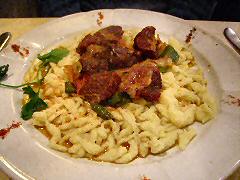 On to our main courses – the spaetzel with goulash caught all four of our eyes – that went on the list, despite the salmon recommendation. It was a hefty plateful too – plenty of spaetzel, less goulash – you can see in the picture, seven little cubes of meat, and they were tough and gristly. The “dumplings” themselves devoid of flavor, seasoning, and the entire dish missing… goulash… yeah, the meat was there, but how about a little sauce? Coating cubes of meat in paprika, cooking them until dried out and setting them atop spaetzel does not a goulash make.
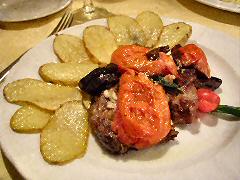 The menu listed a whole slew of entrecôte steaks – okay, half a dozen of them – each basically the same but with a different garnish and sauce. We opted for the Mediterraneo itself – I generally go by the often proven wrong theory that if you’re willing to put your name on the dish, it ostensibly represents your best efforts. A dismal little steak with as much fat and gristle as meat, unseasoned once again, served with some roasted tomatoes, a blackened disk of eggplant, a couple of olives and a “fan” of potato slices that were the best thing about the dish, and only because they had enough oil on them to give them some flavor.
It didn’t take much effort to decide against dessert. I’d say “not recommended” except, for kosher restaurants here, this one is right on par with the rest of them, and at least makes an effort to offer dishes that aren’t just the usual suspects. Maybe we should have sprung for the pricey piece of salmon… somehow I doubt it.
Copyright © 2026 SaltShaker. This feed contains copyrighted photos and text from SaltShaker. If you are not reading this material in a feed aggregator or by e-mail subscription, the site you are viewing may be guilty of copyright infringement. Please contact [email protected] so that I can take appropriate action.
Plugin by Taragana




 ]]>
]]>“How was my weekend? Meh. The mehness of it is indescribable. Just one big, fat meh. If you are an old-media kind of reader, “meh” won’t mean a whole lot to you. The word has appeared in the national press three times in the past year. If you gain new vocabulary from conversation, it is probably unfamiliar. If you can’t be torn from the web, however, you will almost certainly know it, and its meaning. Meh means rubbish. It means boring. It means not worth the effort, who cares, so-so, whatever. It is the all-purpose dismissive shrug of the blogger and messageboarder. And it is ubiquitous.”
– Michael Hann, The Guardian UK
Buenos Aires – My friend Barbara is on a mission. It has various facets, but among them, and the part that holds most interest for me, is her intent to try out all the kosher (and I suppose non-kosher) Jewish restaurants in Buenos Aires. My feelings about kosher food are mixed – there’s certainly some sort of deep-rooted draw based on cultural heritage, and, depending on whether we’re talking ashkenazi or sephardi, some comfort food warm and fuzzies; but there are also negatives – the non-mixing of meat and milk (from my perspective a complete over-extension of the actual scriptural prohibition), the fact that the meats are generally much drier (both from the method for kosher butchering and the insistence on cooking things until they’re well done or close to it), but most importantly, the lack of creativity. Now, that’s not to say there’s no such thing as a creative kosher chef – in fact, I spent a whole day working with one at Levana in New York many years ago, with an eye towards a sous chef position – but on the whole, kosher restaurants seem far less creative than… well, any other type of restaurant I’ve ever been to. They’re cookie cutter versions of some sort of universal standard – some better, some worse, but all with virtually identical menus (with only the variation of the two cultural branches noted above – respectively, eastern European, and Mediterranean, more or less).
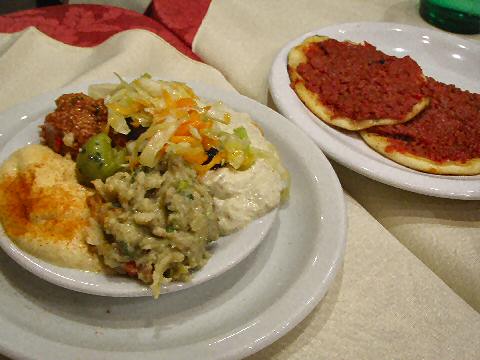
The place is long and narrow and looks, more or less, like a fancied up school cafeteria. No lines to stand in, but it just has that air. We arrive early, only a duo of bearded men in earnest scholarly conversation are present, speaking in a loud mix of Yiddish and Spanish. Over the evening the room fills, with a cacophony of those idioms, plus English and Hebrew. When we ask what an unfamiliar dish is on the menu, rather than simply describe it in Spanish, our waiter insists on sending over some youngster whom he drags out of the kitchen, who offers us English menus, but not a description of the dish. We decline and move on – deciding on a mixed appetizer plate – small size – to share, plus a couple of the open-faced empanadas – this is a sephardi style restaurant. The mixed plate, a train wreck of presentation – with its smoked eggplant mayonnaise (not quite babaganoush with the mayo…), tomato-ey tabouleh, bland hummus, vinegary chambota (olive oil soaked grilled vegetables), and a few desultory olives thrown on for effect. It’s heaped high, and plenty to share, perfectly edible, and completely devoid of interest. The empanadas, the lehem hayim, spark a little more notice, with a sort of barbecue topping that’s actually got some flavor to it.
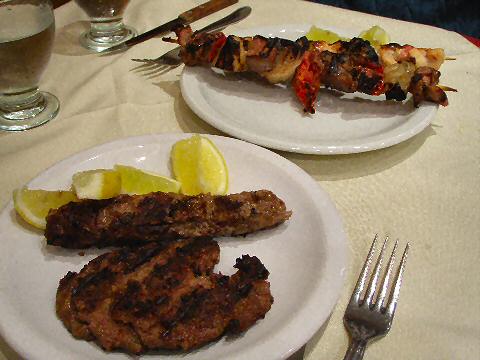
Sucath David offers little in the way of beverage that might perk up the meal – water, sodas, local beer, and a few over-priced and basically undrinkable wines (and nothing by the glass). The bakhlava for dessert was swimming in rosewater, and could simply have been laid out on a table in place of potpourri. The one possible final glimmer of hope, the offering of traditional Turkish coffee, is only a vestige on the menu of times gone by – all that is available is “regular”.
So, meh. It wasn’t horrible. It wasn’t wonderful. It was pretty much what I’d expect, and probably meets the expectations of the average kosher diner. Still, wouldn’t it be exciting to find a kosher restaurant where they actually cared about the food?
Copyright © 2026 SaltShaker. This feed contains copyrighted photos and text from SaltShaker. If you are not reading this material in a feed aggregator or by e-mail subscription, the site you are viewing may be guilty of copyright infringement. Please contact [email protected] so that I can take appropriate action.
Plugin by Taragana
]]>One could argue that these [today’s] ‘plagues’ are fundamentally different than the ones in the Passover story because they can be seen as humankind’s own creations and not sent by God.
– Dan Weiss, Only 10 plagues? Early Egyptians had it easy
Buenos Aires – Most Jewish kids I knew when I was growing up dreaded Passover. First, we had to spend a week eating strange stuff… well, that wasn’t so bad, but it was that we could only eat that stuff… we couldn’t eat other things. Peanut butter and jelly on matzo does, after all, make a satisfying crunchy noise, and certainly a mess a crumbs of matzo go flying off in all directions. So maybe that wasn’t so bad. I think it was the Seder, the first night (and for some, the second as well) of the holiday. There was nothing wrong with the Seder meal – lots of food, interesting stuff – gefilte fish, apples and walnuts, lamb or brisket… it was the ceremony. Like any ritual, it’s hard to keep kids involved, especially when it’s a long, involved ritual, that includes lots of explication, recitation, and droning. And unlike most of the other holidays, at this one we actually had to pay attention, because kids have their part in the ritual – asking questions at certain times, answering others – and having to eat certain parts of the meal and drink “wine” (grape juice for us) at just the right moments. We couldn’t escape.
None of this, thankfully, came to mind when Jorge, the owner of Mama Europa, contacted me and invited me to come with guests to his seder last weekend. As noted in my previous post, I’d already scheduled a Casa S dinner that evening, forgetfully, and I thanked him, but had to decline. He persisted, in the best way, and invited us to come on night two. I invited a couple of friends to join me, and away we went to Las Cañitas and the site of one of Jorge’s former Big Mamma delis (of which only the one in Belgrano remains), which I reviewed a long time ago. The key, and most important thing here, are my/our thanks that go out to Jorge for this invitation and opening up his restaurant to friends, family, and people like us in the community whom he doesn’t know (he’s a regular reader here, and we’ve e-mailed back and forth, but never met). The inviting of strangers to share in the family meal is one of the central tenets of the holiday, though most families probably limit it to a theoretical invitation with the setting of an empty place for the prophet Elijah, in case he were to amble down the street and pick their bell to ring. [Closed]
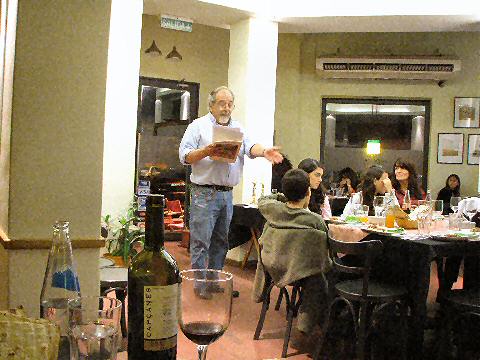
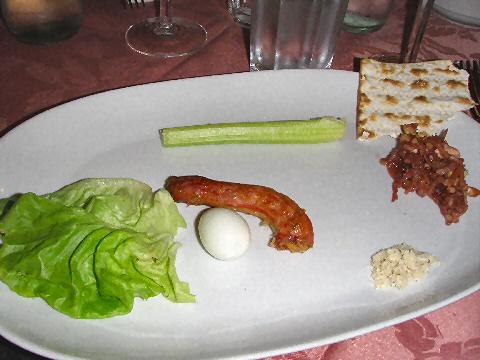
On the wine front, my friends had brought a couple of bottles of Spanish kosher for passover wine (these days, it’s getting much easier to find good kosher wine – when I was growing up, there was little of note out there… I think… I mean, I don’t really know… but most of the good kosher wineries I know of now, weren’t in existence then) – from Bodega Capçanes in Monsant, their 2000 and 2001 Peraj Ha’abib, or “spring flowers” – a blend of roughly equal thirds of Grenache, Carignan, and Cabernet Sauvignon. The 2001 bold and spicy, lots of body, depth, and fruit, nice smoky tones; the 2000 very soft and fruity, just sort of lacking, all around, at least in comparison to the other – the friend who brought it felt it was an off bottle. Jorge contributed a third bottle to the table (we didn’t remotely finish the three bottles, and he joined us in the drinking of what we did consume), Familia Zuccardi’s Textual Marsellan 2003/4, a wine I’ve mentioned before, the grape being a cross between Grenache and Cabernet Sauvignon, and which I continue to enjoy – a light to medium bodied, spicy wine that worked, once again, really well with braised ribs.
Copyright © 2026 SaltShaker. This feed contains copyrighted photos and text from SaltShaker. If you are not reading this material in a feed aggregator or by e-mail subscription, the site you are viewing may be guilty of copyright infringement. Please contact [email protected] so that I can take appropriate action.
Plugin by Taragana
]]>