In the greatest confusion there is still an open channel to the soul. It may be difficult to find because by midlife it is overgrown, and some of the wildest thickets that surround it grow out of what we describe as our education. But the channel is always there, and it is our business to keep it open, to have access to the deepest part of ourselves.”
– Saul Bellow, Novelist
Buenos Aires – Picking up from the start of our Supreme Directors’ tour which I began several weeks ago, we move on to Carlos María de Alvear. Rather than delve deeply into the world of this troubled youngster, let’s do the true nutshell version. Born in 1789 to a Spanish nobleman and a criollo (“of pure blood, but not noble”) woman, he was raised in the north part of the viceroyalty that was to become Argentina, a town which later became part of Brazil. At age 13, on a family trip to England, their ship was fired upon by the British, his mother and brothers were killed, he and his father taken captive and thrown in jail. Released shortly thereafter, his father married an Irish woman and raised young Carlos in England. Returning in his late teens to this country, changed his last name to his mother’s (both in her memory and to prevent embarrassment for his father), took up arms with the revolutionary army against Spain, in short order rising to the top ranks of military officers, and at age 23 supporting his cousin Posadas (some say uncle, but I covered that in the previous post) as the best man for the post of first Supreme Director. Within less than a year, however, finding himself in disagreement with the direction the new country was taking, he undertook to have his cousin replaced and have himself named, at age 24, as the second Supreme Director of the country, a position he managed to hold onto for a mere four months when a combination of his lack of experience, the unwillingness of anyone to pay attention to him, and the discovery that he’d been in contact with the British embassy in Brazil to ostensibly launch a takeover of the new country. Somehow he managed to stay in more or less good graces and continued his military career with varying degrees of success, until in 1815 he was exiled to Brazil and Uruguay. He returned in 1822 under an amnesty law, and within a year managed to get himself appointed as Argentina’s minister to the United States, made a bid to Simon Bolivar to be named president of Colombia, came back to Argentina to become the Minister of the army and navy, and was appointed as Argentina’s first ambassador to the United States, a position he stayed in, living in New York City, until the end of his life in 1852, after which his body was returned to be buried in the family mausoleum in the Recoleta Cemetery.
He is remembered here with a massive monument in front of the Palais de Glace, pictured at the bottom of the previous post linked above, atop a high pedestal and surrounded by four allegories representing his supposed personal virtues – strength, eloquence, liberty, and victory – and the parallel avenue, Avenida Alvear, one block away. The avenue, at one time known as La Bellavista for it’s wide, tree-lined stretch of wealthy family palaces, is now probably the principal luxury shopping district in the city, with the local shops of major international brands like Hermes, Cartier, Zegna, Vuitton, Armani, and Ralph Lauren (which occupies an entire old small palacio on its own).
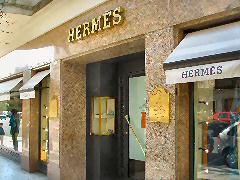
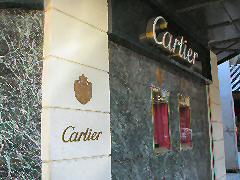
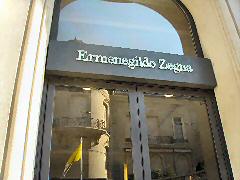
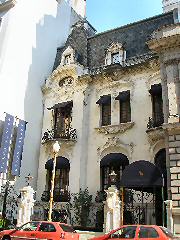
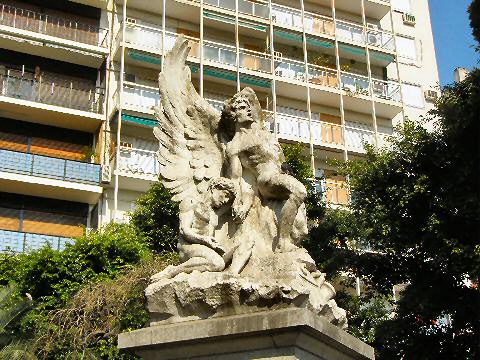
Beginning from his monument, however, the street starts with another, the monument to his son Marcelo Torcuato de Alvear, in the plaza of the same name, and who has his own avenue and who we’ll get to one day…
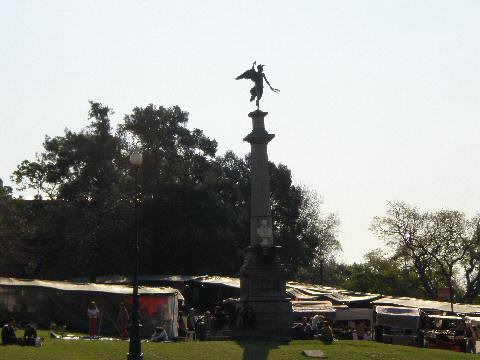
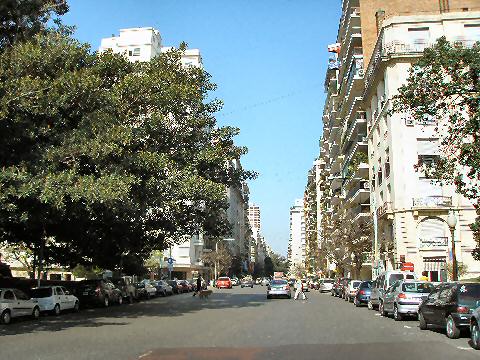
Looking from the monument, you can see down the beginning of this beautiful six-block long avenue…
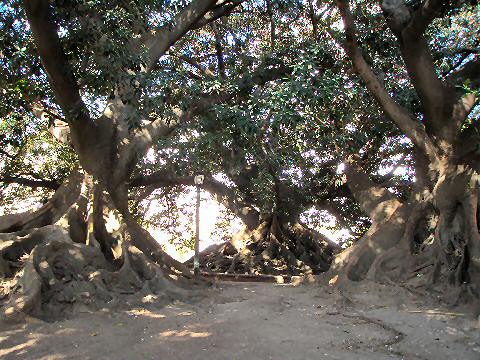
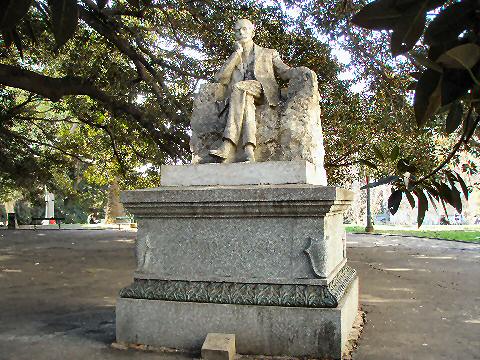
To the left is the small Plaza San Martin de Tours – of main interest are the massive, gnarled, old rubber plants, planted well over a century ago, and beneath them, a statue of famed journailist Emilio Mitre in a pensive pose, the work of sculptor Hernán Cullen, with a base of grey granite, the main sculpture carved from a single piece of Carerra marble, and adorned with various bronze touches…
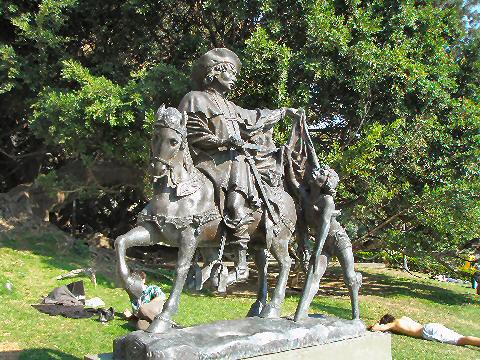
To the right, in a small point of land, two statues, the first that of San Martin de Tours himself, patron saint of France, soldiers, and the city of Buenos Aires, in classic pose astride a horse with a beggar reaching towards him in supplication. At the top of the point, alongside famed cafe La Biela, is a statue to former police chief Ramón Falcon, whose story I covered in a post on Parque Carlos Thays…
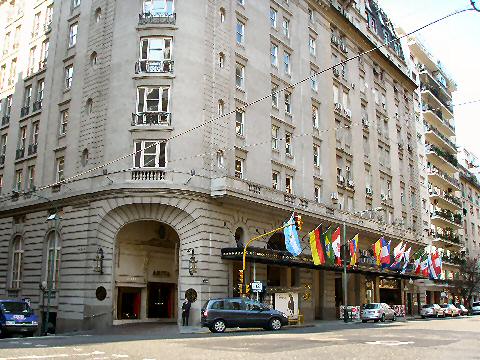
Finally, starting down the avenue, the first sight is the imposing bulk of the Alvear Palace Hotel, while not the most expensive of hotels in Buenos Aires, certainly the classiest, with its not to be missed daily afternoon tea in L’Orangerie and the elegant, if somewhat anachronistic bastion of French dining, La Bourgogne. Built in 1928, the hotel went through a period of decline in the late 40s and early 50s, and many of its larger suites were sold off as private apartments, and remain so to this day. Its rooftop garden is the setting for many of the most elegant porteño functions in the city, and the shopping galleries that surround it are home to some of the most exclusive shops in town. It is also the site for events for many of the city’s wealthy orthodox Jewish families as it is the only hotel in town that maintains a separate, certified kosher kitchen.
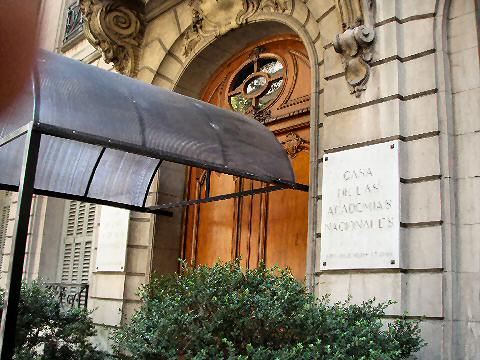
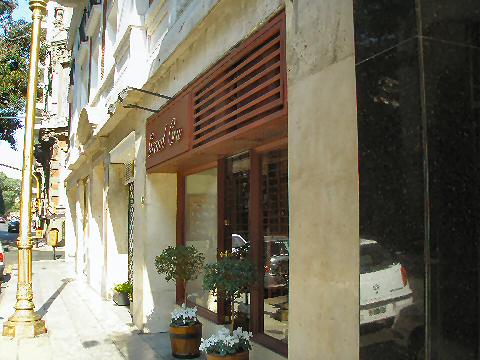
At the far end of the same block, the beautiful 1925 building, originally apartments, and today the Casa de las Academias Nacionales is located at 1711. In 1980 there were plans to demolish this building, along with many others in the area, and it was only through the extensive efforts of local preservationists that the city finally declared the street a historical district – too late for many other buildings that had already been torn down. The Casa is now the headquarters representing most of the national scientific academies. Across the street, for wine aficionados, is Grand Cru, one of the more exclusive wine shops in town, and one of the few importers of wines from overseas.
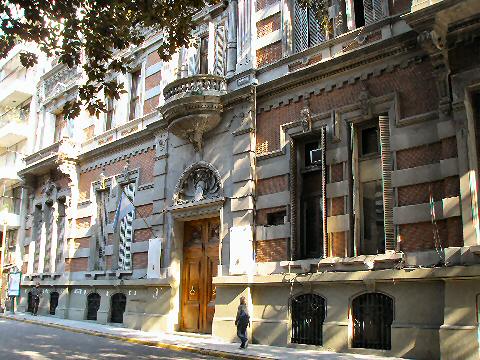
Cross-corner from the Academias, the Palacio Casey, built in 1889 for Eduardo Casey, a wealthy landowner, is now the home of the Secretaría de Cultura de la Nación – the principal offices of the President’s secretary of culture and associated activities…
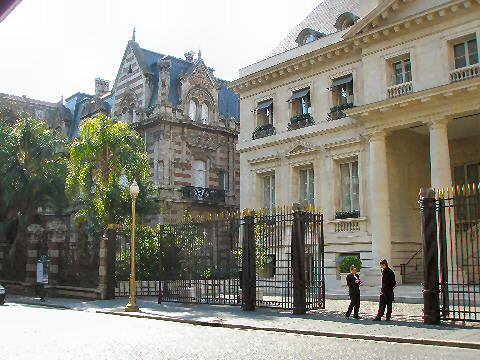
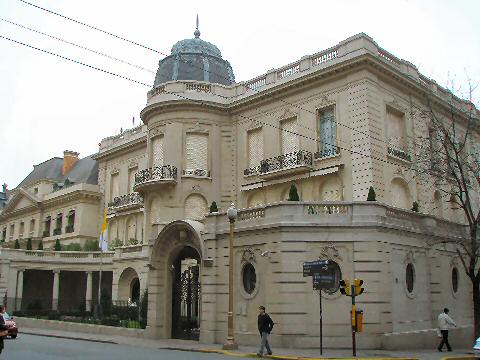
The next block is what I can only imagine is an architect’s wet dream. The left-hand side has a lineup of three old palacios, all interconnected by passageways. First up the original Residencía Hume, built in 1890, which later became part of the Palacio Duhau when it was sold to members of the Duhau family in 1920, and then passed on to a family member, Maria Candelaria Maguire, and is locally simply referred to as La Mansión. Next to it, the more modern (1934) addition of the Residencia Duhau, now the Park Hyatt hotel. And, finally, the 1909 edifice, the Palacio Harilaos de Olmos, which is now the Vatican Embassy and papal residence…
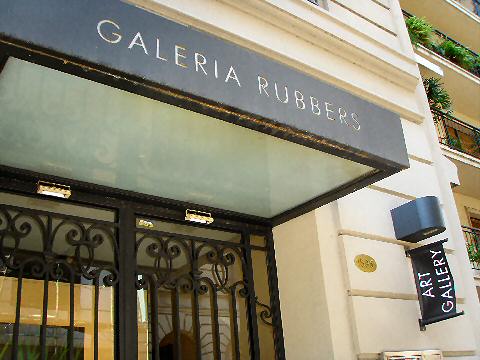
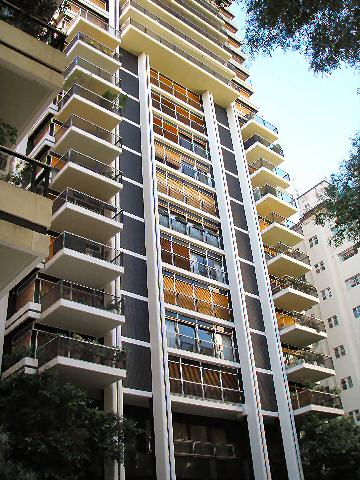
Continuing onto the next block, my least favorite of this short trek, your eye may be drawn to the unfortunately named Galeria Rubbers, one of the more important art galleries in the area. Further down the street, where there once stood a long forgotten palacio, is this ugly, if colorful apartment tower, rising high above anything else in the neighborhood…
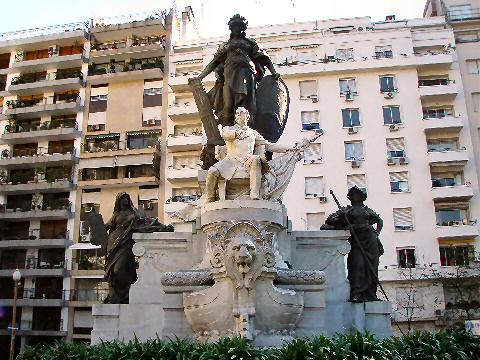
Finally, in the combined 1300 and 1400 blocks, the street opens up into the beautifully landscaped Plaza Carlos Pellegrini. Dominating the plaza is the statue of Pellegrini, president of the nation in 1892, and founder of the Jockey Club, which can be noted along the left-hand side of the street (no photo), housed in the former Palacio Unzue de Casares. The statue depicts Pellegrini on the prow of a boat grasping the national flag in his left hand, and holding up his right in determination. An image of “The Republic” carries the symbol of unity and the national shield as protection for the President, and the side sculptures symbolize justice, and the struggle for progress.
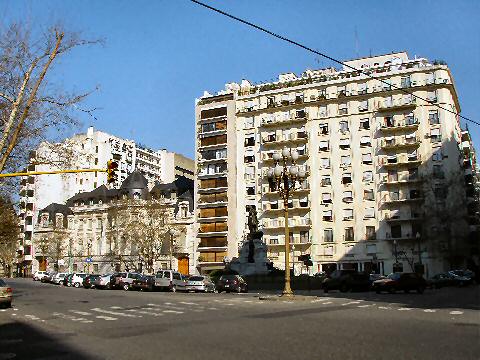
While not actually a part of Avenida Alvear, it is worth noting the trio of buildings that surround the far end of the Plaza. From the left, the Edificio Atucha, originally a private home; the French Embassy, built in 1912 as the
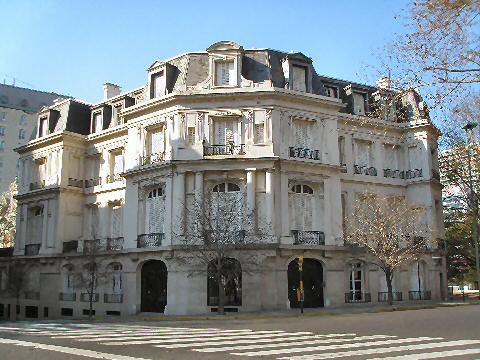
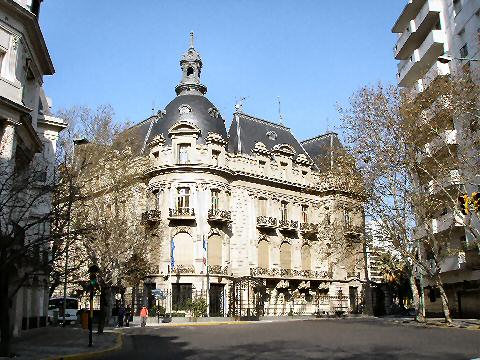
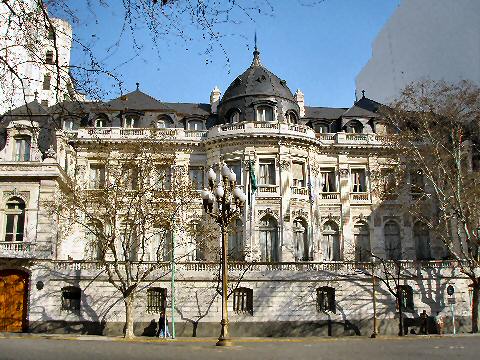
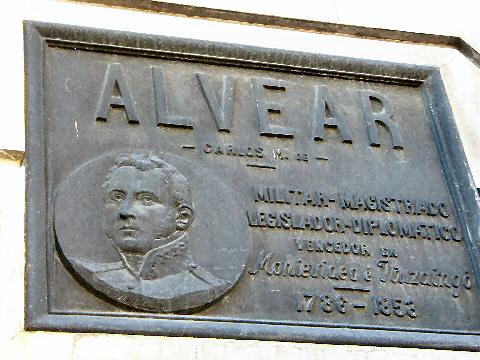
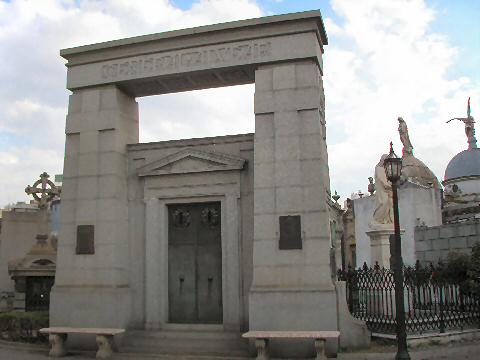
And that, with a whole load of photos, finishes off our look at the remains of Carlos María de Alvear – an avenue, a monument, a plaque on a corner building, and a family mausoleum…
Copyright © 2026 SaltShaker. This feed contains copyrighted photos and text from SaltShaker. If you are not reading this material in a feed aggregator or by e-mail subscription, the site you are viewing may be guilty of copyright infringement. Please contact [email protected] so that I can take appropriate action.
Plugin by Taragana




 ]]>
]]>“Although the Assembly of 1813, as a representative body, did not comply with its fundamental objective of sanctioning a constitution, it developed a vast legislative activity pro individual freedom and constituted the opening into new institutional modes. From the point of view of the political organization, it established a Unipersonal Executive Power, creating the position of Supreme Director of the United Provinces of the Río de la Plata. It instituted May 25 as a patriotic date, established the Coat of Arms and the Anthem and ordered to mint an own coin, actions through which it demonstrated its will to create a sovereign state.”
– Official website of Argentina
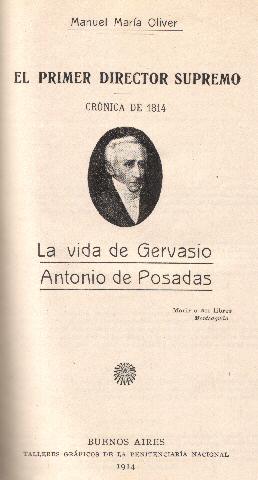 Buenos Aires – I started off a week or so ago with a cursory look at the history of the leadership of Argentina. To continue… if I were to want to write about one of the past leaders of the United States, or, for that matter, most countries, and I could read the language, I could probably walk into any good bookstore or library and find a biography, autobiography, memoir, or historical tome that covered their life. You could probably find the same for many other historical persons – revolutionaries, statesmen, even the occasional vice-president. Not so much here in Argentina. Oh, the major figures of history have their volumes – often multiple shelves worth of books. But the lesser known figures stay that way. Out of the seven different people who served as Supreme Director during the early years of Argentina’s post-colonial period, I’ve been able to find works about five of them – and that took visiting several dozen bookshops and libraries, delving into government archives, and online searches. The best guess on the part of various folk I talked to is that one of the remaining probably never had anything published about him, and the other, they’re quite sure must exist, but there seem to be no records of such a book. I decided against purchasing a copy of Gervasio Antonio de Posadas’ memoirs – the $700 and on up price tag was just a bit more than I was up for. I finally found a copy of his biography in the corner of a dusty old bookstore, where I picked it up at significantly less than the $55-100 prices that I found in the few other stores, all online, that had copies on offer. It’s been a fascinating read and look at the man who was the first official leader of this nation.
Now, how does one sum up someone like this in a paragraph or two? He was born June 19, 1757, his father and both his grandfathers being military officers serving under the Spanish Viceroy. At an early age he was educated by the Jesuits, until the time when the Jesuits were expelled from the country, after which he was moved to a Franciscan school. He excelled in Latin, Philosophy, and Theology, and continued on to study law under a series of increasingly powerful members of the Viceroyalty. He was well respected, accomplished, and had quietly gathered a fair amount of wealth for himself. At age 32 he married the daughter of one of the most respectable families in the region which gained him entry into the top social circles as well. They had five children – a boy and four girls.
In the early 1800s, as unrest began to grow in the area, he found himself in a state of limbo of sorts, as various factions began to appear, the viceroyalty collapsed due to the overthrow of the Spanish monarchy, the English invaded in 1806-7 – and one of the commanders took over Posadas’ home and grounds as his personal command center, turning he and his family out into the street. They took refuge in a local convent, where his wife died, and he threw himself into the cause of the colonial rebels – or at least one faction. And this gets back to my previous post about the constant internal change within Argentine. In the course of a few years, he found himself at various times allied with those in power or those out of – but none of them working together – at one point he was exiled from the country, only to be recalled a few weeks later when someone else was in charge of the governing committee. Eventually, he found himself drafted to replace one of the original members of the “Second Triumvirate”, charged with drafting a constitution for the new republic, and being selected as the most stable of its members to govern as the country’s first Supreme Director, a position in which he served for almost a year, primarily focused on issues related to unifying the new republic and completing the work on the constitution, until being replaced by his cousin (not his nephew as many sources have cited, historical research shows they were related through Posadas’ mother’s family), General Carlos María de Alvear, who wanted to see the English monarchy replace the new rule by former colonists. After the Alvear faction fell (we’ll get to that in a future post), he was jailed as a collaborator simply for his familial relationship, and spent six years incarcerated in, at various moments, 22 different prisons. In 1829 he began writing his memoirs, and completed them shortly before he died, July 2, 1833; though they were not published until 1914.
And that, leads us to the modern day, and our little walking tour in Recoleta. Really, it does, because behind all those delving into early historical lives was simply a reason to go out and wander. To the best I’ve been able to determine, there is no monument to Posadas here in the city (there is a city named Posadas up in the north, the capital of Misiones province), and, as well, there does not appear to be either a Posadas or Davíla (his mother’s side) family mausoleum in the Recoleta cemetery – though, many historic figures were buried either in Chacarita or elsewhere, so that isn’t particularly telling. There is, however, an eight-block stretch of street in Recoleta named after him (I’m fairly certain it isn’t named after Juan Posadas, the pseudonym of a somewhat wacko early 20th century Trotskyite leader), and we’re going to walk it…
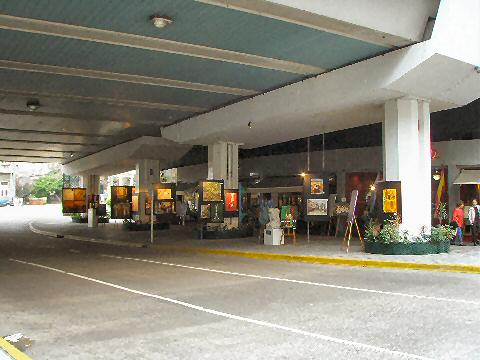
Posadas begins at #1000, off the lower end of Av. 9 de Julio, or at least its service road, Carlos Pellegrini. Given my/our food focus, it should be noted that the endpoint is the well-known restaurant (which I have yet to visit) Juana M. In fact, the whole of the street starts in the midst of food, with the famed Recova, or “under cover” commercial center, taking up both sides of the street and stretching under the 18 lanes of the avenue, and filled with a combination of nearly a dozen very expensive restaurants – mostly steakhouses and Italian food – and an outdoor art gallery, with a constantly changing exhibit of local artists’ work. I have to admit to having avoided dining at any place within the Recova – not because there aren’t probably some very good restaurants, but they’re just so expensive it isn’t worth it for me (the main branch of Piegari, asserted by some to be the best Italian food in the city, is here, but with prices like 60-70 pesos for a bowl of pasta… you know?).
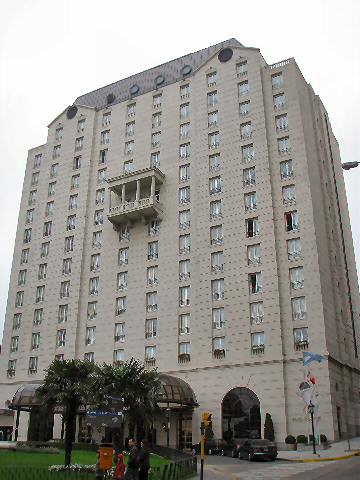
But luxury is what this end of Posadas, well, most of this area of Recoleta is about, and immediately on emerging from underneath the overpass, we find ourselves confronted by the impressive bulk of The Four Seasons hotel, one of the most expensive in the city (likewise its high end restaurant, La Mistral). This is a place where I regularly hear from visitors that they’ve booked, and don’t understand why people say Buenos Aires is so inexpensive in comparison to other world capitals. Of course, they’re probably eating in the Recova and dining at Casa SaltShaker as well, so there you have it. The next block or so include a series of large, but not particularly interesting apartment and professional office buildings, until we arrive into the 1200 block, with the towering Caesar Park hotel on the left at 1232 (with an excellent cocktail bar, and what I hear are two quite good, if expensive, restaurants, Agráz, and the new Japanese themed Midori).
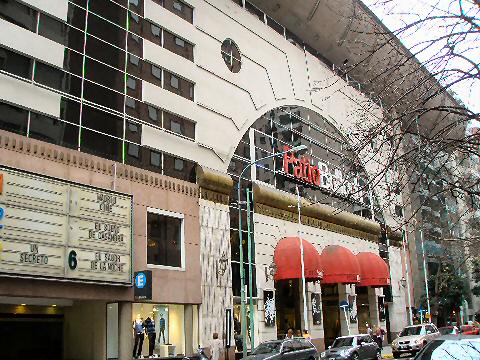
Of more interest, across the street is the Patio Bullrich shopping mall, an imposing building originally designed as the city center’s cattle auction hall in 1921, and refurbished as a shopping center in 1988 after a period of disuse. “The Patio” as locals call it, is designed around international luxury brands – mostly clothing. There’s also a small food court, with nothing of great note, though the upper floor of the center is home to the Recoleta branch of Valenti, a gourmet provider of cheeses, cured meats, and similar sorts of things. There’s also a cinema inside, with a half dozen small rooms, on different levels of the mall, showing everything from popular to “art” films, and is often the site for touring film festival showings.
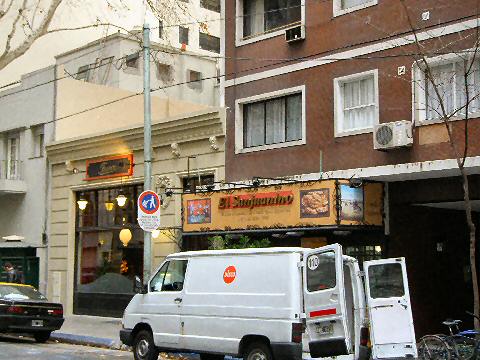
On the next block is, for me, the most important food stop of this short trek – El Sanjuanino, which over the last couple of years has become my favorite spot to take visitors for good “regional” cuisine. Next door is the newly opened Fervor, a seafood restaurant I have yet to try, but which stands out for their unique, bizarre, and utterly useless attempt to accommodate the vast number of international visitors to the city – instead of translating the local fish names on the menu into one or another foreign language, they’ve listed the fish by their Latin genus and species, as if that will somehow clue the average person in to what they are ordering. I’m not even sure I can give them points for trying; still, it’s a pretty room, and for the ‘hood, their prices aren’t bad, so one of these days. Next door, the Melia Recoleta Plaza hotel, with its mediocre restaurant and attached jazz club. This block, by the way, is, while not famed for it, the original home (#1547) of the young radio actress, Eva Duarte, who lived on the fourth floor, and met her husband to be, Colonel Juan Perón, when he moved into the apartment next door (not at some party as the movies love to depict). In fact, they lived for their first year together on this street, and Evita gave her propaganda speeches from the then state radio station housed in the building where we will end this tour, the Palais de Glace.
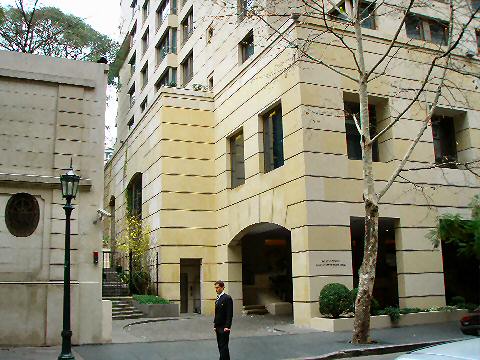
The following block stands out, in slightly bizarre fashion, for the rear entrances of the three buildings that take up most of the entire lefthand side – the Vatican embassy, the Palacio Duhau Park Hyatt, and the other half of the original Duhau estate, now a private home. The 1600 “block” splits in two on the left, with a small side street separating that side in two. Continuing past this…
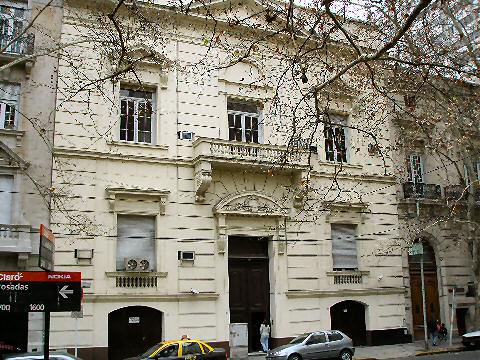
On the right, at 1641 are the offices of the Treasury Proxy (don’t ask, I don’t know), at 1659 the Argentine Electrotechnical Association, and, at 1663, the Russian embassy (picture above); on the left at the end of the block, an apartment building at 1648 where Adolfo Bioy Casares and Silvina Ocampo, two of Argentina’s most famous 20th century writers, lived – originally lovers and later married. The former is most famous for his fantasy book La invención de Morel, the English translation of which has been asserted to be the inspiration behind the hit television show Lost; the latter well-known for her poetry and children’s stories.
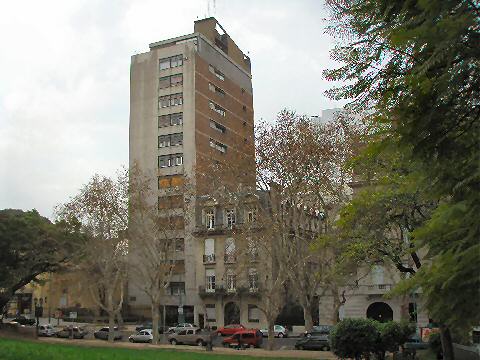
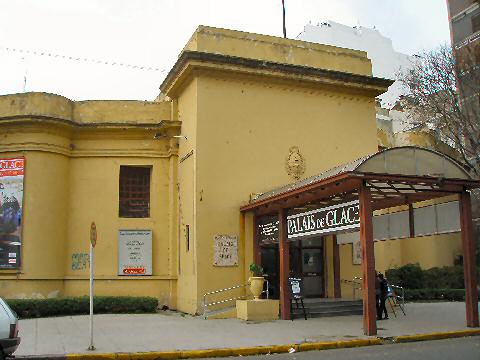
And finally, the 1700 block, with a small park that is filled with massive rubber trees (more about which on the next neighborhood walk) on the left, and on the right mostly nondescript residential buildings, and finally at 1725, the Palais de Glace, built in 1880, and at various times home to an ice skating rink, the Belgrano radio station where Evita used to give speeches glamorizing the Perón policies, television channel 7, and now the slightly rundown National Hall for the Plastic Arts – with a specialization in political photography, cartoons, and other artwork. The building, last renovated in 1931, sits in the small Plaza Julio de Caro, named after a famed tango artist of the 1920s and 1930s.
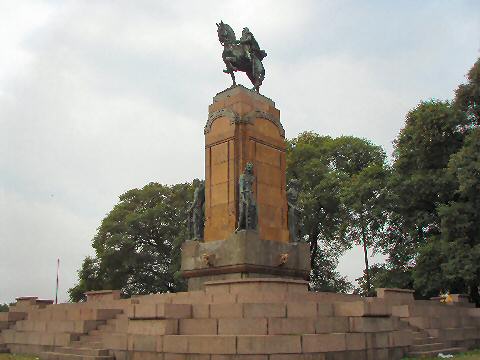
Our little tour of Posadas history ends in front of the Palais de Glace with the massive bronze statue, by French sculptor Antoine Bourdelle (who also re-designed the Palais), of General Carlos María de Alvear, Posadas’ cousin as noted above, who will be the subject of a near future wander. Across from the end of this street is the Plaza Francia and the whole Recoleta Cemetery, Buenos Aires Design Center complex.
Copyright © 2026 SaltShaker. This feed contains copyrighted photos and text from SaltShaker. If you are not reading this material in a feed aggregator or by e-mail subscription, the site you are viewing may be guilty of copyright infringement. Please contact [email protected] so that I can take appropriate action.
Plugin by Taragana
]]>“Stay the course.”
– George W. Bush, president of the U.S.
Buenos Aires – One of the things that fascinates me about history is the way it repeats itself. Despite all those colloquial admonitions about “those who forget the lessons of history are doomed to repeat them”, it’s a common failing throughout the world. We’re seeing it here in Argentina now as various economic, trade, and political policies that have repeatedly led to disastrous results in those fields here are being implemented by the current and antecedent government (let’s face it, they’re one and the same, kind of like if Hillary would have been elected immediately after Bill). One of our guests this last weekend talked a bit about her perception as a porteña in regard to la presidenta – she pointed out that while at the time of the economic collapse, nearly seven years ago, a strong, steady, guiding hand at the helm was needed, and it’s how her husband, Nestor Kirchner, led the country in one fashion or another, out of the disaster, that given the current conditions, that approach is not warranted. Yet Cristina is basically approaching things as if it’s all in disarray and needs to be dealt with swiftly, efficiently, even borderline brutally. It doesn’t – she needs to reevaluate those policies and procedures and adapt them to conditions of today. She’s not. She’s just repeating past actions, regardless of whether they apply to what’s going on or not. — It was an interesting analysis, and rang quite true, and hey, sounds familiar, no?
Today, Argentines regularly talk about that period immediately following the 2001 crisis, bemoaning how sad it was that their country had to go through a succession of leaders rapidly, each one not suited to the task, or betrayed by one another, until finally getting to a relatively stable government. They talk about it as if it’s something historically unusual. True, five presidents in a period of less than a month was a rapid fire version – though, it could easily be pointed out that the first, de la Rúa, simply resigned as inadequate to the task at hand, the second, Ramón Puerta was merely a two day interim appointee to cover until Congress had a chance to meet, Rodríguez Saá was elected and resigned a week later, also not up to handling what was going on, Camaño was once again a couple of day interim appointee, and then Duhalde was elected by Congress and served a bit over a year until the next official election. But this is not the first time Argentina has gone through a quick succession of leaders, though it was the most rapid. From 1976 to 1983 it went through five leadership changes; from 1973 to 1976 it went through four… wait…
It makes more sense to look at when things actually worked, i.e., well, here’s the point, Argentina gained its independence in 1816, though it setup its own government starting in 1810. Since that time the only leaders who served out their entire intended terms were de Rosas from 1829-1832 and again from 1835-1851 (though, in his third term, beginning in 1851, he only lasted a few more months); he was followed immediately by de Urquiza, who stayed in power until 1860; then there were half a dozen changes until a series of three from 1868 to 1886 – Sarmiento, Avellaneda, and Roca – who each served out their terms; then another half dozen changes until Roca was re-elected in 1898 and served until 1904; then again multiple changes until Yrigoyen took over 1916-1922, followed by Torcuato de Alvear from 1922-1928; Justo from 1932-1938; and then no one until Perón served out their entire term, and he only served out his first term – 1946-1952. After Perón, not one president or leader served out their entire intended term until Menem served from 1989-1999, and then Kirchner from 2003-2007. Let’s face it, it’s been a rocky history of leadership, with long stretches where the government changed hands multiple times.
In fact, the country is pretty much built on that as a model. It was directed by a succession of, more or less, committees, the Primera Junta, Junta Grande, First Triumvirate (Argentina), and Second Triumvirate (Argentina) from 1810 to 1820 – and then actually from 1820 to 1826 ceased to exist as a separate entity, becoming a part of the United Provinces of South America. 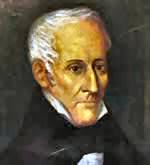 The two juntas there at the beginning truly led as ever-changing committees, the two triumvirates were appointed trios of leaders, until those of the second one realized that they needed, at the very least, a figurehead, if not an official, single leader. And thus, on January 22, 1814, the Second Triumvirate picked one of their threesome (I envision a sort of rock – paper – scissors process) to be the country’s first official solo leader – Gervasio Antonio de Posadas y Dávila, the distinguished looking lawyer in the portrait – who assumed power on January 31st.
He stayed in office for less than a year, followed by Carlos María de Alvear who lasted about four months, José Rondeau for two days, José Ignacio Álvarez Thomas for a year, Antonio González de Balcarce for three months, Juan Martín de Pueyrredón for just under a year, back to Rondeau for a few months, and finally Juan Pedro Julián Aguirre y López de Anaya who managed a week before it was decided no one could remember his whole name and they simply shut the whole government down for six leaderless years starting on February 16, 1820. Six years and eight leaders (seven individuals since Rondeau served twice). Overall, 77 leadership changes in a 198 year history – an average of 2½ years per leader.
It might be time for these folks to take a look at their history and figure out which stuff doesn’t work when they keep repeating it, and what they might do about that… all this, by the way, is leading up to a little walking tour (or several) of the “Supreme Directors” as these seven were known… you know, food, wine, culture, architecture… the stuff you usually get to read about here? Next up, a little “Whatever happened to Gervasio Posadas?” walk…
Copyright © 2026 SaltShaker. This feed contains copyrighted photos and text from SaltShaker. If you are not reading this material in a feed aggregator or by e-mail subscription, the site you are viewing may be guilty of copyright infringement. Please contact [email protected] so that I can take appropriate action.
Plugin by Taragana
]]>