“Sherry… a sickly compound, the use of which will transform a nation, however bold and warlike by nature, into a race of sketchers, scribblers and punsters, in fact into what Englishmen are at the present day.”
– George Borrow, English Novelist
Buenos Aires – I’m going to give you the one sentence basics of sherry, formerly called “sack” by the Englishmen referred to above. There are plenty of websites out there that go into great depth where you can find out more detail and get into the intricacies.
“Sherry is a fortified wine, i.e., relatively pure alchohol is added to it during or after fermentation, that is made from white grapes in the Jerez region of Spain, and is unique in two aspects: first that a good portion of it, the fino category which includes finos, manzanillas, and amontillados, is fermented in open barrels underneath a naturally occurring yeast layer called the flor, while the rest, the olorosos, simply oxidize, a condition that in most wines is undesirable, but with the peculiar grapes of Jerez, produces world-class wine; and second, that it is aged in a solera system, which is a pyramid of barrels that allows the drawing out a portion of the wine from beneath the flor (if it is there) to move into the next level on down the pyramid, so that at the bottom, the wine ready for bottling, is a blend of multiple years stretching back to the first year (at some atomic level) that the solera was started.
Okay, enough about that. Here’s the shame of it all. People don’t really drink that much sherry. In fact, they seem to drink so little of it that I used to wonder how it was that it seems to sell in retail stores or restaurants at all. Sure, there’s the occasional person at a bar who would ask for a “Tio Pepe”, one of those fino style sherries that technically needs to be consumed within about 2-3 days of opening, but usually sits in the bar’s refrigerator for 6-8 months going bad. And there’s the cream sherry (semi-sweet) drinkers, or even sweet sherry drinkers, who have a little nip before bedtime. But who, exactly, is drinking the really good stuff – the legendary dry sherries that encompass a range of styles and weights and flavors and colors from pristinely transparent to deep chocolate brown? And what, exactly, are they drinking them with?
Which brings me to what I want to focus on, just prior to a rundown on the recent sherry dinner we put on here at Casa SaltShaker. Food and wine pairing. Let’s face it, if there’s any topic other than how to keep a souffle from falling that calls up dread from the deepest, darkest recesses of the hindbrain, it’s food and wine pairing. The casual wine drinker readily admits to not having a clue and being consumed with fear that they will select the wrong wine to go with their food and then nothing will be good and the dinner will be horrible and nobody will like them anymore and so they order a beer. (Should I bring up food and beer matching?) The wine aficionado will have done his or her research and perhaps even tried a wide range of wines with different foods, and invariably, will have settled on a particular combination which they will swear up and down is a heaven-made match that no one can top, beat, or shake a stick at, and there’s simply no exception, and to do anything else would be disrespectful of both the food and wine, and they secretly are hoping you like the combination as much as they do in order to validate their self-worth, and if you don’t they’ll realize that you’re not the sort of person whom they want to hang out with anyway. This, by the way, is how sommeliers came into the forefront of the whole topic – it’s not because we know more, or are willing to experiment more, or have gotten past the delusions of there being a perfect match – it’s quite simply because if you leave the choice up to us, you have someone to blame if you don’t like it, thus preserving self-worth and tenuous friendships, and if you do like it, you can congratulate yourself on having recognized a kindred spirit.
There’s no perfect match. Really. At best, there are certain wines, that certain people (because no one’s done any kind of extensive controlled research on large numbers of people), like really, really well with certain foods, in certain settings. And you know what? Other certain people, don’t. Not one bit. One of them might be you. In fact, not only might you not like the food and wine pairing, you might not even like the wine at all. Wouldn’t that be a shocker? It’s spawned another whole industry in the wine world – people who write books and articles about how to go about matching food and wine – by weight, by style, by color, by region, by acidity, by tradition, by shape of the bottle, by color of the label, or by whether or not the winemaker puts his pants on two legs or one leg at a time. I tell you right now, I wish I’d written one of those books, especially early on when the subject was just taking off. I’d have a whole pile of pesos in the bank.
With all that in mind, I set out with my friend Mickey, who brought the sherries in from his private stash in New York, to create a sherry dinner. Now, Mickey, dear friend that he is, falls into that wine aficionado category above, though with many years of experience he’s come to recognize that there’s room to loosen up a bit. He still has some ideas about the perfect matches for things, but as long as he was willing to let me play a bit in the kitchen (not that he had alot of choice, I was buying the sherries from him, and although we discussed the plans for dinner, I made my own changes as I went along), we were going to get along fine on this. In fact, I’d assert, that the convivial setting of a Casa S dinner contributes much to the enjoyment of food and wine matches. Not that I don’t have a generally good sense of things that go well together and can usually please a good number of people with those combinations, but the whole relaxed, casual chatting, like friends at a dinner party atmosphere, heightens the appreciation of those matches. It really does – I can even tell by the commentary I receive after the dinners – invariably people who felt uncomfortable at the table (whom, thankfully, are few), or been part of a stilted or even discordant conversation, have notedly lower opinions of the food and wine pairings. Time for a food photo, no?
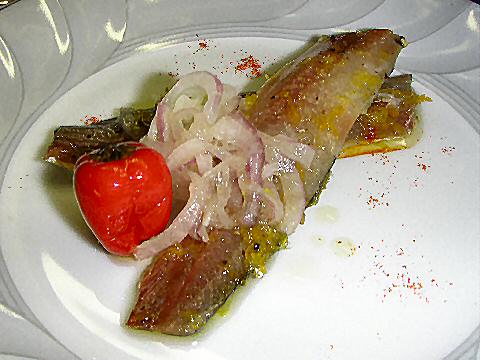
The dinner opened up with a crisp, crystalline, dry Pedro Romero Aurora Manzanilla. Manzanilla is a type of fino that comes from one particular area, Sanlúcar de Barrameda, and has a peculiar note of brininess too it that (generally) matches with things like oysters, shrimp, octopus, and salt-cured fish. I was all for doing something interesting with baby octopus, but my partner in this venture asserted that a salt-cured fish would be the better match from his perspective. This one I went his direction on, and obtained some fresh imported sardines, cured them whole in salt for two days, then filleted them and marinated them for about 8 hours in good olive oil, tangerine and lemon zest, and a little cracked pepper. I served them simply with a little thinly shaved onion (salted, rinsed, drained), and a pickled pepper.
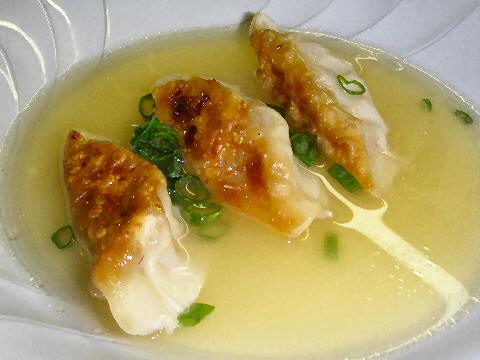
I’ve got to say, this dish turned out even better than I’d hoped, and was my personal favorite of the evening. We’d talked about doing something with a cured ham and good cheese to go with the M. Gil Luque Bandera VORS Amontillado, I think he was envisioning some sort of antipasto platter. I had this idea that started off as a ravioli, but then went more to my style with potstickers – filled with Manchego cheese and Jamón Serrano, with just a splash of balsamic vinegar to help hold them together – sitting in a bacon broth. Yes, bacon broth – it was all the rage a few months ago in various newspapers and magazines, all asserting that it requires this week long process involving more gelatin than Bill Cosby has ever eaten, freezers, cheesecloths, strainers, pots and bowls, and ending up with a fraction of the original volume. Now, I can’t claim that perhaps the broth wouldn’t have been more crystal clear had I done such a thing, but with the cost of good bacon here, and the fact that one can clarify a meat stock with eggs, as has been done by cooks for centuries, I went that route and ended up with nearly my original two liters of broth, nice and clear and smoky and delicious.
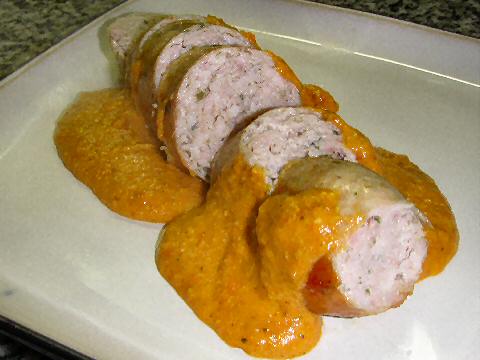
One of the styles of sherry that’s a bit of an oddball is the Palo Cortado. This is a version that starts out like an amontillado style fino, with that layer of flor that I mentioned, but for unknown reasons, the flor dies off leaving the wine exposed to the air. You end up with an amazingly complex, and fairly rare, wine that falls between the amontillado and oloroso styles. We had a Barbadillo Obispo Gascon Palo Cortado to play with, and started thinking about a lighter game meat. And almonds. So of course I made rabbit sausage (rabbit, salt, black pepper, ginger, dried hot peppers, parsley, white wine, garlic), poached them lightly and then sauteed them to serve, sliced, with a slightly simplified romesco sauce (lightly charred red bell peppers, tomatoes, almonds, pureed with olive oil, bread, and a splash of anise liqueur – no garlic or onions in this version). There was some debate as to whether this was the best pairing of the evening – underscoring my point, with eleven guests present, plus myself, I think 5 went with this, 4 with the ham and cheese potstickers, and 3 with the next course…
Which was a simple filet steak, top round cut, about the closest we can get to a London Broil here, simply seared and finished in the oven, and topped with a rich blue cheese sauce (I wanted to use the very potent Cabrales, but there was none to be found this last week, and Mickey wanted me to just cut a piece of it and set it atop the steak – but that’s not me, ya know?) – sauteed shallots in a little butter, then deglazed them with gin and cooked that down until there was little liquid remaining, added the strongest blue cheese I could find, let that melt, added a splash of beef stock, thickened it all with a little bit of flour, and finished it with some freshly chopped yerba buena, a type of mint. Served up with some candied carrots – cooked in butter, marsala, mustard, orange juice, brown sugar and honey. And all to accompany the big wine of the evening, Hidalgo Vaedro Oloroso.
And, finally, a solera style dessert wine, technically not a sherry, but in the same general category, the Barbadillo Laura Moscatel matched up with a date and mascarpone cheesecake, cocoa crust, drizzled with a little fig syrup.
See, all that food and wine pairing stuff isn’t so hard after all…
Copyright © 2026 SaltShaker. This feed contains copyrighted photos and text from SaltShaker. If you are not reading this material in a feed aggregator or by e-mail subscription, the site you are viewing may be guilty of copyright infringement. Please contact [email protected] so that I can take appropriate action.
Plugin by Taragana




 ]]>
]]>To choose doubt as a philosophy of life is akin to choosing immobility as a means of transportation.”
– from Life of Pi
Buenos Aires – I do seem to be falling behind on the dinner posts… hmm… well, I’ll try to get caught back up. Here we are a week after Pi Day, which, of course, you all celebrated… March 14… 3.14… in reality we celebrated it for two days and miraculously, the numbers work… 3.14 15… The natural thought on the part of some of the guests was that I might be subjecting them to a series of five pies of one sort or another, and I did consider it – there are enough different ways to approach a pie that I could have made it work, but in the end I went a bit further afield…
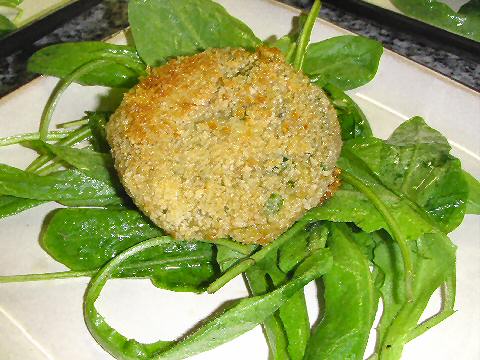
We started off with the “history” of pi… to a certain extent. The number, the ratio, has been around for roughly four millenia – at least as a human concept – likely it was there beforehand, we just hadn’t figured it out. However, I wasn’t about to try preparing some ancient Babylonian recipe, even had I had one to work from. Besides, the number wasn’t called pi then – that didn’t happen until 1706, when Welsh mathematician William Jones named it – and led to our first course, a Welsh treat called Glamorgan Sausages. No meat involved, presumeably from some time period when the stuff was scarce… or perhaps there’s another reason behind it, but these are a mixture of fresh breadcrumbs and grated cheese (I used a mix of cheddar and lincolnshire), green onions, parsley, thyme, sage, hot English mustard, egg, salt and pepper, all packed together to form a nice, firm sausage – I went with patty shaped rather than the more traditional elongated ovoid – have to keep the pi theme going you know – dipped them in more egg and then rolled them in dry breadcrumbs, fried them up in butter and served them atop a radichetta salad with honey mustard dressing. Radichetta is a common local green that we might refer to as “country lettuce”…
From there, we moved on to a barley soup, specifically an Austrian barley soup called Graubünden. And why, you might ask? Because, though William Jones named this irrational constant, well, he was from Wales, and pretty much nobody paid him any mind. However, Leonhard Euler, an Austrian (aha!) took the idea and published it hither, thither, and yon, and generally gets credit for naming it, even though he didn’t. He did, however, steer me in the direction of an Austrian soup, and a simple barley one – packed with celery, carrots, cabbage, leeks, and, of course, barley. Very simple, but very good – and perfectly timed given that the weather decided to turn a bit chillier last weekend.
Next up, you might recall my experimenting with an oyster mushroom coca a few weeks ago – and a nice twist on the idea of a “pizza pie”. The only differences here, I made small individual rounds and I used a mix of oyster and portobello mushrooms. In retrospect, I think I like it better with just the oyster ones… And that lead us on to the main course, and my first thought of some sort of “pot pie” – beef, chicken, lamb… wait, rabbit! And from there, a decision to go with just a more traditional “old English” rabbit pie, and then looking at the menu and realizing that everything had some sort of starchy component, to go with a crustless rabbit pie. For this, I cooked a whole lot of onions – mixed white, yellow, and red, thinly sliced, and a couple of peeled and sliced appels, in a splash of olive oil and a good amount of diced bacon. I added some bay leaf and nutmeg, and when the onions were soft, I added rabbit pieces that I’d previously dredged in flour and sauteed just enough to brown them. Then I added dried prunes, and topped the whole thing up, just enough to come up about midway on the rabbit pieces, with apple juice (cider was called for, but hard to find here – at least the dry kind) and a bit of white wine. Brought it up to a simmer, turned the heat down very low, covered the pot, and let it go for about three hours, until the rabbit was very tender and basically falling off the bone. Ladled that up onto plates and served.
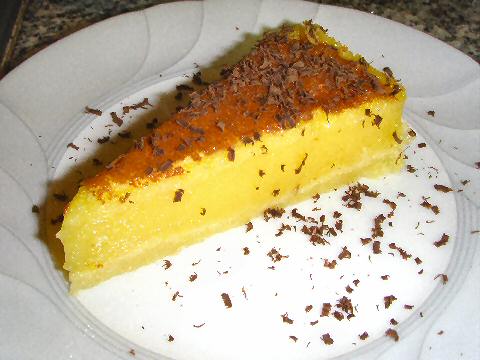
Finally, on to a real pie of sorts – or at least a tart. A couple of years ago I’d contacted the owner of Marion’s Continental restaurant in New York to get their recipe for Lemon Kiss Pie, and Richard was nice enough to send it to me. It’s truly a spectacular lemon pie – really, I used to stop in at the bar there for just a piece of the pie and a cup of coffee. I gather from recent blog reports that Marion’s has just closed and is being replaced by some gentrifying lounge/club that probably has no place on the Bowery, even in 2008, and that’s a shame. But I promise to carry on the tradition of Marion’s Lemon Kiss Pie!
Copyright © 2026 SaltShaker. This feed contains copyrighted photos and text from SaltShaker. If you are not reading this material in a feed aggregator or by e-mail subscription, the site you are viewing may be guilty of copyright infringement. Please contact [email protected] so that I can take appropriate action.
Plugin by Taragana
]]>My temper leads me to peace and harmony with all men; and it is peculiarly my wish to avoid any personal feuds or dissentions with those who are embarked in the same great national interest with, myself; as every difference of this kind must in its consequence be very injurious.”
– General George Washington
Buenos Aires – I have noted before the difficulties we approach here at Casa S when we offer up a Peruvian dinner. Yet, every now and again, I give in to a bit of wheedling and schedule one. I was determined that one way or the other, this time was not going to be a huge stressful mess between Henry and me, with our different approaches to cooking, and to getting work done. So I posed it to him, how much work did he really want to do, and within that, what did he want to do. He decided he could comfortably handle taking on preparing two dishes. At that point, I laid it out as clearly as I could – I would take on the other three dishes, planned around his, and even with input on what sort of things he might suggest to accompany them, but he was not to interfere, question, complain, or anything else, in regard to my interpretation of the dishes, in fact, he was simply to pretty much stay out of the kitchen. I would get my stuff prepped and/or finished early on in the day, and then… the kitchen was his to make his two dishes. He could plan his own schedule, what he wanted to do, and I wouldn’t interefere, question, complain, or anything else about his plates.
It worked. We stayed out of each other’s way, we got the dishes prepared, and then when it was time for the dinner, we simply took turns in the kitchen and the dining room. Slightly disconcerting, but not stressful, and I think that all around the food came out better than it has in our past Peruvian dinners. We still probably won’t have them that often, as it’s still extra work and organization, plus, honestly, I like working in the kitchen, I don’t play waiter/host well…
First up, I whipped up a batch of ají de huacatay that we just put in bowls around the table for those who wanted to add more spice to their food, or for slathering on bread
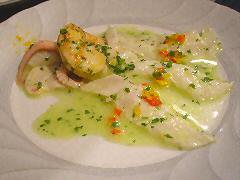 We started off with a Tiradito de Mariscos. Now, a tiradito is related to a ceviche, but there are some differences. There’s not 100% agreement amongst Peruvians as to what those differences are. The one constant seems to be that the tiradito arose from the Japanese influence in Peru, and the fish and shellfish are cut, generally, in a completely different manner – more of in longer strips rather than diced or chopped – a tira being a strip – imitating Japanese sushi cuts. From there, however, there seems to be a lot of disagreement as to what constitutes a tiradito. Generally, and these are not hard and fast rules, apparently – no onions are used, more herbs, and often herbs other than cilantro, are used, and, the citrus juice that’s used for curing the fish often has some element of something that gives it a creamier texture – several sources use some sort of good quality oil whipped into the citrus juice, not quite like a vinaigrette since the citrus predominates, but enough to give it some texture. So my version – strips of lenguado, or sole; some langostinos, or large shrimp, and some pulpito, which are small octopuses. I left the langostinos whole but peeled, and the octopuses I cleaned and separated the tentacles from the body – the former I separated into individual curls, the latter cut into strips like the fish. The curing liquid – a mix of orange and lime juice, about 1:2, chives, cilantro, garlic, one hot chili, salt, and a small amount of really good olive oil, all blended together. The langostino was cooked until just cooked through, the pulpito literally got dunked into boiling water for about 30 seconds, just enough to “set” it, but still staying very tender. The fish and shellfish were cured in the liquid for 20 minutes before we served them. A little confetti made of finely diced orange peel, and yellow, green, and red hot peppers, was sprinkled over the top for both decorative and spice effect.
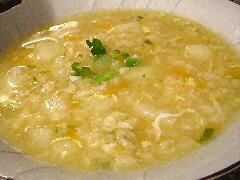 Now, here’s the one problem with our separation of duties. I really did stay out of the kitchen while he worked so that he wouldn’t get upset that I was interfering with his traditional methods. So I can, at best, extrapolate as to what he prepared. This is a Caldo de Mote, a wheatberry based soup – the wheat being husked, and then, I believe, par-boiled, then dried out again. It’s not entirely clear, as all the Peruvian reference books and sites I can find refer to corn being prepared that way, but Henry says that in the southern parts of Peru, in the altiplano, mote is a wheat preparation. More research in the future… I know he put the mote in first and simply added water to it, and then started adding vegetables. I can be fairly sure there were onions, celery, carrots, and potatoes. I know he wanted both black pepper and pimentón amarillo powder at one point. Beyond that, I don’t know if he added anything else – I think, probably not – other than some chopped green onions for garnish. I do know that it was really good, and we got lots of compliments on it.
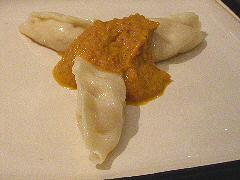 I’ve posted on what I’ve come to call “regular Peruvian sauce“, or the sauce used on the dish tallarines con pollo – noodles with chicken – which is ubiquitous in Peruvian restaurants, though everyone seems to have their own take on just how the sauce is made – no different than Italians all have their own version of basic red sauce. I proposed to Henry that I reinterpret it as a chicken filled ravioli with the sauce. In principle he agreed, though started to object when I began to make them that it “wasn’t traditional”. I reminded him of our agreement for this dinner and he agreed to withhold judgment. I basically took the two components of the recipe and prepared them separately – I boiled the chicken, and then pureed it with a mix of red wine, salt, black pepper, cumin, and pimentón rojo, and just a little bit of extra cream cheese that I’d made for the dessert coming up. I then let it cool, and filled wonton skins, making little potstickers – which I later cooked in standard potsticker fashion – browning the bottoms in oil in a hot pan, pour in a splash of wine, cover, and let steam until the rest of the empanadita is cooked through. The sauce, I used the ingredients but changed the cooking method a bit – following the approach I’ve been using for our quite successful roasted tomato sauce – I threw some coarsely cut carrots, onions, and tomatoes, coated in olive oil and salt, into the convection oven at high heat and cooked them until well browned. Then I pureed them in the blender with reduced red wine, pimentón rojo, cumin, powdered bay leaf, black pepper, and salt to taste. I simply ladled the sauce over the potstickers. We both agreed that the roasted carrots get almost a touch too sweet over the usual cooking method, but that it was on the track to being something really interesting – I think if we do it again, we’ll simply add some hot peppers to the roasting vegetables.
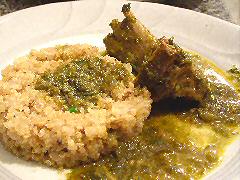 I truly can’t tell you much about the seco de cabrito other than it was really well received. I know that he dry rubbed the portions of cabrito, or baby goat, with a mix of spices – cumin, black pepper, and salt certainly, but he probably added in some other stuff. I know he simmered up some dried ají panca and mirasol, the yellow and red peppers, until they were soft, then skinned and seeded them, and pureed them with some of their cooking liquid. I know he pureed a huge amount of cilantro in oil and poured it over the dry-rubbed goat an hour or so later and let it marinate in that for another two hours. I know he chopped up lots of garlic, leeks, and red onion. I’m fairly certain that he sauteed those last items in a little oil, then added the goat pieces, browned them, then added both the pepper puree and the marinating liquid, and then stewed the pieces in the liquid for a good hour or more. As to whether there was more to it? I’m not sure – I actually think not, because he was confirming details with one of his sisters earlier in the day by phone, so I heard the conversation back and forth. He served the pieces of cabrito alongside a simple quinua that had been toasted in oil, and then cooked in water, but I’m not sure what he added to the quinua – not a lot, as it didn’t have anything spicy going on, and I think he was letting the sauce from the seco give the dish its spice.
We finished off the night with a simple cheesecake that we added some concentrated passionfruit juice to. Originally we’d hoped to find some lúcuma flavoring, which the chef at Moche restaurant told us he buys in the food shopping strip of Liniers, but I couldn’t find any – I walked the entire strip, both sides, and asked in every single store, and several people knew they’d seen it around, but not recently, and of course, none of them were the one who carried it, but maybe the guy down the block… we settled on passionfruit, which aren’t yet in season, so we went with a juice concentrate. It gives just a nice, fruity, sharp edge to the cheesecake, and we drizzled a little butterscotch syrup over it, which worked really well.
Copyright © 2026 SaltShaker. This feed contains copyrighted photos and text from SaltShaker. If you are not reading this material in a feed aggregator or by e-mail subscription, the site you are viewing may be guilty of copyright infringement. Please contact [email protected] so that I can take appropriate action.
Plugin by Taragana
]]>“In a hole in the ground there lived a hobbit. Not a nasty, dirty, wet hole, filled with the ends of worms and an oozy smell, nor yet a dry, bare, sandy hole with nothing in it to sit down on or to eat: it was a hobbit-hole, and that means comfort.”
– J.R.R. Tolkein, The Hobbit
Buenos Aires – This weekend was the 70th anniversary of the publication of The Hobbit, an excellent historical tome that precedes all that Lord of the Rings affair. The early years, if you will. The funny thing is, I received almost as many e-mails saying something like “I’m really curious to see what you’re going to serve for your Hobbit dinner” as I did requests for reservations. Now, some of those requests came from far away, beyond the oceans, over the mountains, and so, you see, are quite sensible questions. Some, however, came from folks right here in town… who very well could have come to the dinner and found out for themselves.
Now, if you’re one of the sort who has never read The Hobbit, you probably won’t know that hobbits are inordinately fond of food, often eating four and five meals a day, when they can get them. While recipes amongst the Shire-folk, as they might like to refer to themselves, tend to be passed on within and between families, they are rarely written down, and as such, difficult for an outsider, such as myself, to research. Especially when there are simply no flights from Buenos Aires to Middle Earth, and no time to take one anyway. What appears on the internet is, for the most part, a lot of speculative nonsense. A bit of delving into what scraps of credible records there are suggests that hobbits are particularly fond of mushrooms, also honey cakes, and there are some suggestions that bacon, especially when combined with mushrooms, is a favorite, and perhaps a rabbit or two for the stewpot. With little to go on, I found myself having to simply offer up some plates that I can only hope would be enjoyed by any hobbit who happened by for dinner.
We began our meal with a simple Mushroom Cheesecake. I know I’ve been going a bit cheesecake happy since the whole making homemade cream cheese thing started, but that’s just the way it is. I decided to try my hand at a savory one rather than a sweet one. For the first evening I went with a simple tartlet style cheesecake, filled with a cream cheese base, sans sugar and vanilla, and pureed some sauteed mushrooms and a handful of tarragon leaves into it. Baked up, they were all pretty and such, but the texture of the basic tart crust didn’t come out the way I wanted – it got a bit soggy on the bottom when the tartlets were chilled. For the second evening of the dinners I decided on a more traditional cracker crumb type crust, just instead of graham cracker, I went with a nice savory whole grain cracker, and made one big cheesecake that I cut into slices. I also thought that the tarragon hid the flavor of the mushrooms, so I left it out, perhaps somewhere in between, just a touch of tarragon… both nights, I topped it off with some whipped chive cream.
We moved on to a hearty little Cheddar Soup. I don’t know that Cheddar cheese is available in the Shire, I just have this sense that it might be. At least were one to have a decent cheese there, it ought to be something like that. The soup base made from chopped and cooked leeks, carrots, and celery, and then added a mix of pretty much equal parts of whey left over from the cream cheese making, beef stock, and beer. If you don’t have whey, just do the beef stock 2:1 to the beer. After cooking a little while, puree the whole thing with a hand blender, bring up to a boil, and then put in a good amount of both white and orange Cheddar, or, as they’re referred to here, English and American – let them melt and blend them in. Season to taste with salt and white pepper.
Bacon and mushrooms in combination… well, how can you beat that? Start with some sliced shallots in olive oil, cooked until soft, then add finely chopped bacon, sauteed until it renders its fat and is beginning to brown, then add chopped portobello mushrooms and cook until they’re soft and lightly golden. At that point, this would be all fine and such to eat, but there were some beautiful fresh broad beans in the market, so I bought some, cut them into bite sized pieces, blanched them, and then added them to the saute. A bit more olive oil. Cooked up some penne pasta – a stretch for the Shire, I know, in fact one guest even asked if there was any evidence that pasta had ever been brought to that part of Middle Earth – I simply don’t know, but consider it my personal touch. All tossed together with salt and lots of black pepper.
On to a main course of Hobbit Stew. Now, all the jokes about fresh, tender hobbits and where to obtain them aside, and the jokes did fly, no hobbits were used in the preparation of the stew. Just a nice hearty, rich stew started with a base of chopped ginger and onions, cooked until soft, then chopped bacon added, a bit of time to render the fat, then diced red and green peppers, and some diced eggplant that I’d salted and let sit to drain, and then rinsed. Cooked all that for a bit, then added diced tomatoes (all the dice on these fairly large, at least half an inch), and equal parts of diced rabbit and pork, cook it all until the meat is slightly browned, add a cup of marsala and let it cook until absorbed, then add water to cover, and a handful of chopped parsley and one of chopped oregano (marjoram would be even better, but isn’t in season here yet). Bring to a boil, reduce heat and let it simmer for 3-4 hours until its all tender and melded together.
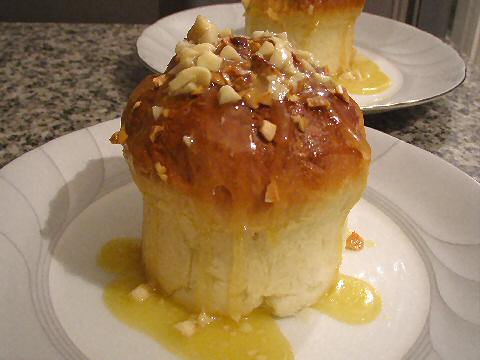
Now, given that hobbits have a tendency, it seems, to carry honey cakes with them to nibble on as they stroll about greeting their neighbors and such, I’m sure this isn’t the type they’re baking, but I have to imagine that they’d be quite pleased sitting down in front of one of these. Bring a ½ cup of milk to a boil, remove from heat and dissolve ½ cup of sugar, 1½ teaspoons of salt, and ¼ cup of shortening in it (I used some margarine, I’m sure it would work just fine with butter or other shortenings). Let cool off to the side for a few minutes. Proof a packet of dry yeast in ½ cup of warm water. Add the milk mixture to it and combine well. Beat two eggs and add them to this. Then add five cups of sifted cake flour and mix thoroughly, then knead until nice and smooth and elastic. Cover, put in a warm place, and let it rise until at least doubled in volume. Punch down, divide into a dozen equal balls of dough that you put into individual greased or buttered ramekins. Cover and let rise again until they’ve filled the ramekins and are sticking out the top. Brush with a mixture of equal parts butter, honey, and sugar that you’ve brought to a boil, and then sprinkle with chopped almonds, then brush with more of the syrup. Bake in a 350°F oven for about 30-35 minutes until browned. When ready to serve, pour more syrup, and if you want, some lightly toasted almonds, over the top.
Copyright © 2026 SaltShaker. This feed contains copyrighted photos and text from SaltShaker. If you are not reading this material in a feed aggregator or by e-mail subscription, the site you are viewing may be guilty of copyright infringement. Please contact [email protected] so that I can take appropriate action.
Plugin by Taragana
]]>The RMS Lusitania, or “The Lucy” as she was affectionately known, was launched on Thursday, 7 June 1906, at the shipyard of John Brown & Co., Clydebank. She was built as a result of negotiations between the British Government and Cunard Line to build two superliners capable of taking back the Blue Riband for the fastest Atlantic crossing. At her launch she was described by Charles McLaren, Chairman of John Brown, as “the largest vessel ever to have put into the water… whilst her engine power would be such as to send her across the Atlantic at a speed never yet accomplished, except by a torpedo boat destroyer”. She was the first British passenger ship to be built with four funnels, with a gross tonnage of 32,500 tons and overall length of 785 ft, and with seven decks for the use of passengers. On Saturday, 7 September 1907, after the completion of her trials, she sailed from Liverpool on her maiden voyage to Queenstown and New York, watched by a crowd of 200,000 spectators.”
– Merseyside Maritime Museum Archives
Buenos Aires – Dining aboard an ocean liner was, and sometimes still is, a very elegant affair. These days, perhaps too many of them offer up all you can eat buffets, many stocked with mediocre food, but there was a time when the dining was truly a wonderous affair – with ornate printed menus and classic French service – and a cuisine that was “haute Continental” – the only continent of note, at the time, being Europe. Being the 100th anniversary of the launch of the RMS Lusitania, it seemed worthy of looking at some of the cuisine that they offered up. It took a little digging… well, not really that much, a google image search, to come up with a couple of photos of some of those early menus, and pulling ideas off of them, where I was able to read them clearly enough, turned out to provide more than enough inspiration for our Casa S dinner this weekend.
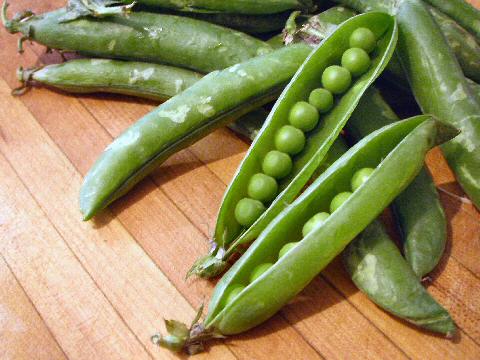
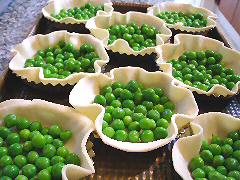 The timing proved fortuitous, as just this last week, fresh peas in the pod started appearing on the local vegetable stands. I grabbed a couple of kilos of them and set to work shelling peas – something I don’t think I’ve done since I was a kid. It was actually kind of fun, and I really liked knowing, and being able to see, just how fresh these were. The usual styrofoam packed shelled peas that I see around here are often a little on the hard side, need a lot of time cooking, and have probably been sitting around for way too long. Aren’t these just, well… mouthwatering looking?
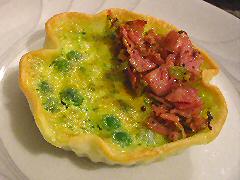 The filling was simple – I blanched and shocked the peas to set their color, which also proved to be enough time to have cooked them ready to eat – and I scooped a few up for myself to nibble on while I worked. The rest of the filling, a mix of cream, eggs, and lots of parsley, pureed together and seasoned with salt and white pepper. The topping on the one half is a lightly crispy mix of sauteed ham and leeks, flavors that go incredibly well with fresh peas. On our second night of the dinners, I made lots of extras… we wanted some for ourselves!
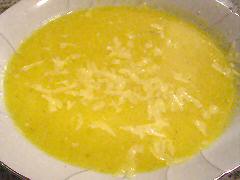 While I have no idea exactly what recipes the chefs on the Lusitania used, it’s not hard to go back and look at classic recipes from the era and use them as inspiration. This soup is a simple one of artichokes – I started off by cooking a coarsely chopped mirepoix – carrots, onions, celery – along with a little garlic, and then added in chopped artichoke hearts (jarred are fine, just soak them in a little fresh water to remove some of the tartness of the liquid they’re packed in, which is usually laced with citric acid). I cooked them until the vegetables were soft, but not browned, then added diced potato, some marjoram, and a good amount of dry vermouth, letting that absorb into the vegetables, then topped it all up with good chicken stock, brought it up to a boil, and let it simmer for awhile. Then I pureed it roughly with a hand blender, seasoned it with salt and white pepper, and served it up with a little grated reggianito cheese over the top.
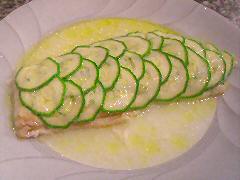 Didn’t this come out pretty? It’s a simple supreme, or fillet of sole, that I placed inside a foil packet with some butter below and above, chopped shallots, and then laid out very thin slices of zucchini in an overlapping scale pattern. A splash of white wine and some salt, sealed the packets, and then baked them in the oven to let the fish steam in its own juices, the wine and butter. It’s a very simple dish, but very elegant to serve, and really tasty – the delicate flavor of the fish is enhanced by the sauce rather than masked, which is what I really wanted to emphasize.
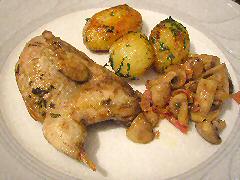 How could I not offer up a roast partridge, especially when it was featured on both menus that I tracked down. I wonder just how many partridges had to be stocked on an ocean liner with nearly 2,000 passengers, with a six-day crossing of the Atlantic in the offing? They’ve gotten pricey here since the last time I cooked up partridges, doubling in cost in less than a year – though perhaps it’s more of a seasonal thing, since being early spring this probably isn’t their main season. This time I halved them, marinated them in juniper and thyme, and then pan roasted them to just a shade past medium – they’d gotten a bit dried out the last time with longer cooking. I served them up with a saute of bacon and button mushrooms, and chateau potatoes, which seemed to be quite popular in that era – I’d actually never made them before, but trust me, I will again – these are delicious! Peel the potatoes and cut them into sections – depending on the size of the potato you’ll get 2-4 pieces probably – and then roughly shape them into “olive shapes” is the classic – mine are a little less formed than the tradition probably calls for, more of a general ovoid… roughly one-inch across and maybe an inch and a half in length. In a big saute pan, put a 50:50 mix of olive oil and butter in – a good amount of each, get it nice and hot, and then add the potatoes. Stir to coat, and regularly keep stirring, while cooking over fairly high heat. I kept the pan covered other than when stirring for about the first 8-9 minutes, just to help cook the potatoes through a little quicker, then removed the cover and kept cooking – the idea being to have them cooked through, and nice and brown and slightly crispy on the outside. At the last moment, toss in lots of chopped parsley (I used the curly type, I like the fresh flavor), and load them up on the plate.
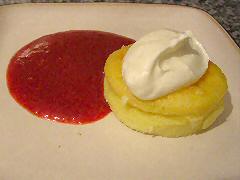 Saxon Pudding anyone? I didn’t even have an idea of what one was, but it sounded intriguing. It’s kind of a heavy souffle of sorts – it doesn’t collapse quite as much as a souffle does when you let it cool, but it’s in the same family – I don’t know, maybe traditionally they’re served right out of the oven still in their ramekins, but I don’t think so – all the recipes I found made a point of removing them, which you could never do with a souffle, and is impossible to do while still hot. For a dozen of these, I creamed together 6 ounces of butter, 6 ounces confectioner’s sugar, 6 ounces of flour (sift the two dry ingredients, please). Then I added in a cup of boiling milk, combined them well, and returned them to the pot over medium heat, stirring continuously, until it forms a sort of loose dough that pulls away from the sides of the pan – it’ll be really obvious, and only takes a few minutes. Remove from the heat, add in 7 egg yolks and combine well. Beat the 7 egg whites until very stiff, and then fold the two mixtures together. Scoop into buttered ramekins – I ended up with about a half cup of mixture for each, and bake in a 350°F oven until puffed and browned. As mentioned, they’ll collapse when they cool. Remove them from the molds, and plate with fresh, sweetened whipped cream, and a roasted strawberry sauce – roast a bunch of strawberries in the oven until all soft and mushy, then puree with a little lemon juice, some maple syrup (or other sweetener or sugar), and a splash of red wine to taste.
Copyright © 2026 SaltShaker. This feed contains copyrighted photos and text from SaltShaker. If you are not reading this material in a feed aggregator or by e-mail subscription, the site you are viewing may be guilty of copyright infringement. Please contact [email protected] so that I can take appropriate action.
Plugin by Taragana
]]>The saying of John Peale Bishop is worth recalling, that the South excelled in two things which the French deem essential to civilization: a code of manners and a native cuisine. Both are apt to suffer when life is regarded as a means to something else. Efficiency and charm are mortal enemies, and Southern charm indubitably derives from a carelessness about the efficient aspects of life.”
– Richard M. Weaver, Jr., Professor and Author
Buenos Aires – You know, given the whole reversal of the magnetic poles and which direction it’s warmer, and all that, one would think that here in Argentina we’d be looking for Northern charm, and the Northern hospitality, and talking about the Deep North… but, it seems there’s just something about going south that brings all that out, even when south is a frozen glacier… Okay, the glacier’s only a small part of Patagonia, which actually encompasses several provinces “down that-a-way”. And it’s home to not only some charming folk whom I’ve met over time – though I have to actually get down there and see some of it for myself – but also some cuisine, and the ingredients for that cuisine, that are unique in regard to the rest of the country – particularly in the world of game animals and seafood. The other night found a trio of us, myself and two friends who’ve just moved here from New York to live (not my influence, if anything, they influenced me, they’ve been planning this for several years), seated in what could only be described as a charming dining room.
[As of the end of 2009, this place has closed both of its branches.]
The owners of the restaurant, Divina Patagonia, Honduras 5710, Palermo, 4771-6864, have infused an old home with warmth and coziness, despite managing to pack in a dozen plus white painted butcher block style tables. They’ve left the feel a bit rustic, with rough wood floors, and some exposed brick here and there, along with nice homey touches in the decor. They also have a second spot, which I haven’t visited, in San Telmo, where I gather the menu is roughly the same, but, we’ll leave that, and it’s ambiance, to be discovered on another visit. I love the underground wine cellar with the thick glass trapdoor over it that sits in the center of the dining room, so you walk over a glass pane, looking down at the wine…
Now, a nice colder night is definitely just right for heartier game, and we had that in mind as we perused the menus. But we started out light, sharing two appetizers for the three of us – a platter of deep fried, smoked trout “meatballs” with a dijon mustard dipping sauce, and a phyllo-wrapped round of a regional Patagonian cheese, all melty on the inside, and surrounded by an unnecessary, but quite tasty cream sauce. We also had a nice bread board toppling over with whole wheat rolls and a sort of cornbread… see, there’s that southern thing creeping in again… with a surpising, zippy horseradish spread on the side. We popped open a bottle of Bodega Fin del Mundo’s Newen Syrah 2005, which was a decent, fruitier sort of Syrah, not quite as hearty or spicy as we might have liked – interestingly, less than half the wine list is devoted to Patagonian wines, and those few that are there are all from, I think, three different producers… there are certainly plenty of other choices available out there, as we’ve seen at places like Mítico Sur, where the whole, and fairly extensive, wine list is devoted to the wines of the region.
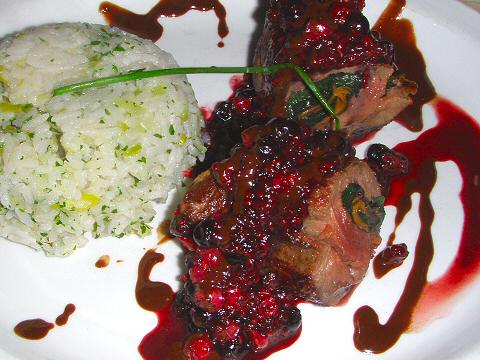
We moved on to our main courses, two of us opting to go all out on the game wagon – a solomillo de jabalí, or loin of wild boar, served up with a raspberry sauce and a thick potato cake, the boar fork tender and a huge portion, and a lomo de ciervo, above, loin of wild venison, cooked medium rare and topped with an interesting bitter chocolate sauce that was studded with frutos del bosque… or forest fruits… what appear to be elderberries and currants. In both cases, the fruit might have been just a touch too present in the sauces… I would have liked for the flavor of the meat to shine through a bit more, but the combinations were really quite good. Our third member of the trio decided on a “lighter” dish, what turned out to be a large bowl filled with herb gnocchi and coated with a creamy wild mushroom sauce. Not so light…
Overall – very good, though very rich… hmm… heavy food (even the seafood dishes on the menu sounded like they’d be pretty rich)… but, of course, we’re in mid-winter here, so that’s not really a bad thing. It’d be interesting to see what they do with their main ingredients during warmer months. Moderately priced, the food running us about 150 pesos for two appetizers and three entrees, and that taking into account that I think the two game dishes were the most expensive items on the menu. Service was warm and friendly, and fairly efficient… although I noted that food came out fairly slowly from the kitchen, especially given that we were the first folk in, and only two other tables were fillled with another one arriving when we left… but it was relaxing enough that it didn’t feel like we really waited.
Copyright © 2026 SaltShaker. This feed contains copyrighted photos and text from SaltShaker. If you are not reading this material in a feed aggregator or by e-mail subscription, the site you are viewing may be guilty of copyright infringement. Please contact [email protected] so that I can take appropriate action.
Plugin by Taragana
]]>