Capt C. killed 2 bucks and 2 buffaloe, I also killed one buffaloe which proved to be the best meat, it was in tolerable order; we saved the best of the meat, and from the cow I killed we saved the necessary materials for making what our wrighthand cook Charbono calls the boudin blanc, and immediately set him about preparing them for supper; this white pudding we all esteem one of the greatest delacies of the forrest, it may not be amiss therefore to give it a place. … it is then baptised in the missouri with two dips and a flirt, and bobbed into the kettle; from whence after it be well boiled it is taken and fryed with bears oil untill it becomes brown, when it is ready to esswage the pangs of a keen appetite or such as travelers in the wilderness are seldom at a loss for.”
– The Journals of Lewis and Clark, 1804-1806
Buenos Aires – For whatever reason, it seems that my boudin blanc from last weekend’s dinner has generated much interest. I’ve received a dozen e-mails asking questions about it, ranging from simple “can you describe how it tasted?” to requests for clarification about the process of making it. There’s even a discussion about it going on amongst several folk on Facebook. Who knew that such a pale sausage could elicit such passion?
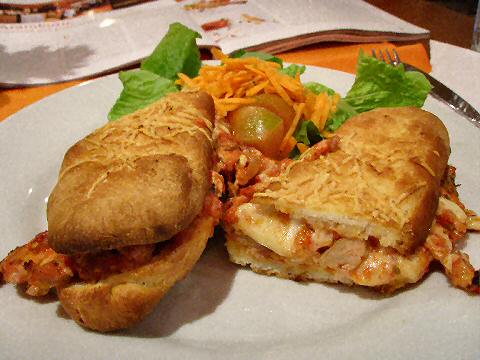
On the other hand, they were really, really good. And I had a small amount of sausage stuffing leftover – or sort of returned, since it was basically a couple of sausages that burst while I was tying them off and I simply put the filling into the refrigerator rather than going to the trouble of stuffing more casings. And next morning that led to one of the best breakfasts I think I’ve ever had. Really.
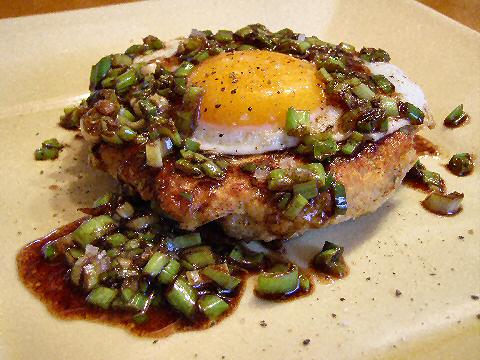
I took the remaining sausage meat and mixed in one extra egg to help it bind together – possibly not necessary but I didn’t want to take a chance that it would fall apart. I patted it into a couple of patties, and simply sauteed one in a mix of butter and neutral oil. When it was cooked, I set it aside on some paper towel to drain, and slipped an egg into the same pan, cooking it until the white had just set and the yolk merely quivered with anticipation. I trimmed the egg, slid it atop the boudin. I drained most of the oil out of the pan, leaving just whatever didn’t easily pour out, and into that I put a handful of chopped green onions, cooking them over very high heat until they’d just started to soften – only about 30-40 seconds. I deglazed the pan with a fruit vinegar, cooked it another 10 seconds or so, and spooned the sauce over the boudin and egg. I added a little fresh cracked black pepper and a sprinkle of coarse sea salt, and sat down to feast. Let’s put it this way, it was so good, that although I’d planned to do something else with the other patty at a later moment in the day, I went ahead and made another one and ate it.
Copyright © 2026 SaltShaker. This feed contains copyrighted photos and text from SaltShaker. If you are not reading this material in a feed aggregator or by e-mail subscription, the site you are viewing may be guilty of copyright infringement. Please contact [email protected] so that I can take appropriate action.
Plugin by Taragana




 ]]>
]]>“The first time you buy a house you think how pretty it is and sign the check. The second time you look to see if the basement has termites. It’s the same with men.”
– Lupe Vélez, actress
Buenos Aires – I like celebrating people’s 100th birthdays or similar events for Casa SaltShaker dinners. They basically give me free rein to do a lot more interesting dishes, you know? Now, we’ve hosted some fairly famous centenaries here over the last many months, and I thought it would be fun to stretch the envelope a bit and celebrate a life that was over far too early. María Guadalupe Vélez de Villalobos was born in 1908 in San Luis Potosi, Mexico, to a colonel in the Mexican army and an opera singer. When old enough for school she was sent to San Antonio, Texas, to be educated in a convent, but she ran away to Mexico City to learn to dance when she was 13. Despite being hauled back to the convent, she continued her “tempestuous ways”, and eventually found her way to Hollywood in 1926, where, over the next 18 years she appeared in nearly four dozen films (save a brief interlude in a Cole Porter musical on Broadway), generally playing the beautiful, volatile girl opposite such comic stars as Jimmy Durante and Leon Errol. Though she never really rose above the “b-movie” level, she was well known for her very public private life as a party girl, and had tabloid covered affairs with a number of actors, including Gary Cooper, eventually married Johnny Weismuller (Tarzan), divorced, and an affair with a young actor named Harald Maresch. She got pregnant during this affair, and rather than have an abortion or bring an out of wedlock child into the world both of which she felt were the ultimate sins against the catholic church, she committed suicide by taking an overdose of sleeping pills at age 36. Adultery, sex outside of marriage, divorce, suicide… aren’t those against the rules too? Methinks there was more to it…
So there I was, with Lupe Vélez’ ghost hovering about and wondering if I was going to do something cool for her birthday or not. I have to admit, San Luis Potosi is not the first region of Mexico I tend to delve into when I cook Mexican food, so this gave me all the excuse I needed to do so. Turns out there are some pretty interesting dishes….
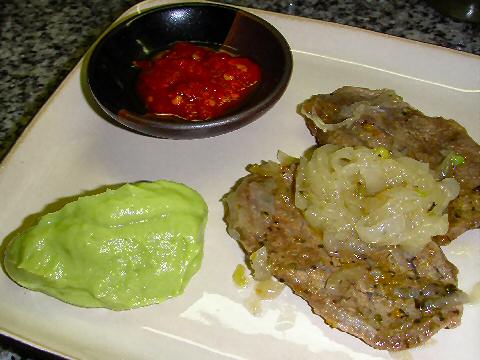
Next up a sopa verde de elote, or green corn soup. The corn isn’t green, it’s simply a pureed soup of corn, peas, fire-roasted poblano peppers, onion, cilantro, a good amount of pre-cooked tomatillos (I finally found a source for fresh tomatillos, yay!), lettuce, and chicken stock, all then cooked together for just a short time – 15-20 minutes or so on simmer – seasoned to taste and served with some freshly chopped cilantro.

The main course was pollo en ajo-comino, or chicken in garlic and cumin. In a big saute pan I sauteed a mixture of cumin, garlic, ancho chili powder, and salt until it was nice and aromatic. Then I added chicken breasts to the mixture and cooked them until lightly browned. Earlier, I’d reconstituted some dried ají panca, the red sort, as dried Mexican peppers aren’t available here (anchos would have been the way to do it right), peeled and seeded them, and then pureed them with their cooking liquid. Once the chicken was browned, I added this puree to the pan (if there’s not enough liquid to cover the chicken, add a little water), covered it and simmered them until cooked through, about 20 minutes. Sliced and served atop freshly made wheat tortillas. Simple, but quite good.
I wonder if I can find any copies of the old Mexican Spitfire films around…
Copyright © 2026 SaltShaker. This feed contains copyrighted photos and text from SaltShaker. If you are not reading this material in a feed aggregator or by e-mail subscription, the site you are viewing may be guilty of copyright infringement. Please contact [email protected] so that I can take appropriate action.
Plugin by Taragana
]]>Sun, sea, wine and red meat every day. Scientists say a village in Sardinia holds the key to long life.”
– Robert Hardman, UK Daily Mail
Buenos Aires – While I’m gathering my thoughts and notes on Supreme Director Posadas, I thought I’d fill in the time with a little diversion….
A “giara” is a plateau, the most famous of which, the “giara manna” is in south central Sardinia famous for its mysterious miniature horses – mysterious as their ancestry is simply not known. Sardinia, if you’re not sure, is a large island in the Mediterranean that officially is part of the Italian republic, though I’d bet not a Sardinian out there would claim to be Italian. If anything, they probably share more in common with the next neighboring large island, Corsica, which has a similar relationship to France. I can’t claim vast knowledge of Sardinian cuisine – I’ve sampled a dish here and there over the years, I’ve probably even tried my hand at one or two in the kitchen, following a recipe from a book. So when my friend Wayne over at Southern Cone Guidebooks mentioned a new spot serving up the stuff, I put it on my list to check out. Sa Giara, Gurruchaga 1806 in Palermo, 4832-5062, was, to put it simply, delightful. [Closed in early 2012]
First, the room – nicely, cleanly laid out, vivid blue and white, nice glassware and flatware, a little gas-fired fireplace off to one side, a charming brick patio in an alcove out front. Our waiter, friendly, effecient, cute… the manager popped by to make some personal recommendations for some of the food. All in all a good beginning.
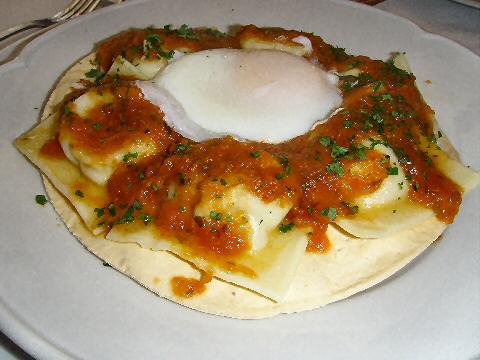
We started off with some delicious flatbread, variously called carta de musica or pane carasau in different parts of the island, along with two different dips, one of beans the other of chickpeas, both delicious. We ate our way through the flatbread much faster than we should have, and our waiter showed up with more when we were both just considering that we really ought to leave room for lunch. The menu is focused on casual food – a range of tablas, plates of cheeses and cured meats are offered, along with various pastries, all to go with tea, which is stated as a specialty of the house, though it didn’t seem as if their selection was particularly large. There is a small menu of meat dishes – beef, lamb, and pork – and a short selection of pastas, which was the direction we both decided to go for lunch.
Prices are not inexpensive, but that’s becoming more and more common these days. The pastas run around 30 pesos apiece, the specialties slightly more. But, with two pastas, one dessert, two bottles of water, a coffee and a tea (and the ubiquitous cubiertos charge here) it ran us roughly 60 pesos apiece. Still, we’ll be back to try the place again. It was well worth it….
Copyright © 2026 SaltShaker. This feed contains copyrighted photos and text from SaltShaker. If you are not reading this material in a feed aggregator or by e-mail subscription, the site you are viewing may be guilty of copyright infringement. Please contact [email protected] so that I can take appropriate action.
Plugin by Taragana
]]>“Amaranthus, collectively known as amaranth or pigweed, is a cosmopolitan genus of herbs. Approximately 60 species are presently recognized, with inflorescences and foliage ranging from purple and red to gold. Members of this genus share many characteristics and uses with members of the closely related genus Celosia. Although several species are often considered weeds, people around the world value amaranths as leaf vegetables, cereals and ornamentals. The word comes from the Greek amarantos, the “one that does not wither,” or the never-fading (flower).”
Buenos Aires – I expect this one will not whither. A restaurant, that is. Relatively new, it’s a mere couple of blocks from home and I’d passed it by numerous times, thinking it was nothing but a simple cafe. Then one Sunday morning I wandered in, figuring on some toast and coffee, perhaps an egg, only to discover that they offer real brunch – eggs benedict (though having difficulty sourcing Canadian bacon), huevos rancheros, bagels with lox and cream cheese – and real bagels too, they make them on-site, muffins, waffles, pancakes… you get the idea, right? Not common here in Buenos Aires. Since then, I’ve been back to Amaranta, Junín 1559, many more times, and it’s become my neighborhood hangout. It’s also seems to be the spot of choice for many a norteamericano expat or visitor, as they seem to be the mainstay of the clientele. [As of December 2009, this place is closed, and the owners have moved back to Bolivia, where the chef is now teaching at a culinary school in Santa Cruz. We stay in touch, on and off.]
As best I can tell, the name is just a name, I have yet to see amaranth or any other Andean grains on the menu, even if Humberto is from Bolivia.
Copyright © 2026 SaltShaker. This feed contains copyrighted photos and text from SaltShaker. If you are not reading this material in a feed aggregator or by e-mail subscription, the site you are viewing may be guilty of copyright infringement. Please contact [email protected] so that I can take appropriate action.
Plugin by Taragana
]]>It’s not quite breakfast, it’s not quite lunch, but it comes with a slice of canteloupe at the end.”
– from The Simpsons
Buenos Aires – I’ve always liked brunch. Except when I worked the brunch shift in a restaurant, which, thankfully, was only at one place, The Sazerac House. The problem with brunch is that it happens way too early for people to be eating anything other than coffee and maybe a Bloody Mary to help them get their day going, and it involves eggs. It’s not that I don’t like eggs, they’re actually a favorite food, but everyone, and I mean everyone, who goes out for brunch has their own idea of how their egg should be cooked… “I’d like mine cooked for 37 seconds on the first side, then flipped and cooked for 26 seconds, salted and peppered, then flipped back for 14 seconds, and then served on a piece of toast that’s been toasted in a vertical toaster only, oh, and please trim the egg so it fits exactly square on the toast, otherwise I’m sending it back.” And then, when you cook it for 38 seconds on the first side, they really do send it back… Brunch is easily the meal at which restaurants end up wasting more food than any other, more dishes come back to the kitchen to be recooked than probably the rest of the week combined. And it’s all because their eggs aren’t the way they wanted them.
Personally, I’m not that picky. As long as the yolk is still runny, I don’t really care if it’s fried, poached, or coddled, and if you’re going to cook the yolk through, scramble it or bake it and tell me that’s just the way it is. Well, almost. I have my favorites, no question, but it’d be rare for me to send an egg dish back (it’s rare for me to send any dish back, unless there’s truly something wrong with it – working on that side of the equation, I think, gives me a lot of empathy for what cooks are going through back in the kitchen – it, of course, depends on the situation). Anyway, back to the topic at hand, brunch. It’s something that I’ve gotten out of the habit of going out for since moving to Buenos Aires – first off, it’s not a big thing here, though becoming more of one, and second off, most of the time on Sunday mornings the effort of going out seems harder than just cooking a couple of eggs and toast here at home. But my friend Jerry is in town for a few weeks, and he likes brunch, so it seemed the perfect opportunity to go out and start sampling a few spots and seeing what they have to offer.
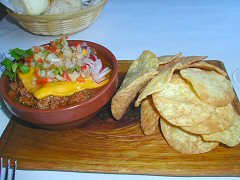 We started off last weekend with Novecento, Báez 199, Las Cañitas, 4778-1900, the international chain started off by an Argentine who wanted to bring Argentine food to New York, and did so successfully. He expanded on to other locales and cities, and then came back to Argentina, where, rather than opening a spot that offered local food to locals, he brings norteamericano food to Argentina. And he does so pretty successfully, if brunch is any indication. It wasn’t perfect, not by any stretch – but it wasn’t bad. An excellent Bloody Mary, and an equally good Mimosa started off the day – hard to screw up the latter, but the former is often, well, crap, and here it’s not – it’s appropriately spicy, balanced, and just what I wanted. The nachos left a bit to be desired – first off, they weren’t really nachos, they were a bowl of chili with some corn chips on the side, and the chips were too fragile to do any scooping of the chili, which meant spooning it onto them. Also, no spice. What’s chili without spice? And that slice of melted “American” cheese… what’s with that? Disappointing, though we did finish both the bowl of chili and the chips.
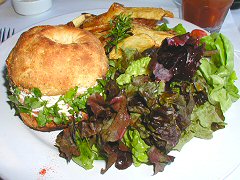 Okay, we had to order a couple of classics. So, the bagel with lox was first off the hit parade. Now, the filling was good – it wasn’t sliced lox – nor was it really lox, it was smoked salmon, but it was tasty – it was chopped up smoked salmon in decent cream cheese. The bagel, however, was nothing more than a whole wheat bread done up round with a depression (not even a hole all the way through) in the middle. Come on, this is a guy who’s spent the last 16 years working in New York, he’s got to know that that’s not a bagel. I’m beginning to wonder if someone has ever tried making real bagels here and found that locals just don’t like them or something. It’s not hard to make a bagel, but so far no one that I’ve tried here seems to understand the concept (a couple of places come close, like Big Mama) – and I can tell you exactly what they’re doing wrong, they’re not boiling the bagels before baking them – bagels are cooked twice, it’s what gives the crust that chewy texture… and, the dough isn’t ordinary bread dough, it’s got different proportions of its ingredients.
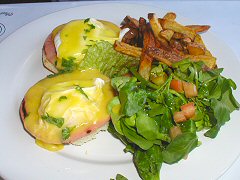 The Eggs Benedict, on the other hand, were dead on. I’m guessing they had to make their own English muffins, since I’ve never seen them here, and where they came up with Canadian bacon, I have no idea – interestingly, they also offer something called a “Perfect Benedict” which is identical except using local fatty bacon – nah, that’s an Imperfect Benedict. The hollandaise sauce was made right, the eggs had nice runny yolks, it was exactly what one could hope for. The fries served with both dishes were quite good too – more of steak fries than French fries, and not as crunchy as I generally like on the outside, but really tasty. Novecento also attracts a nice attractive crowd, so there’s plenty of eye candy during brunch, both at other tables and walking by on the street…
More brunches to come.
Copyright © 2026 SaltShaker. This feed contains copyrighted photos and text from SaltShaker. If you are not reading this material in a feed aggregator or by e-mail subscription, the site you are viewing may be guilty of copyright infringement. Please contact [email protected] so that I can take appropriate action.
Plugin by Taragana
]]>