“The potato takes little care of lung and heart. It reaches the head, but only, as I said, the lower head, not the upper head. It does go into the lower head, where one thinks and exercises critical faculties. Therefore, you can see, in earlier times there were fewer journalists. There was no printing industry yet. Think of the amount of thought expended daily in this world in our time, just to bring the newspapers out! All that thinking, it is much too much, it is not at all necessary — and we have to thank the potato diet for that! Because a person who eats potatoes is constantly stimulated to think. He can’t do anything but think. That’s why his lungs and his heart become weak. Tuberculosis, lung tuberculosis, did not become widespread until the potato diet was introduced. And the weakest human beings are those living in regions where almost nothing else is grown but potatoes, where the people live on potatoes.”
– Rudolf Steiner, philosopher
Buenos Aires – There are those restaurants that everyone knows about, recommends, and no one writes anything new about. These are the sorts of places that show up in every guidebook, piece of hyperinflated promotional fluff, or casual mention – just because… everyone knows about them. Several in town come to mind – and perhaps I’ll eventually get to them all, but I may as well start with La Cabrera Norte, Cabrera 5127 in Palermo, 4832-5754, which is ever so slightly north, though perhaps more west, of La Cabrera sans more than that. And what does everyone talk about when it comes to La Cabrera? The side dishes. Oh, the steaks too, which, in a beef-centric culture like this are quite good as well. In fact, they’re better than quite good – I’d put the steaks at La Cabrera up there among the better ones in the city, and as you can see in the photo below, there was no wanting of forks to dig into them.
I was out last Sunday with a group of master sommeliers who’d flown in for a tour and series of seminars out in the vineyards of Mendoza, but they were spending a couple of days seeing Buenos Aires, dining out, and generally having a good time. Knowing a couple of them, and the person who organized the tour, I got myself attached to the group for the day, which is not only great fun when the people are (and anyone who knows sommeliers that have been around for awhile knows they know how to have a good time), but gets me a chance to pop in on places that I don’t frequent all that often. So here we were, eight MS’s, myself, and the PR person who’d put it altogether, and they shove the menus in my hands and say, “Choose stuff we’ll like.” No pressure, you know?
We had to give them a bit of the usual suspects and a bit of the off the wall stuff – so a round of chorizos, morcillas, chinchulines (the latter two – blood sausage and grilled intestines), and the weirdest looking provoletas I think I’ve ever seen – no, that’s not a sea monster crawling out of the ooze….
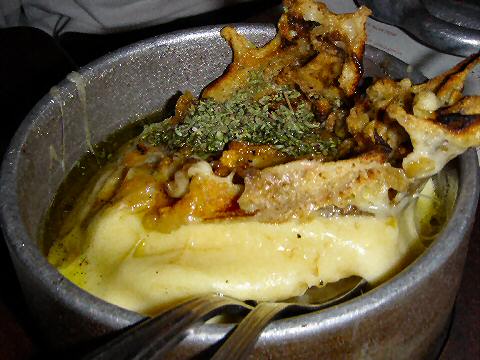
Then on to a couple of mounded salads, followed by a trio of steaks – entraña, bife de chorizo, ojo de bife (respectively, skirt steak, loin steak, rib-eye) – which, at La Cabrera Norte (and the non-norte spot as well), are simply huge – ten of us couldn’t finish the three steaks. So, while the menu can look pricey at first glance, given than each steak can easily feed 2-4 people, depending, you know?, it’s not really.
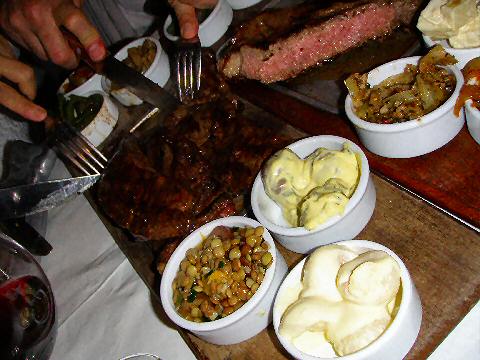
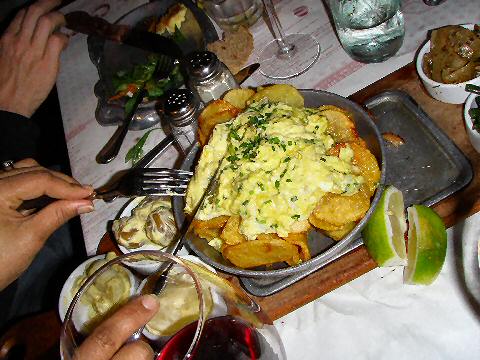
Now, the side dishes are not so much side dishes as little ramekins of stuff – starchy stuff. Each steak comes with a half dozen (not the dozens and dozens that most folk seem to hype) little ramekins – potatoes in mayonnaise, roasted potatoes, potatoes in some sort of eggy dressing, hearts of palm in mayonnaise, chambota (onions and peppers in oil), and lentils, all served room temp – each of which is a few forkfuls – which is not to disparage them, it’s plenty of food – but we’re not exactly talking about some sort of amazing accompaniments to the steaks. They’re good, but that’s about as far as I’d go. There’s also the ubiquitous chimichurri and salsa criolla, though the latter is served pureed, which is flavorful, but not my style. Personally, I’m more for just going for the steaks – the entraña is really excellent – and ordering another provoleta, and cholesterol be damned for one day every now and again. The french fries, which of course we needed to order, are simply okay – nothing special, and perhaps a little overdone and greasy. Plus they have this very strange dish called papas fritas criollas, which are basically french fries topped with a mess of soft scrambled eggs (which, no, don’t come with side dishes, we just set the bowl on the empty platter from one of the steaks). Odd, just odd, but the group wanted to try them – personally I like the provencal, with garlic and parsley, but hey, this was something different….
Overall, La Cabrera Norte gets high marks for food. The ambiance is a bit boisterous, and the place tends to be packed, at a lot of times, with tourists (Sunday afternoon I could hear enough English being spoken around the place to think I was back in Manhattan) – and the waiters all cater to that crowd. It’s not that you won’t find locals there, but more likely early on in the week in the late evenings….
Copyright © 2026 SaltShaker. This feed contains copyrighted photos and text from SaltShaker. If you are not reading this material in a feed aggregator or by e-mail subscription, the site you are viewing may be guilty of copyright infringement. Please contact [email protected] so that I can take appropriate action.
Plugin by Taragana




 ]]>
]]>The 550 farmers who contribute the cow’s milk for Beemster cheese belong to a century-old Dutch cooperative in the province of North Holland. But the land they farm, a 200-square-mile area called the Beemster Polder, has been dairy country for four centuries. Prior to that, the land was underwater.”
– Janet Fletcher, The Cheese Course, SFGate
Buenos Aires – I’ve never been big on “tasting notes” – those pithy (well, truly, more often pedantic) descriptions of, generally, a wine or liquor that purport to tell you what the liquid tastes like. I find too often that the writer is given to bizarre flights of fancy and associations with past memories that as often as not come from unshared experiences. That’s not really the problem – we’re all used to someone desribing a past event and being able to figure out a common reference point from which to appreciate their description. The problem is, that it’s about wine, or something similar, and that scares people. It really does. When it comes to flavors, people simply don’t trust their own palates – and more so when it’s about a luxury item. I’m not saying they don’t have a reaction, a visceral yum or yuck (the yin-yang of the tasting world), but too often, people have a need to “get it right”. And there is no right, despite the claims of one or another expert.
Look, if I tell you that a wine tastes like snizzleberries with hints of three day old mandlebrot and just a touch of well-steamed steffle seeds, you ought to be looking at me like I’m crazy and haven’t the foggiest idea what I’m talking about. The issue is, most people won’t – they’ll start sniffing away at the wine and trying to pick up those lovely fruit, fractal and spice aromas, and some of them will actually declare them into existence. Worse, is the person who simply doesn’t find anything more than “it smells fruity”, who now feels a complete failure, idiot, dolt, incompetent, and lacking in all abilities olfactory and gustatory.
And that’s all a shame, because despite the intent of a tasting note (on the part of most writers, with the exceptions of a few who really do set out to paint themselves as superior beings) is really just to give a frame of reference, a picture if you will, of a flavor. In fact, my favorite technique for teaching people about wine is to have one after another person taste a wine, with eyes closed, and describe not the flavors, but the picture that comes into their mind. I don’t tell them all until afterwards that they’ve all tasted the same wine – and it’s amazing how different the described scenes are, yet how they often have a truly common thread – try it with a group of friends… really.
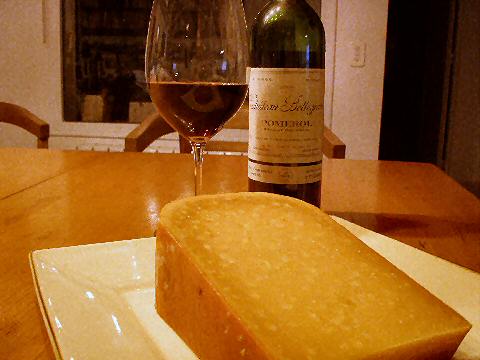
So, all that said, I’m about to give you some tasting notes. Of a cheese and wine. Some guests of Casa SaltShaker recently came in from the Netherlands, and one had asked me if there was anything he could bring me. Without hesitation, I answered, “an aged gouda”. This is not the little wax wrapped gouda cheese of the supermarket that we’re all used to, this is one of the king’s of the aged cheese world, and certainly up there in my top five favorite cheeses on the planet. To date. I’ve had the wedge of cheese here for a week or so, just waiting for an evening when a couple of friends who might appreciate it would join me (and couldn’t get anyone to, more’s the shame), for the wedge and some wine. Not that I finished off either on my own (Henry was off to La Plata for a couple of days and wouldn’t have been interested anyway) – so there’s still some time to come over and try… the cheese.
Our guests brought a four year old aged “gouda-style” cheese called a Beemster, and one in particular from the town of Alkmaar, where they live. A little shy of a kilogram piece, it came in at 74 pesos – or $11 and change a pound.
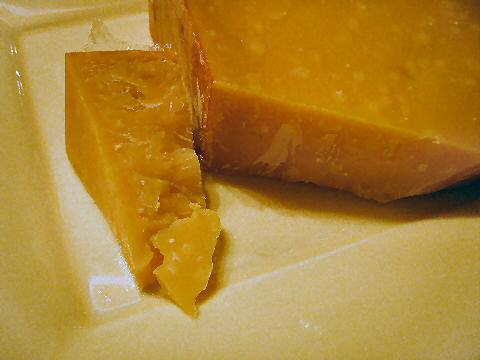
Thoughts on the cheese as I tasted it: fine crunchy crystals, rich, creamy, mouth filling – almost like peanut butter, with a viscous oiliness, flavors of brown butter, roasted almonds, aged rum, salt, incredible length.
I selected a bottle of Château Bellegrave 1996 Pomerol ($33 wholesale ten years ago) to open with it – on opening: beet red, with brick orange rim. Aromas of wild strawberry, leather, fresh mushrooms, on the palate great acidity, mature, soft tannins, roasted wild strawberries, old leather, hints of earth. After one hour – smoother, less acidity, more leather, picks up note of tangerine peel. At two hours – hints of smoke, szechuan peppers creep in.
The combination? Absolute heaven. Those are my tasting notes and I’m sticking to ’em.
Copyright © 2026 SaltShaker. This feed contains copyrighted photos and text from SaltShaker. If you are not reading this material in a feed aggregator or by e-mail subscription, the site you are viewing may be guilty of copyright infringement. Please contact [email protected] so that I can take appropriate action.
Plugin by Taragana
]]>When I am an old woman I shall wear purple
With a red hat which doesn’t go, and doesn’t suit me.
And I shall spend my pension on brandy and summer gloves
And satin sandals, and say we’ve no money for butter.
I shall sit down on the pavement when I’m tired
And gobble up samples in shops and press alarm bells
And run my stick along the public railings
And make up for the sobriety of my youth.
I shall go out in my slippers in the rain
And pick flowers in other people’s gardens
And learn to spit.
You can wear terrible shirts and grow more fat
And eat three pounds of sausages at a go
Or only bread and pickle for a week
And hoard pens and pencils and beermats and things in boxes.
But now we must have clothes that keep us dry
And pay our rent and not swear in the street
And set a good example for the children.
We must have friends to dinner and read the papers.
But maybe I ought to practice a little now?
So people who know me are not too shocked and surprised
When suddenly I am old, and start to wear purple.
– Jenny Joseph, Warning
Buenos Aires – Ten years ago, artist Sue Ellen Cooper gave a friend of hers a red fedora and a copy of this poem for her 55th birthday. Via word of mouth, as she repeated the same gesture for other friends “of a certain age”, her circle quickly became a group, and then an organization, The Red Hat Society, or, as they prefer to refer to themselves, a dis-organization. Basically, it’s a bunch of women, most of whom are over fifty (those under fifty wear pink hats and lavender dresses rather than red and purple), who like to have a good time. Given that I’m approaching that milestone myself this year, I empathize. If you see me on the streets in a red fedora and a purple shirt, just know we’re headed out somewhere for some fun…
Since the tenth anniversary of the founding of this group fell on this weekend, it seemed a fun theme to play with – a little red and purple on the plate, as it were… and I managed a red t-shirt with a purple shirt over it, a few guests went for a purple or red sweater or shirt, and one arrived with a red fedora, which he claimed to have bought just for the occasion…
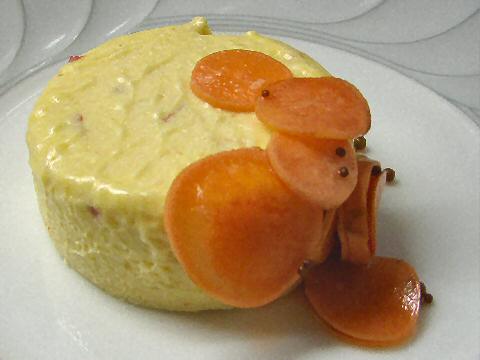
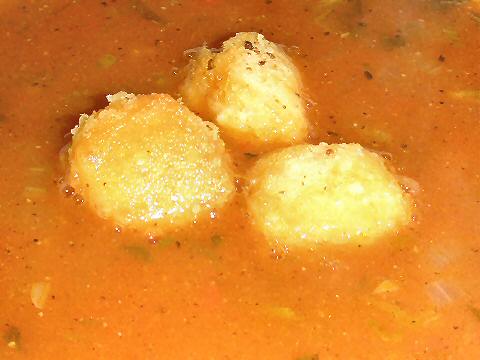
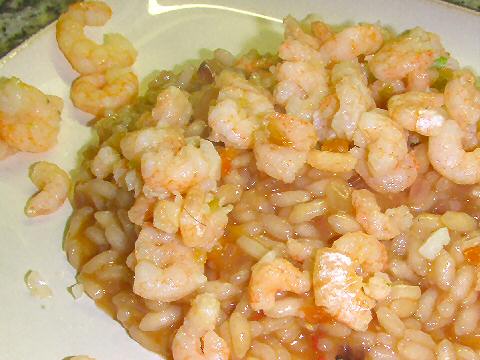
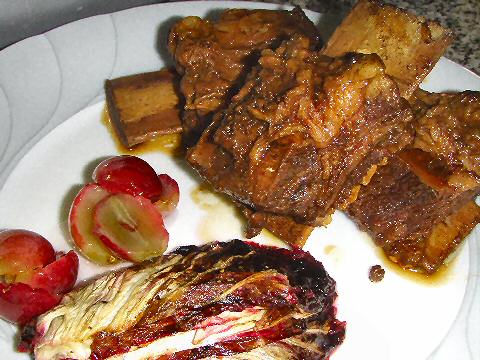
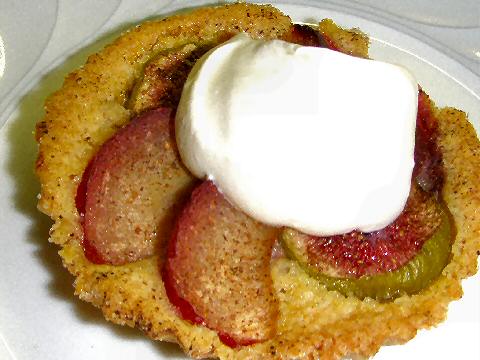
Happy Anniversary Red Hat folk!
Copyright © 2026 SaltShaker. This feed contains copyrighted photos and text from SaltShaker. If you are not reading this material in a feed aggregator or by e-mail subscription, the site you are viewing may be guilty of copyright infringement. Please contact [email protected] so that I can take appropriate action.
Plugin by Taragana
]]>To choose doubt as a philosophy of life is akin to choosing immobility as a means of transportation.”
– from Life of Pi
Buenos Aires – I do seem to be falling behind on the dinner posts… hmm… well, I’ll try to get caught back up. Here we are a week after Pi Day, which, of course, you all celebrated… March 14… 3.14… in reality we celebrated it for two days and miraculously, the numbers work… 3.14 15… The natural thought on the part of some of the guests was that I might be subjecting them to a series of five pies of one sort or another, and I did consider it – there are enough different ways to approach a pie that I could have made it work, but in the end I went a bit further afield…
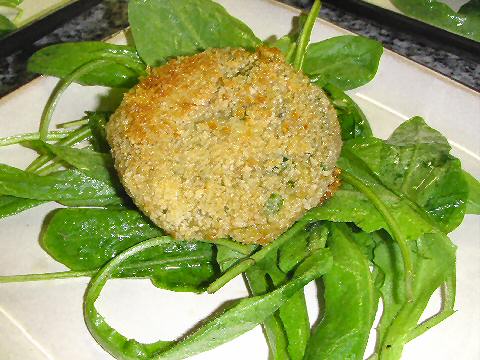
We started off with the “history” of pi… to a certain extent. The number, the ratio, has been around for roughly four millenia – at least as a human concept – likely it was there beforehand, we just hadn’t figured it out. However, I wasn’t about to try preparing some ancient Babylonian recipe, even had I had one to work from. Besides, the number wasn’t called pi then – that didn’t happen until 1706, when Welsh mathematician William Jones named it – and led to our first course, a Welsh treat called Glamorgan Sausages. No meat involved, presumeably from some time period when the stuff was scarce… or perhaps there’s another reason behind it, but these are a mixture of fresh breadcrumbs and grated cheese (I used a mix of cheddar and lincolnshire), green onions, parsley, thyme, sage, hot English mustard, egg, salt and pepper, all packed together to form a nice, firm sausage – I went with patty shaped rather than the more traditional elongated ovoid – have to keep the pi theme going you know – dipped them in more egg and then rolled them in dry breadcrumbs, fried them up in butter and served them atop a radichetta salad with honey mustard dressing. Radichetta is a common local green that we might refer to as “country lettuce”…
From there, we moved on to a barley soup, specifically an Austrian barley soup called Graubünden. And why, you might ask? Because, though William Jones named this irrational constant, well, he was from Wales, and pretty much nobody paid him any mind. However, Leonhard Euler, an Austrian (aha!) took the idea and published it hither, thither, and yon, and generally gets credit for naming it, even though he didn’t. He did, however, steer me in the direction of an Austrian soup, and a simple barley one – packed with celery, carrots, cabbage, leeks, and, of course, barley. Very simple, but very good – and perfectly timed given that the weather decided to turn a bit chillier last weekend.
Next up, you might recall my experimenting with an oyster mushroom coca a few weeks ago – and a nice twist on the idea of a “pizza pie”. The only differences here, I made small individual rounds and I used a mix of oyster and portobello mushrooms. In retrospect, I think I like it better with just the oyster ones… And that lead us on to the main course, and my first thought of some sort of “pot pie” – beef, chicken, lamb… wait, rabbit! And from there, a decision to go with just a more traditional “old English” rabbit pie, and then looking at the menu and realizing that everything had some sort of starchy component, to go with a crustless rabbit pie. For this, I cooked a whole lot of onions – mixed white, yellow, and red, thinly sliced, and a couple of peeled and sliced appels, in a splash of olive oil and a good amount of diced bacon. I added some bay leaf and nutmeg, and when the onions were soft, I added rabbit pieces that I’d previously dredged in flour and sauteed just enough to brown them. Then I added dried prunes, and topped the whole thing up, just enough to come up about midway on the rabbit pieces, with apple juice (cider was called for, but hard to find here – at least the dry kind) and a bit of white wine. Brought it up to a simmer, turned the heat down very low, covered the pot, and let it go for about three hours, until the rabbit was very tender and basically falling off the bone. Ladled that up onto plates and served.
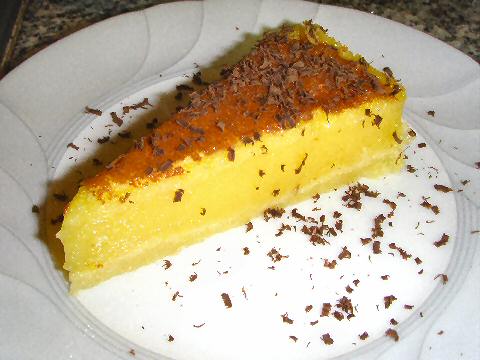
Finally, on to a real pie of sorts – or at least a tart. A couple of years ago I’d contacted the owner of Marion’s Continental restaurant in New York to get their recipe for Lemon Kiss Pie, and Richard was nice enough to send it to me. It’s truly a spectacular lemon pie – really, I used to stop in at the bar there for just a piece of the pie and a cup of coffee. I gather from recent blog reports that Marion’s has just closed and is being replaced by some gentrifying lounge/club that probably has no place on the Bowery, even in 2008, and that’s a shame. But I promise to carry on the tradition of Marion’s Lemon Kiss Pie!
Copyright © 2026 SaltShaker. This feed contains copyrighted photos and text from SaltShaker. If you are not reading this material in a feed aggregator or by e-mail subscription, the site you are viewing may be guilty of copyright infringement. Please contact [email protected] so that I can take appropriate action.
Plugin by Taragana
]]>“The sun of my Cuba
Salutes me good morning
I take breakfast and come out
The whole world is already up
Hey chico turn the volume up
Coz I love this bolero
And this line to buy the bread, goes around the entire world anyway
Now picture La Habana
The old streets with colonel air
Problems can’t be hidden
But you’ll find sweetness at you pass by”
– from Guantanamo, by Outlandish
Buenos Aires – How to sum up the whole Guantanamo Bay Cuban – American relations in a few short sentences…. Spain invades and takes over Cuba from the Taino and Ciboney tribes shortly after Columbus’ discovery – roughly 1511. Nearly 400 years later, in the Spanish – American War, the U.S. helps Cuba (and numerous other Caribbean countires) gain independence from Spain, establishing a naval base in 1898. At the time, it seemed to the Cubans a good thing to keep a U.S. Naval presence, and a 99 year lease on Guantanamo Bay, and an island-wide military access, was granted to the U.S. in 1903 for the price of $2000 in gold coins by Cuba’s first president. Jump ahead to 1934 and in a new treaty, the U.S. agreed to give up the island-wide access and restrict their presence to Guantanamo, however extending the lease to “in perpetuity” unless a new treaty is bilaterally agreed upon, and giving the Cubans access to the bay that they hadn’t had since 1898. The lease amount is changed to just over $4000, but in a treasury check rather than gold coins. The check is cashed, annually, until the Castro revolution in 1959 – Fidel Castro does cash the 1959 check, but since 1960 has supposedly kept the checks stacked up in a desk drawer, claiming that both the 1903 and 1934 treaties were signed by the Cubans “under duress”. The U.S. claims that since he cashed the first check and kept the money in 1959, he acknowledged the validity of the last treaty. Guantanamo has continued as a naval base, and in 2002 a portion was converted to a “terrorist detention facility” – the subject of much news in the last six years. That’s the nutshell version. For our purposes at Casa SaltShaker, all that’s really important is the variety of dishes that make up traditional Cuban cuisine – from the heavily Spanish influenced eastern dishes, to the African influenced (via slaves) western, to the refined plates of Havana, to the “cubans in exile” Cuban-American fare.
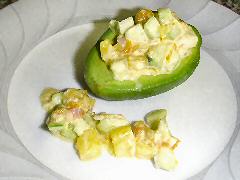 My first plan was to being with an unusual salad based on chayote, a type of squash that looks a bit like a light green pear or avocado. It’s actually a favorite vegetable, but they’re hard to find here, and a couple of weeks searching yielded a “coming soon to a market near you”, which didn’t help a lot for dinner this last weekend. Plan B, and what turned out to be a fun one, was to take some nice, ripe, fresh avocados and fill them with a refreshing salad of pineapple, cucumber, shallots, lime zest, cooked squash (I used a mini-melon baller and scooped out little spheres which I then cooked quickly in boiling salted water, then drained and chilled – I was going to go with little spheres for the pineapple and cucumber, but the former kept falling apart, and so I diced it, and then figured it didn’t make a difference with the cucumber…), and then mixed those together with a mayonnaise made with egg yolk, olive oil, fresh lime juice, mustard, and just a splash of worcestershire sauce. It was a nice way to get the evening rolling, though one problem with stuffed avocados is finding that sometimes, inside, the avocados are just not completely ripe and soft – you end up having to cut open extras just to get enough that are…
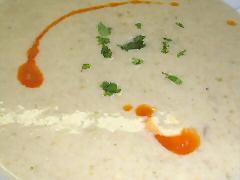 Most of you know that I love bananas… I’ve presented banana guacamole, banana bread and cake, banana springrolls, banana ice cream… and plantains are a close enough cousin that now that they’re in season I figured I’d make the most of them – we had that plantain salad just a couple of weeks ago, and so I was immediately intrigued when I saw some Cuban recipes for a cream of plantain soup. This took a little work – the first night I thought it was too thick and almost… hmmm… gloopy, is that a good word? It probably communicates. The next night I cut back on the amount of plantains in the soup, just by one (I’d use four whole ones the first night, three the second), and got a much creamier consistency, more like a thick soup than a porridge. Since I was making ricotta for our dessert, I had a nice pot of whey to use as a base, into which I put the peeled and broken up plantains, the peel of an orange, some onions and garlic that had been sauteed in butter until soft, and then topped it off with a little chicken stock (vegetable stock would be fine here too – and as a note, the soup needs some acidity, so if you’re not using whey and just using stock, add some fresh lemon juice or a bit of vinegar). When the plantains were softened, I added in about a cup of sweetened condensed milk and two cups of coconut milk. Then I pureed the whole thing with a handful or two of fresh cilantro, and seasoned with salt and white pepper. The soup comes out sort of medium sweet, and definitely needs balance – a drizzle of some kind of hot sauce is perfect for that, and, in fact, while we served it with just a drizzle, I liked it even better with more – the heat and sweet contrast each other perfectly.
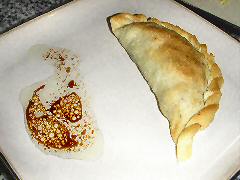 I found numerous recipes for Cuban empanadas, most of which seemed to involve cheese in one form or another. I sort of combined several and came up with one that sounded interesting. The filling is a mix of grated manchego cheese (a somewhat salty, sheep’s milk cheese), black and gold raisins, crushed hazelnuts, and then some finely chopped onions and spinach that have been sauteed and cooled. The dough recipes seemed quite different from Argentine versions, they come out almost cookie-like, with a touch of a zing to them from some vinegar added to the dough – 1 pound of flour, 1 teaspoon salt, ½ pound of cold butter, all mixed together until it forms a coarse crumb texture. Then add in one egg and 2 tablespoons of red wine vinegar and mix thoroughly. Add cold water until it comes together as a nice, smooth, soft dough. Interestingly, the original recipes all called for somewhere between ½-1 cup of water – I don’t know how that would be possible, with the quantity of butter, egg, and vinegar the dough was almost finished without any water – I used about 1-2 tablespoons – if I’d have put in half a cup it would have been paste, and a full cup would have been soup. Chill the dough well until it’s nicely firmed up – 1-2 hours minimum, overnight even better. Roll out, put the filling in, close them up, and bake until nicely golden brown. I thought these needed something to contrast the filling so I put a spoonful of lightly mixed hazelnut oil and tomato vinegar on the side.
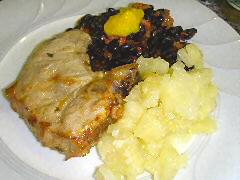 Let me just say upfront, I loved this main course – this is my kind of food – and probably would have been enough for dinner without the three appetizers! I started from a classic masitas de puerco recipe, which is small cubes of pork marinated in a sour orange mixtured for several hours, then either deep fried or cooked in a mix of water and oil until they’re lightly crispy outside, and then served with black beans and rice. I wanted a slightly more elegant preparation, so fresh cut pork loin chops – I marinated them in a mix of equal parts orange and lime juice, grated garlic and red onion, chopped oregano, cumin, and salt – for about 4-5 hours. I then pan roasted them in just a bare splash of olive oil. The two side dishes were based on some recipes that just sounded… yummy. The black beans were cooked until just soft, then drained. In another pot I sauteed together some crumbled fresh chorizo sausage, finely diced red bell pepper, onion, garlic, a couple of finely chopped hot chilies, and some dried oregano. When those were nearly cooked, I added the beans to the pot, a little bit of olive oil, and cooked them together, covered, for about 15-20 minutes, stirring occasionally. A little salt and pepper, topped with a spoonful of freshly mashed ripe mango, and these are some of the best black beans you’ll ever have. The other dish, I peeled and sliced yuca root into discs (a post will be coming up about yuca root and its preparation…), boiled them in salted water until just soft, and then drained. In another pot I sauteed together a large quantity of garlic and onions in olive oil, and then tossed the yuca root with that mixture. A little salt, and voila.
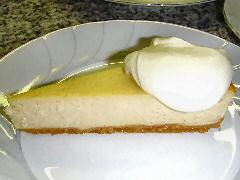 You knew I had to get a Cuba Libre in somehow – especially given the events of this week – when I planned this dinner a month earlier, I had no idea that Fidel would announce his resignation on the day before these meals. So a Free Cuba seems, perhaps, a real possibility… Regardless, back to the drink – we don’t really serve cocktails, though I thought about a sort of mini-shot on the side of some sort of interesting cake, maybe a citrus spice cake, which could be kind of fun, but in the end, well, you know I like cheesecakes, and it seemed like a workable proposition to flavor a cheesecake with the drink – I used aged rum, coca cola, and fresh lime juice to flavor the cake – the filling was a bit more liquid than my usual cheesecake batter so I added an extra egg to help thicken it up, which did the trick. A little lightly sweetened whipped cream, and our celebration of Cuban American relations was complete!
Copyright © 2026 SaltShaker. This feed contains copyrighted photos and text from SaltShaker. If you are not reading this material in a feed aggregator or by e-mail subscription, the site you are viewing may be guilty of copyright infringement. Please contact [email protected] so that I can take appropriate action.
Plugin by Taragana
]]>“God defend me from that Welsh fairy, Lest he transform me to a piece of cheese!”
– Titania, A Midsummer Night’s Dream, by William Shakespeare
Buenos Aires – I promised more cheese, you get more cheese. That’s the long and short of it, the meat of the matter, the curd… The making of a pasta blanda, or soft cheese. This will be more a simple photo presentation with brief explanation, since you’ll get far more useful information out of a good home cheesemaking book than I can give you here, but hopefully I can provide some insight into the visuals of the process, since having now perused through around a dozen such tomes, it seems that photographs are not their strong suit – some of them being completely unillustrated, others with only a picture of the finished cheese, and a couple with stick figure drawings.
Most of these photos, especially of the process, come from the classroom time I spent – I was in a position to take photos while my teacher demonstrated – I found when I was making one at home, that it was too complicated and things needed to be done too quickly for me to get good photos – you need a second person.
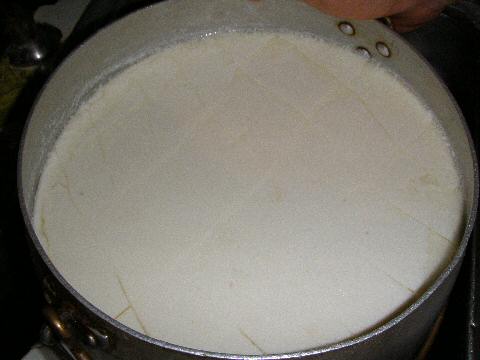
The first step is to heat the milk – we used 10 liters, with the addition of about a cup of heavy cream to add some fat content, a little calcium chloride to make up for the lost calcium in the ultrapasteurization process, and then onto the fire. Temperature and time variables have a big impact on the way a cheese ends up, along with different cultured bacteria, and other processes. For a basic cheese like this, we heated the milk to about 100°F and then added a little homemade yogurt and let it sit for about 20-30 minutes – we wanted a higher acidity, and yogurt is a perfect way to do that. Then we added two cultures to it, that he’d made earlier – both were about a cup and a half of milk with a little milk powder mixed in, and a spoonful of the bacterial culture (you can buy various types from a cheesemaking supply company) – we used a thermophillic and a mesophillic culture, the former is the primary means of culturing a soft cheese, the latter adds specific flavors. We then let it sit a bit longer to start developing the bacterial cultures in the big pot, and then added rennet – which is an enzyme that coagulates milk into cheese. The mixture is quickly stirred well to distribute the enzyme throughout, and then left to sit, untouched for about half an hour in this case (different cheeses, different lengths of time and amounts of rennet). This first photo illustrates the first key process, once the cheese is set and about the texture of soft jello – I don’t quite understand the physics of it all, but using a long knife, you cut the cheese into a checkerboard pattern – and cutting it with different widths creates different final textures. These cuts are about 2cm apart. We then let it sit for another 10 minutes, until the whey seeping out between the cuts when the pot is jiggled comes out clear.
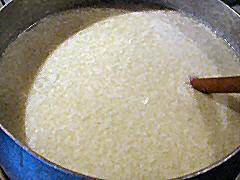
Next up, you agitate the cheese – not with taunts or barbs, but a nice wide spoon or paddle, at first slowly, and then gradually faster – breaking up the cheese into smaller bits – and again, the size of the bits has a dramatic effect on the texture of the cheese – the smaller you break it up, the firmer the cheese will be – because you’re allowing more moisture to be released. Or something like that…
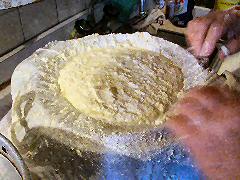
When it’s broken up the way you want it, you pour it through a cheesecloth – a fine to moderate weave cloth – that’s laid out in a colander, to drain out the whey (which can be used for things like making ricotta – the protein that’s coagulated out of milk by rennet is casein, the proteins that are coagulated out by acid are albumen and globulin, so the processes are complementary, and the reason for ricotta’s name – “re-cooked”).
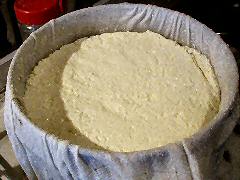
Manually pressing out as much of the liquid whey as you can, you gradually fit the cheese into a mold. At this point, for a soft cheese, you put it through a process called thermoexcitation – if you’re lucky enough to have a way to warm it up to speed up the bacterial growth, you can put it in that warming oven – but otherwise, and what I don’t have a photo of, you put it, in the mold, very near to an open flame, and just turn it every minute or so, so that you keep warming it from all sides – this goes on for about 30-40 minutes, again, depending on the type of cheese you’re trying to make – you spend the time measuring the pH of the whey that’s coming out of the mold, when it reaches a certain point that you’re looking for, you stop.
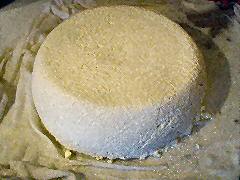
When this process is done, the cheese will be fairly firm. You carefully flip it out of the mold onto another cheesecloth and then fit it back into the mold upside down. You end up doing this a few times, the idea being to make sure it sets evenly. But it’s certainly looking quite cheese-like at this point!
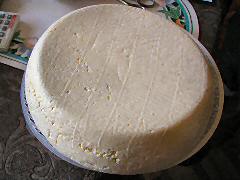
And then, you stick it in the refrigerator, or the colder part of a cheese aging cave (the white wine section of a wine refrigerator is probably perfect) – preferably away from anything smelly, and/or anything that might contaminate it with a mold. The next day, you brine the cheese – literally removing it from the mold and letting it paddle about in a big pot of saltwater that you’ve prepared and cooled. For this cheese it was brined for about an hour (I wasn’t there since it wasn’t a class day, the teacher took care of that, as well as the additional flipping and such). And after that you keep it wrapped in its cheesecloth, which is kept damp with brine, occasionally flipping the cheese over – maybe every 2-3 days. After two weeks, which is the minimum you want to let a cheese like this age, you have something that looks like this.
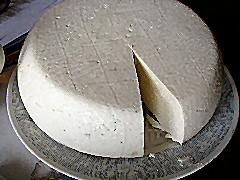
At three weeks, which is more optimal, you take it out, warm it to more or less room temperature, and serve. This came out nice and creamy, very lightly salty. It’s about a 1.4 kilo cheese, or 3 pounds…
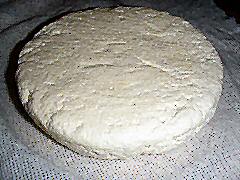
Versus… my first attempt at home, where I somehow or other miscalculated, drastically, the amount of rennet to use, and ended up with this puny little thing of 800 grams, or 1-3/4 pounds. I also clearly need some work at the whole molding process, mine didn’t come out nice and pretty and smooth – but hey, it was a first attempt, with no one watching over my shoulder saying – wait, do this, and this…
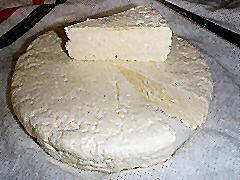
It’s interior structure is a bit coarser than the one we made in class, probably from not being pressed into the mold firmly enough, and, being a smaller size, and having left it in the brine for the same length of time as the bigger cheese, it ended up taking on much more salt. In flavor it came out very much like a feta cheese – salty, soft but not creamy. Still, I was quite pleased by the first time out, and more to come down the line…
Copyright © 2026 SaltShaker. This feed contains copyrighted photos and text from SaltShaker. If you are not reading this material in a feed aggregator or by e-mail subscription, the site you are viewing may be guilty of copyright infringement. Please contact [email protected] so that I can take appropriate action.
Plugin by Taragana
]]>