“I am–fanatically, unapologetically–a placeist. This makes me a virtual thought-criminal in an age of global homogeneity. ‘Placeism’ might be defined in the criminal code as the unreasoned love of a particular place, be it a neighborhood, village, city, or even state. Placeists insist that residents of real places have histories, customs, accents, and concerns that are irreducibly different that those of other places.”
– Bill Kauffman, author, Dispatches From the Muckdog Gazette
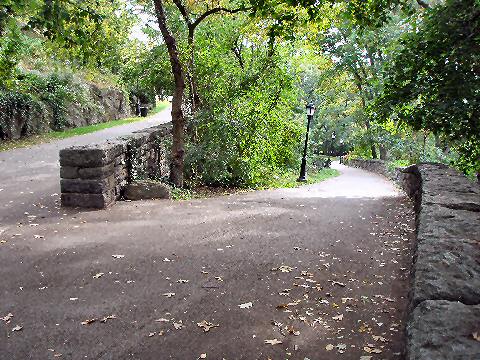
New York City – When you live in the “core” of Manhattan, i.e., roughly somewhere between, say, Houston Street and maybe 84th or 96th Street at the most, it’s easy to forget that New York is not all tall buildings, apartment buildings, concrete, glass, and steel, with the occasional museum piece of a historical building. My first experience of the city was back in early 1982 when I drove in for an interview at Long Island University’s downtown Brooklyn campus – my first stop, however, the apartment of a great-aunt who lived in Washington Heights in a beautiful old apartment building right off of Fort Tryon Park. I stayed there for a couple of days to get a sense of the city (that was the theory, in practice, two days in New York for a small town midwestern boy did nothing but leave a swirl of confusing impressions), and then returned when I came back for graduate school, to stay there for a week or two while looking for my own apartment (ending up, at that time, in Bay Ridge, the far reaches of Brooklyn).
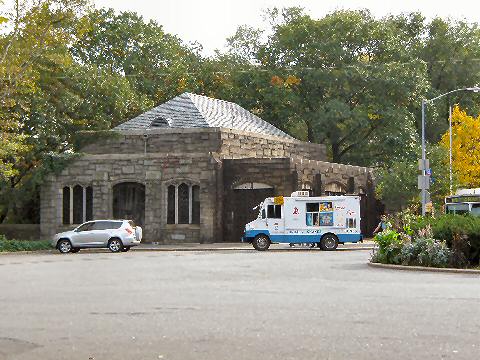
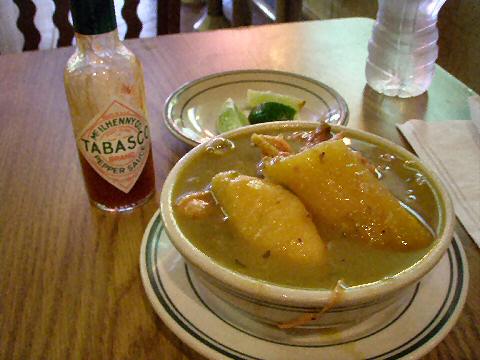
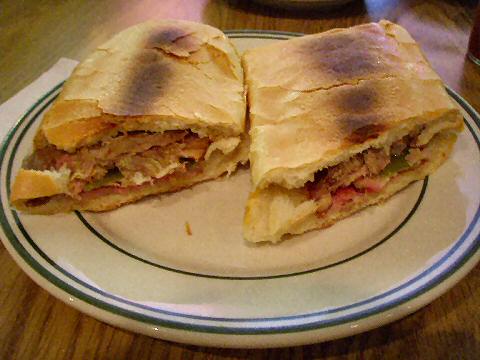
While she was still alive I made it back to the neighborhood reasonably regularly, though, unfortunately, that was not to be for a long period of time, and after she passed on, I think over the course of the next twenty some years the only time I got to the area was in the course of Sunday bike rides with a good friend – we used to circle Manhattan in the afternoon, sometimes stopping in Washington Heights for a cuban sandwich or something similar. I went to the Cloisters Museum in the park once, though, thinking about it, that may have been with my aunt back in that first year. It’s a neighborhood that has two strong identities, split by both the natural feature of a deep valley between two hills, and by the manmade upper end of Broadway, which shoots up the center of that valley – to the west, where she lived, Fort Tryon Park and the old German and Russian Jewish community, since 1928 centered around Yeshiva University and several older synagogues, and to the east, Highbridge Park and a strong Caribbean, primarily Dominican, neighborhood, which at the time I rarely ventured into.

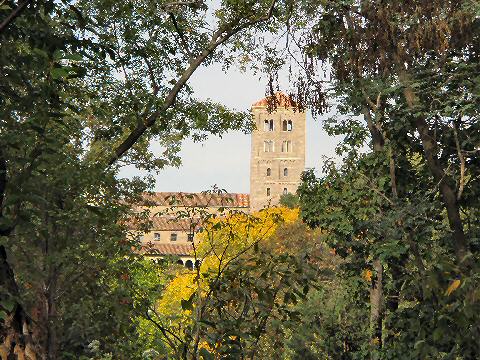
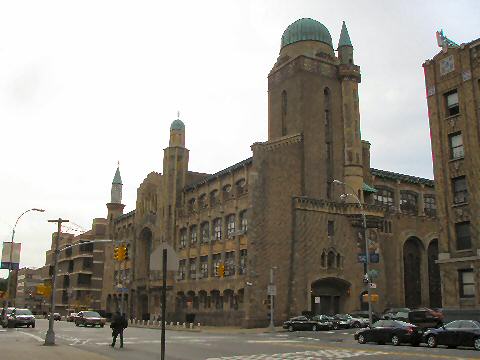
It’s one of those architectural surprises to find in New York – the picture doesn’t do it justice – every time I see it I find myself just stopped in time and place, staring.
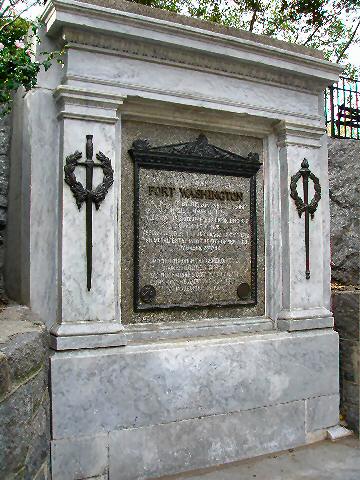
(do those dates somehow not quite jive…?)
“SITE OF FORT WASHINGTON BATTLE TO BE SOLD AT AUCTION NEXT TUESDAY; The Cutting Up of the Bennett Estate Into Building Plots Endangers Memorial Erected to Mark the Scene of the Most Disastrous Battle Fought on Manhattan Island During the Revolution: A larger number of persons representing a greater variety of interests will watch the results of the public sale of the James Gordon Bennett property in the upper Washington Heights section on Tuesday next in the Vesey Street Salesroom by Joseph P. Day than is usual in the offering at auction of any large parcel of real estate.” – New York Times, June 8, 1919
Copyright © 2026 SaltShaker. This feed contains copyrighted photos and text from SaltShaker. If you are not reading this material in a feed aggregator or by e-mail subscription, the site you are viewing may be guilty of copyright infringement. Please contact [email protected] so that I can take appropriate action.
Plugin by Taragana




 ]]>
]]>“The sun of my Cuba
Salutes me good morning
I take breakfast and come out
The whole world is already up
Hey chico turn the volume up
Coz I love this bolero
And this line to buy the bread, goes around the entire world anyway
Now picture La Habana
The old streets with colonel air
Problems can’t be hidden
But you’ll find sweetness at you pass by”
– from Guantanamo, by Outlandish
Buenos Aires – How to sum up the whole Guantanamo Bay Cuban – American relations in a few short sentences…. Spain invades and takes over Cuba from the Taino and Ciboney tribes shortly after Columbus’ discovery – roughly 1511. Nearly 400 years later, in the Spanish – American War, the U.S. helps Cuba (and numerous other Caribbean countires) gain independence from Spain, establishing a naval base in 1898. At the time, it seemed to the Cubans a good thing to keep a U.S. Naval presence, and a 99 year lease on Guantanamo Bay, and an island-wide military access, was granted to the U.S. in 1903 for the price of $2000 in gold coins by Cuba’s first president. Jump ahead to 1934 and in a new treaty, the U.S. agreed to give up the island-wide access and restrict their presence to Guantanamo, however extending the lease to “in perpetuity” unless a new treaty is bilaterally agreed upon, and giving the Cubans access to the bay that they hadn’t had since 1898. The lease amount is changed to just over $4000, but in a treasury check rather than gold coins. The check is cashed, annually, until the Castro revolution in 1959 – Fidel Castro does cash the 1959 check, but since 1960 has supposedly kept the checks stacked up in a desk drawer, claiming that both the 1903 and 1934 treaties were signed by the Cubans “under duress”. The U.S. claims that since he cashed the first check and kept the money in 1959, he acknowledged the validity of the last treaty. Guantanamo has continued as a naval base, and in 2002 a portion was converted to a “terrorist detention facility” – the subject of much news in the last six years. That’s the nutshell version. For our purposes at Casa SaltShaker, all that’s really important is the variety of dishes that make up traditional Cuban cuisine – from the heavily Spanish influenced eastern dishes, to the African influenced (via slaves) western, to the refined plates of Havana, to the “cubans in exile” Cuban-American fare.
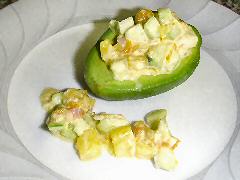 My first plan was to being with an unusual salad based on chayote, a type of squash that looks a bit like a light green pear or avocado. It’s actually a favorite vegetable, but they’re hard to find here, and a couple of weeks searching yielded a “coming soon to a market near you”, which didn’t help a lot for dinner this last weekend. Plan B, and what turned out to be a fun one, was to take some nice, ripe, fresh avocados and fill them with a refreshing salad of pineapple, cucumber, shallots, lime zest, cooked squash (I used a mini-melon baller and scooped out little spheres which I then cooked quickly in boiling salted water, then drained and chilled – I was going to go with little spheres for the pineapple and cucumber, but the former kept falling apart, and so I diced it, and then figured it didn’t make a difference with the cucumber…), and then mixed those together with a mayonnaise made with egg yolk, olive oil, fresh lime juice, mustard, and just a splash of worcestershire sauce. It was a nice way to get the evening rolling, though one problem with stuffed avocados is finding that sometimes, inside, the avocados are just not completely ripe and soft – you end up having to cut open extras just to get enough that are…
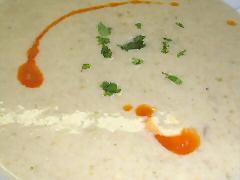 Most of you know that I love bananas… I’ve presented banana guacamole, banana bread and cake, banana springrolls, banana ice cream… and plantains are a close enough cousin that now that they’re in season I figured I’d make the most of them – we had that plantain salad just a couple of weeks ago, and so I was immediately intrigued when I saw some Cuban recipes for a cream of plantain soup. This took a little work – the first night I thought it was too thick and almost… hmmm… gloopy, is that a good word? It probably communicates. The next night I cut back on the amount of plantains in the soup, just by one (I’d use four whole ones the first night, three the second), and got a much creamier consistency, more like a thick soup than a porridge. Since I was making ricotta for our dessert, I had a nice pot of whey to use as a base, into which I put the peeled and broken up plantains, the peel of an orange, some onions and garlic that had been sauteed in butter until soft, and then topped it off with a little chicken stock (vegetable stock would be fine here too – and as a note, the soup needs some acidity, so if you’re not using whey and just using stock, add some fresh lemon juice or a bit of vinegar). When the plantains were softened, I added in about a cup of sweetened condensed milk and two cups of coconut milk. Then I pureed the whole thing with a handful or two of fresh cilantro, and seasoned with salt and white pepper. The soup comes out sort of medium sweet, and definitely needs balance – a drizzle of some kind of hot sauce is perfect for that, and, in fact, while we served it with just a drizzle, I liked it even better with more – the heat and sweet contrast each other perfectly.
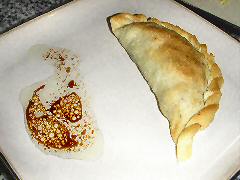 I found numerous recipes for Cuban empanadas, most of which seemed to involve cheese in one form or another. I sort of combined several and came up with one that sounded interesting. The filling is a mix of grated manchego cheese (a somewhat salty, sheep’s milk cheese), black and gold raisins, crushed hazelnuts, and then some finely chopped onions and spinach that have been sauteed and cooled. The dough recipes seemed quite different from Argentine versions, they come out almost cookie-like, with a touch of a zing to them from some vinegar added to the dough – 1 pound of flour, 1 teaspoon salt, ½ pound of cold butter, all mixed together until it forms a coarse crumb texture. Then add in one egg and 2 tablespoons of red wine vinegar and mix thoroughly. Add cold water until it comes together as a nice, smooth, soft dough. Interestingly, the original recipes all called for somewhere between ½-1 cup of water – I don’t know how that would be possible, with the quantity of butter, egg, and vinegar the dough was almost finished without any water – I used about 1-2 tablespoons – if I’d have put in half a cup it would have been paste, and a full cup would have been soup. Chill the dough well until it’s nicely firmed up – 1-2 hours minimum, overnight even better. Roll out, put the filling in, close them up, and bake until nicely golden brown. I thought these needed something to contrast the filling so I put a spoonful of lightly mixed hazelnut oil and tomato vinegar on the side.
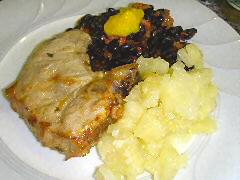 Let me just say upfront, I loved this main course – this is my kind of food – and probably would have been enough for dinner without the three appetizers! I started from a classic masitas de puerco recipe, which is small cubes of pork marinated in a sour orange mixtured for several hours, then either deep fried or cooked in a mix of water and oil until they’re lightly crispy outside, and then served with black beans and rice. I wanted a slightly more elegant preparation, so fresh cut pork loin chops – I marinated them in a mix of equal parts orange and lime juice, grated garlic and red onion, chopped oregano, cumin, and salt – for about 4-5 hours. I then pan roasted them in just a bare splash of olive oil. The two side dishes were based on some recipes that just sounded… yummy. The black beans were cooked until just soft, then drained. In another pot I sauteed together some crumbled fresh chorizo sausage, finely diced red bell pepper, onion, garlic, a couple of finely chopped hot chilies, and some dried oregano. When those were nearly cooked, I added the beans to the pot, a little bit of olive oil, and cooked them together, covered, for about 15-20 minutes, stirring occasionally. A little salt and pepper, topped with a spoonful of freshly mashed ripe mango, and these are some of the best black beans you’ll ever have. The other dish, I peeled and sliced yuca root into discs (a post will be coming up about yuca root and its preparation…), boiled them in salted water until just soft, and then drained. In another pot I sauteed together a large quantity of garlic and onions in olive oil, and then tossed the yuca root with that mixture. A little salt, and voila.
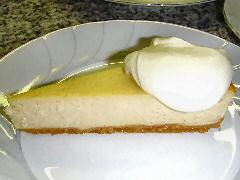 You knew I had to get a Cuba Libre in somehow – especially given the events of this week – when I planned this dinner a month earlier, I had no idea that Fidel would announce his resignation on the day before these meals. So a Free Cuba seems, perhaps, a real possibility… Regardless, back to the drink – we don’t really serve cocktails, though I thought about a sort of mini-shot on the side of some sort of interesting cake, maybe a citrus spice cake, which could be kind of fun, but in the end, well, you know I like cheesecakes, and it seemed like a workable proposition to flavor a cheesecake with the drink – I used aged rum, coca cola, and fresh lime juice to flavor the cake – the filling was a bit more liquid than my usual cheesecake batter so I added an extra egg to help thicken it up, which did the trick. A little lightly sweetened whipped cream, and our celebration of Cuban American relations was complete!
Copyright © 2026 SaltShaker. This feed contains copyrighted photos and text from SaltShaker. If you are not reading this material in a feed aggregator or by e-mail subscription, the site you are viewing may be guilty of copyright infringement. Please contact [email protected] so that I can take appropriate action.
Plugin by Taragana
]]>