The Dutch Empire was broken up mostly during WWII and for a decade or so thereafter, and, these days, the school system in the Netherlands, as I understand it, pretty much pretends that the 300 some year period of colonization never existed. Still, obviously there are influences in various parts of the world – of note, as I mentioned last time, Suriname, which only became independent in 1975, Indonesia finally becoming independent in 1949 after repeated attempts by the Dutch to reestablish control, and probably South Africa, where a lot of back and forth between the Dutch and the British doesn’t diminish the fact that some 13-14% of the population speak the Dutch “daughter language” of Afrikaans.
And that led me to the language world – have you noticed I like that sort of thing? – discovering that there’s an Afrikaans speaking population here in Argentina. Who knew? Between 1903 and 1909, some 800 families of Boers (literally, “farmers”), for a combination of reasons economic and political, left British dominated South Africa after what was known as the Second Boer War and came to Argentina. The country, at the time, was trying to develop the range-lands of Patagonia, and offered settlers who were willing to take on taming the wilds of the region, a free grant of 625 hectares as a homestead, conditional on that over a period of five years following, the settler purchased an additional 1,875 hectares at the price of 1 peso apiece, and show that they were actively developing the area.
At one time the population of Afrikaans speaking settlers grew to several thousand, virtually creating from what had been a very small town of only a couple hundred people, what became the thriving city of Comodoro Rivadavia in the province of Chubut. Originally the city was simply a port for the town of Sarmiento, 140 km inland. But conflicts, understandably, arose. The Boers wanted to maintain their own heritage, as other groups have done in Argentina’s past, while the Argentine government made many attempts at, more or less forced, assimilation – banning the speaking of Afrikaans in public schools being one of the primary methods. Basically that led to the establishment of private schools where Afrikaans was the primary language. And, not surprisingly, the Catholic Church got into the act, trying to dominate the local religious scene, which led to requests from the Boer settlers to the Netherlands’ consulate for assistance, that ended in the consulate arranging for a Dutch Reformed minister to be sent to the area to establish a church.
Over time, however, assimilation and attrition have occurred. Succeeding generations had less and less interest in maintaining ties to a homeland they didn’t know, and, also, a good number of Boer descendants repatriated to South Africa as the twentieth century wore on. These days, as I understand it, the city of Comodoro Rivadavia, with a population of 50,000, hosts only about 200 people who actively claim Boer descent, and only a handful of those still speak Afrikaans, though there is still a Dutch Reformed church with, apparently, a dedicated Afrikaans library, in town. Sarmiento, primarily these days known for the tourist attraction of Argentina’s Petrified Forest, 30 km south, and the paleontology park tours in the Valley of the Giants (dinosaurs), maintained for a much longer period its cultural ties, and as recently as the 1960s Afrikaans was still the primary language spoken. The last two generations, however, have almost totally assimilated, and I understand that these days only about 14 families are still members of the local Dutch Reformed Church, and only a couple of dozen people, mostly of retirement age, still speak Afrikaans regularly and/or fluently.
Some interesting references on the topic: The Last Boers of Patagonia; South Africans in Patagonia; Afrikaners in Argentina
And, for locals, I don’t know if David speaks Afrikaans, but we have a local South African fellow making classic biltong here in BA!
Copyright © 2026 SaltShaker. This feed contains copyrighted photos and text from SaltShaker. If you are not reading this material in a feed aggregator or by e-mail subscription, the site you are viewing may be guilty of copyright infringement. Please contact [email protected] so that I can take appropriate action.
Plugin by Taragana




 ]]>
]]>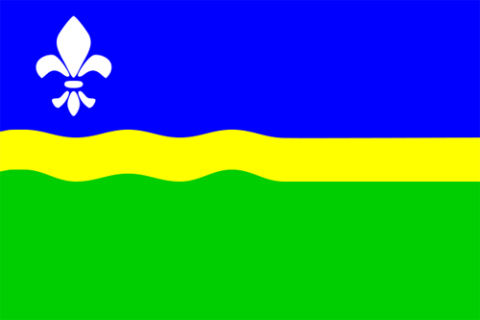
There we were, humming along with Strauss and suddenly we find ourselves proudly flying the banner of Flevoland – which is not, despite your initial reaction, an imaginary country – I feel like I’m in training for a Wiki Race, only I don’t have an end target, and I keep stepping outside of Wikipedia. So, the skips and jumps, the turns and twists, how did we get here from Zarathustra?
Well the obvious reference, particularly for a sci-fi nerd, having started from a post entitled The Big Z, would have been to jump to Zaphod Beeblebrox, whom, as you all know, was the two-headed, three-armed briefly President of the Galaxy, a job which entails being just visible and entertaining enough to the public eye to distract the entire galactic population from wondering just exactly who was really running the show behind the scenes. Sounds like most modern heads of state, no?
But we’re not going to the obvious choice – instead, there were brief explorations into the letter Z itself, a vaguely interesting topic that involved the letter being added and dropped and added into the alphabet as we know it – that whole buzzing sound was given up as a bad idea at one point and then brought back by popular demand. And settling on the letter’s shape, well that’s a whole other kettle of fish.
But, “zee” led to various disambiguations that led to the Dutch word for “sea”, and on to the Zuiderzee, or southern sea, which we’ll come back to in a moment – and that led, you see, to the history of Lake Flevo, or Flevo Lacus (more properly, it appears, referred to as the Flevum Vliestroom) – you don’t want to go there (scholars arguing about Latin declension) – but basically translating as “Lake of Tears”. That led into a ten minute exploration of the “doom metal” genre of music as I listened to the vaguely depressing House of the Setting Sun
and Raven Land
– though I must admit that the latter video is actually kind of interesting to watch. But, I returned to Lake Flevo….
…which at some point in the history of the Netherlands since Roman times became a part of an inland sea called the Zuiderzee – this involves a whole series of things like waterwolf, a process where waters in low lying areas flood surrounding peat-lands and destroy whole communities and generally upset everyone which led to a system of creating polders, essentially reclaimed peat-lands by enclosing those waters with those famous dams of Holland (which almost led to Hans Brinker, silver skates, and Dutch speed skating, but I quickly backed out of that direction). The creation of this sea was overseen by a civil engineer named Cornelis Lely in the late 19th century – and which also reclaimed the surrounding sea bed as dry land, now known as Flevoland (which became an official region just back in 1986 and may disappear shortly, rendering this all moot, with the merger of three regions into a large South Holland, a proposal before the Dutch parliament), which brings us in a moment to the flag above – but first…
…I tried a brief tangent into Campingflight to Lowlands Paradise, the annual music festival held in Flevoland, for which I did not spend much time listening to all the various bands confirmed for next month (August 17-19th if you’ll be in the area), a few seconds attempting to listen to The Whitest Boy Alive and The Eagles of Death Metal – not that I expected anything of interest from them, but at least I’m expanding my music horizons, right? And, back to the region and the flag…
…and there I rested, with three lovely wavy stripes, the blue of the sea, the yellow of, depending on whose interpretation you read, either “transition”, or the color of corn and coleseed – which, at least in the US we know more as rapeseed, the source of canola oil (see, I’m tying in food here), and on to the green of the reclaimed lands for agriculture and living. The little fleur-de-lys in the corner of the flag was from the coat of arms of the above-mentioned Sr. Lely, who was not only a civil engineer, but the Minister of Transport and Water Management three different times in his career, bracketing a period when he gave it all up and headed to the Dutch colony of Surinam to be the Governor-General for a few years (tying in a bit of a South American theme – Suriname (why the “e” was added when it became an independent country, after being called Dutch Guiana (not Dutch Guinea, which was in Africa, nowadays Ghana) by the British for awhile, I’m not clear) and its capital city of Paramaribo are on my list for a short vacation sometime while I’m down here, just to be different.
More than you wanted to know?
Copyright © 2026 SaltShaker. This feed contains copyrighted photos and text from SaltShaker. If you are not reading this material in a feed aggregator or by e-mail subscription, the site you are viewing may be guilty of copyright infringement. Please contact [email protected] so that I can take appropriate action.
Plugin by Taragana
]]>The story led me to Smerdis, a magus and prince of Persia, and son of Cyrus the Great. His life story led me to Darius the Great, Cyrus’ successor, following numerous battles, whose exploits to secure the throne are detailed in the Behistun Inscription, on Mount Behistun and the Persian story of Khosrow and Shirin, but I digress…. Darius credited his victories to Ahura Mazda (Did you know that Mazda means wisdom? Did you know that his name is also the source of the name for the Mazda Motor Corporation – another tangent, because the Japanese name is Matsuda Kabushiki-gaisha – literally “Matsuda Stock-Foreign Capital”, presumably a way of more or less saying “International Corporation”, from founder Jujiro Matsuda’s name, but when they translated it to English, they went for something that sounded similar and had a spiritual meaning) who is the principle diety in Zoroastrianism, the religion founded by the prophet Zoroaster, a.k.a. Zarathustra, which led me to both Freidrich Nietzsche’s Also sprach Zarathustra: Ein Buch für Alle und Keinen and Richard Strauss’ Also sprach Zarathustra, Op. 30, the latter (and tying into the science fiction theme where I started) known by most of us from its opening fanfare, which is used in the opening sequence of Stanley Kubrick’s 2001: A Space Odyssey. And listening to the whole piece (around half an hour, and which I’m pretty sure I’d never done before) made my morning. I didn’t try reading the book at the same time – it would have taken too long, and, I wanted to listen to the music.
Copyright © 2026 SaltShaker. This feed contains copyrighted photos and text from SaltShaker. If you are not reading this material in a feed aggregator or by e-mail subscription, the site you are viewing may be guilty of copyright infringement. Please contact [email protected] so that I can take appropriate action.
Plugin by Taragana
]]>I thought about Cicero, the author of the semi-plagiarized text – I doubt other than those passages I’ve ever read anything by Cicero. But, I’ve probably said about as much as I ever wanted to say about him in a recent BA Herald article:
“You all of course remember Marcus Tullius Cicero, Roman statesman and philosopher from the 1st century B.C.E. – famed orator and enemy of the emperor and empire. What you likely don’t know is that his name, Cicero, was an insult – his family was in the business of growing and selling chickpeas, cicer, in Latin (and still the genus of the plant). When he entered politics numerous advisors pleaded with him to change his name, but he declared that he would make the name Chickpea, umm, Cicero, one of glory.”
But the Wikipedia entry for Lorem led me to a different type of writing, moving on from where this started in the world of Macaronic Latin, to Asemic Writing – a sort of nonsensical form of writing where the author, presumably intentionally, writes in some unrecognizable form, be it random letters and words or a made up language or cipher, or bizarre calligraphy. The height, apparently, of Asemic Writing is when the author him or herself cannot read what they’ve written. Which, to me, sounds like a bunch of hooey.
But, this led me to the world of these sort of books, which actually exist, and actually get published. The two that stood out initially were the Codex Seraphinianus and the Voynich Manuscript. Both of these are single volume “encyclopedias” or natural histories (how convenient for this little game). The former covers everything from plant to animal to sapient being and technology, the latter is focused entirely on plants, an “herbal” if you will. The former is elaborately and lavishly illustrated, the latter is more like a handwritten and drawn journal. Then again, the Codex was written in the late 1970s/early 1980s by Luigi Serafini, an author who is still alive and kicking, but who apparently refuses to discuss the book (which purports to be a reproduction of a natural history from another world), while the latter, based on whatever scientific tests it’s been subjected to, is a 16th century document, theories about which range from having been written by Roger Bacon to some random friar of the era, to being a complete hoax by the bookseller who supposedly discovered it and sold it for what amounted to a fortune at the time, Wilfrid Voynich. Some interesting and speculative details in this article which also brings in the writings of Jorge Borges and Italo Calvino. Both have also sparked novels of the ancient manuscript cult sort like the writings of Dan Brown or Umberto Eco.
The text of both books is in unrecognized glyphs, alphabets or ciphers that while resembling bits and pieces of various existing languages, have yet to be decoded. Speculation has run from actual codes which simply haven’t been broken to made up languages to random writing such as glossolalia, to many other possibilities. It’s possible that one day Serafini will reveal the details of what he wrote – who knows? I leave you with a page from each – both are, by the way, available for Kindle, fairly inexpensively, if you feel like exploring further.
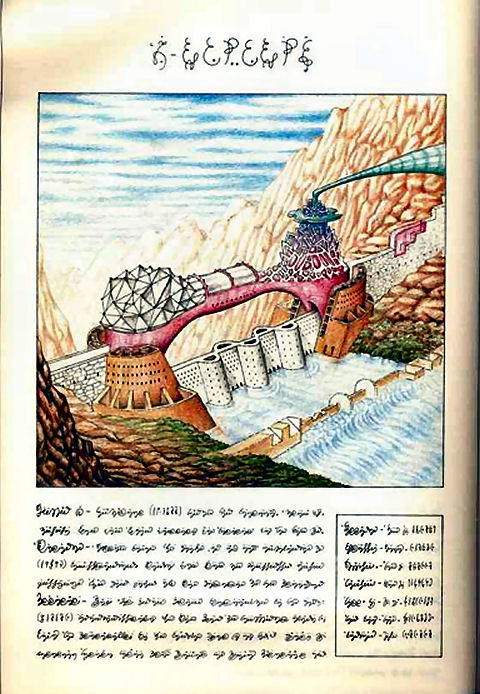
Page from the Codex Seraphinianus
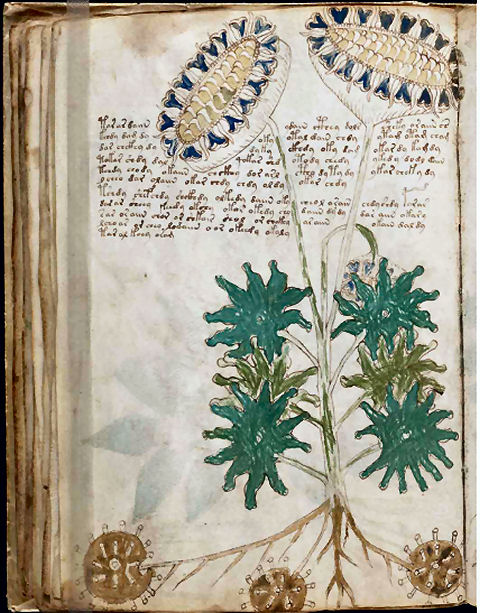
Page from the Voynich Manuscript
Copyright © 2026 SaltShaker. This feed contains copyrighted photos and text from SaltShaker. If you are not reading this material in a feed aggregator or by e-mail subscription, the site you are viewing may be guilty of copyright infringement. Please contact [email protected] so that I can take appropriate action.
Plugin by Taragana
]]>“Lorem ipsum dolor sit amet, consectetur adipisicing elit, sed do eiusmod tempor incididunt ut labore et dolore magna aliqua. Ut enim ad minim veniam, quis nostrud exercitation ullamco laboris nisi ut aliquip ex ea commodo consequat. Duis aute irure dolor in reprehenderit in voluptate velit esse cillum dolore eu fugiat nulla pariatur. Excepteur sint occaecat cupidatat non proident, sunt in culpa qui officia deserunt mollit anim id est laborum.”
Now a quick and superficial search says it’s all nonsense, meant to look like Latin, but isn’t really. Some folk even refer to it as “greeking”, from the old “It’s all Greek to me” phrase meaning it’s all nonsense. But here’s the thing. It’s not. Not really. While it’s true that there are some problems with the grammar, and a few of the words are either misspelled or perhaps even made up, it’s actually selected lines, paraphrased, out of a two millenia old text roughly entitled The Extremes of Good and Evil written by Cicero in 45 B.C.E. So while not proper Latin, it’s also not completely random, nor completely nonsense.
The original text takes up a couple of paragraphs, which I won’t bother to reproduce, but they basically translate (according to H. Rackham’s translation of 1914) as:
“But I must explain to you how all this mistaken idea of denouncing pleasure and praising pain was born and I will give you a complete account of the system, and expound the actual teachings of the great explorer of the truth, the master-builder of human happiness. No one rejects, dislikes, or avoids pleasure itself, because it is pleasure, but because those who do not know how to pursue pleasure rationally encounter consequences that are extremely painful. Nor again is there anyone who loves or pursues or desires to obtain pain of itself, because it is pain, but because occasionally circumstances occur in which toil and pain can procure him some great pleasure. To take a trivial example, which of us ever undertakes laborious physical exercise, except to obtain some advantage from it? But who has any right to find fault with a man who chooses to enjoy a pleasure that has no annoying consequences, or one who avoids a pain that produces no resultant pleasure?
On the other hand, we denounce with righteous indignation and dislike men who are so beguiled and demoralized by the charms of pleasure of the moment, so blinded by desire, that they cannot foresee the pain and trouble that are bound to ensue; and equal blame belongs to those who fail in their duty through weakness of will, which is the same as saying through shrinking from toil and pain. These cases are perfectly simple and easy to distinguish. In a free hour, when our power of choice is untrammelled and when nothing prevents our being able to do what we like best, every pleasure is to be welcomed and every pain avoided. But in certain circumstances and owing to the claims of duty or the obligations of business it will frequently occur that pleasures have to be repudiated and annoyances accepted. The wise man therefore always holds in these matters to this principle of selection: he rejects pleasures to secure other greater pleasures, or else he endures pains to avoid worse pains.”
Copyright © 2026 SaltShaker. This feed contains copyrighted photos and text from SaltShaker. If you are not reading this material in a feed aggregator or by e-mail subscription, the site you are viewing may be guilty of copyright infringement. Please contact [email protected] so that I can take appropriate action.
Plugin by Taragana
]]>Dog Latin (Canis latinicus?), a.k.a. cod Latin, macaronic Latin, or mock Latin is not the same thing as “pig latin” that we used to use as kids or that our parents used to use hoping that we kids didn’t understand it. Nor should it be confused with “dogg latin” or “nig latin” (hey, I didn’t make it up), which the Urban Dictionary defines as pig latin using the ebonics “izzle” instead of “ay”. There are basically two definitions – one is when someone generally tries to write in Latin but simply does a poor job of it, the other, and more common, is when pseudo-Latin phrases or words, or actual Latin words are mixed with English, either way, in order to come across sounding scholarly. Most often, it’s done with a humorous intent. Allowing me to tie this to my general themes on this blog, a perfect example would be from Sam Weller’s Budget of Recitations published by J. Clement (1838) (which, apparently there’s some debate on whether it was written by Charles Dickens because the fictional character Sam Weller appears in The Pickwick Papers, or by another author as a parody of that character) – the definition of a “kitchen”:
“Now, in the first place, they have called a kitchen my client’s premises. Now a kitchen is nobody’s premises. a kitchen is not a warehouse nor a washhouse, a brewhouse nor a bakehouse; an outhouse nor an innhouse, nor a dwelling house, nor any house; no, my lud, ’tis absolutely and bona fide, neither more nor less than a kitchen; or as the law more classically expresses, a kitchen is, camera necescuria pro usus cookare; cum sauce pannis, stewpannis, scullero, dressero, coalholo, stovis, smoakjacko; pro rostandum, boilandum, fryandum, et plum puddings mixandum, pro turtle soupes, calves head hashibus, cum calipee et calipashibus.”
People have written entire books in this “language”.
Back tomorrow with next entry – in the meantime, the next post will be the weekend’s dinners.
Copyright © 2026 SaltShaker. This feed contains copyrighted photos and text from SaltShaker. If you are not reading this material in a feed aggregator or by e-mail subscription, the site you are viewing may be guilty of copyright infringement. Please contact [email protected] so that I can take appropriate action.
Plugin by Taragana
]]>