This is one I’ve been playing around with the idea for quite some time. There’s a classic dish from Ayacucho, Perú, called rocotos rellenos – it’s a hollowed out, stuffed rocoto chili, kind of like stuffing a bell pepper, but smaller. It’s usually stuffed with a mix of ground beef, some veggies, potato, herbs, and a lot of cheese. Then it’s topped and surrounded by even more cheese.
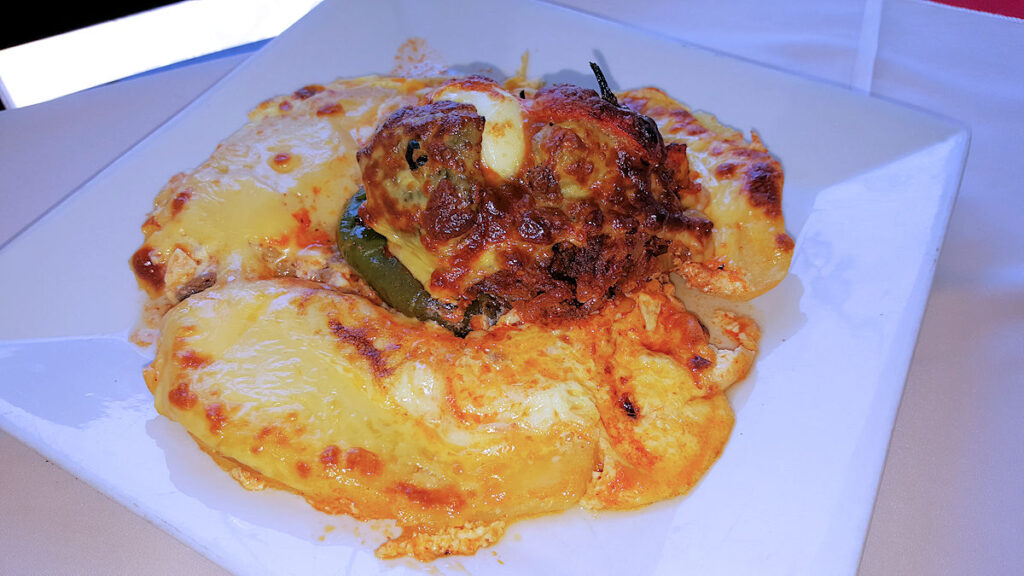
It’s kind of a mess. And it’s… a lot of cheese.
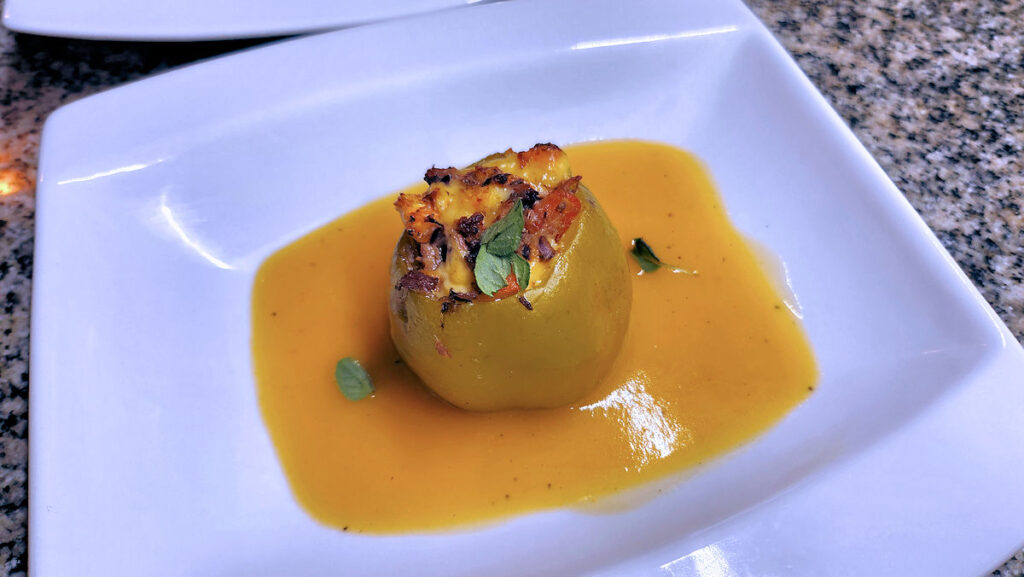
Here’s our refined version, after several iterations. I core and then blanch and shock the rocotos twice. It removes some bitterness and tones down a little of the fiery heat – you want that as an accent to the filling, not overwhelming it. The filling is a mix of duck leg confit, chopped up, garlic, red onion, tomato, black olive, and pategras cheese – an Argentine cheese fairly similar in flavor to Swiss cheese. The whole thing is seasoned with salt, pepper, cumin, oregano, sugar, rice vinegar, and just a couple of spoonfuls of ají amarillo, yellow chili, puree. It’s then baked in the oven for 20 minutes just before serving. The sauce is a reduced duck stock from the bones of the confit, plus leeks, oregano, salt and pepper, which is then pureed with papaya and papaya seeds, and then strained and emulsified with just a touch of xanthan gum.
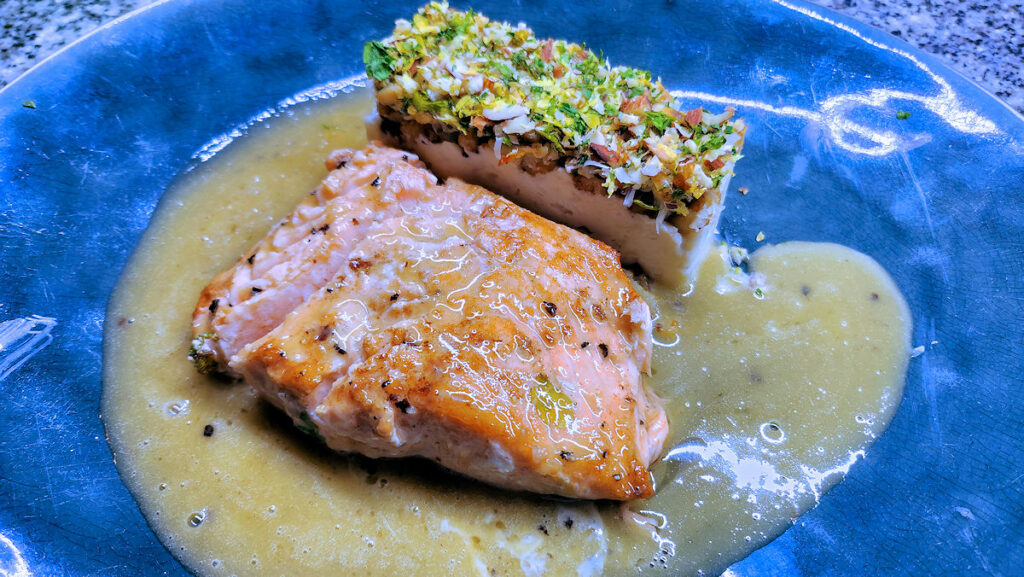
This was a first stab at a new dish. A fillet of salmon, cooked sous vide and then seared, served over a beurre blanc, and accompanied by a little tian of cauliflower. The base is cauliflower stems cooked down in milk with garlic, and then pureed with a little cream cheese, smoked salt, and white pepper; then a layer of fried cauliflower florets (cut small); then grated pecorino sardo; and finally a gremolata of chopped parsley, lemon zest, toasted almonds, and chilies.
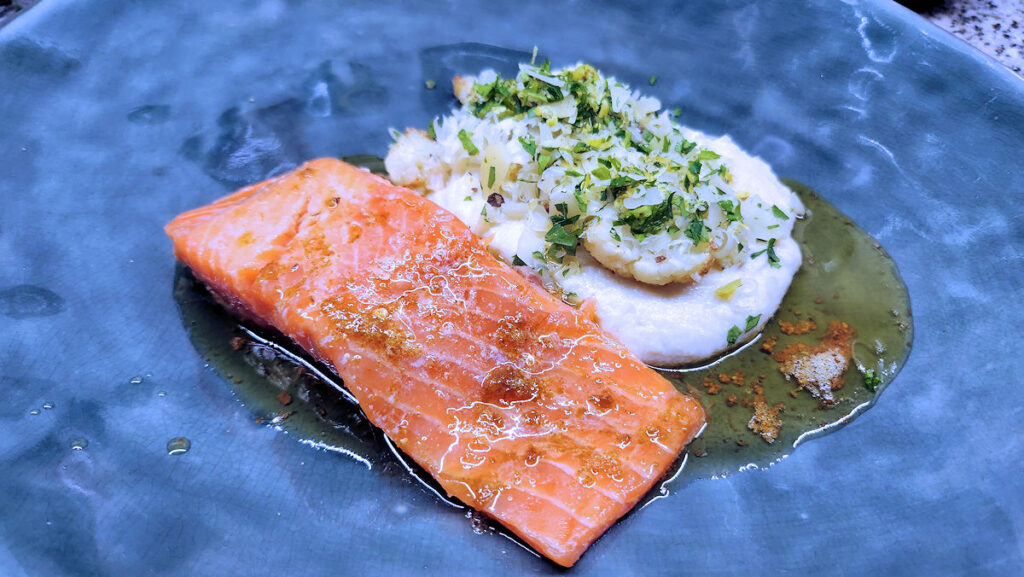
Some changes to it – I would have liked to stick with the tian presentation, but when you don’t have kitchen staff, constructing something like that solo for multiple diners ends up with everything being cold – so it’s the same cauliflower (slight variation, in the puree I used black garlic instead of fresh garlic), just done as a scoop on the plate. And, I decided to switch up the salmon for sea trout, a little firmer and more flavorful, and not sear it after sous vide-ing it. Finally, I’d found the beurre blanc to be just a little too intense and lemony for the dish, so I went with browned butter seasoned with a little chopped garlic, dried apple, and a hint of paprika, chili powder, and thyme, and all finished with just a squeeze of lemon juice. There’s nothing quite like a good brown butter…. I’m going to have to figure out how to do those tians quickly, because it is a far prettier presentation.
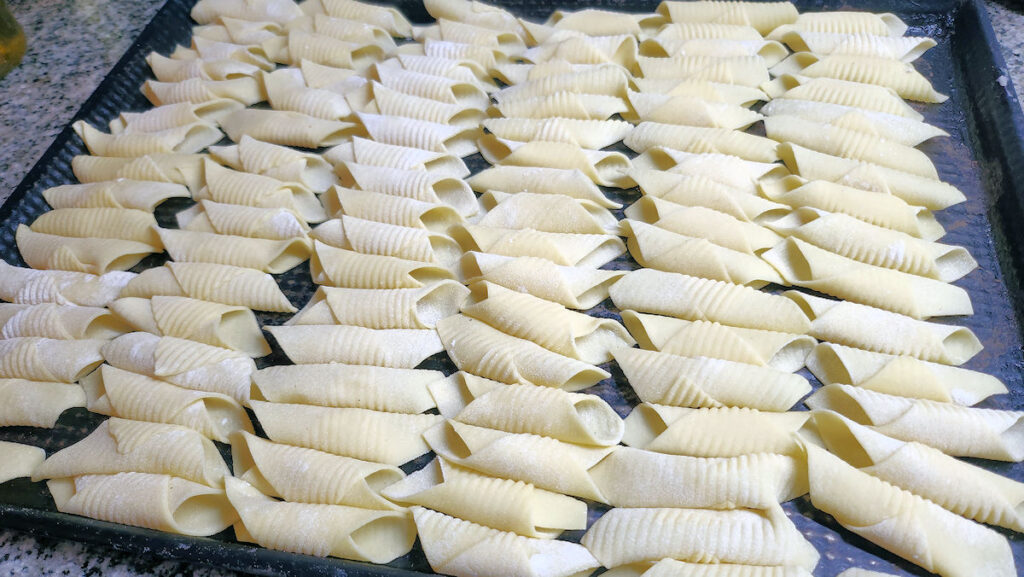
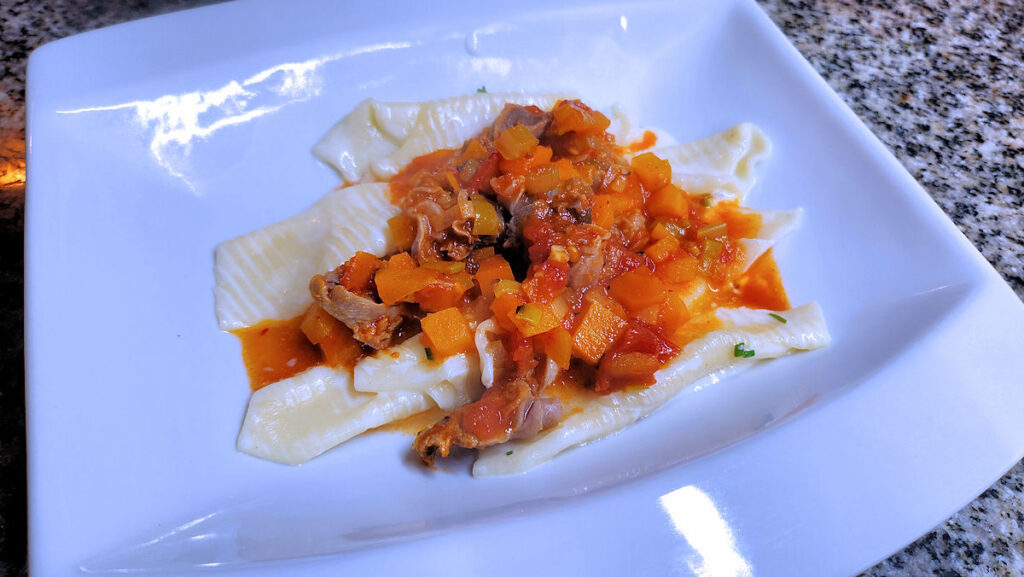
Hand-rolled garganelli pasta. The pasta are tossed with a pecorino sardo cream sauce, and then topped with a ragú of chicken giblets.
Okay, now, on to the star of the post. We start with a mention, somewhere on a social media site, somewhere back a year or so ago, mentioning a chicken fritter, coated in quinua, and served with a passionfruit dipping sauce.

Musing on this, I started thinking about Koli milagu masala, a south Indian dish known in English as Chettinad Pepper Chicken. I first played around with it for a Tamil Nadu festival dinner some thirteen years ago. There, I’d turned the braised chicken dish into a mousse, of chicken breast meat pureed with onion, tomato, ginger, garlic, chili, cinnamon, turmeric, fennel seed, clove, lots of black pepper, and salt, all bound together with egg and cream. I’d wrapped it in crepes and then baked them until golden brown and served them up with a coconut and yogurt raita.
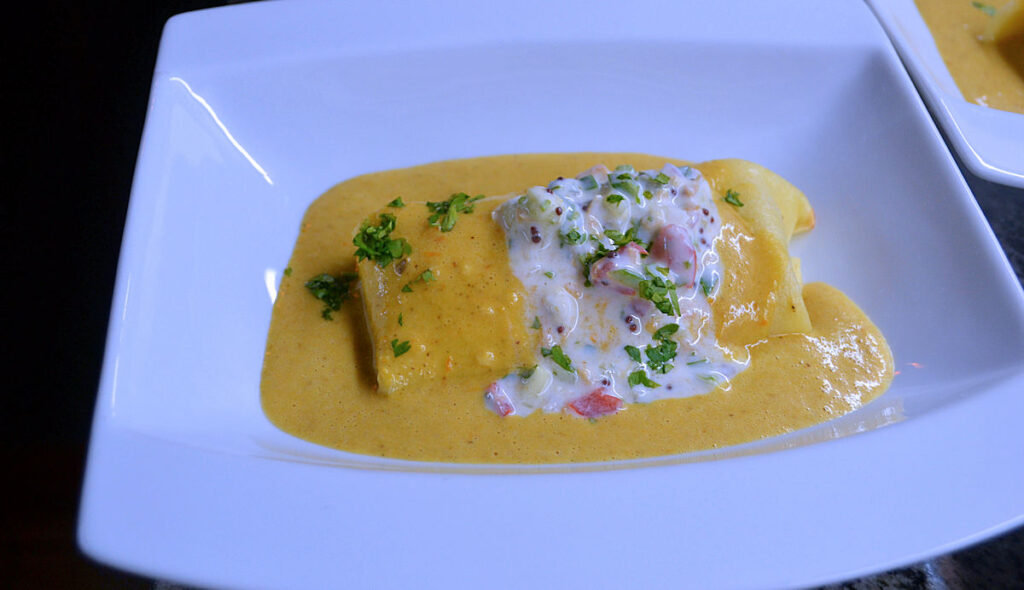
I made a few different versions of that dish, now and again, and at some point reinterpreted it more as a blintz, served with huancaina sauce – a Peruvian puree of yellow chili, walnuts, fresh cheese, milk, and bread (which, I’ve done a few oddball things with over time). The combination of all that worked beautifully, and we brought it back a few times on different menus.
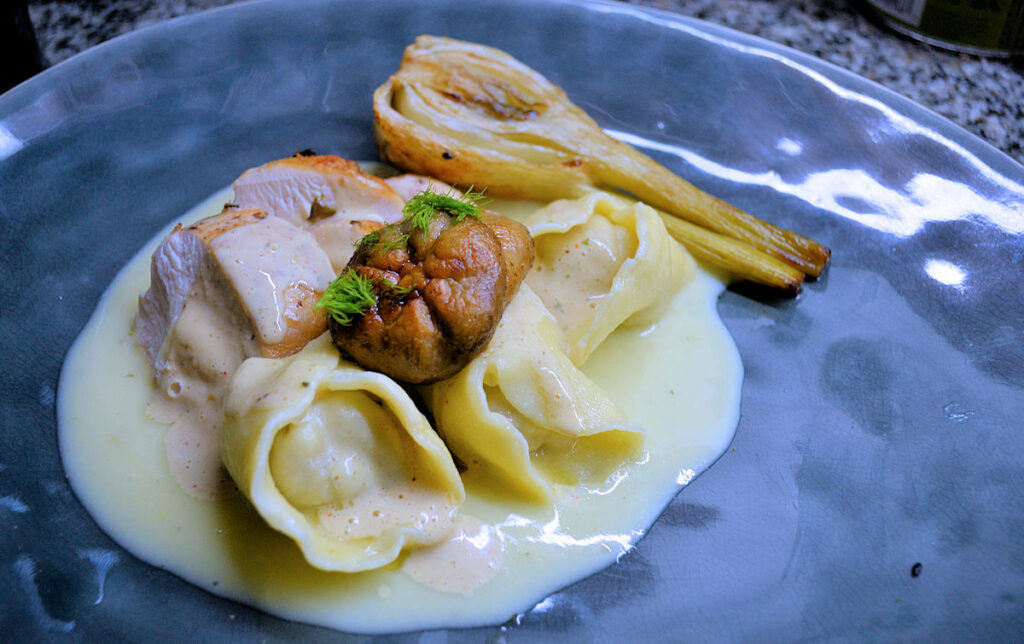
Then came a pasta version. Served up the mousse inside tortellini alongside roasted chicken, fennel, and mushrooms, with a lemon-egg and taratur sauces.
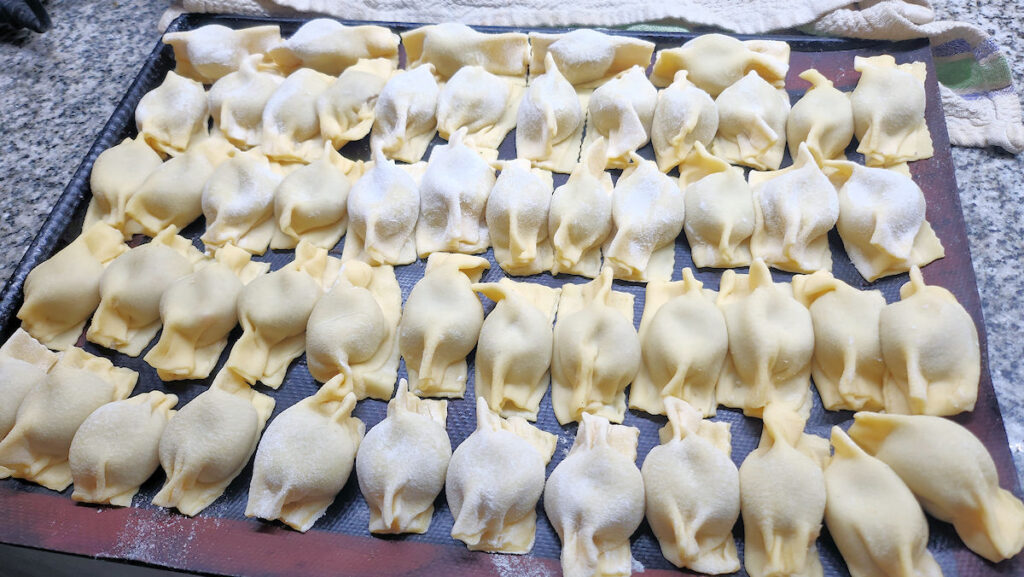
Which, brings us to the latest evolution of this. I’m never 100% sure what to call this shape. It’s sort of a scarpinocc, but not quite, and also not quite agnolotti del plin. I went with the former on the menu. They’re filled with that same pepper chicken mixture.
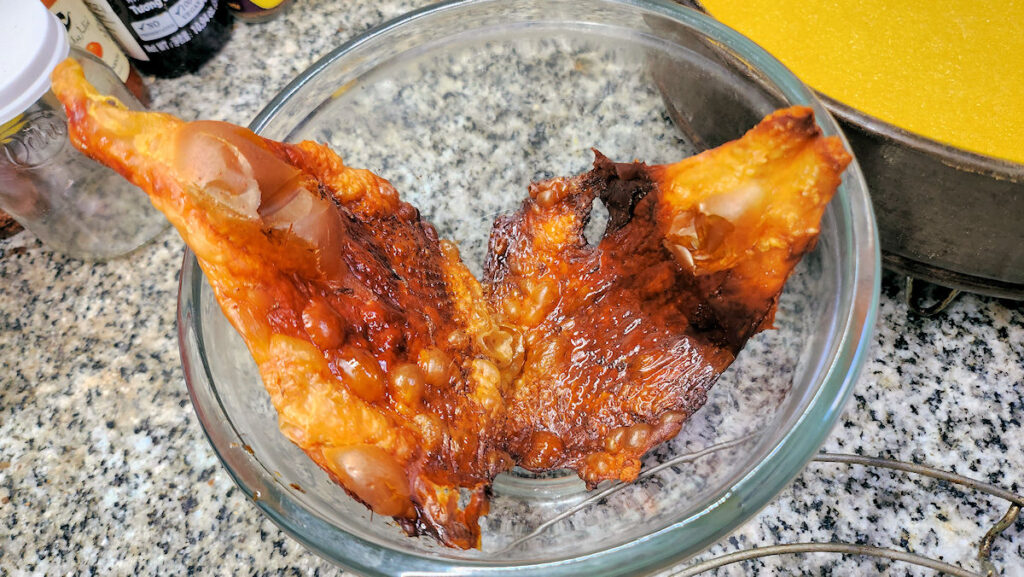
And we couldn’t waste the chicken skin, so I crisped that up in the oven, and then crushed it.
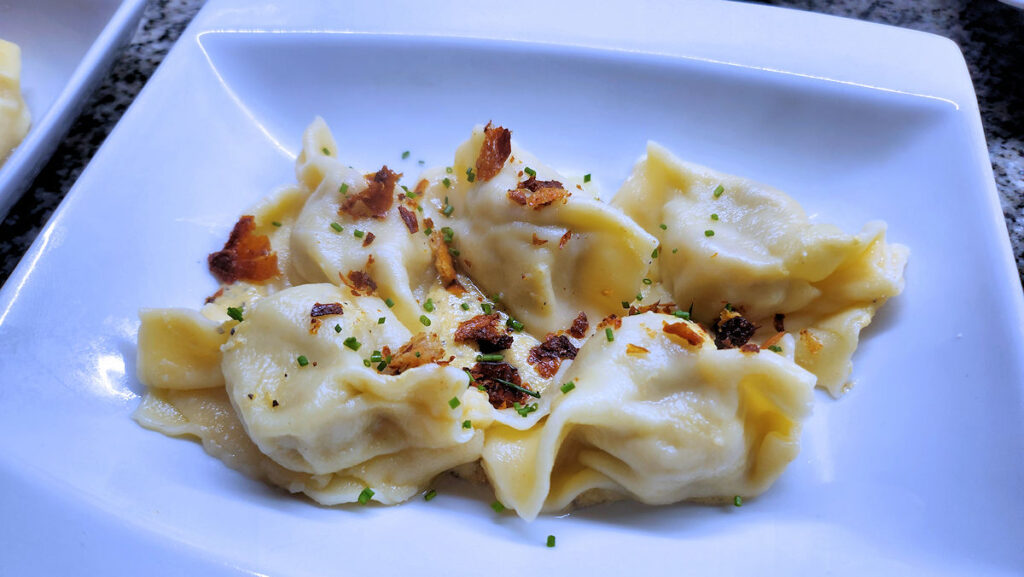
And, arrived at our dish with all of these elements coming together. We have the pasta filled with the black pepper chicken, served over a huancaina sauce that has some passionfruit pureed into it (the influence of that original post). I was going to go with some crispy fried quinua, or quinua puffs, but again… crispy chicken skin. So the quinua went out the window, so to speak, and the pasta is garnished with crushed chicken skin and finely chopped chives. One of the best pastas I think I’ve come up with in the last year or so. I think if we had a “regular” restaurant, this would have a signature spot on the menu.
Copyright © 2026 SaltShaker. This feed contains copyrighted photos and text from SaltShaker. If you are not reading this material in a feed aggregator or by e-mail subscription, the site you are viewing may be guilty of copyright infringement. Please contact [email protected] so that I can take appropriate action.
Plugin by Taragana




 ]]>
]]>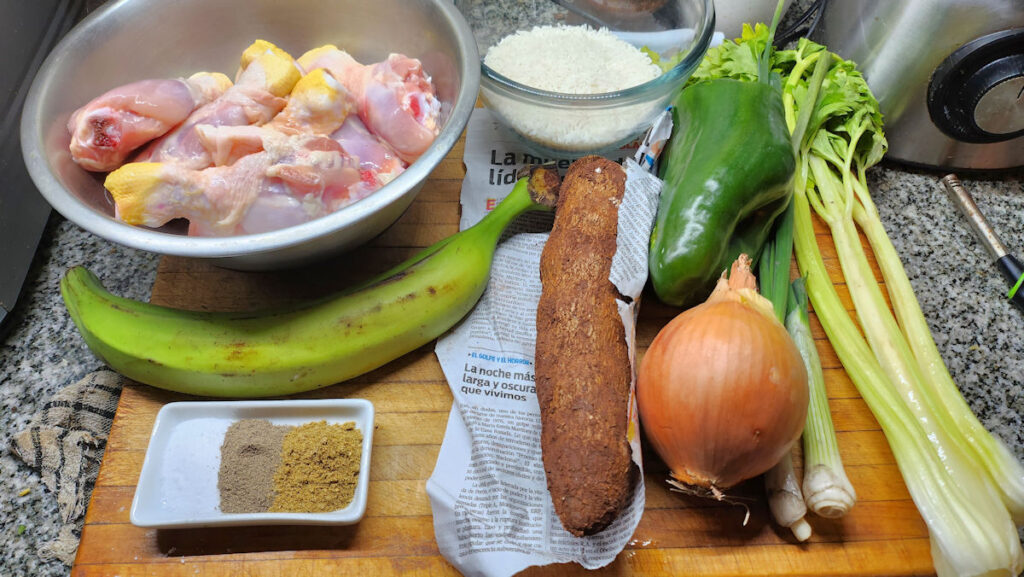
Our ingredients: Traditionally a whole chicken cut into ten or so pieces, since I was making this for just the two of us, I went with just some chicken legs – my favorite part anyway; a half cup of rice, a plantain, a yuca root, a green bell pepper, an onion, some stalks of celery, some green onions, and two teaspoons each of salt, pepper, and cumin (you may want to adjust this, depending on how seasoned your chicken stock is – if it’s already fairly salted/peppered, cut those back – you can always add more later). Off to the side, a pot of chicken stock, and also just some plain flour in a bowl.
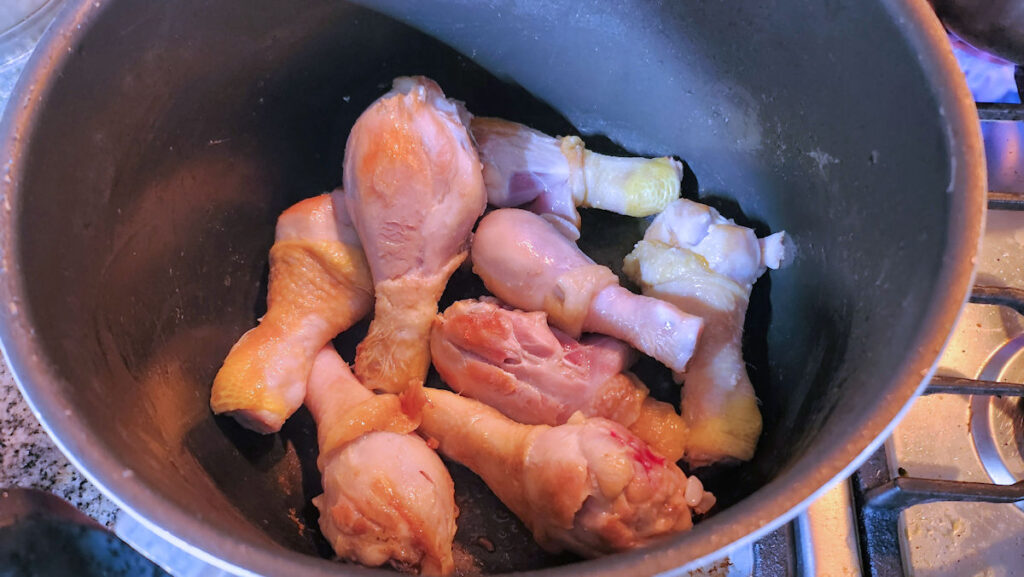
Dredge the chicken in the flour and then lightly brown it in a little oil.

While they’re browning, chop your onion, bell pepper, and celery.
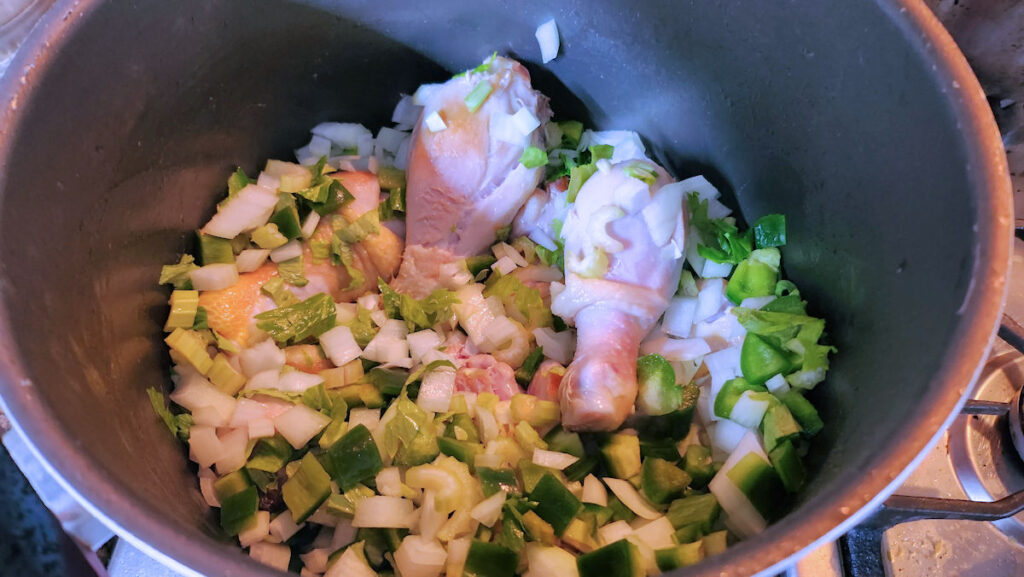
Add to the pot and continue cooking until the vegetables start to soften.
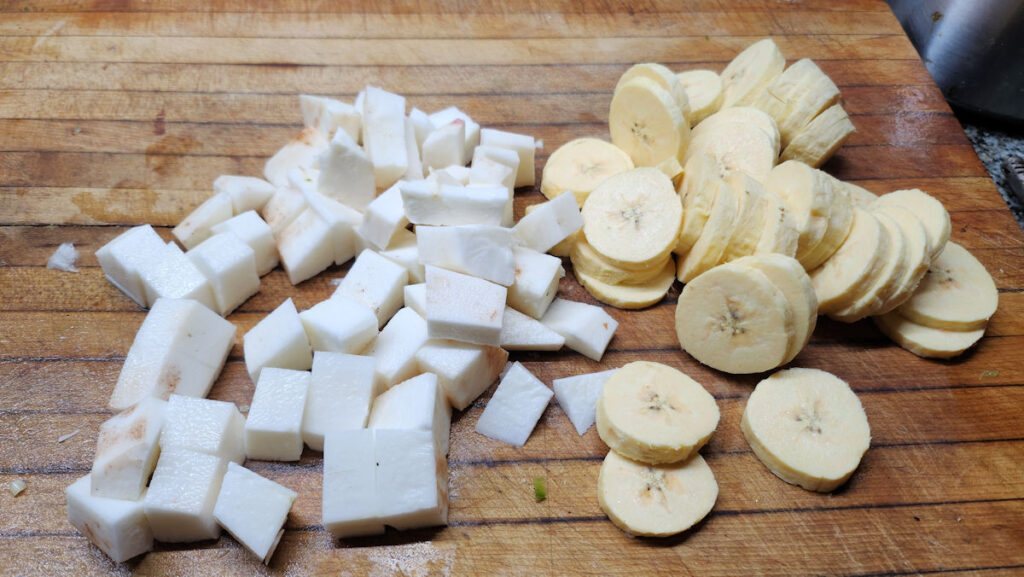
Peel and dice the yuca root, peel and slice the plantain.
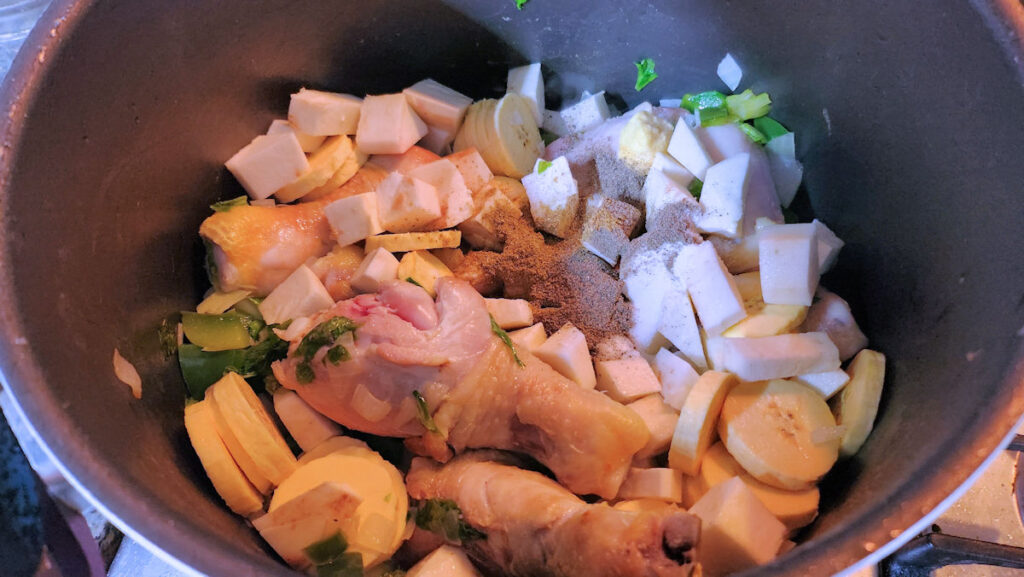
Add those to the pot along with the seasonings.
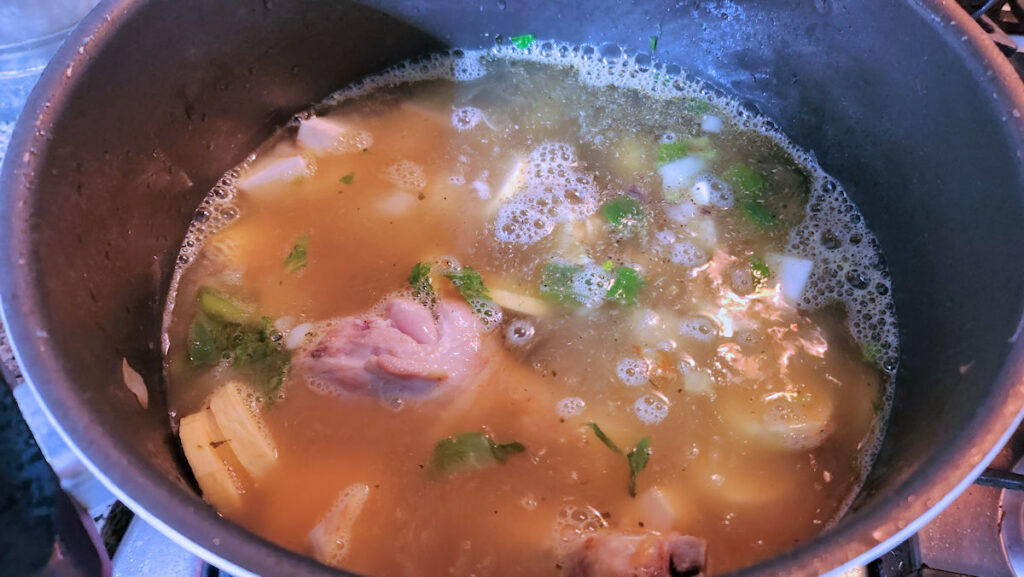
Top with the chicken stock, bring to a simmer, cover and let simmer for about 40 minutes.
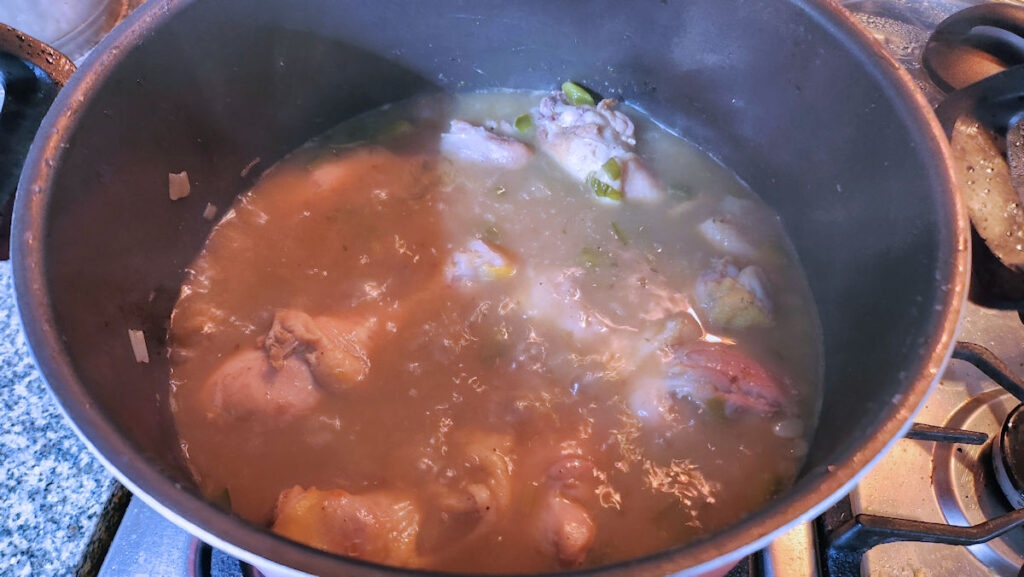
It should look more or less like this. It’s interesting how the starch from the flour on the chicken, the yuca root, and plantain, give such a richly textured broth.
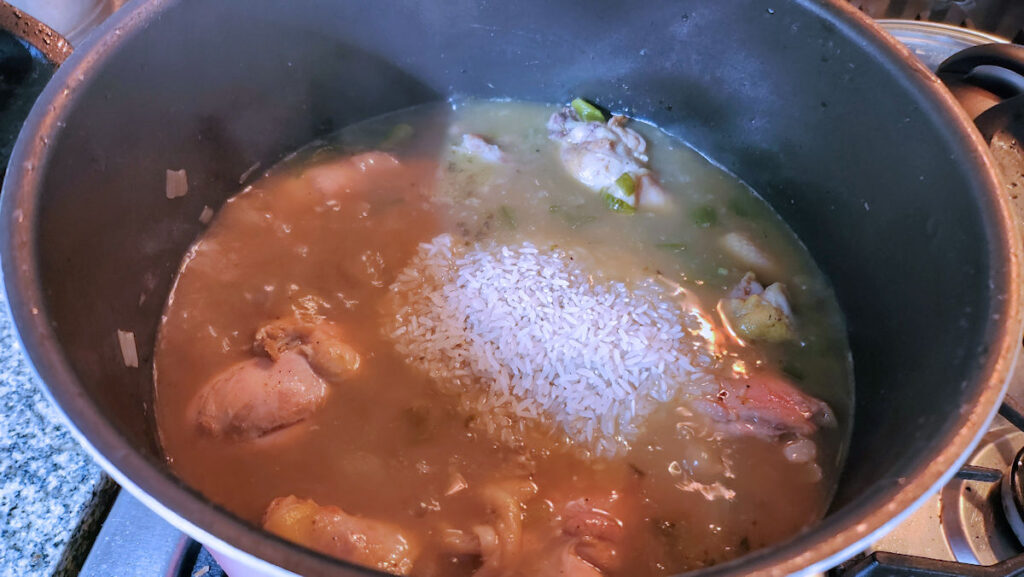
Add the rice, mix through, cover again, and continue simmering for about 20 minutes more.
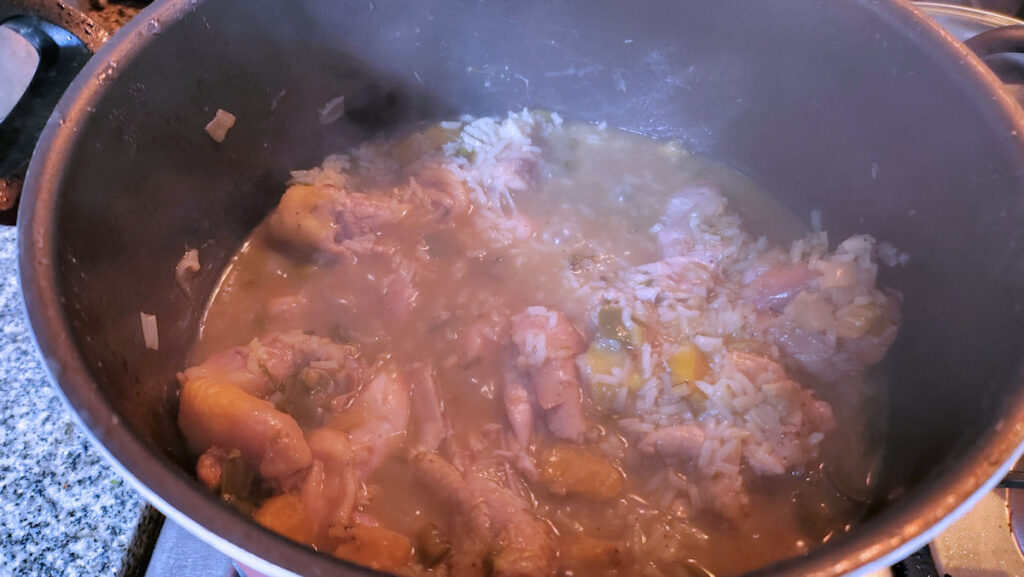
It should look a bit like this. Mixed messages on various recipes for this dish. Some people make it very stew-like, like this, others go more in the soup direction and probably would have about 50% more stock, or even more. We like our stews. Plus it feels more locro-like.

Finish by adding in the chopped green onions and adjusting seasoning if need be – much of it will depend on the seasoning of your chicken stock.
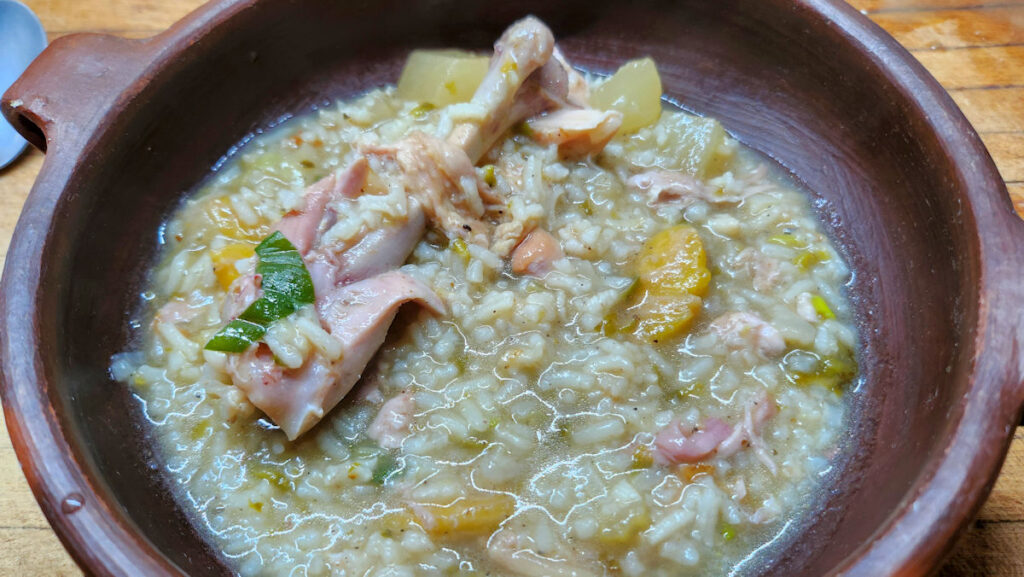
And, serve!
It’s a really tasty bowl of chicken and rice. We liked the hint of sweetness from the plantains, the texture of the cubes of yuca. As I noted above, it’s not something I’d identify on sight or taste as a locro, because it’s missing pretty much any element that the others (to date) have had in common (potatoes and legumes being the primary connection I think of). But who am I to dictate what’s called a locro or not?
Copyright © 2026 SaltShaker. This feed contains copyrighted photos and text from SaltShaker. If you are not reading this material in a feed aggregator or by e-mail subscription, the site you are viewing may be guilty of copyright infringement. Please contact [email protected] so that I can take appropriate action.
Plugin by Taragana
]]>
The Eswatini flag, adopted in 1968, consists of five horizontal stripes: two blue at the top and bottom, a central red stripe, and thin yellow stripes bordering the red. The central focus is a black and white Nguni shield with two spears, symbolizing protection from enemies, and peaceful, sort of yin-yang coexistence between the white and black populations. The red represents past battles, blue signifies peace, and yellow represents the country’s resources.
Eswatini’s cuisine reflects its primary crops of sorghum and maize, often served with goat meat – the most common domesticated food animal. The farming industry relies on sugar cane, tobacco, rice, corn, and peanuts. Traditional dishes include various types of porridges and drying meat for later use is common practice.
For our project, I went with a modern version of a traditional cornbread. The very traditional version, sinkwhat sembila, is more like a tamal than a bread – a mix of ground corn, salt, and sugar, steamed in a corn husk. But modern bakeries and home bakers often make it much more like a loaf of bread – called Mealie Bread. On the soup side, going with something goat based seemed like the right move, and I went with a rich, almost stew-like soup called Imbuti. It did require me buying an entire small goat, frozen, from one of my neighborhood butchers. Luckily he was wiling to cut it into sections and wrap each piece separately, so I could stick all but the one I was using (the shoulders and head) into the freezer for future use.
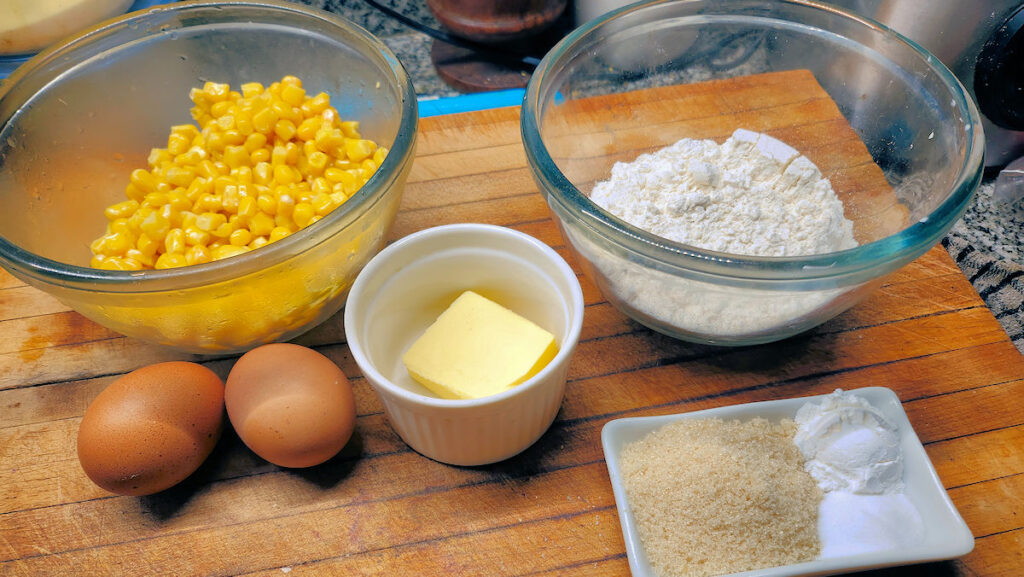
We have about a cup and a half of corn kernels – either freshly cut off the cob, or, basically, one thawed frozen package of corn; about 3/4 cup of all purpose flour, two eggs, two tablespoons of butter, two tablespoons of sugar, 1 teaspoon of baking powder, and a half teaspoon of salt.
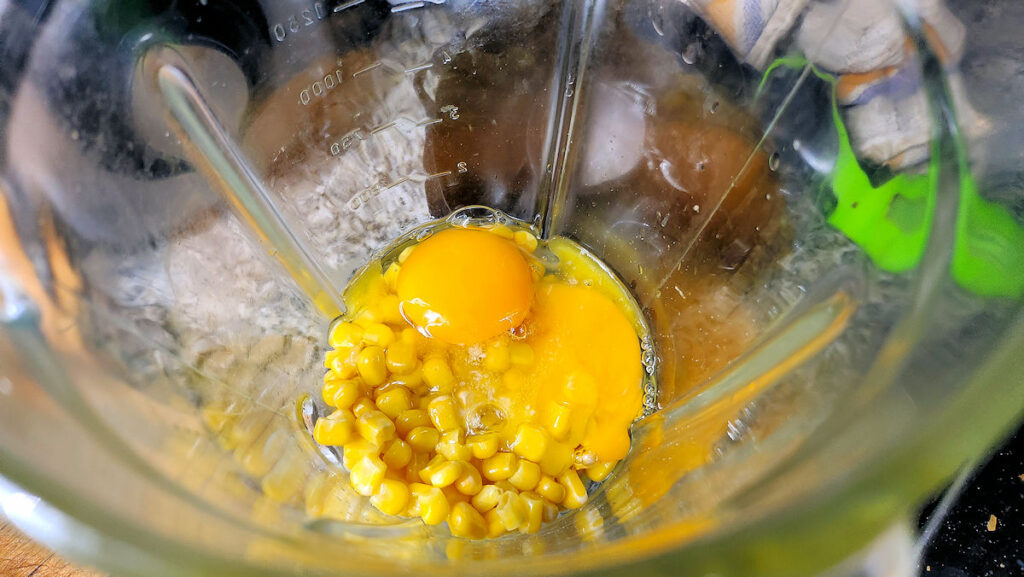
Put 1 cup of the corn, the eggs, and butter (melted) in a blender.
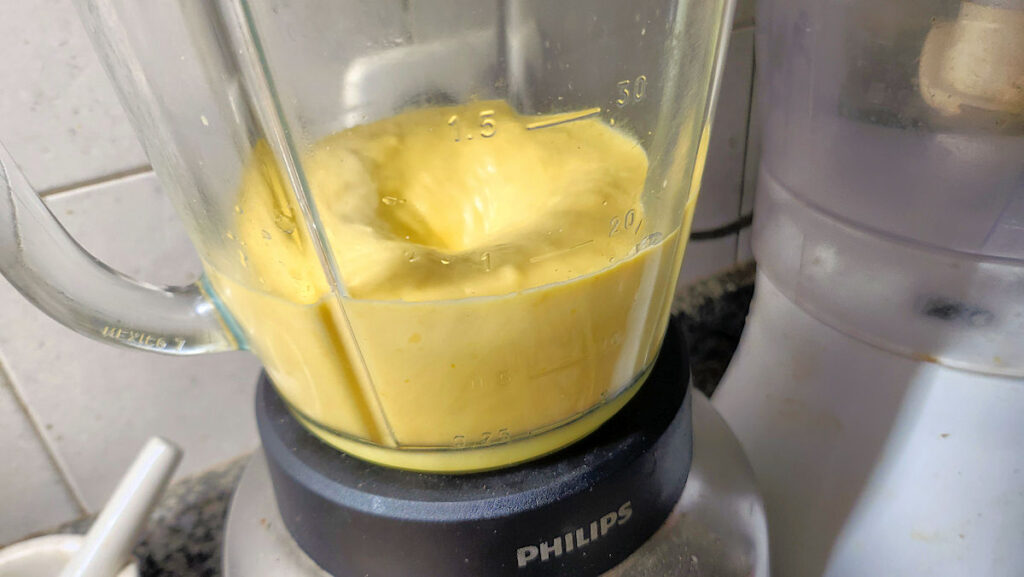
Puree until completely smooth.
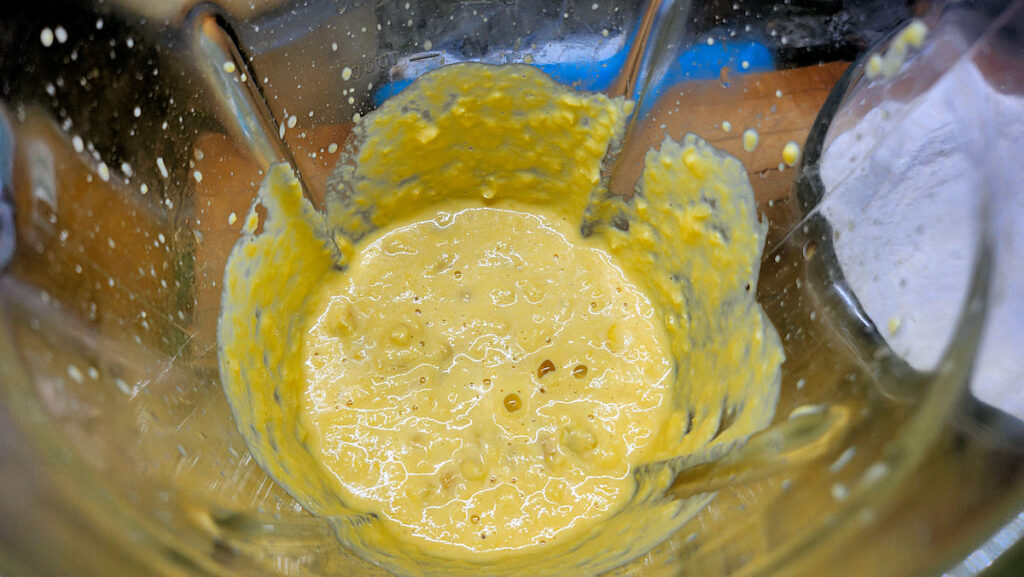
Add the rest of the corn and pulse twice, just to coarsely chop it.
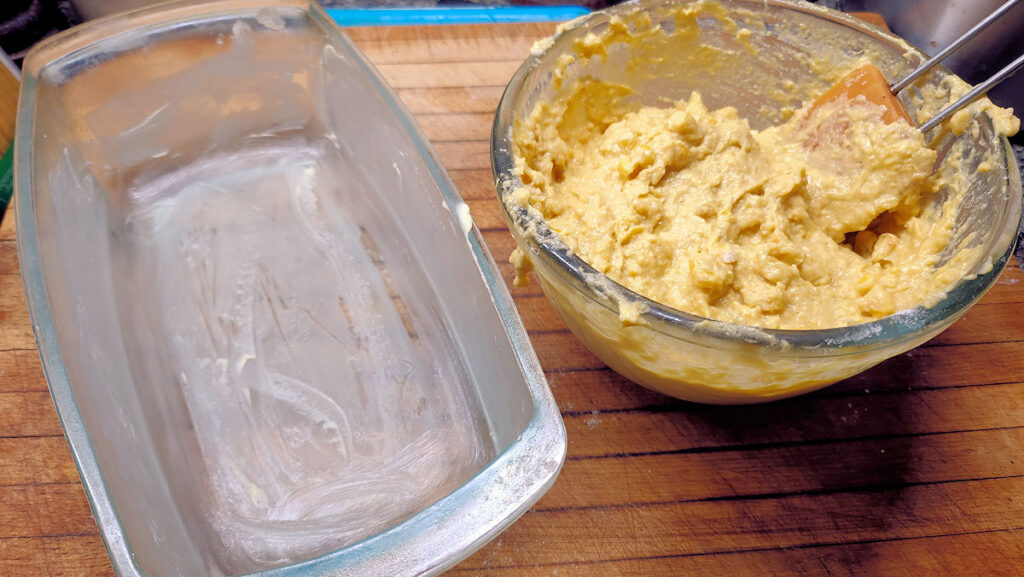
Mix with the dry ingredients. Butter a loaf pan.
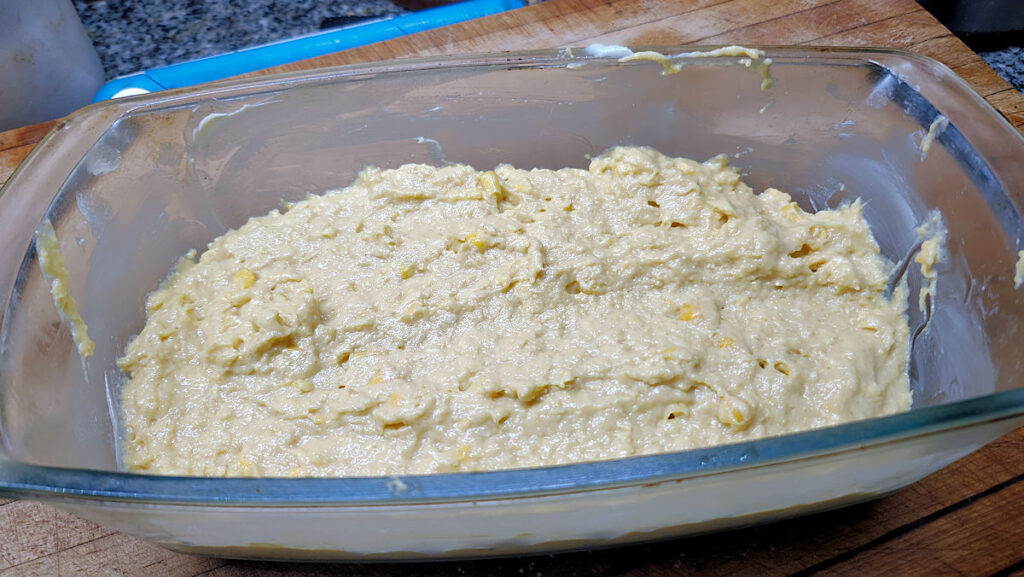
Put in the pan, and bake in a medium hot oven for about 30-35 minutes.
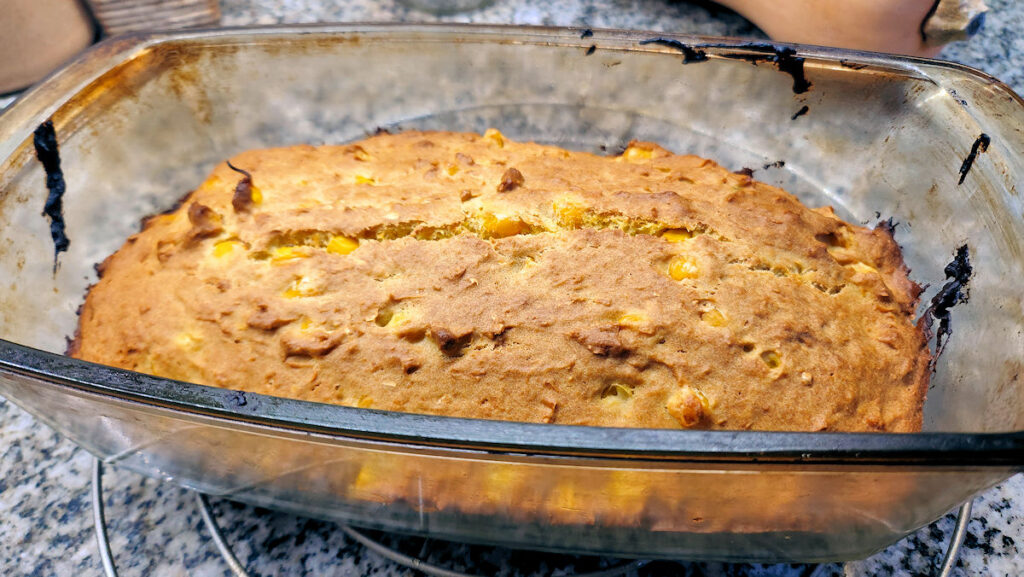
And, voilà! Mealie Bread!
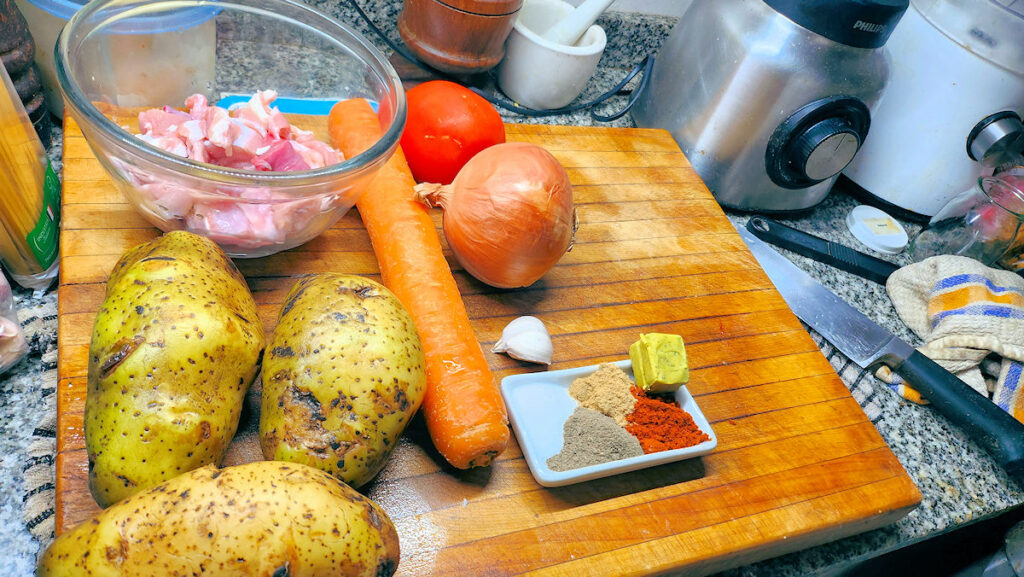
Cut the goat meat into bite sizes pieces (this is most traditionally made as a thicker stew, with pieces of goat left on the bone, but the soup version seems to be an adaptation geared more to modern living) – you want about a pound of meat; a carrot, a tomato, an onion, a couple of garlic cloves, some potatoes; and then salt, pepper, ginger, hot paprika, and vegetable stock cubes (obviously a modern addition, and probably to replace some of the flavor lost in not using the bones – ideally, maybe, make a goat stock with the bones). I started with a teaspoon of each, and then later adjusted with a bit more salt.
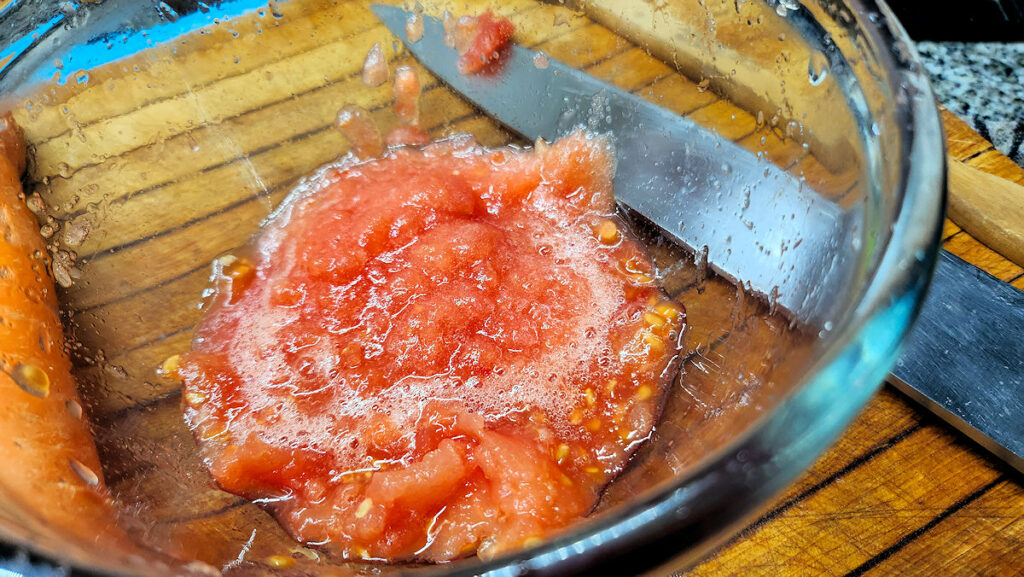
Grate the tomato, which is a quick way to separate it from the skin.
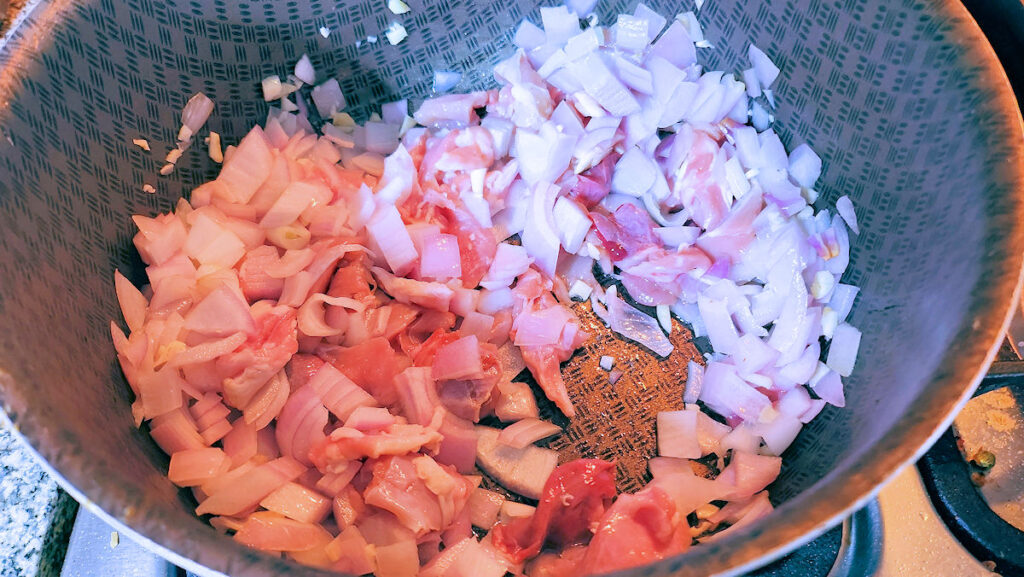
In a little oil, saute the chopped onion and garlic until softened.
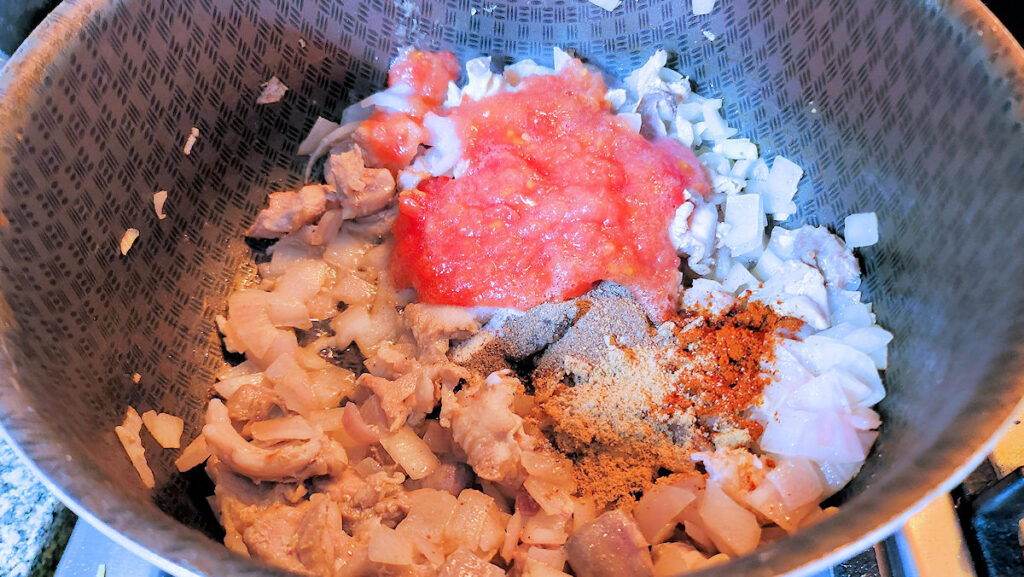
Add the goat meat, tomato, and spices and saute for a few minutes.
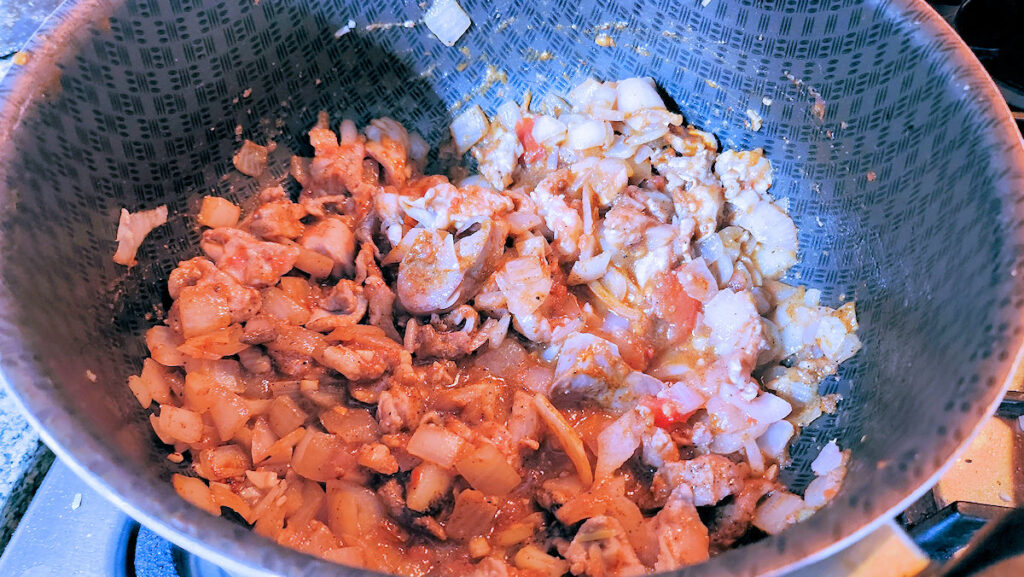
You should get some color on meat in particular – not browned, but at least… tinged.
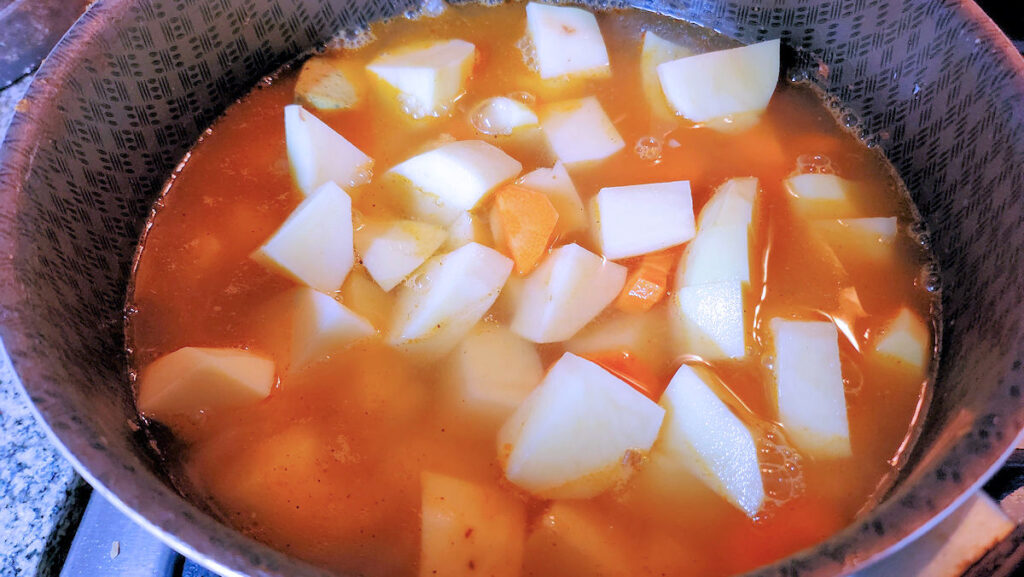
Add the vegetables, cut into bite sized pieces, the stock cubes, and top with water. Bring to a boil, reduce heat to low, and simmer for an hour and a half.
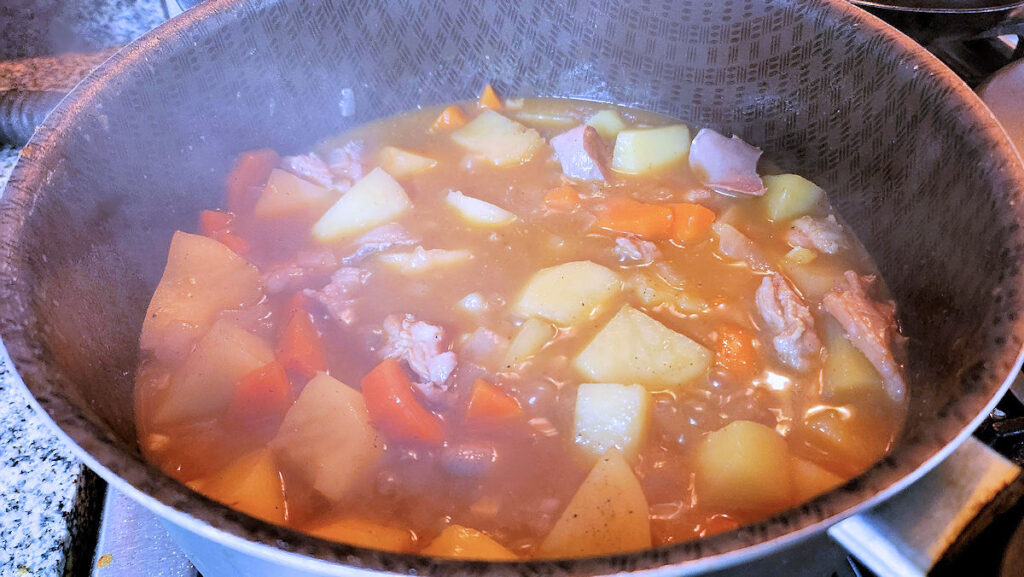
We have soup! Adjust the seasoning – I added probably just shy of another teaspoon of salt.
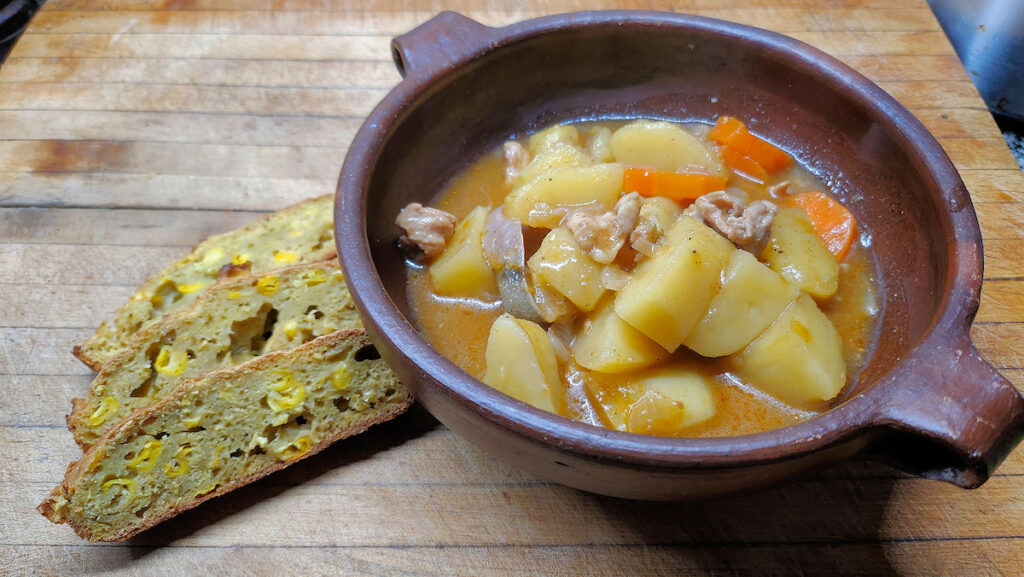
And, serve!
The soup – absolutely delicious! The cornbread too, though I’ve had better, and despite having cooked the designated amount of time and sounding hollow to a thump on the bottom, it collapsed as it cooled, so it wasn’t quite cooked through – maybe another 5-10 minutes. Just dependent on how hot a “medium hot oven” is – I’d probably just up the heat a little from where I had it. What else would I do to improve it? I think I’d brown the meat more fully beforehand – before even cooking the onions and garlic, and then just set the meat aside to add back in at the right step. Other than that, I liked it as is.
Next time up, we’re staying, it seems, in Africa, as we move on to Ethiopia.
Copyright © 2026 SaltShaker. This feed contains copyrighted photos and text from SaltShaker. If you are not reading this material in a feed aggregator or by e-mail subscription, the site you are viewing may be guilty of copyright infringement. Please contact [email protected] so that I can take appropriate action.
Plugin by Taragana
]]>Locro is a stew, a classic, staple dish that, while often associated with Argentina, is far more widespread. Versions of locro can be found throughout South America, particularly anywhere that there’s an influence from the cultures that spoke (or speak) the Quechua language. In fact, locro is a name derived from the Quechua “ruqru” or “luqru”, which originally was a traditional stew centered around the papa chola, a particular type of potato with bright yellow flesh and a pinkish skin, but over time has come to refer to a wide variety of stews based on potato or corn or wheat or beans.
There are dozens and dozens of recipes from virtually all of the South American countries for different types of locro. I doubt I’ll ever get to try all of them, nor even make all of them (I have almost three dozen recipes to make at some point or another), but here are my adventures in the kitchen doing the latter. Before anyone writes me to tell me how my recipe doesn’t match your grandmother’s, let me just point out that your grandmother’s recipe doesn’t match your best friend’s grandmother’s recipe either. I’ve spent the time researching, and generally take anywhere from half a dozen to a dozen different versions of the same recipe and try to both distill them down to their essentials, but also use the bits from each that intrigue me.
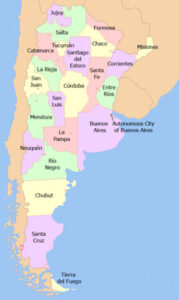
Today, we’re headed to the northeast of the country, where Corrientes province (in pink) is bordered to the east primarily by Brazil, with a short frontier with Uruguay, and to the north by Paraguay, and Misiones province. In particular, this version is called Locro de mandioca, with mandioca or yuca root, filling in for the squash used in many other versions. I’ve written in detail before about both the root and how to prepare it, here.
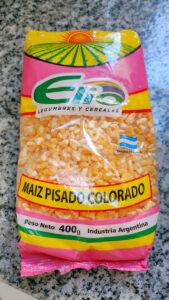
This version also uses maíz colorado, or “colored maize/corn” versus the more commonly seen maíz blanco, or “white maize/corn” in the Argentine national version, locro criollo (which basically just means the version that the folk around Buenos Aires have decided is the “real” one).
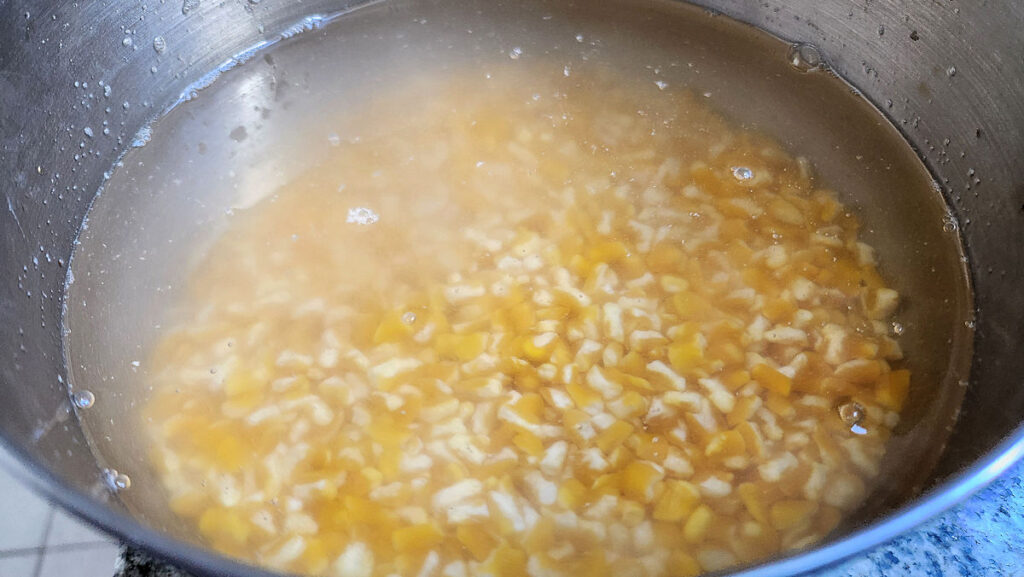
Rinse and then soak the corn overnight in water.
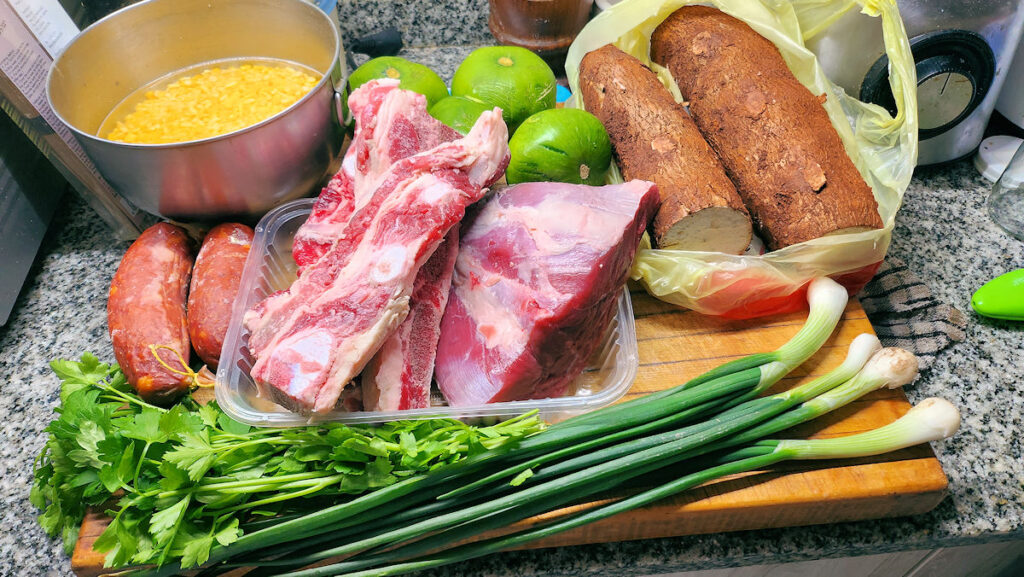
We have our soaked corn; some zapallitos redondos or zapallitos troncos, depending on who you ask – a globe zucchini; some yuca root; some mildly spicy cured chorizo, cross-cut beef ribs, and some beef cut from the upper shank (the ribs are pretty much a standard, the other cut – anything that needs some long cooking); green onions, and parsley. Not pictured – salt, pepper, and about a tablespoon of dried oregano.
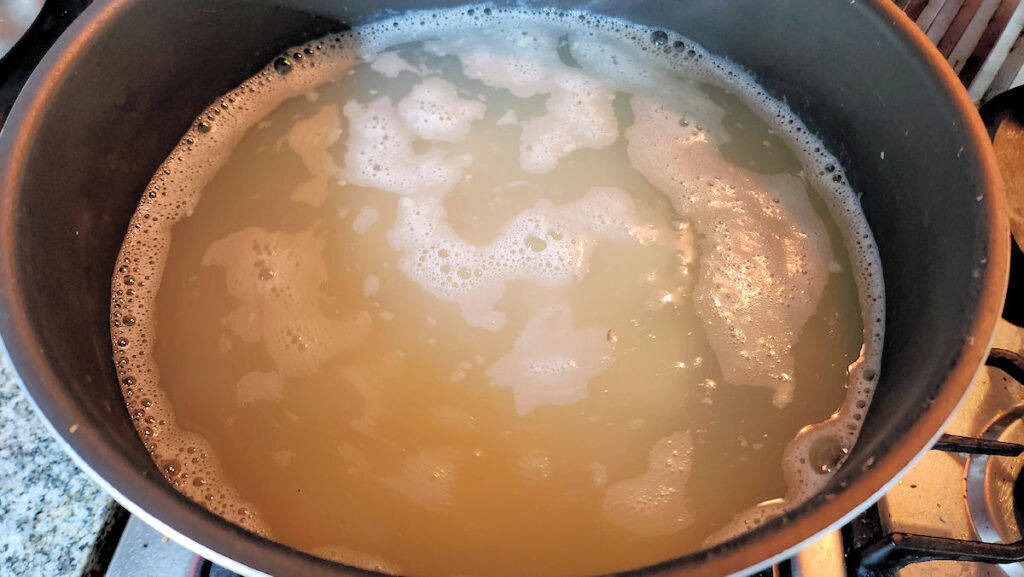
Bring the corn to a boil in what looks like enough water to cover everything once it’s in there. You can always add more water – it’s harder to remove excess without losing flavor. Boil for about 15 minutes.
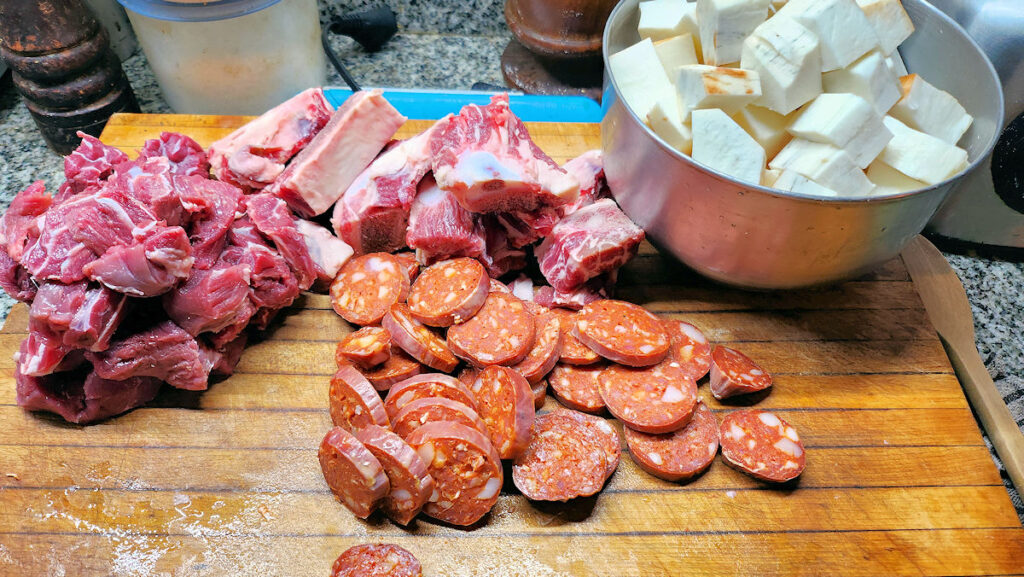
Prepare the yuca root – this is probably the most time consuming step. I’ve gone through the process in detail here, the only difference being here I cut it in roughly 1″ cubes. Slice the chorizo, trim and cut the ribs into sections, trim and cut the other beef into cubes.
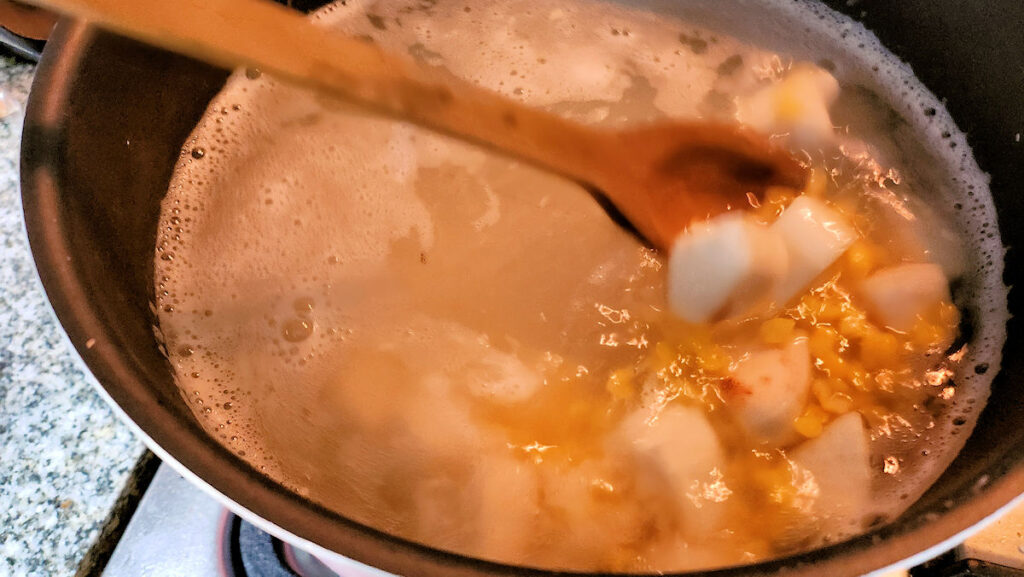
Add the yuca root to the pot, bring it back to a boil for about another 15 minutes.
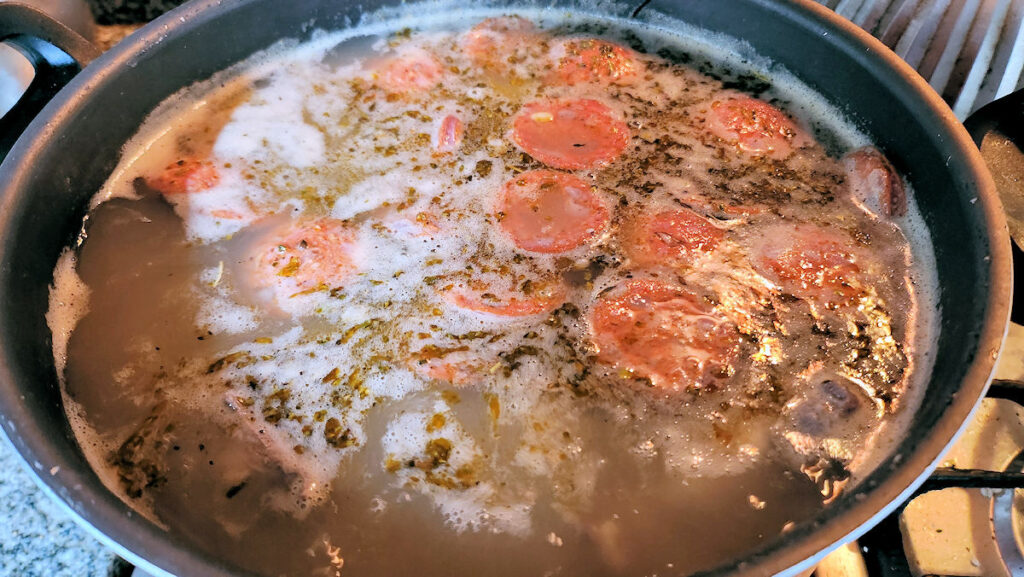
Add the meats, the oregano, and some salt and pepper. Bring back to a boil, turn the heat down to minimum, cover, and simmer for 90 minutes.
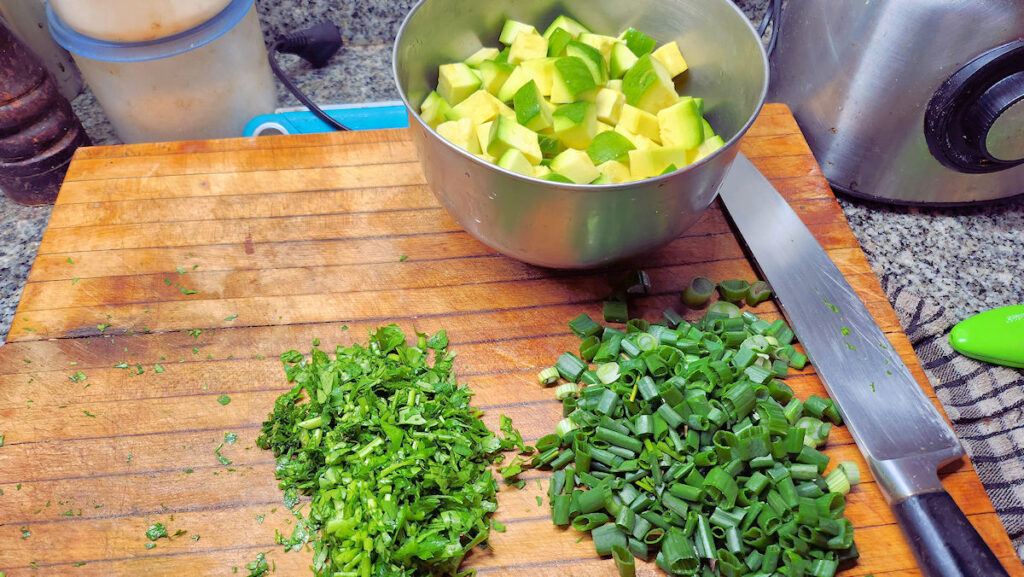
Cut the zapallitos in small cubes, chop the green onions and parsley.
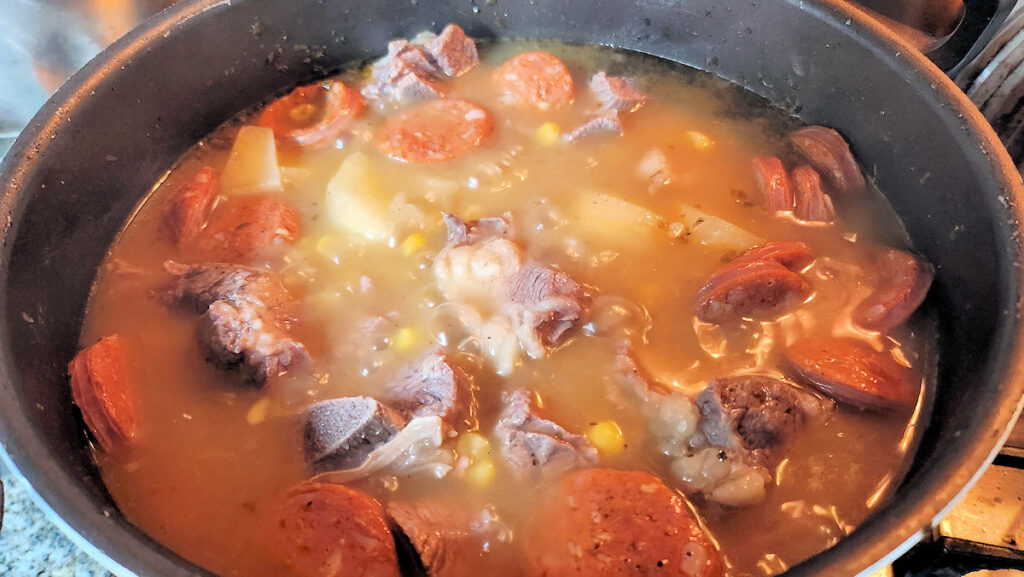
After 90 minutes your locro should look more or less like this.
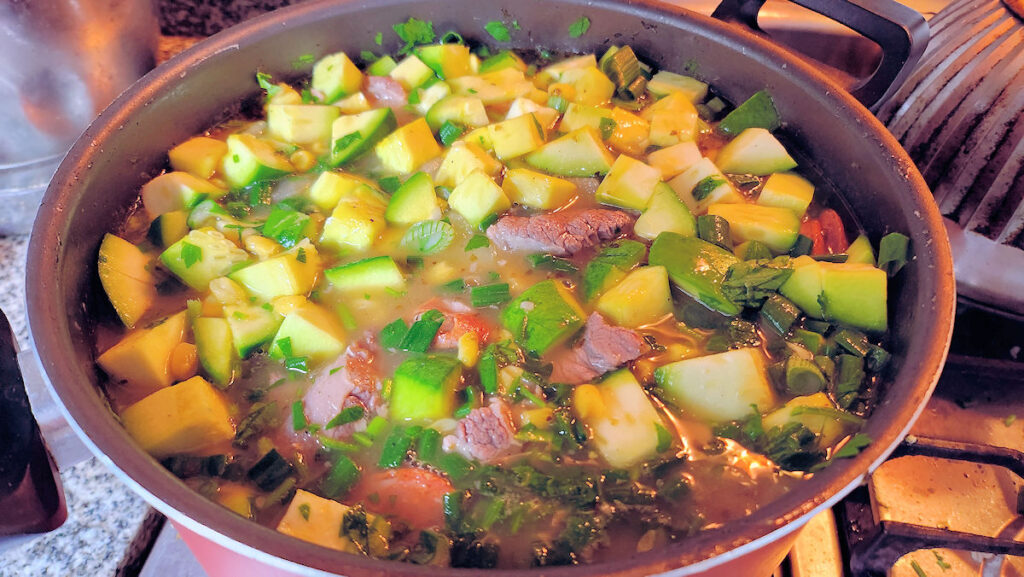
Add the green stuff. Resist the urge to add more water. The zapallitos are going to give off a fair amount and you want this to be a nice thick stew. Bring back to a boil, reduce the heat to minimum again, cover, and cook 30 minutes. If it seems like you have too much water, leave the cover off and more of it will evaporate.
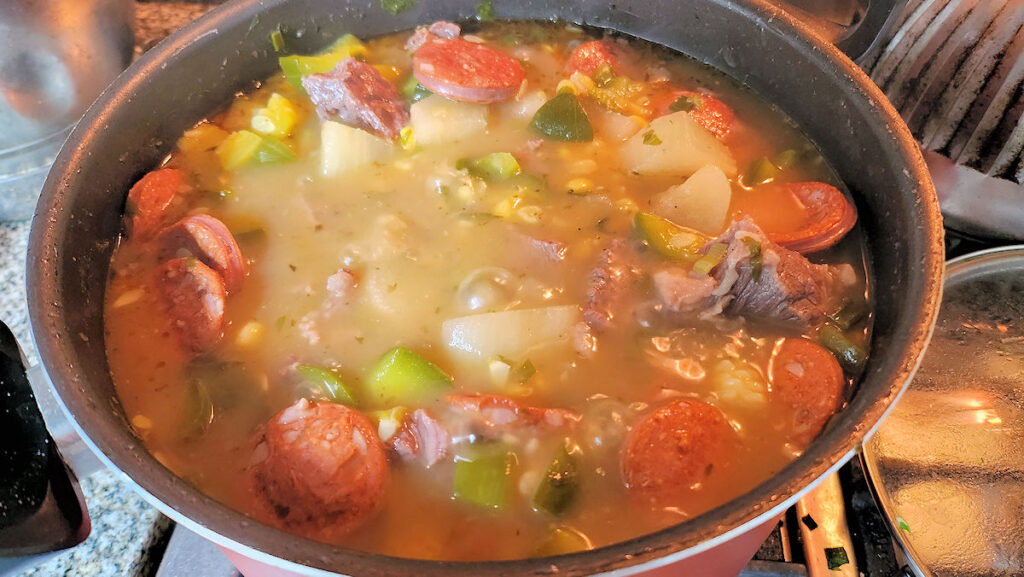
This should be the final result. Taste – add salt and pepper if needed.
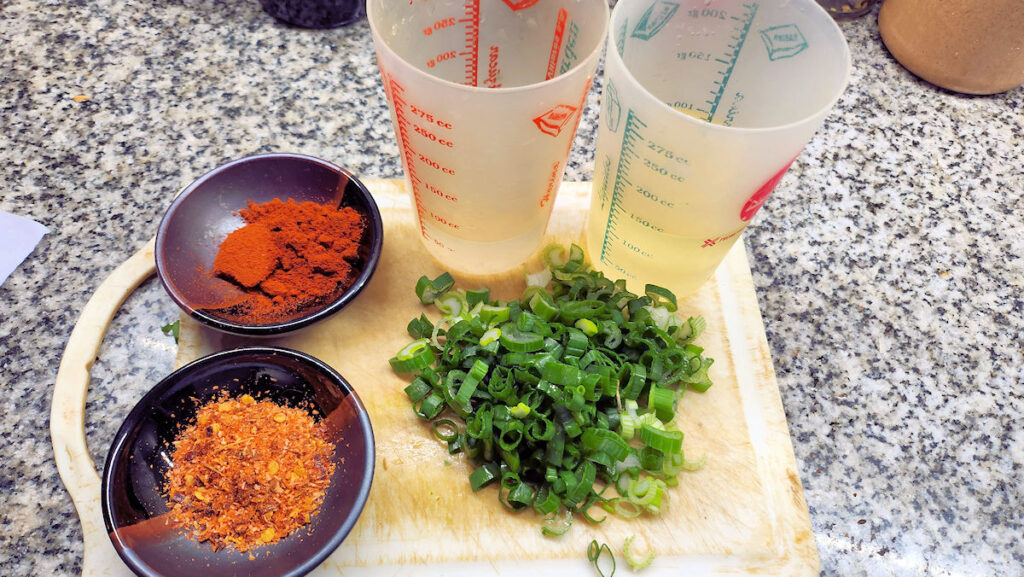
Now, on the side, during that 90 minutes of simmering, we’re going to make a typical “hot sauce” from the Corrientes region. They’re big on green onions up there. Here we have a couple of green onions chopped, a couple of teaspoons of chili flakes, one of hot paprika, 120 ml (1/2 cup) of neutral vegetable oil, and 60 ml (1/4 cup) of cold water.
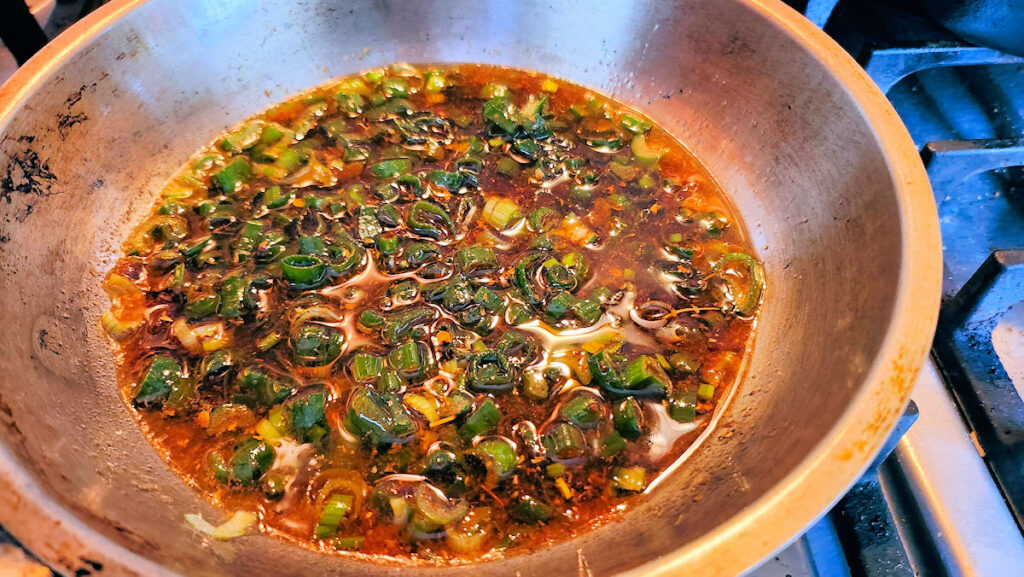
Over low to medium heat, fry the green onions, and the two spices in the oil for a few minutes. You want to just get it to the point where the green onions would start to brown if you kept going.
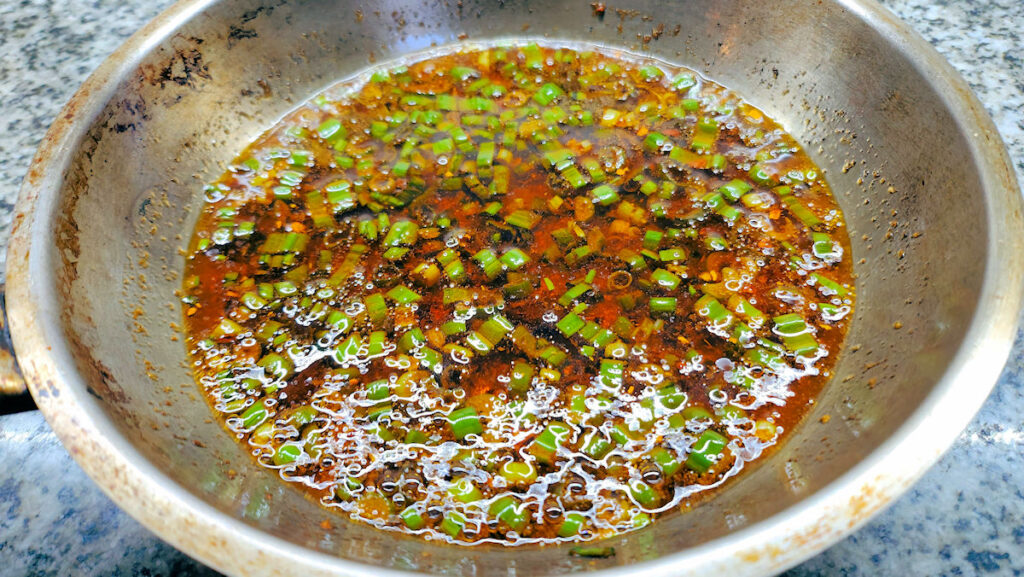
Remove from heat and add the cold water to stop the cooking. Mix it together well and let it sit.
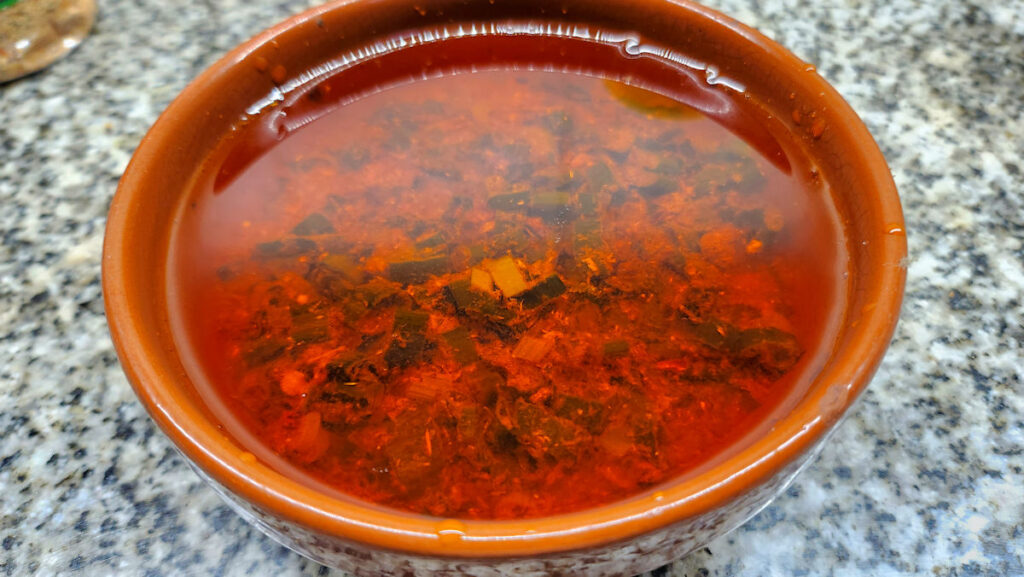
And you have this delicious moderately hot sauce to drizzle over the locro, as in the photo at the top of the post.
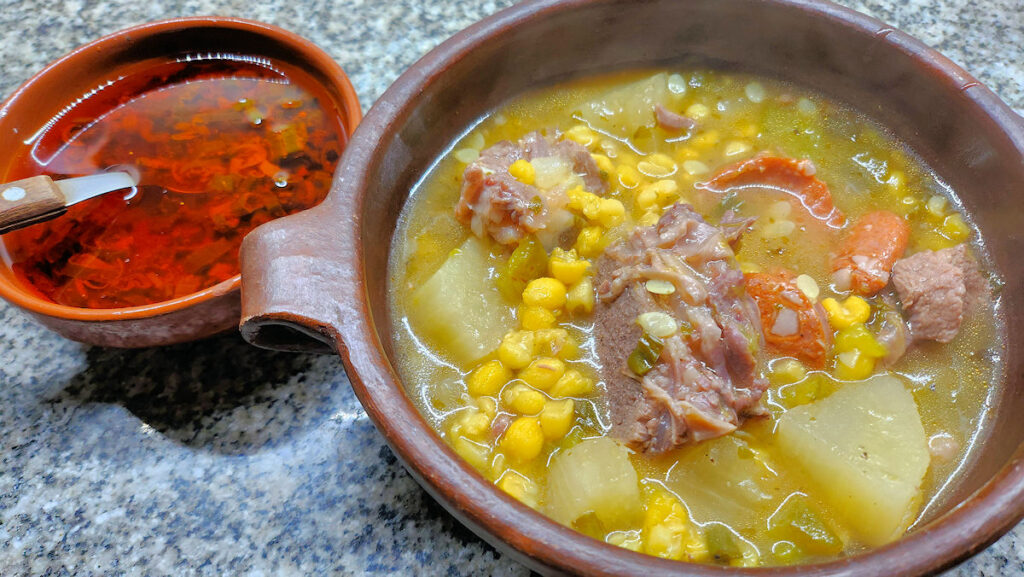
Serve it up and let people add the hot sauce to their own preferences.
Overall, this is one of the simpler locros we’ve made in this series. We liked it a lot. The yuca root gives a different texture than squash or potatoes, and the stew is just plain delicious. Our next door neighbor is from Corrientes and while the yuca sub for the potatoes was “different from how my mom would make it”, everything else was apparently dead on for a bit of nostalgia for him.
Copyright © 2026 SaltShaker. This feed contains copyrighted photos and text from SaltShaker. If you are not reading this material in a feed aggregator or by e-mail subscription, the site you are viewing may be guilty of copyright infringement. Please contact [email protected] so that I can take appropriate action.
Plugin by Taragana
]]>Thought so. Okay, let’s start with the basics – small country, 17,504 square miles (45,335 square kilometers), putting it about midway between the size of West Virginia and Maryland. That includes the mainland, two larger islands, and 2300 small islands in the Baltic. It has a much sparser population, coming in at around 1.4 million inhabitants, about the same as either New Hampshire or Maine. Historically, it was a part of various empires related to Russia, and a national movement to codify its local culture and language didn’t really take off until the 1850s, but remained subject to various forms of Russian and then Soviet occupation until 1988 when it declared itself an independent nation.
The capital is Tallinn, also the country’s largest city, at 453,000 people, though with the metropolitan area approaching 700,000, or half the country’s population. Just over two-thirds of the population are ethnic Estonians, about 22% are Russian, 5% Ukranian, and the rest a mix. While a quarter of the population are Christian, over 60% of the population claim to be atheist or at least non-religious. For my heritage, there are just shy of 2000 Jews in the country.

The Estonian flag, as I understand it, is meant to evoke a scene of a blue sky over a distant tree line, with a foreground of snow-covered ground. Something like this:

Estonian cuisine is very seasonal, affected significantly by long winters. Pork, potatoes, dairy products, and rye bread make up a large percentage of the diet. Influences on the cuisine come from both the Russian side of things along with its neighboring Baltic states, but also from the western side, from Scandinavia. When it came time to pick the bread and soup for this entry, the classic local rye bread, Leib, was an obvious choice. Several options for a soup popped up, but the most interesting, and seemingly most widespread, was Hernesuppe (“pea soup”), a yellow pea soup with smoked pork. Yellow peas proved difficult to find here – our local Indian products supply store was out of them and he wasn’t going to get any in for about two months, so I picked up a package on my recent trip to New York.
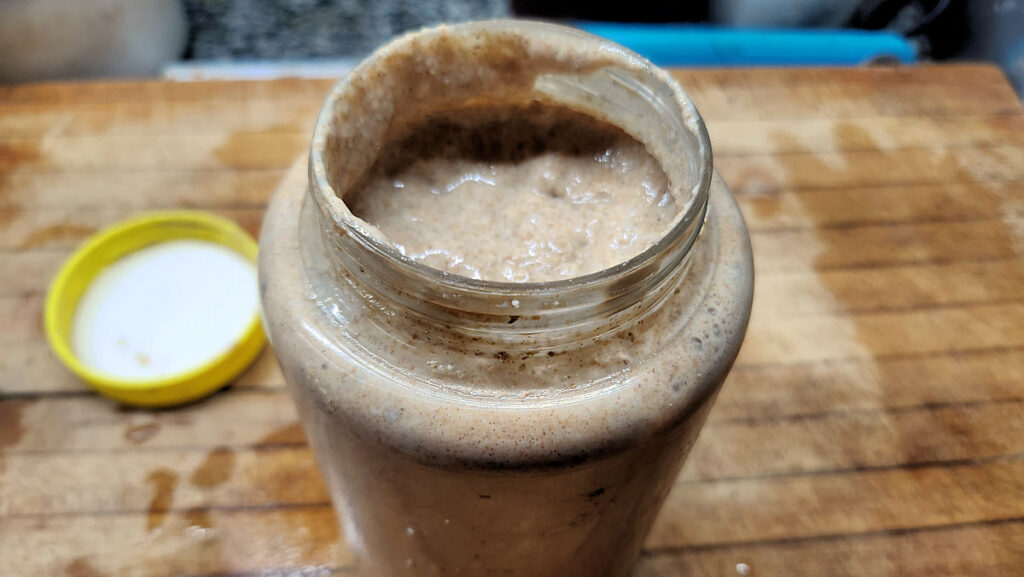
This was the starting point for the Leib. I had to make a rye sourdough starter. Actually really easy to do – just mix equal parts of a quarter cup each of rye flour and filtered water, leave for a day or two to start fermenting, and then each day add another 1-2 tablespoons of each to the mix to “feed” it. After about a week you have a bubbling, ready to work with starter. It’s also more forgiving than a wheat flour one – I put it in the refrigerator while I spent over two weeks on my little vacation, and came back, pulled it out, added a couple of tablespoons to it, and by the next morning when it had warmed up, it was bubbling away again.
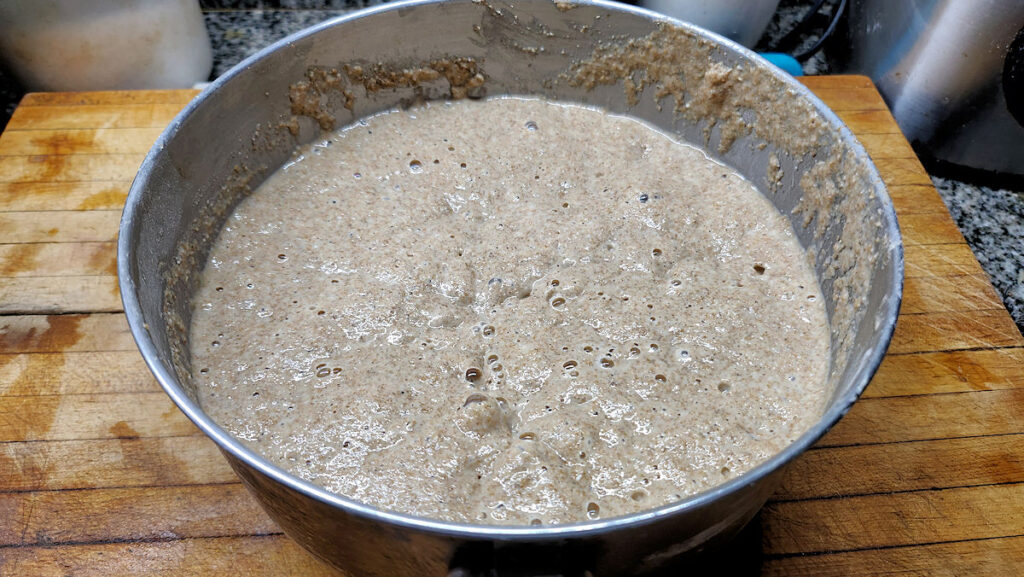
Next step is basically to make an even bigger starter – a “poolish” as the bread-baking folk call it. I took about half of the starter from the jar (maybe a cup?) and then added about a cup and a half each of rye flour and water to it, covered it, and left it for a day.
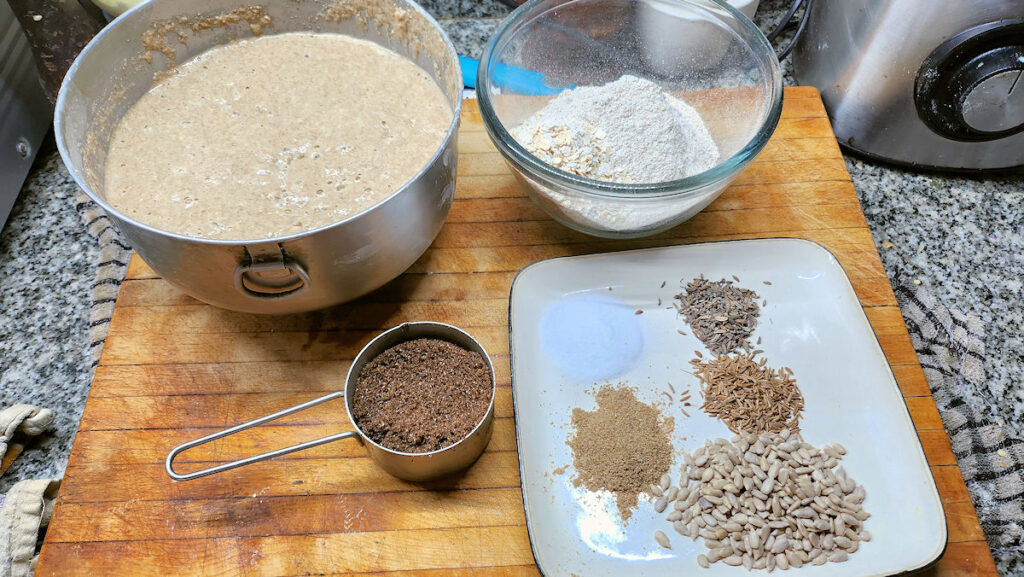
Next day… we have our poolish, another cup and a half of rye flour, 2 tb of oatmeal, 3/8 cup of brown sugar, 2 tsp salt, 2 tb sunflower seeds, 1/2 tsp ground coriander, and 1/8 tsp each of aniseeds and caraway seeds. So many different recipes used so many different spices and mixes, that I just sort of distilled down to ones that sounded like I’d like them together.
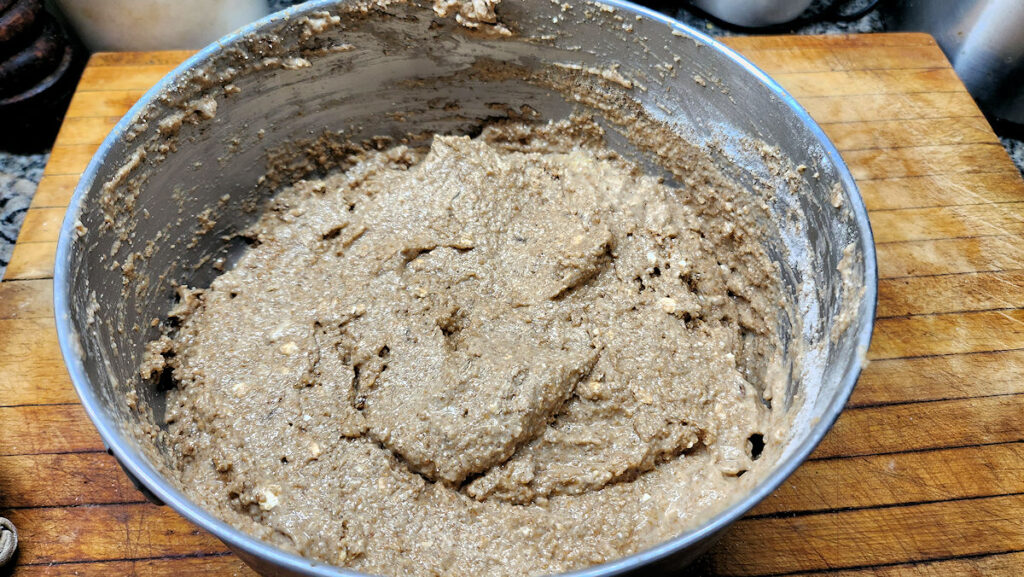
Mix it all together to get a stiff dough. No additional water. A couple of recipes recommended small amounts of additional water to lighten up the bread, but also noted that it was less traditional. I decided to leave it dense and heavy.
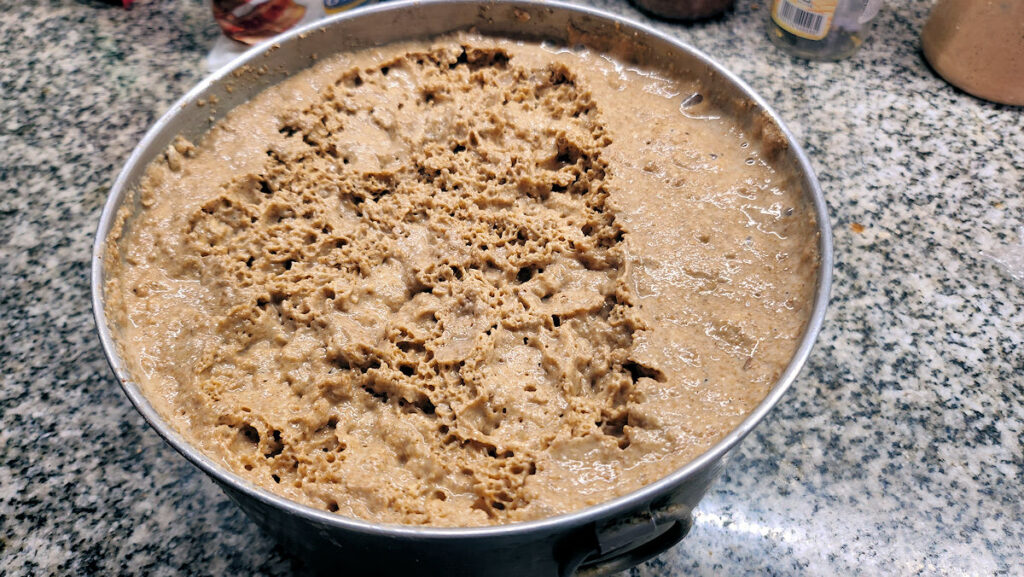
Cover and let it proof for about six hours. All that bubbling away lightens it up a fair amount anyway!
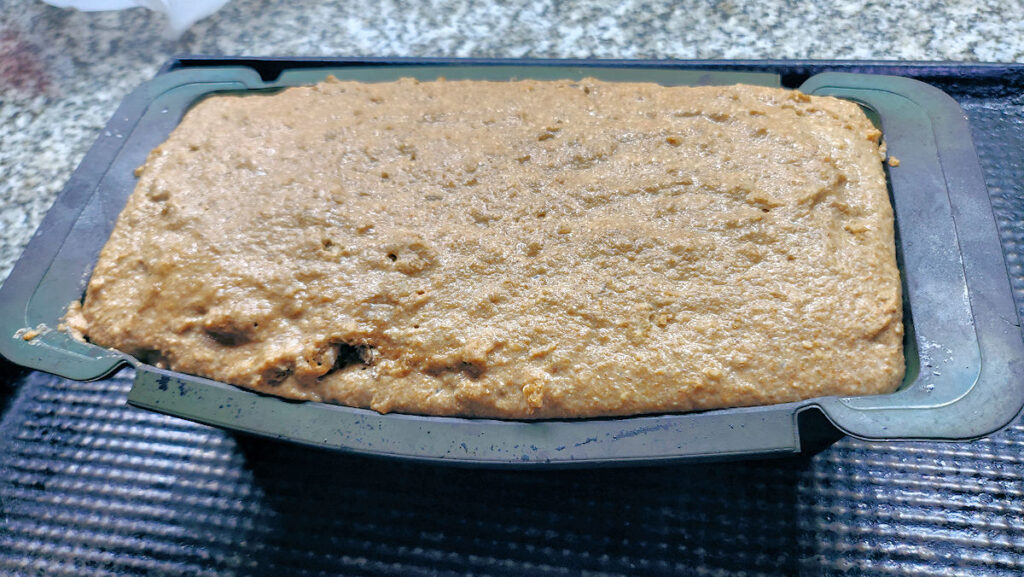
Put into a loaf pan, cover and let proof, yet again – this is a long process. Though, this time it only took about an hour to rise back up.

And, bake. The recommendation is to put a dish of hot water in the oven while it’s heating so that the interior of the oven stays humid, and start on high temperature. After about 10 minutes at high temp, lower it down to medium and bake “until done”. Recipe directions varied from claiming this would take anywhere from about 30 minutes to more than an hour additional time. I let it go for a total of about an hour and a half and it still came out somewhat wet in the middle. Not sure if that’s the temperature or if that’s just the way it’s supposed to be (doesn’t look like it in photos that people have posted). Maybe I lowered the temperature too much, or should have just let it sit for another 15-20 minutes in the oven.
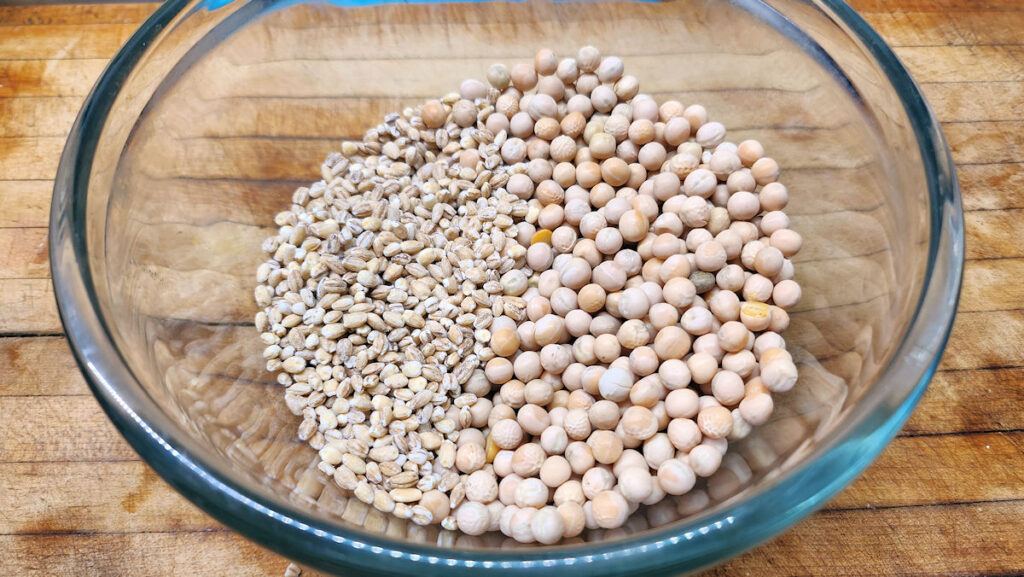
On to our Hernesuppe. I have about 200gm (6-7 oz) of whole dried yellow peas – some people use whole ones, others split ones, since I’ve done several split pea soups, I thought it’d be interesting to go the whole route. Roughly an equal amount of pearled barley.
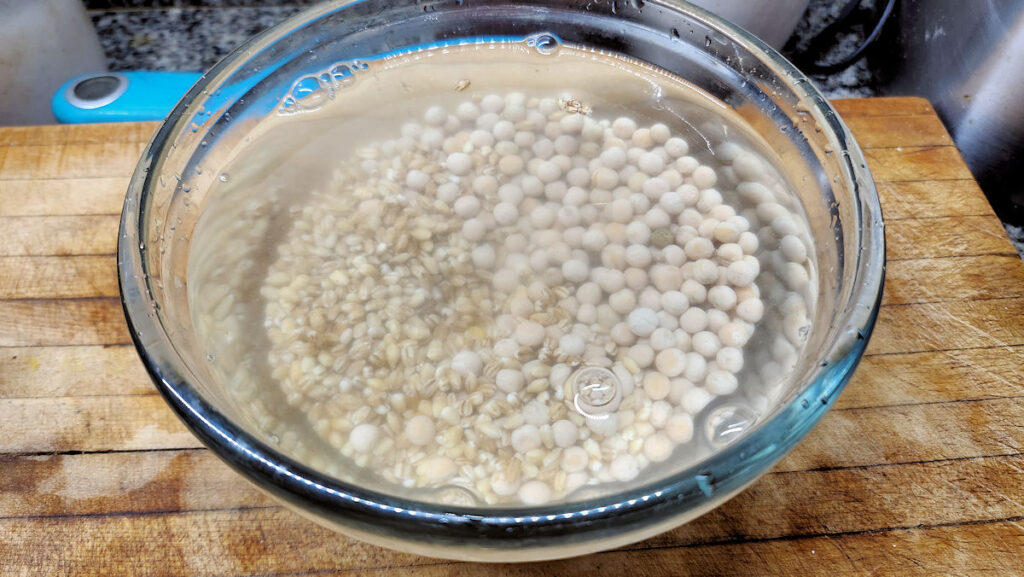
Soak in water overnight.
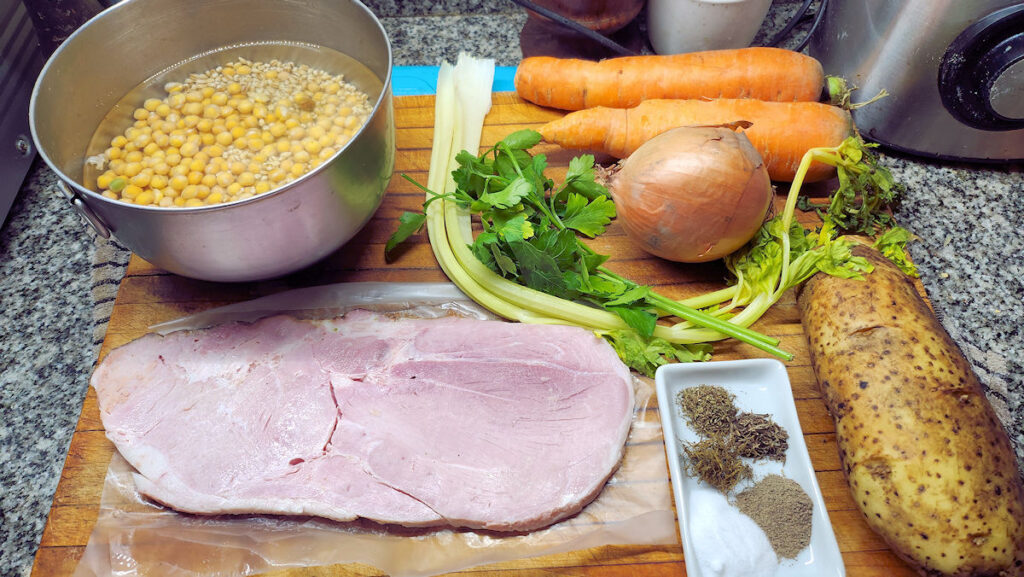
Next day, we have our soaked peas and barley, about 300 gm (10 oz) of smoked pork, a couple of carrots, a couple stalks of celery, an onion, a potato, a couple stalks of parsley, 1 tsp salt, 1/2 tsp pepper, and about a quarter teaspoon each of dried savory, thyme, and dill. Missing from the photo, a heaping tablespoon of whole mustard.
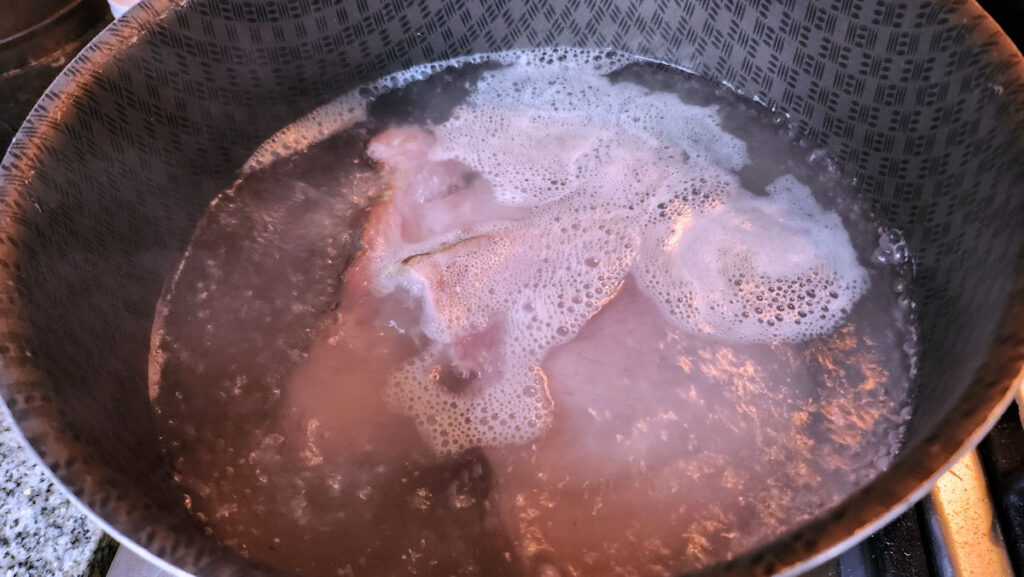
Boil the smoked pork for about ten minutes, then remove it and chop it up. Skim the foam off the water.

Add the peas and barley, bring back to a simmer and cook at very low heat for an hour.

Peel and shred, grate, or finely chop the carrots, celery, and potato, and cook down in a skillet with the spices, herbs, and mustard, until soft and starting to color.
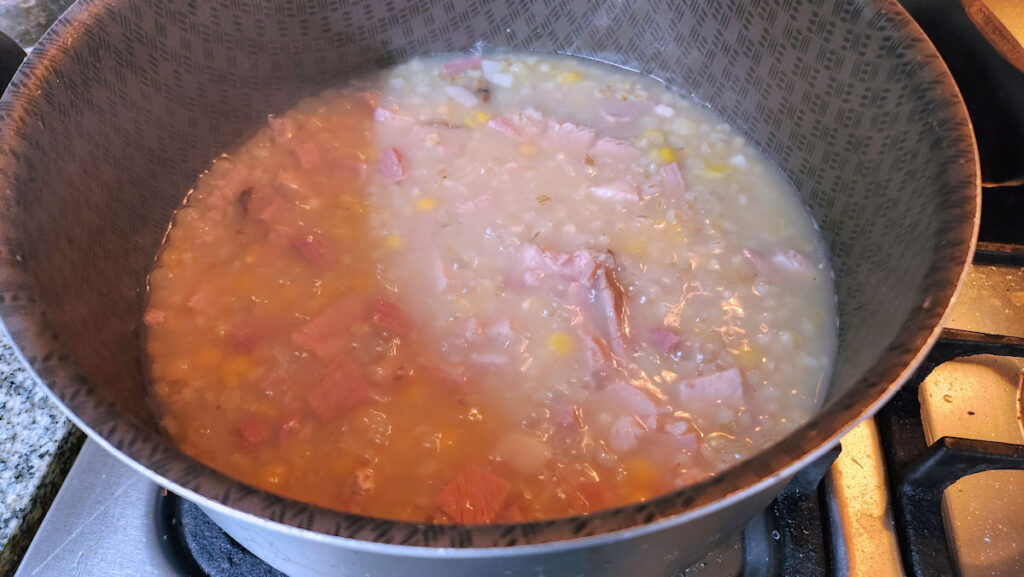
Your soup base should look like this, more or less.
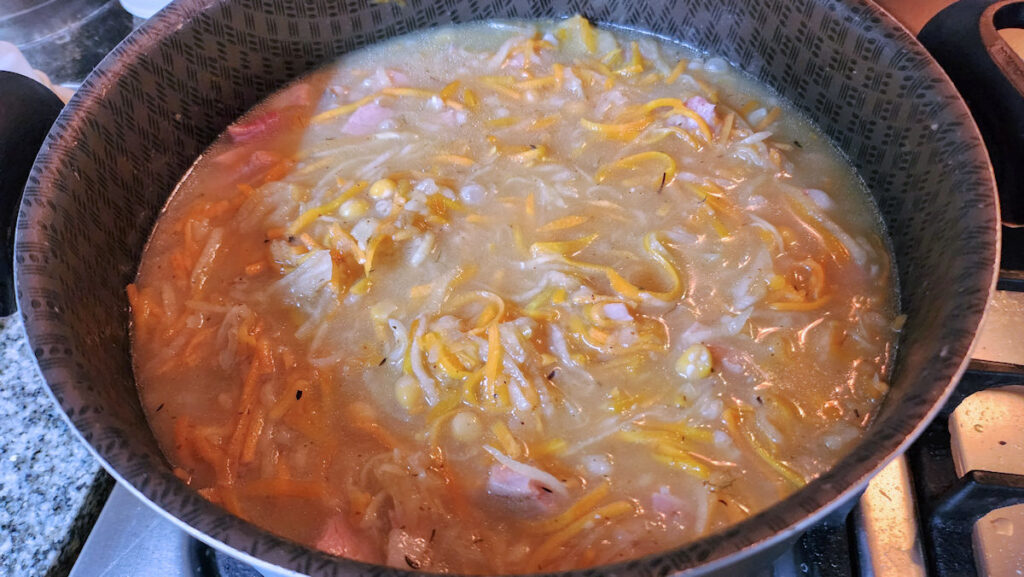
Add the vegetables and top with a little more water if needed. This is intended to be a thick soup, so don’t overdo it.
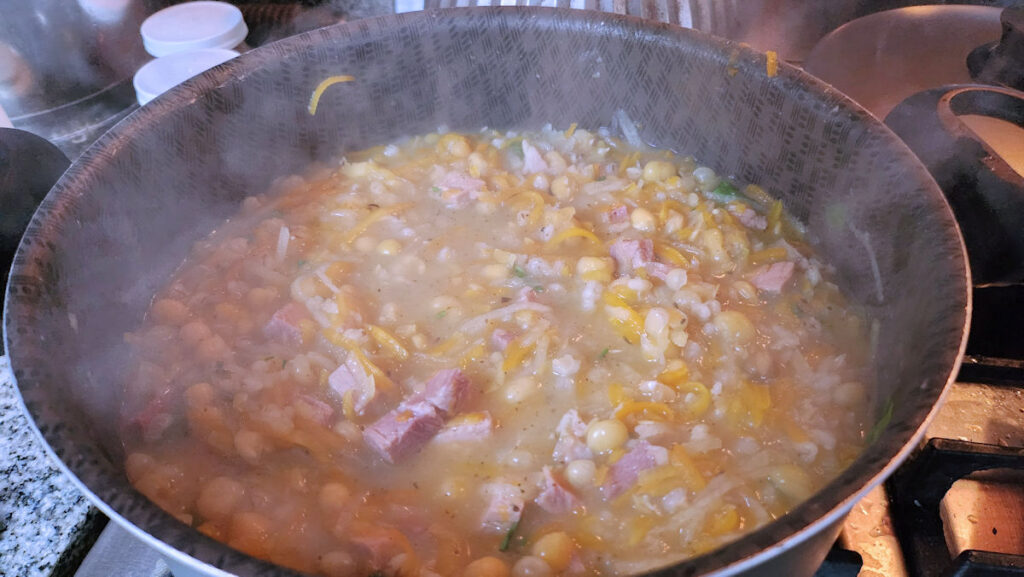
Bring back to a simmer, cook thirty minutes. Taste, adjust the seasoning if needed – I added a bit more salt and pepper at this point. And, you’re ready to serve.
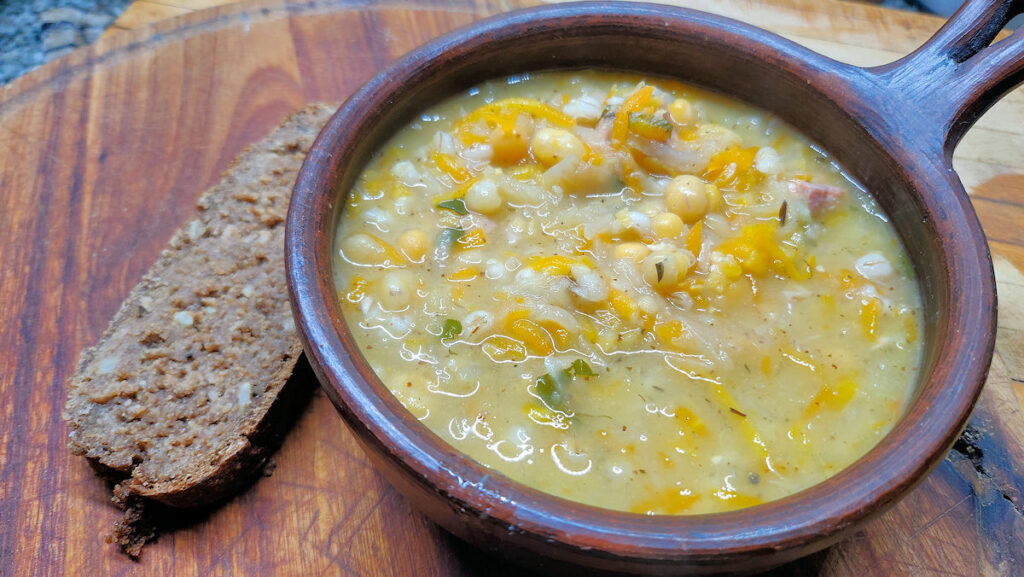
The soup? Delicious. Hearty, rich, great flavors. I think I might grate or dice the vegetables if I make this again, almost more for aesthetics than anything – though just shredding them with a food processor is so easy…. The bread? Great flavor, but you can see it’s still very moist – far more than I think it should be. And really, too much work to make again. I guess when it’s your daily bread and you can make a couple of loaves at a time, you can just get all the various proofings into a timeline that works, but to make it one time… probably never again.
Next stop? It’s back to Africa (how many countries are there in Africa, it seems like half this project has been spent there? the answer is 54, which is more than a quarter of the countries in the world), and on to Eswatini, what I grew up knowing as Swaziland.
Copyright © 2026 SaltShaker. This feed contains copyrighted photos and text from SaltShaker. If you are not reading this material in a feed aggregator or by e-mail subscription, the site you are viewing may be guilty of copyright infringement. Please contact [email protected] so that I can take appropriate action.
Plugin by Taragana
]]>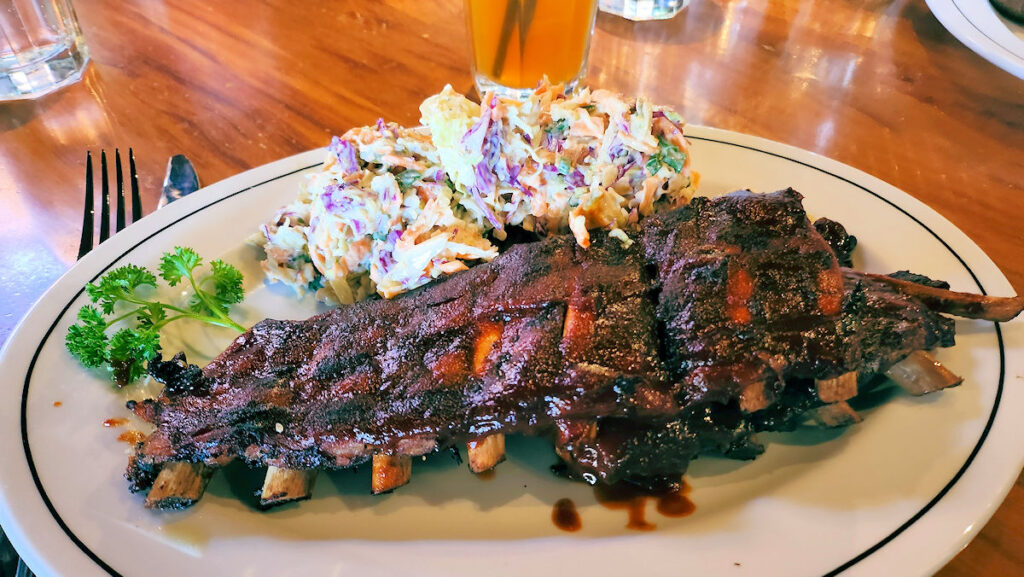
And that place is Kansas, Av. del Libertador 4625, in Palermo (kitchen pictured in the cover photo). These days they have three locations of their flagship Kansas restaurants (which are basically recreations of Houston’s restaurant chain in the US), plus half a dozen locations of their Burger 54 joints. For awhile they had two locations of a Pizzas by Kansas start of a chain, but as best I can tell, they’re either gone, or they’re folded into the burger chain as an option. In a city where barbecue sauce is usually candy-sweet and poured with abandon over ribs, the Argentine interpretation of what barbecue is, this is the one place you can get really good, smoked, falling off the bone babyback ribs with a lightly sweetened sauce grilled right on to the ribs. There used to be some scattered really good norteamericano restaurants here (El Tejano and Randall’s come to mind), but they’re gone.

The hype is out there for this place, Carmen Pasta, Gurruchaga 1428, Palermo. The build-up is that Juan Ignacio “Nacho” Feibelmann, the chef and co-owner, was on Masterchef Argentina, and while they word things oh so carefully, there’s an implication like he took home the trophy and was a superstar. He did make an amazing pasta for his audition for the third season of the series, but he was also one of the first couple of contestants eliminated. Still, you’ve got to be pretty good to even get to the twenty folk who make up the contestant batch.
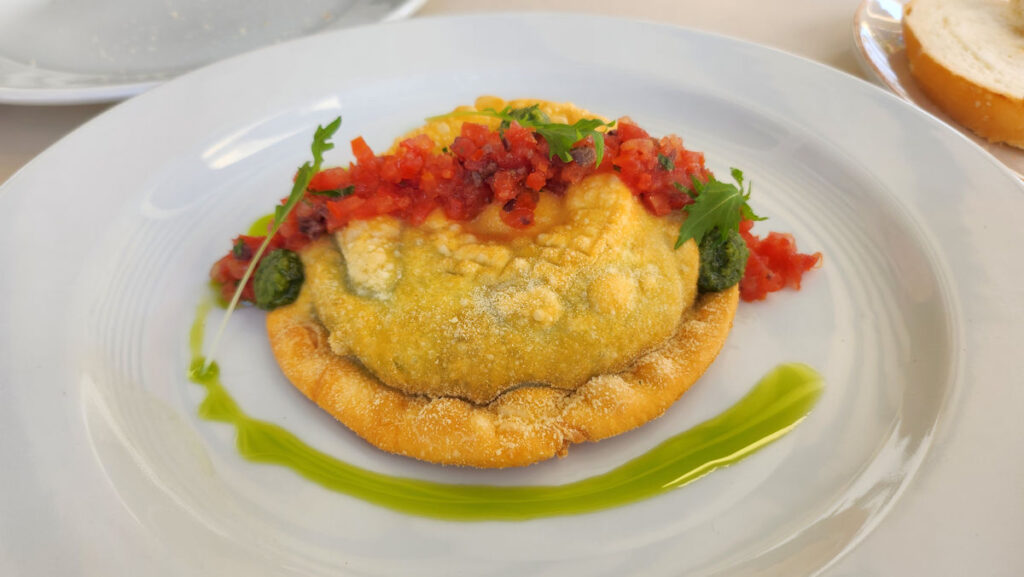

We started with their much touted fried raviolon, a giant raviolo, filled with mozzarella, pesto, and an egg yolk, and topped with a chopped tomato salsa. The filling was great, the egg yolk, obviously, just perfectly oozing. But here’s the place that it didn’t work. When you boil pasta, you boil it in salted water, which infuses it with just enough saltiness to make it really tasty. When you fry pasta dough, that doesn’t happen – if you’re making pasta to fry, you have to salt the dough. You also have to fry it enough that it gets a little crunchy. This was neither. It was soft and chewy and bland, and just detracted from the filling.
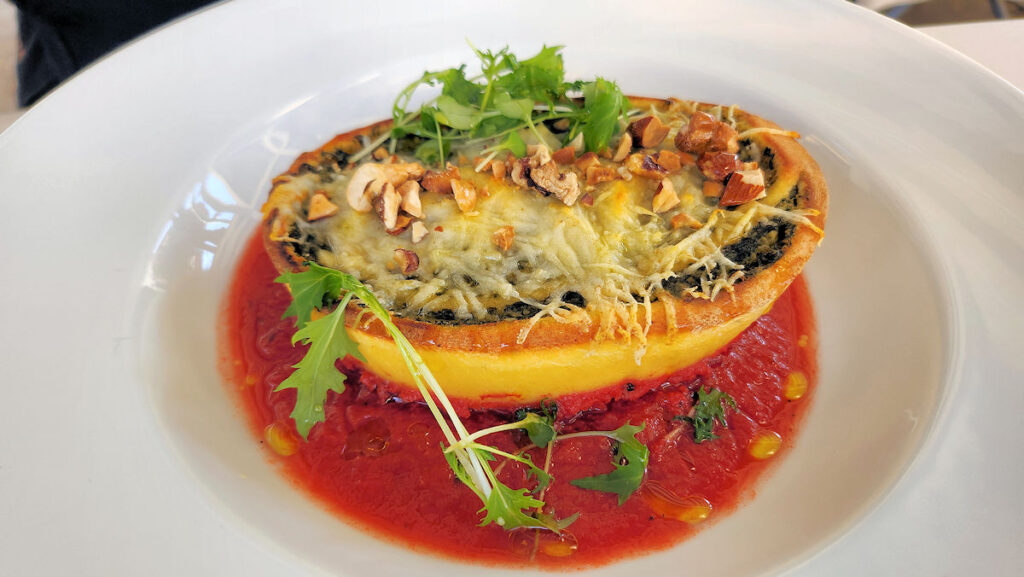
A rotolo filled with spinach, chard, ricotta, and parmesan was pretty good on its own – but again, you’ve got a baked pasta, no boiling salt water, and the dough was bland. Unfortunately, too, the tomato passata underneath was unseasoned. I get you want the vibrancy of the tomatoes to shine through, and you don’t want to mix in garlic or chilies or herbs, but… salt, maybe even some pepper. Oh, and you might want to mention on the menu that it’s covered with mixed nuts – my companion at lunch is mildly allergic to walnuts – not enough that he needed to send the dish back, but he carefully removed all of them from the plate.
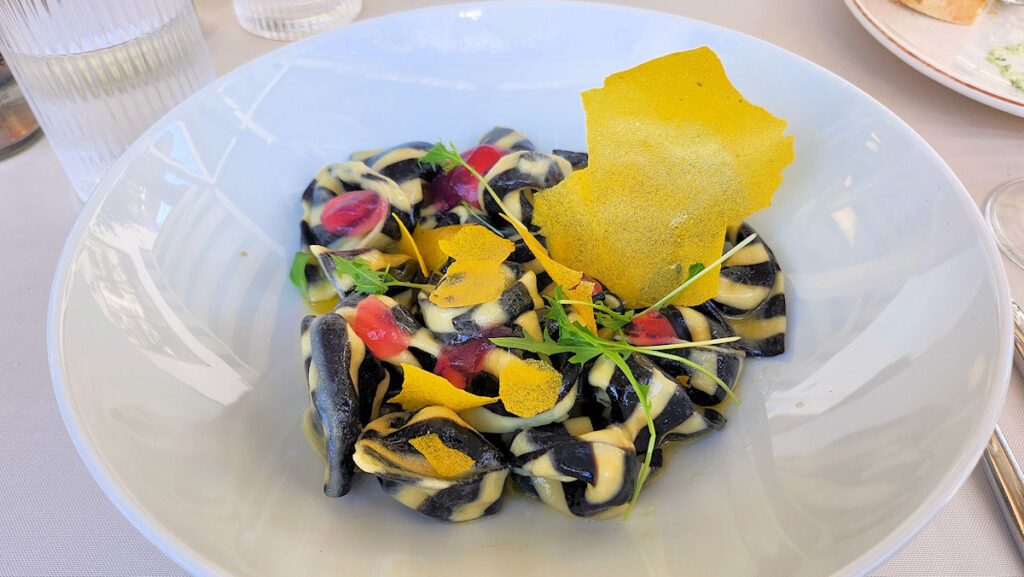
Beautifully colorful and well made tortelli filled with grilled surubí fish and in a lemongrass infused butter. Couldn’t even finish this one. The was undercooked and still nearly raw in places, the fish filling was dry and chalky, the butter was basically just melted butter (maybe brown it or something) and unseasoned, and no hint of lemongrass that either of us could find – and that’s a pretty pungent flavor to be missing. The only thing on the plate I liked were what I guess were potato starch chips and the dots of tomato gel.
Service was friendly and attentive, I like the look of the place. Pricing – 3000 peso/person cover charge for… nothing as best we could tell; 9000 for the raviolon, 16k for the rotolo, and 18k for the tortelli, wine by the glass, either 4000 or 8000, depending on which “level” you want to drink.
Sorry, but three failed pastas doesn’t have me wanting to go back. Eliminated from the competition once again.
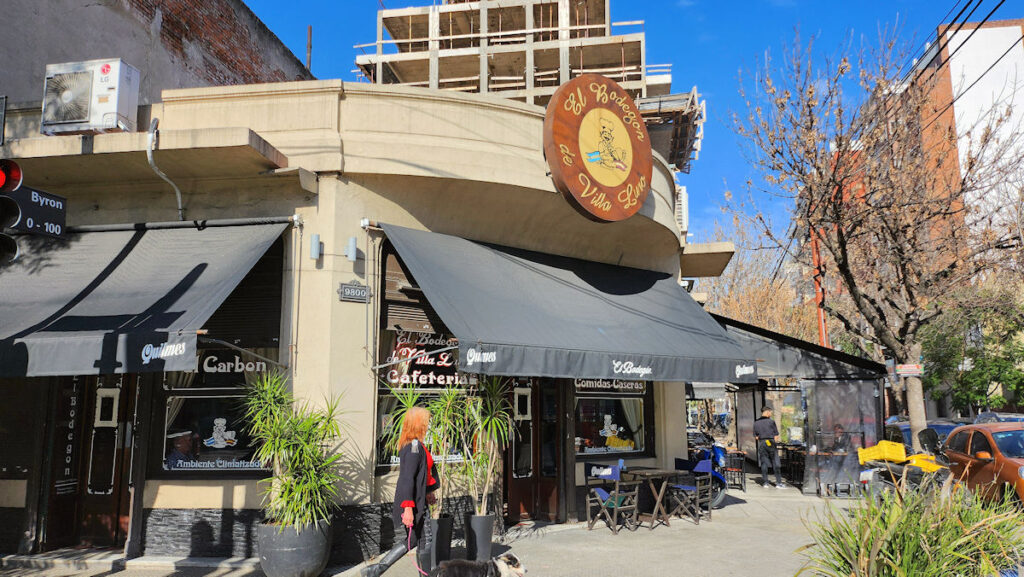
Just a randomly selected bodegón from my map of places that have been recommended through one or another routes. In this case, it was from one of the local newspaper’s “Best of my Barrio” write-in votes, where, for the far northwest barrio of Villa Luro, the aptly named El Bodegón de Villa Luro, Av. Rivadavía 9800 got the nod as one of the two places worth checking out. (Cubierto charge, 400 pesos.)
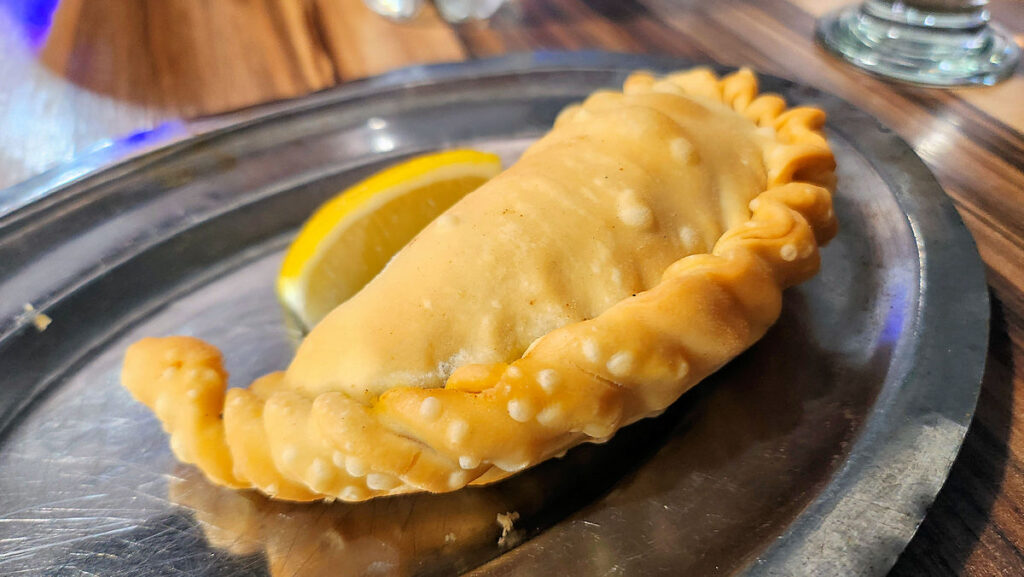
My bright, shiny, new penny of a waiter was enthusiastic in making recommendations, and they fit in with what online reviewers say about this place. Had to start with one of their fried empanadas. It is made with ground beef rather than diced steak, but it’s well seasoned, heavy on the onion, and with a drizzle of lemon, a great start (1200 pesos).
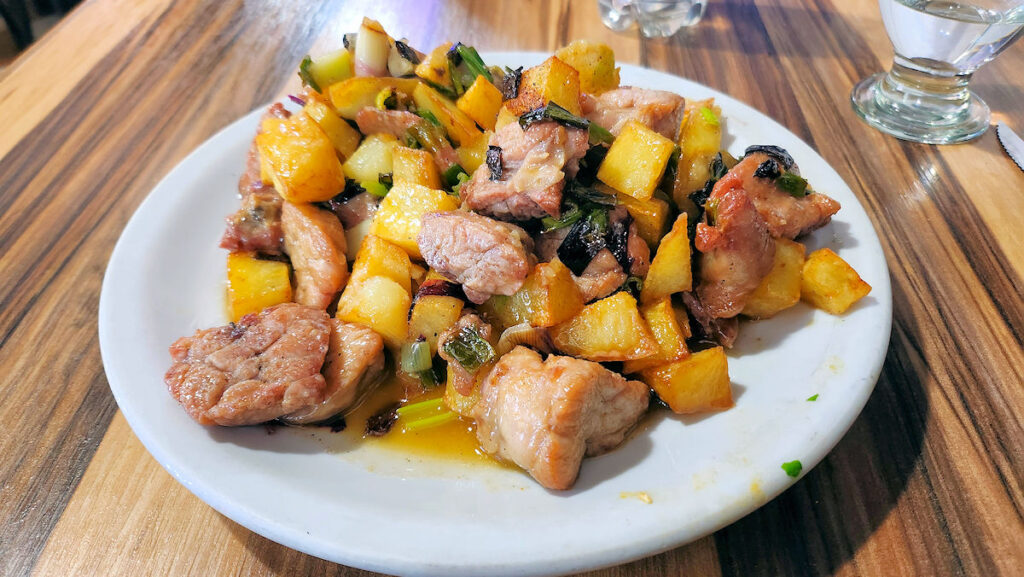
The other recommended dishes came down to four possibilities. One of them is no longer on the menu, and of the other two, my waiter didn’t even hesitate to recommend the “star of the restaurant”, the mollejas al verdeo – sweetbreads in green onion sauce (15000 pesos). Now, that’s a dish that’s really rich, and it’s also a bit unforgiving. It’s kind of got three ingredients – sweetbreads, potatoes, and green onions. Usually just sort of stir-fried together with a little oil and wine. The positives on this one – the sweetbreads were trimmed properly and cooked just right, and the dish is well seasoned. The big negative, the whole thing is just sopping in oil – that puddle underneath is literally just oil that is dripping off – and the potatoes have soaked up so much of it they’re like filled sponges. It was just too much, and I ate very little of the dish and gave up. Even just draining the oil off of the ingredients before putting them on the plate would have helped, and my guess is, the pan needed to be over a much hotter flame. I’ll stick with the best version of this dish I’ve found to date, at Club Atlanta.
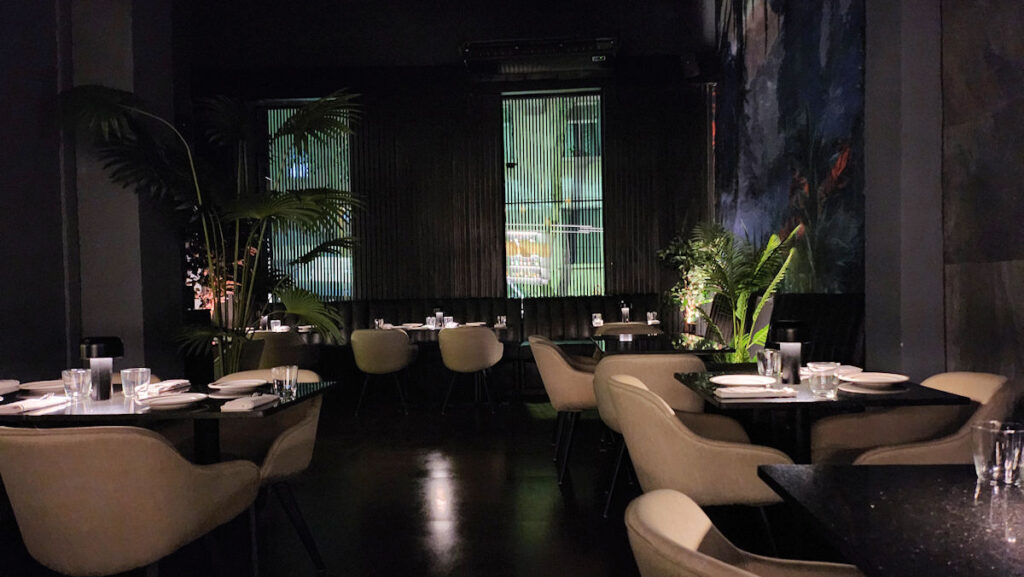
And, let’s end with last week’s “date night”. We decided to check out a new spot that opened here in Recoleta, Savvy, Pacheco de Melo 2814. This photo, and the rest, I’ve had to manipulate to get anything to show up – the place is kept ridiculously dark, with nothing but faint flows from lights suspended well above the tables (it’s a two-story high dining room), and almost as dim table lamps – though those are adjustable enough that you can almost see the menu without using your phone’s lantern. I ended up holding the table lamp above each dish in order to take the photos of the food.
I don’t know what it is at the place, but I feel like the Russian mob must be meeting in a back room somewhere – and the few people in the open air courtyard bar in front of the place looked as us suspiciously when we entered, and the person who greeted us had no idea we had a reservation, nor, it seemed, that they took reservations in the first place. Service was… odd… almost like they were surprised that people were there to eat and drink. The place is deafeningly loud. I don’t normally pop out my decibel meter app, but I did for this one – with just the music pounding out of the speakers it was running around 80db, “like sitting next to a running vacuum cleaner”, and once there were people in the place that spiked to staying a bit over 85db, “like standing in the middle of busy traffic having a shouted conversation”.

Cocktails from their rather creative sounding cocktail list took awhile, but once we had them, they were delicious.
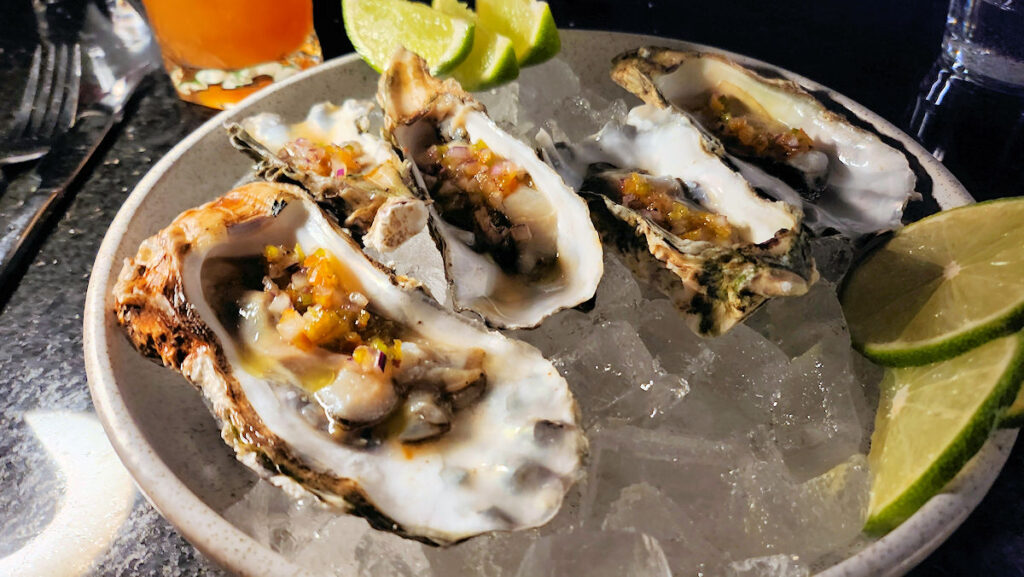
And, despite temporary misgivings from the approach to the whole thing, the food is quite good. I started with a quint of oysters with a lovely mignonette.
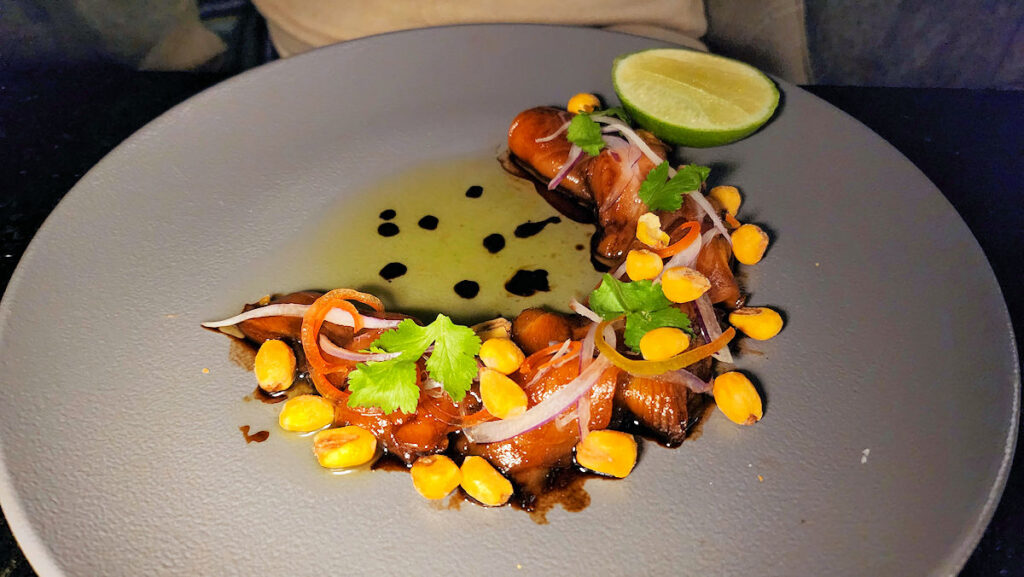
Henry had the salmon tiradito. He’s not a fan of salmon at all, but this was good enough that he ate the whole thing. Okay, he added a fair amount of tabasco to it, but he still ate it!
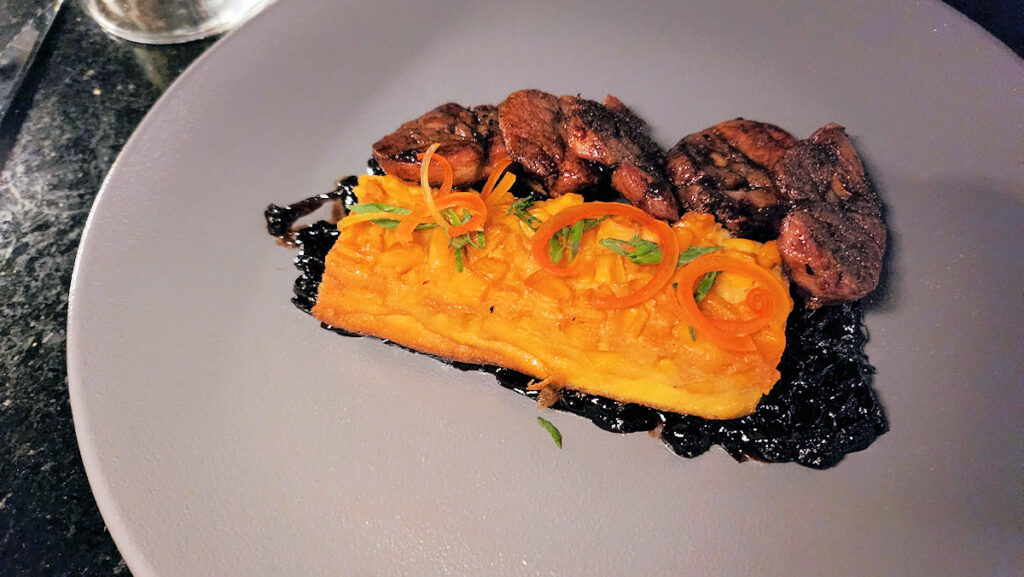
I went with a second appetizer for my main course. Sweetbreads again. Here, perfectly fried and served with a baked humita, sort of like a fresh corn tamal filling, over a red onion marmalade. Maybe a bit less marmalade is in order, but it was superb all around.
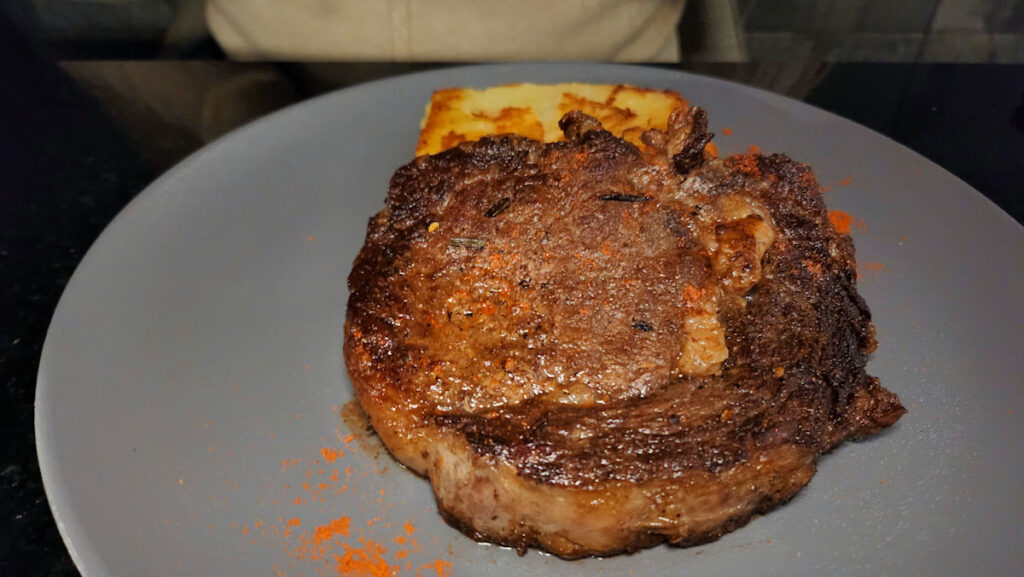
He went with a ribeye steak – cooked to his requested medium – properly seasoned, and accompanied by a truffle oil infused potato cake. Delicious.
Maybe once they get their rhythm on service down, we’ll give it a shot again, because we did enjoy the cocktails and food. They do need to turn down the music volume, just a bit, and turn up the lamps, just a bit. Then again, the most expensive date night out we’ve had so far, with tip coming in at just over 125,000 pesos.
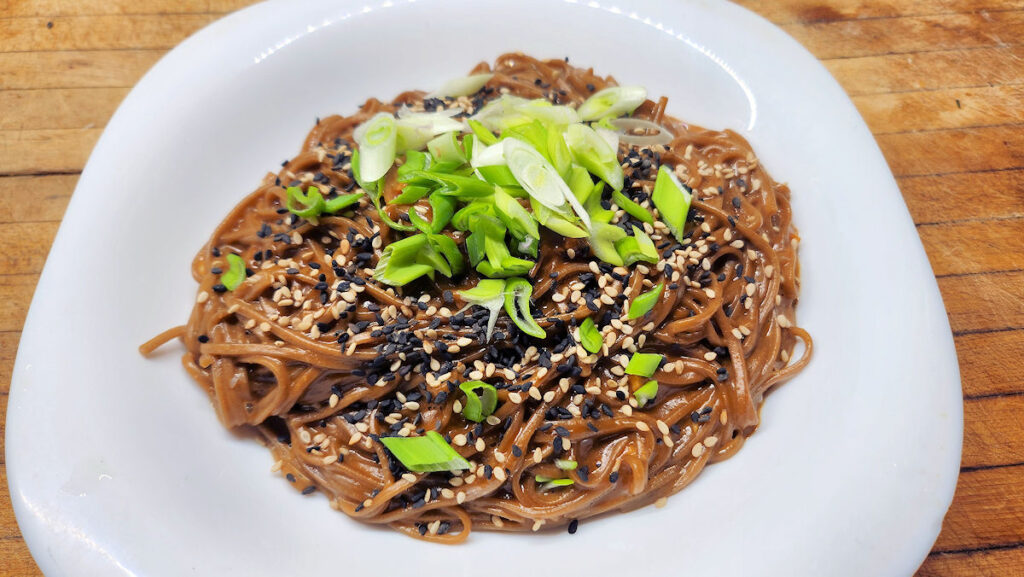
And, we’ll finish off with one of my favorite quick dishes to make when I’m feeling peckish at home – warm sesame noodles. My version of the sauce is a mix of peanut butter, tahini, soy sauce, oyster sauce, fish sauce, and chili oil, all tossed with buckwheat soba and then garnished with toasted black and white sesame seeds and lots of green onion. Sometimes I add in thin batons of green apple too, but didn’t have one on hand.
That was my week in food, what was yours?
Copyright © 2026 SaltShaker. This feed contains copyrighted photos and text from SaltShaker. If you are not reading this material in a feed aggregator or by e-mail subscription, the site you are viewing may be guilty of copyright infringement. Please contact [email protected] so that I can take appropriate action.
Plugin by Taragana
]]>